
Caregiver decision guide
How to Navigate the Aging and Disability Resource System: A Step-by-Step Guide to Finding Help
Feeling lost in the maze of senior services? This guide walks you through the exact steps to find and access help through the 'No Wrong Door' system — from calling the Eldercare Locator to working with your local Area Agency on Aging and benefits enrollment centers.
The Navigation Problem: Why Finding Help Feels So Hard
If you have recently tried to find help for an aging parent or a disabled family member, you already know the feeling: you call one number, get transferred to another, are told to call a third agency, and end up back where you started. The U.S. long-term services and supports (LTSS) system is not a single pipeline. It is a patchwork of federal programs, state-administered waivers, county-level agencies, and nonprofit organizations — each with its own eligibility rules, application forms, and waiting lists.
The scale of the need is enormous. According to the CDC, more than 1 in 4 U.S. adults have some type of disability, and among adults aged 65 and older, that figure rises to 43.9%. The most common disabilities affecting older adults are those impacting mobility (12.2% of all adults) and cognition (13.9%). When a crisis hits — a fall, a dementia diagnosis, a sudden decline in mobility — families are thrust into a system they have never navigated before, often while managing full-time jobs and their own households.
This article does not catalog every benefit program — that resource already exists in our Compass for Caregiving guide. Instead, this is a procedural walkthrough: exactly how to use the "No Wrong Door" system — Aging and Disability Resource Centers (ADRCs), Area Agencies on Aging (AAAs), and Benefits Enrollment Centers — to get from confusion to action. If you are feeling lost, start here.
Before you dive into the steps below, you may also want to read our triage guide for caregivers, which helps you prioritize what to do now, next week, and next month. The navigation path in this article works alongside that triage framework.
Step 1: Start with the Eldercare Locator — Your Single Entry Point
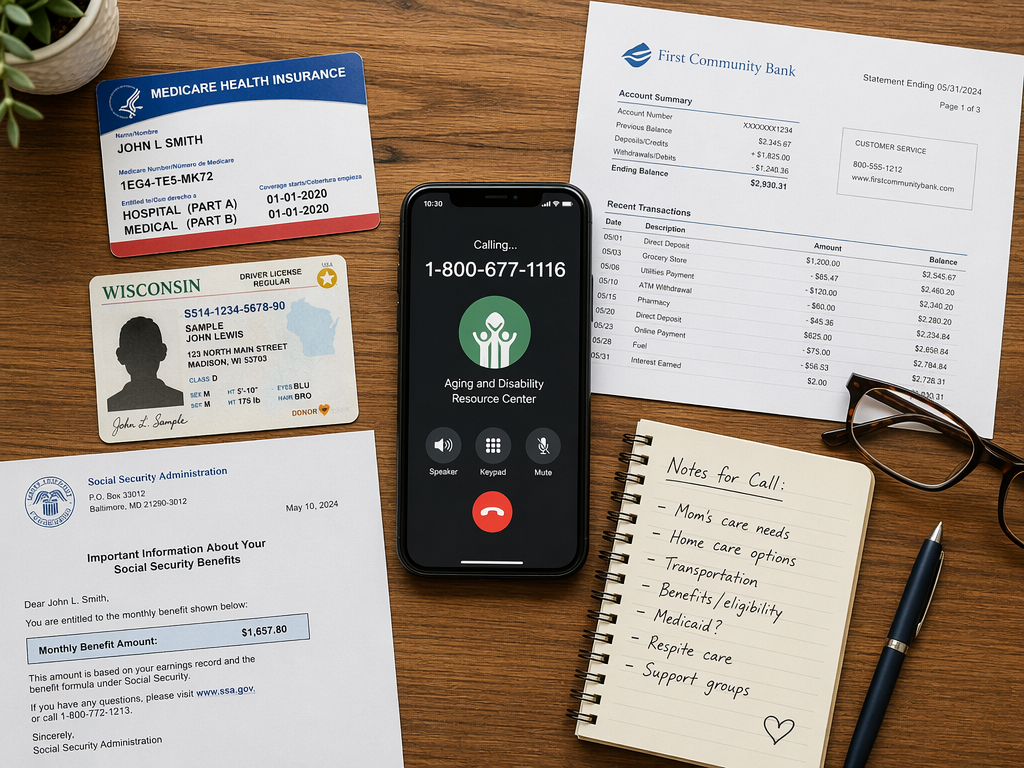
The single most important phone number you need to know is 1-800-677-1116 — the Eldercare Locator, a free, confidential service funded by the Administration for Community Living and operated by USAging. When you call, a trained information specialist listens to your situation and connects you to your local Area Agency on Aging (AAA) or Aging and Disability Resource Center (ADRC). This service is available to anyone, regardless of income.
Here is what to expect on the call and how to prepare:
- You will speak with a real person, not an automated system. The specialist will ask for your zip code or city and a brief description of the situation.
- They will not ask for financial information or proof of income. The Eldercare Locator is a referral service, not an eligibility screening tool.
- Within a few minutes, they will provide the name and phone number of your local AAA or ADRC. In many cases, they can also give you direct contact information for specific services like meal delivery, transportation, or in-home care.
- You can also use the Eldercare Locator website at eldercare.acl.gov to search online, but the phone call is often faster for complex situations.
Questions to bring to a clinician or OT
This is not medical, legal, or a family's final decision — only a framework. Bring these questions to a clinician, occupational therapist, or your local Area Agency on Aging.
Find Local HelpRelated reading
Noticed something outdated or inaccurate on this page? Flag a correction. We review every report against CDC, NIA, and AARP HomeFit guidance before updating a page.