
Caregiver decision guide
Long-Distance Caregiving: A Complete Guide for Adult Children
If you live more than an hour from an aging parent, you face a caregiving challenge that is structurally different from local care — a chronic shortage of firsthand information that makes both daily oversight and crisis response harder. This guide helps adult children build a proactive, multi-layer care system covering warning sign recognition, local support networks, legal and financial foundations, remote monitoring, and communication protocols.
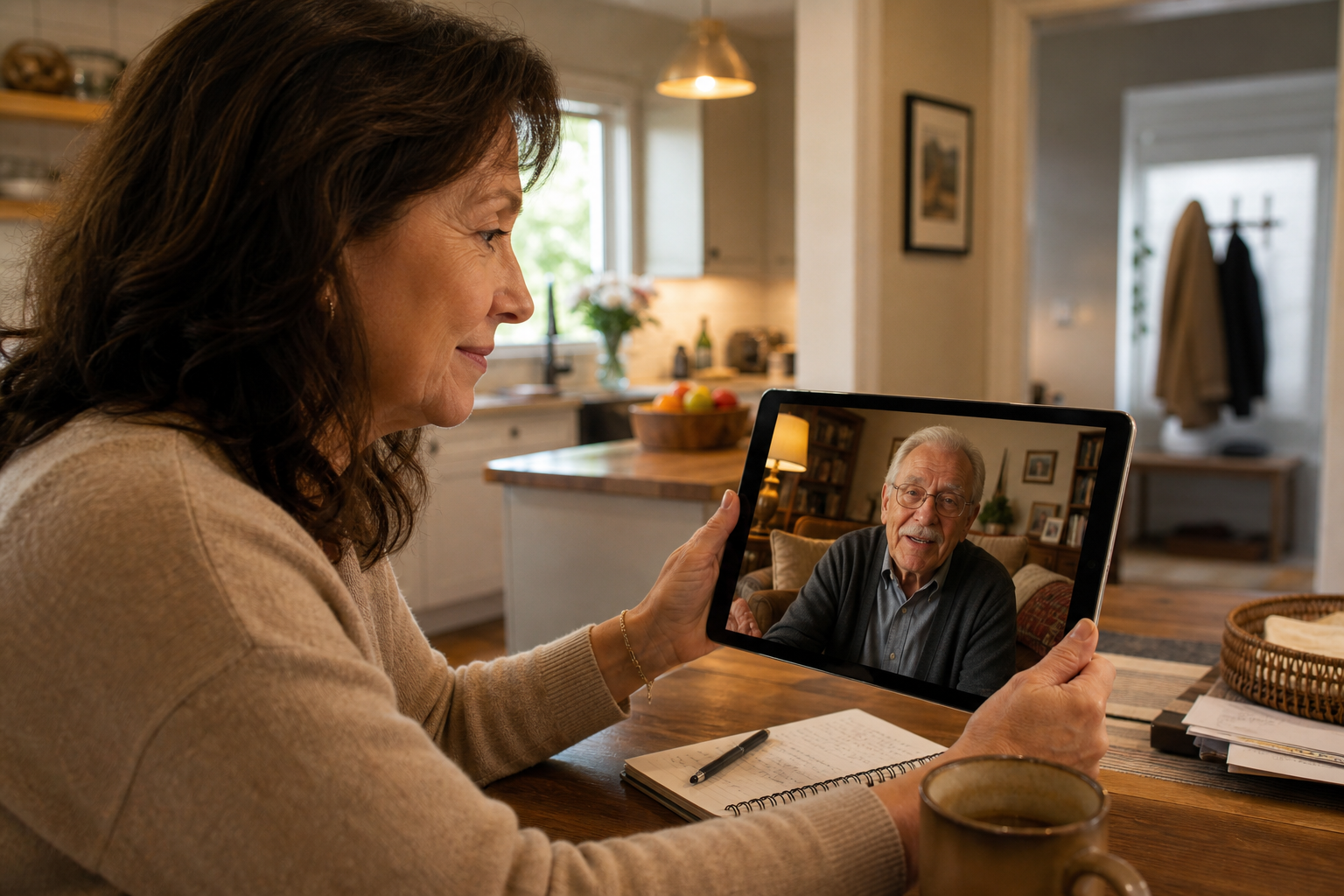
The Information Deficit: Why Long-Distance Caregiving Is Structurally Different
When a local caregiver notices that their parent's refrigerator is nearly empty, that the mail has been piling up, or that they seem unsteady getting out of a chair, they can act on that observation the same day. A long-distance caregiver cannot. They depend on what their parent chooses to share during a phone call, what a neighbor happens to mention, or what a doctor is willing to relay without a signed authorization on file.
This is the defining structural problem of long-distance caregiving: not the distance itself, but the chronic shortage of firsthand information it creates. Secondhand information — from a parent who minimizes concerns to avoid worrying you, from a neighbor who only sees the front yard, from a physician who cannot discuss a patient's status without proper authorization — is often incomplete, delayed, or filtered through someone else's judgment about what matters.
Researchers who have studied this population call it the information deficit. A peer-reviewed systematic review published in the academic literature found that long-distance caregivers frequently must make decisions without firsthand knowledge of the situation, and that proximal informants may distort the patient's needs by either exaggerating or minimizing concerns. The result, as the same research documented, is that long-distance caregiving tends to be more crisis-driven than care provided by someone nearby — because problems are only discovered when they have already become urgent.
Every section of this guide addresses a different dimension of the same problem. Building a local care team closes the observational gap. Establishing legal documents before a crisis gives you the authority to act on information when it finally arrives. Remote monitoring technology creates a passive information stream that does not depend on your parent's willingness to self-report. Purposeful visits are your highest-bandwidth opportunity to see conditions directly. The goal throughout is not to check in more often — it is to build a system that compensates for the information you cannot observe in person.
Who Counts as a Long-Distance Caregiver — and How Many of Us There Are
The standard definition is straightforward: a long-distance caregiver is someone who lives an hour or more from the person they help. That hour threshold matters because it marks the point at which dropping by on short notice becomes impractical, where you cannot easily accompany a parent to a medical appointment without planning, and where your visibility into daily life is fundamentally limited.
The scale of this population is larger than most people realize. The 2025 AARP/NAC Caregiving in the US report found that 63 million Americans are now family caregivers — a 45% increase over the past decade, meaning roughly 1 in 4 American adults is providing some form of family care. More than 10% of those caregivers live an hour or more from their care recipient. That translates to millions of people managing care from a distance, most of them doing it without a formal plan.
The typical long-distance caregiver is in their early 50s, employed full-time, and often simultaneously managing their own children — the sandwich generation dynamic that the 2025 report found affects 29% of all caregivers. They average roughly 300 miles from their care recipient. Half report that caregiving interferes with their work, social, and family life.
- Average age of long-distance caregivers: approximately 51 years old
- More than 10% of 63 million US family caregivers live an hour or more from their care recipient
- 29% of all caregivers are simultaneously raising children (sandwich generation)
- Long-distance caregivers report higher emotional distress (47%) than local caregivers (28%) or co-residing caregivers (43%)
- Half of long-distance caregivers report that care responsibilities interfere with work, social, and family life
Recognizing Warning Signs From a Distance
Because you cannot observe your parent's daily life directly, you need a structured mental model of what to listen and watch for during calls, video check-ins, and occasional visits. Warning signs fall into five domains, each detectable — at least partially — through secondhand observation.
Falls deserve particular attention. According to CDC 2024 data cited by AARP, falls are the leading cause of injury among adults 65 and older, with 1 in 4 falling annually and 1 in 10 falls resulting in an injury serious enough to require restricted activity or medical care. A long-distance caregiver may not learn of a fall for hours or days — or may never learn of one their parent chooses not to mention.
| Domain | Observable Warning Signs | How to Detect Remotely |
|---|---|---|
| Physical and hygiene | Unexplained bruising, significant weight loss, poor personal hygiene, unwashed clothing mentioned during video calls | Video calls with camera-on; direct but gentle questions about eating and bathing; neighbor check-ins |
| Cognitive and memory | Repeating the same stories or questions within a single call, confusion about dates or recent events, difficulty with familiar tasks they previously managed easily | Pattern tracking across multiple calls; asking open-ended questions about recent activities; sibling cross-checking |
| Behavioral and social | Withdrawal from activities they previously enjoyed, unusual irritability or sadness, evasive or vague answers to direct questions | Consistent phone and video contact; input from friends, neighbors, or faith community members who see them regularly |
| Household management | Unpaid bills, missed medical appointments, empty refrigerator, utilities at risk of being shut off | Authorized access to financial accounts; trusted local contact who can visit; mail forwarding or bill-pay setup |
| Vehicle and driving | New dents or scrapes on the car, getting lost on familiar routes, traffic citations, reluctance to discuss driving | Direct observation during visits; input from neighbors who see them driving; primary care physician consultation |
Conducting a Remote Needs Assessment
When warning signs appear — or immediately after a crisis like a fall, hospitalization, or new diagnosis — the first structured step is a remote needs assessment. Its purpose is to replace guesswork with a documented baseline that can support care planning and future decision-making.
A useful assessment covers six domains:
- Activities of Daily Living (ADLs): Can your parent bathe, dress, eat, use the toilet, and move around their home independently? Are they managing these tasks safely or with difficulty?
- Instrumental Activities of Daily Living (IADLs): Are they managing medications, preparing meals, handling finances, driving or using transportation, and keeping medical appointments?
- Medication management: Do they have a system for taking medications correctly? Are prescriptions being filled on schedule? Are there signs of missed doses or confusion about which medications to take?
- Home safety: Are there obvious hazards — loose rugs, poor lighting, cluttered pathways, bathroom without grab bars? This is best assessed during a visit, but a trusted local contact can provide a basic report.
- Social connection: Are they maintaining contact with friends, neighbors, or community? Social isolation is both a warning sign and a risk factor for faster functional decline.
- Cognitive status: Are there signs of memory lapses, confusion, or judgment problems that go beyond normal age-related changes? This domain requires input from the primary care physician and ideally a geriatric assessment.
Gather input from multiple sources: your parent directly (with awareness that they may minimize), the primary care physician (with appropriate authorization in place), any existing home care providers, and trusted neighbors or friends. Document what you learn in writing — a shared notes document or a simple care summary that can be updated and shared with siblings or other family members involved in care decisions.
Building a Local Care Team
No amount of phone calls or remote monitoring can fully substitute for people who are physically present in your parent's community. Building a local care team is the most direct way to close the information deficit — it creates a network of eyes, ears, and hands that can observe, respond, and report in ways you cannot from a distance.
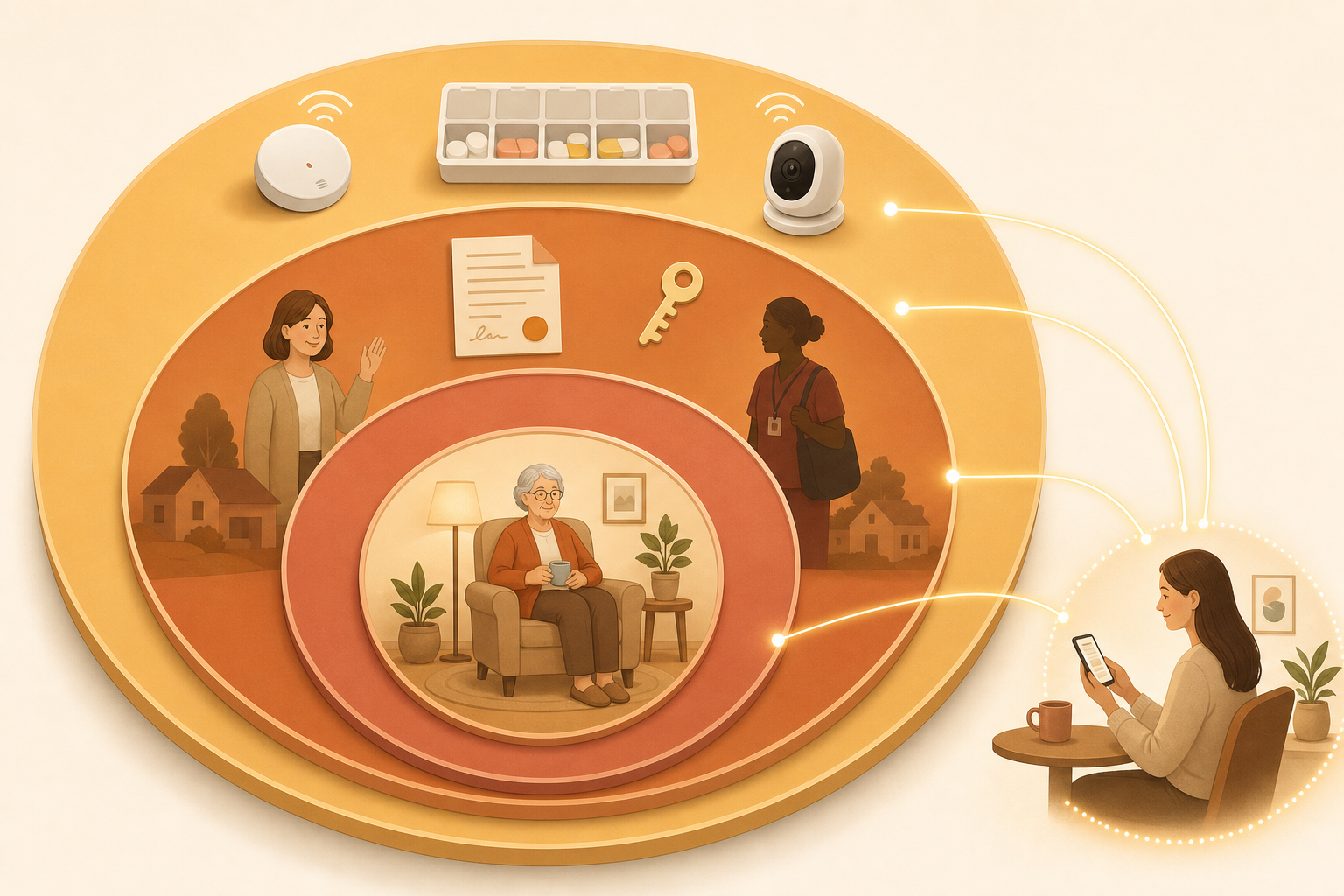
Think of your local care team as four concentric layers, each serving a distinct function:
Layer 1: Informal Network
Neighbors, friends, faith community members, and former colleagues who have regular contact with your parent. These are the people most likely to notice a change before it becomes a crisis — an uncharacteristic absence from a weekly gathering, a car that has not moved in days, a porch light left on at noon. Cultivate these relationships deliberately: introduce yourself, share your contact information, and ask explicitly whether they would be willing to call you if something seems off.
Layer 2: Geriatric Care Managers
A geriatric care manager — also called an aging life care professional — is a licensed professional (typically a social worker, nurse, or gerontologist) who provides local oversight, care plan management, provider coordination, and crisis response. They are the closest thing to having a knowledgeable family member living near your parent.
According to the Aging Life Care Association, geriatric care managers typically charge between $75 and $300 per hour depending on their credentials and location. This is not inexpensive, but it is significantly less than the cost of repeated emergency flights or the consequences of a crisis that went undetected. The Aging Life Care Association (aginglifecare.org) maintains a directory for finding credentialed professionals by location.
Layer 3: Area Agencies on Aging
For families who cannot afford private geriatric care management, Area Agencies on Aging (AAAs) provide lower-cost or no-cost alternatives through federally funded programs. Services vary by location but often include case management, caregiver support, respite care, transportation assistance, and meal programs. Waiting lists exist for some services.
The Eldercare Locator (800-677-1116 or eldercare.acl.gov) connects families to their local AAA. This is a free federal resource and should be one of the first calls a long-distance caregiver makes when beginning to build a care system.
Layer 4: Professional Home Care
When informal support is insufficient for the level of need, in-home aides — whether companion care, personal care aides, or home health aides — provide hands-on assistance with ADLs and IADLs. Beyond the direct care they provide, professional home care workers are also a significant information resource: a regular aide who visits several times a week will observe changes in your parent's condition that no remote system can detect.
Legal and Financial Foundations: What Must Be in Place Before a Crisis
Legal authority is the foundation that enables you to act on information when it finally arrives. Without it, you may learn that your parent has fallen, been hospitalized, or is no longer managing their finances — and still be legally unable to speak with their physician, access their accounts, or make decisions on their behalf.
Three documents form the essential legal foundation. All three must be established while your parent has decision-making capacity. Once cognitive incapacity occurs, the window for voluntary document execution closes.
| Document | What It Does | What Happens Without It |
|---|---|---|
| Durable Power of Attorney (DPOA) | Authorizes a named agent to manage financial and legal affairs — paying bills, managing accounts, filing taxes — on behalf of the person if they become unable to do so | Family members have no legal authority to access accounts or manage finances; court-ordered guardianship or conservatorship proceedings required, which are costly and time-consuming |
| Healthcare Proxy / Durable Power of Attorney for Healthcare | Designates a named agent to make medical decisions when the person cannot communicate their own wishes | Medical providers default to facility or state protocols; family members may disagree without a designated decision-maker; court intervention may be required |
| Advance Directive / Living Will | Documents the person's own wishes about life-sustaining treatment, resuscitation, and end-of-life care | Medical providers and family must make high-stakes decisions without guidance from the person whose life is at stake; potential for family conflict |
If the client does not have a durable power of attorney because they do not want to spend the money, but then they lose capacity, their loved ones have to go to court and get guardianship, and it's 10 times the cost and takes the control out of the family and into the court's hands.
That framing — from an aging life care professional quoted in an AARP resource on long-distance caregiving — captures the practical stakes clearly. The cost of establishing a durable power of attorney with an elder law attorney is a fraction of the cost of guardianship proceedings, which also remove family control and hand decision-making authority to a court.
Beyond the three core documents, long-distance caregivers also need practical financial access: the ability to see account balances, pay bills, and monitor for unusual activity. This may involve being added as an authorized user on banking accounts, setting up online account access, or establishing a bill-pay system. These arrangements are separate from the legal documents and should be set up while your parent is fully capable of authorizing them.
Remote Monitoring Technology: Categories and What to Evaluate
Remote monitoring technology has matured significantly over the past several years. According to the 2025 AARP/NAC Caregiving in the US report, adoption of remote monitoring by family caregivers doubled from 13% in 2020 to 25% in 2025 — reflecting both improving technology and growing recognition that passive monitoring reduces the information deficit in ways that periodic phone calls cannot.
There are five functional categories of remote monitoring technology relevant to long-distance caregivers. Each addresses a different dimension of the information deficit:
| Category | What It Does | Information Deficit It Addresses | Key Evaluation Dimensions |
|---|---|---|---|
| Fall detection | Detects falls automatically and alerts a monitoring center or designated contacts; may include two-way communication | Falls may go unreported for hours or days; passive detection removes dependence on self-reporting | Detection method (wearable vs. ambient), false positive rate, response protocol, two-way communication capability |
| Passive activity sensors | Monitors movement patterns throughout the home — kitchen activity, bathroom use, door openings — and alerts caregivers to unusual deviations from baseline | Provides continuous behavioral data without requiring the care recipient to do anything; detects gradual decline patterns | Coverage area, alert thresholds, caregiver notification format, privacy model |
| Medication management systems | Automated dispensers or reminder systems that prompt correct medication taking and alert caregivers to missed doses | Medication non-adherence is common and often invisible to remote caregivers; these systems create a verifiable record | Dispensing accuracy, missed-dose alert speed, caregiver notification format, refill management |
| Vital sign monitoring | Wearable or ambient devices that track heart rate, blood pressure, oxygen saturation, sleep patterns, or other health indicators | Gradual health changes that precede a crisis may be invisible without continuous monitoring | Accuracy, data sharing with healthcare providers, alert thresholds, comfort and wearability |
| Video check-in | Scheduled or on-demand video calls using consumer devices or purpose-built senior-friendly systems | Provides visual observation that phone calls cannot; allows caregivers to assess appearance, environment, and behavior directly | Ease of use for care recipient, privacy considerations, scheduled vs. on-demand capability |
Coordination and Communication Systems
A local care team without a coordination system is a collection of well-intentioned people who may not know what the others are doing. Information that reaches one family member may not reach another. A neighbor who reports a concern to one sibling may not know to call the geriatric care manager. A home care aide who notices a change in behavior has no clear channel for communicating it to the family.
Coordination infrastructure converts your local care team into a functioning whole. The key components:
- Shared medical and care documentation: A single document — updated after every provider visit, hospitalization, or significant change — that contains your parent's current medication list, diagnosis history, provider contacts, insurance information, and care plan. This document travels with your parent to appointments and is accessible to all family members and authorized care providers.
- Caregiver coordination tools: Shared digital platforms designed for care coordination allow family members and professional caregivers to log observations, schedule tasks, share updates, and track medication. Evaluate these tools by function — task tracking, communication logging, provider contact storage — rather than by brand name.
- Sibling communication protocols: Designate one family member as the primary point of contact for providers, with a clear protocol for sharing information with other siblings. Duplication (multiple siblings calling the same physician) wastes time and can create confusion. Conflict (siblings receiving different information and drawing different conclusions) can be reduced by centralizing information flow and scheduling regular family updates.
- Medical provider access: Ensure that HIPAA authorizations are signed and on file with every provider your parent sees — primary care, specialists, and any facilities. Without this, providers cannot share information with family members regardless of circumstances. Ask providers about patient portal access, which allows authorized family members to view records, test results, and appointment summaries.
- Emergency contact protocol: A written emergency action plan that every member of the local care team has: who to call first (and in what order), where the medical information dossier is located, which family member has legal authority to make decisions, and what the care recipient's expressed wishes are for emergency situations.
Planning Purposeful Visits: How to Use Your Time Well
Visits are your highest-bandwidth opportunity to close the information deficit — the one time you can observe your parent's home, behavior, and physical condition directly. The instinct to spend that time doing hands-on tasks (cooking, cleaning, driving to appointments) is understandable, but it creates a care vacuum the moment you leave. A more useful frame: treat each visit as a structured assessment and planning session, with relationship time built in deliberately rather than as whatever is left over.
Before You Arrive
- Have a direct conversation with your parent about what you want to accomplish during the visit — not to set an agenda over their objections, but to surface their own priorities and concerns, which may differ from yours.
- Contact the primary care physician or geriatric care manager to schedule a meeting or phone consultation during your visit. Many providers will speak with authorized family members; some will schedule a joint appointment with the patient present.
- Identify any legal or financial documents that need to be reviewed, updated, or executed — and confirm what, if anything, requires notarization or witness signatures that can only be obtained in person.
- Brief your local care team contacts that you will be visiting and ask if there is anything they have observed that you should know about.
During the Visit
- Conduct a home safety walkthrough: look for fall hazards (loose rugs, poor lighting, cluttered pathways, absence of grab bars in the bathroom), medication organization, food supply and refrigerator contents, and general cleanliness and maintenance.
- Review the current medication list in person — compare what is in the medicine cabinet against what should be there, check expiration dates, and look for signs of confusion (medications in wrong containers, outdated prescriptions still in use).
- Meet with providers, the geriatric care manager, or key members of the informal support network while you are in the same location.
- Update care documentation — the shared care summary, emergency contact list, and any legal or financial records that need revision.
- Reserve time for non-caregiving activities with your parent. The relationship is the reason the care system exists; do not let the logistics consume the entire visit.
After You Leave
- Write up what you observed and share it with siblings and any professional care team members — while your observations are fresh and before the next crisis obscures the baseline.
- Leave behind an updated contact list, care plan summary, and emergency protocol in a location your parent and their local supporters know about.
- Schedule your next contact points — both the next visit and the regular check-in calls or video sessions in between.
Managing Caregiver Guilt, Anxiety, and Emotional Strain
Long-distance caregivers report higher rates of emotional distress than both local caregivers and those living with the care recipient. This is not a reflection of caring less — it is largely a consequence of the information deficit. The feeling of not knowing is experienced as not doing enough, and that gap between what you know and what you fear may be happening is the source of a specific, persistent anxiety that local caregivers do not carry in the same way.
Guilt is often the emotional expression of structural limitation rather than moral failure. When you feel guilty for not being there, it is worth asking whether the feeling reflects something you could reasonably have done differently — or whether it reflects the inherent constraints of managing care from a distance, which no amount of effort can fully eliminate.
Some practical anchors that help:
- Name the information deficit explicitly. When anxiety spikes, ask whether it is responding to actual information or to the absence of information. The two require different responses: actual information calls for action; the absence of information calls for building better detection systems.
- Distinguish between guilt that points to a real gap in the care system and guilt that is simply the emotional experience of living far away. The first is actionable; the second is not.
- Maintain your own health and relationships. The 2025 AARP/NAC report found that nearly 1 in 5 caregivers report fair or poor health attributable to caregiving — a finding that applies to long-distance caregivers as much as to those providing hands-on care.
- Use the coordination infrastructure you have built. Knowing that a local care team is in place, that monitoring systems are active, and that legal documents are current reduces the ambient anxiety that comes from feeling that everything depends on you alone.
Escalation Triggers: Recognizing When the Current Care Level Is No Longer Enough
Even well-designed care systems eventually reach a point where the current level of support is insufficient for the level of need. Recognizing that point — and responding with an appropriate increase in support rather than a crisis-driven improvisation — is one of the most important skills a long-distance caregiver can develop.
The following signals, individually or in combination, indicate that the current care arrangement needs to be reassessed:
- Frequent falls or hospitalizations: A single fall may be an isolated event; repeated falls or hospitalizations indicate that the home environment, the care support level, or both are no longer adequate for your parent's current functional status.
- Medication failures or hygiene decline despite support: If medication management systems and reminders are in place but doses are still being missed, or if personal hygiene is declining despite home care aide visits, the frequency or type of support may need to increase.
- Burnout in local supporters: Informal supporters — neighbors, friends, family members who live nearby — have limits. If a key member of your local network is showing signs of strain or stepping back, the care system has lost a critical node and needs to be rebuilt around professional support.
- Significant cognitive decline affecting safety: When cognitive changes reach the point where your parent is leaving the stove on, getting lost in familiar environments, or making decisions that put them at risk, the care system needs to be redesigned around safety — not just assistance with tasks.
- Your parent's own expressed needs: Sometimes the clearest escalation signal comes from the care recipient themselves — expressing that they feel unsafe, lonely, or unable to manage. Take these statements seriously even when they are accompanied by resistance to change.
When these signals appear, the first-line responses are home-based and community-based — not institutional placement. Consider:
- Increasing home care aide hours or adding overnight care
- Engaging or re-engaging a geriatric care manager for a formal reassessment and updated care plan
- Exploring adult day programs, which provide structured daytime supervision and social engagement while supporting family caregivers
- Arranging respite care to relieve any family members who are providing direct support and showing signs of burnout
- Reassessing the home environment for modifications that could extend safe independent living
Questions to bring to a clinician or OT
This is not medical, legal, or a family's final decision — only a framework. Bring these questions to a clinician, occupational therapist, or your local Area Agency on Aging.
Find Local HelpRelated reading
Noticed something outdated or inaccurate on this page? Flag a correction. We review every report against CDC, NIA, and AARP HomeFit guidance before updating a page.