
Caregiver decision guide
How to Talk to a Parent with Dementia About Stopping Driving: Understanding Anosognosia
When a parent with dementia insists on driving, it’s often not stubbornness but anosognosia — a neurological inability to recognize impairment. This article explains why reasoned arguments fail and offers strategies that respect the brain’s limitations, from therapeutic storytelling to physician-led intervention, along with escalation steps when conversation alone isn’t enough.
Why 'Just Talking About It' Doesn't Work with Dementia
If you've tried reasoning with your parent about why they should stop driving — pointing out the new dents, the close calls, the times they got lost on a familiar road — and gotten back anger, dismissal, or genuine confusion, you are not failing at the conversation. The problem is not your approach. It is that the part of your parent's brain responsible for recognizing their own impairment has been damaged by dementia.
This condition has a name: anosognosia. It is not denial. Denial is a psychological defense — a person unconsciously avoids an uncomfortable truth. Anosognosia is neurological. The Alzheimer's Association notes that people with anosognosia "may truly believe nothing is wrong, even when symptoms are obvious to others." Your parent is not lying to themselves; their brain has lost the ability to update its self-image.
Recognizing anosognosia as the barrier changes the entire approach. Instead of trying to convince a parent that they are unsafe, you shift to strategies that work around the impaired self-awareness — redirecting, using trusted authority figures, and controlling the environment rather than arguing.

The Brain Science Behind Anosognosia: Why Your Parent Can't See What You See
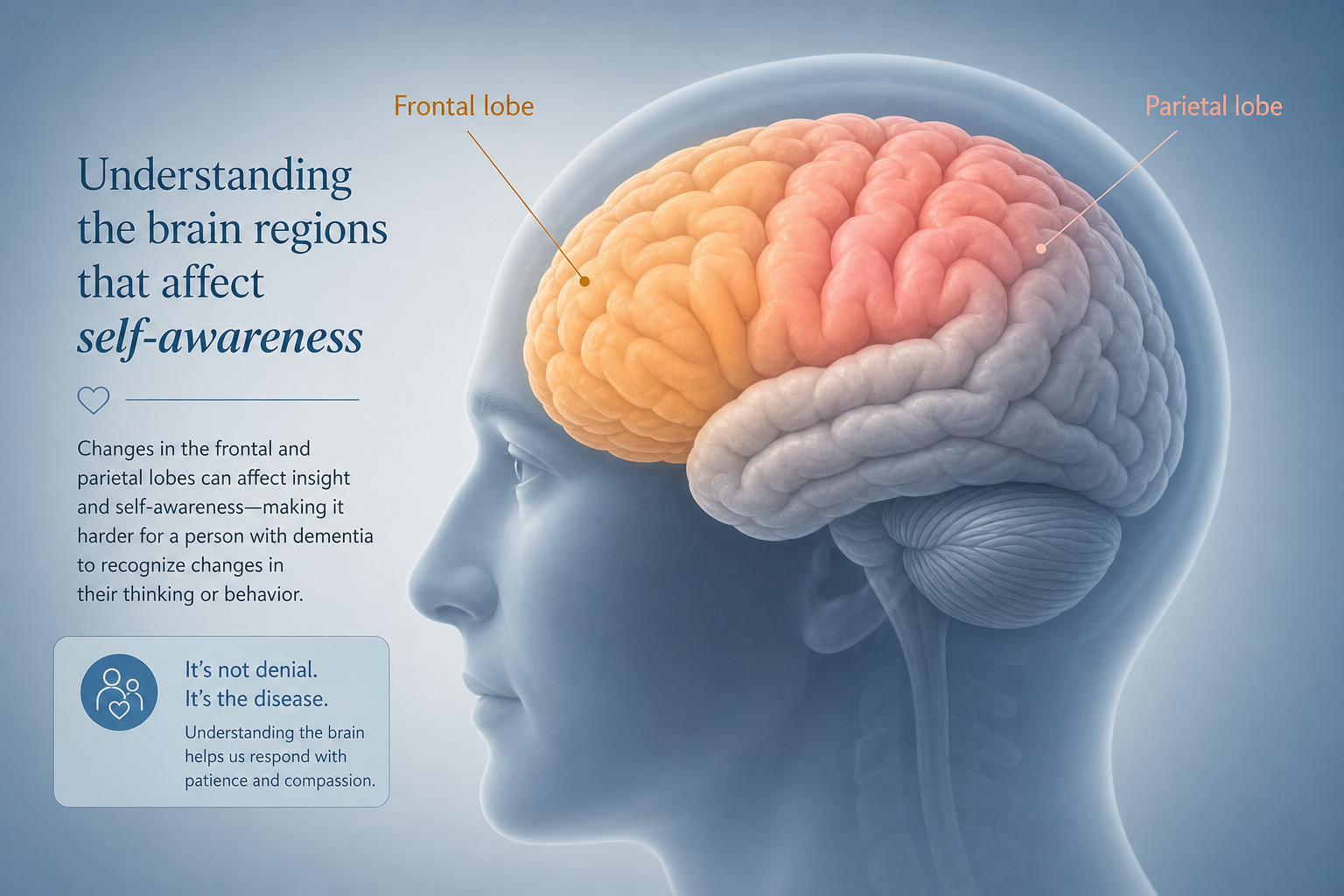
Anosognosia results from damage to specific regions of the brain — primarily the frontal lobe and the parietal lobe. The frontal lobe governs insight, self-monitoring, and executive function. The parietal lobe integrates sensory information and contributes to body awareness. When dementia attacks these areas, the brain loses its ability to compare its own performance against reality.
Think of it like a software bug that prevents a program from running a self-check. Everything else may appear to function, but the diagnostic module is broken. Your parent may still be able to start the car, turn left, and stop at red lights — but the part of their brain that would register "I nearly hit that pedestrian" or "I missed my exit again" has stopped recording those events as problems.
Recognizing When Driving Is No Longer Safe: Dementia-Specific Warning Signs
Anosognosia means your parent may genuinely believe they still drive well. That makes it essential to rely on observable, objective signs rather than their self-report. The National Institute on Aging lists several warning indicators specific to dementia.
- Getting lost on familiar routes, even short trips to the grocery store or a neighbor's house
- Confusing the gas and brake pedals, or pressing both at once
- New, unexplained dents or scratches on the car
- Failing to obey traffic signals, stop signs, or yield signs
- Driving at inappropriate speeds — too fast or too slow — for conditions
- Difficulty making left turns across traffic or navigating roundabouts
- Getting angry, frustrated, or tearful while driving
- Forgetting the purpose of a trip or where they parked
If you observe any of these signs, especially more than once, it is time to take action. For those with mild dementia who still drive, the Family Caregiver Alliance recommends re‑evaluation every six months. Cognitive decline can accelerate, and a person who was safe in January may not be safe by July.
Conversation Strategies That Work with the Anosognosic Brain
When anosognosia makes rational persuasion ineffective, you need approaches that bypass the damaged self-awareness circuits and speak to the parts of the brain still working. These strategies rely on authority, distraction, and advance planning.
- Use a physician's authority. The Alzheimer's Association recommends asking the person's doctor to write "Do not drive" on a prescription pad or in a letter. Your parent is far more likely to accept the message from a medical authority than from a family member who "doesn't understand." The NIA also supports this approach: a doctor's written instruction carries significant weight.
- Frame it as a medical condition, not a judgment. Say "The doctor says the Alzheimer's is affecting your reaction time — it's a medical issue, not you doing anything wrong." This shifts blame away from the person and onto the disease.
- Create a driving contract early. The Alzheimer's Association provides a sample driving contract on its website (page 3 of the Driving and Dementia PDF). In early-stage dementia, ask your parent to sign an agreement giving the family permission to intervene when driving becomes unsafe. It is easier to get cooperation before insight fades.
- Use therapeutic storytelling. Rather than arguing, redirect: "The car needs a repair and it will be in the shop for a few weeks" or "Your doctor wants you to focus on physical therapy for a while so let's put the keys in a safe place." This avoids direct confrontation and lets the person save face.
- Validate emotions, not opinions. When your parent expresses frustration or fear about losing driving, acknowledge those feelings without agreeing that they should still drive. "I know this is hard. I hate that this is happening." Validation builds trust without reinforcing the unsafe behavior.

When the Conversation Isn't Enough: Escalation Steps That Prioritize Safety
Despite your best efforts, your parent may continue driving. Anosognosia is persistent, and some individuals cannot be persuaded or redirected. At this point, the priority shifts from conversation to safety. The following steps are arranged from least to most confrontational.
- Obtain a physician's letter or prescription. Ask the doctor to write a clear medical order stating the person must not drive. Post the letter near the steering wheel or keep a copy in the car. The National Institute on Aging explicitly recommends this as an effective intervention.
- Schedule a driving evaluation by an occupational therapy driving rehabilitation specialist. An objective, standardized test carries authority. If the evaluator determines the person is unsafe, you can present their report as an independent assessment. The Alzheimer's Association recommends this as a step before resorting to more extreme measures.
- Report unsafe driving to the DMV. Many states have a process for medical reporting. Some states require physicians to report a dementia diagnosis; others rely on family to alert the licensing agency. Check your state's specific rules. AgingCare notes that this can trigger a formal review and possible license suspension.
- Remove visual triggers: hide the keys in a place your parent does not think to look, park the car out of sight (neighbor's driveway, garage with a remote only you control), or cover it with a car cover. Out of sight often means out of mind for someone with dementia.
- Disable the car. Remove the battery, disconnect the ignition coil, or install a kill switch that only you know about. Some families replace the car keys with a similar set that will not start the vehicle — as the NIA suggests, this can stop attempts without a power struggle.
- Sell or remove the vehicle. If the car is no longer on the property, the daily reminder is gone. This is often the most effective long-term solution, but it should be done with the person's knowledge and ideally with their agreement — framed as a financial decision or a medical recommendation.
If your parent becomes determined to drive despite these measures, be aware that confiscating keys can in rare cases lead to accusations of theft or stolen vehicle. The AgingCare article cautions about this legal gray area. Involving the physician and the DMV first provides documentation that you are acting out of safety concerns, not coercion.
Preserving Dignity and Mobility: Transportation Alternatives That Work
Stopping driving can feel like a profound loss of independence. The goal is not to trap your parent at home, but to replace driving with reliable, dignified alternatives that still allow them to maintain social connections, attend medical appointments, run errands, and feel autonomous.
| Alternative | How It Works | Best For |
|---|---|---|
| Ride services (Uber/Lyft) | Services like Uber for Older Adults or Lyft Concierge allow family to book rides on behalf of the passenger. No smartphone needed — trips can be scheduled by phone or online. | Adults who are comfortable with a stranger driving and need flexible, on-demand transportation. |
| Family and neighbor schedules | Create a shared calendar for rides to appointments, shopping, and social visits. Rotating among siblings and neighbors spreads the load. | Situations where family or neighbors are available and willing; can also strengthen social ties for the parent. |
| Volunteer driver programs | Many Area Agencies on Aging, faith communities, and nonprofit organizations offer free or low-cost volunteer driver services for older adults. | Seniors who prefer a familiar driver and have predictable transportation needs. |
| Public transportation paratransit | For those who qualify under the Americans with Disabilities Act, paratransit services offer door-to-door transport for a small fee. Requires advance scheduling. | Active older adults comfortable with scheduled pickups and a longer travel window. |
When presenting these options, avoid framing them as a replacement for driving that you are imposing. Instead, say something like, "Let's figure out the best way for you to get where you need to go. There are some services we can try." Focus on the positive outcome — maintaining freedom of movement — rather than the loss of the car.
Driving cessation is not the end of your parent's autonomy — it is a shift in how that autonomy is supported. With the right alternatives and a compassionate approach, your parent can remain engaged, connected, and respected. And you, the caregiver, can rest a little easier knowing they are safe.
Questions to bring to a clinician or OT
This is not medical, legal, or a family's final decision — only a framework. Bring these questions to a clinician, occupational therapist, or your local Area Agency on Aging.
Find Local HelpRelated reading
Noticed something outdated or inaccurate on this page? Flag a correction. We review every report against CDC, NIA, and AARP HomeFit guidance before updating a page.