
Clinical term
ADL (Activities of Daily Living): What the Assessment Means for Older Adults and Family Caregivers

What ADLs Are — and Why Clinicians Use This Language
When a discharge planner asks whether your parent can "perform ADLs independently," or when a long-term care insurance form asks how many ADLs require assistance, they are using a framework developed in the 1950s by geriatrician Sidney Katz. Katz was trying to define what functional recovery looked like after disabling events like strokes and hip fractures. The resulting framework — activities of daily living — became the universal clinical shorthand for measuring how independently an older adult can care for themselves.
ADLs give healthcare providers, insurers, and care planners a shared vocabulary. Instead of describing a person's situation in narrative terms, a clinician can say "the patient is independent in 4 of 6 ADLs" and every professional in the room understands the functional picture immediately. For family caregivers, learning this language means being able to participate in those conversations — not just listen to them.
The framework has two tiers: basic ADLs (the six fundamental physical self-care tasks) and instrumental ADLs (eight complex skills required for independent living in the community). Both tiers matter for care planning and benefit eligibility, but they measure different things and are assessed with different tools.
The 6 Basic ADLs: Bathing, Dressing, Toileting, Transferring, Continence, and Feeding
Basic ADLs describe the physical self-care tasks a person must perform every day to maintain their health and hygiene. Clinicians assess whether each task can be completed independently, with partial assistance, or only with full assistance. The six domains, as defined by the Katz framework, are:
- Bathing: Washing the body, including getting in and out of a tub or shower. Difficulty may appear as avoiding bathing, incomplete washing, or needing help with lower limbs or back.
- Dressing: Selecting and putting on clothing appropriate for the weather and occasion, including fastening buttons and managing footwear. Watch for repeated outfits, weather-inappropriate clothing, or difficulty with fastenings.
- Toileting: Getting to and from the toilet, managing clothing, and cleaning oneself. This includes the physical mechanics, not just continence.
- Transferring (Ambulating): Moving from one position or surface to another — rising from a chair, getting in and out of bed, or walking within the home. Difficulty here is a significant fall risk signal.
- Continence: Controlling bladder and bowel function. Incontinence is assessed as a separate ADL domain from toileting because it reflects a different type of functional limitation.
- Feeding: The physical act of bringing food to the mouth and eating once food is prepared and presented. This is distinct from meal preparation, which is an IADL. A person can be independent in feeding but dependent in meal preparation.
The 8 IADLs: Complex Skills Required for Independent Living
About a decade after Katz defined basic ADLs, psychologist M.P. Lawton identified a second tier of functional ability — instrumental activities of daily living. IADLs require planning, problem-solving, and organizational skills that go beyond physical self-care. They are the tasks that allow a person to manage their own life in the community.
- Managing finances: Paying bills, balancing accounts, managing banking. Unpaid bills or unusual financial decisions are often among the first observable signs of decline.
- Managing medications: Obtaining, organizing, and taking medications correctly and on schedule. Missed doses, double dosing, or confusion about prescriptions are meaningful warning signs.
- Transportation: Driving independently or arranging alternative transportation. Stopping driving — whether by choice or necessity — is a significant IADL change with broad consequences for independence.
- Meal preparation: Planning and cooking meals safely. This includes operating a stove, using appliances, and managing food safely — not just physical cooking ability.
- Housekeeping: Maintaining a reasonably clean and safe home environment. A noticeable decline in home cleanliness can indicate cognitive or physical change.
- Communication: Using a telephone or other communication devices to reach others. Difficulty with this IADL can isolate an older adult from their support network.
- Shopping: Purchasing food, clothing, and household items independently. This requires planning, transportation, and financial management skills.
- Laundry: Washing and caring for clothing. While this may seem minor, decline in laundry management often reflects a broader pattern of reduced self-maintenance.
A note on the Lawton Scale's original design: the scale was developed with gender-differentiated scoring, with some items historically not scored for men. Contemporary clinical use encourages scoring all eight items for all individuals, as the full set provides a more complete picture of independent living capacity.
Why ADL Assessment Matters: Care Planning, Insurance Triggers, and Eligibility Thresholds
ADL and IADL scores are not just clinical data points — they are the inputs that drive care-level decisions, determine insurance benefit eligibility, and set the pricing structure for assisted living. Understanding what the thresholds are, and which programs use them, helps caregivers anticipate what documentation will be needed and what to expect from each system.
| Program or Decision | ADL/IADL Threshold Used | Notes |
|---|---|---|
| Long-term care insurance benefit triggers | Typically 2 or more of 6 ADLs | Most common threshold, but policy language varies — verify your specific policy |
| VA Aid and Attendance benefit | Need for help with at least 2 ADLs | Requires formal application and documentation; VA determines eligibility |
| Medicaid level-of-care determination | Varies by state; typically 2–3 ADLs | Each state sets its own threshold for Medicaid-funded long-term care |
| Assisted living pricing tiers | Number of ADLs requiring assistance | More ADL dependencies typically correspond to higher monthly care costs |
| Medicare home health coverage | Skilled nursing or therapy need + homebound status required | ADL dependency alone does NOT trigger Medicare home health coverage |
The "2 or more ADLs" threshold appears frequently across long-term care insurance policies, VA benefits, and Medicaid programs, but it is not a universal rule. Individual long-term care insurance policies vary in which ADLs they count, how they define "assistance," and whether cognitive impairment alone can trigger benefits independent of ADL scores. Always read the specific policy language or consult a benefits counselor before assuming eligibility.
The Three Main Assessment Tools: Katz Index, Lawton Scale, and Barthel Index
Three tools dominate clinical ADL and IADL assessment. Each was designed for a different purpose and is most useful in specific care settings. Caregivers will encounter all three referenced in clinical notes, discharge summaries, and insurance documentation.
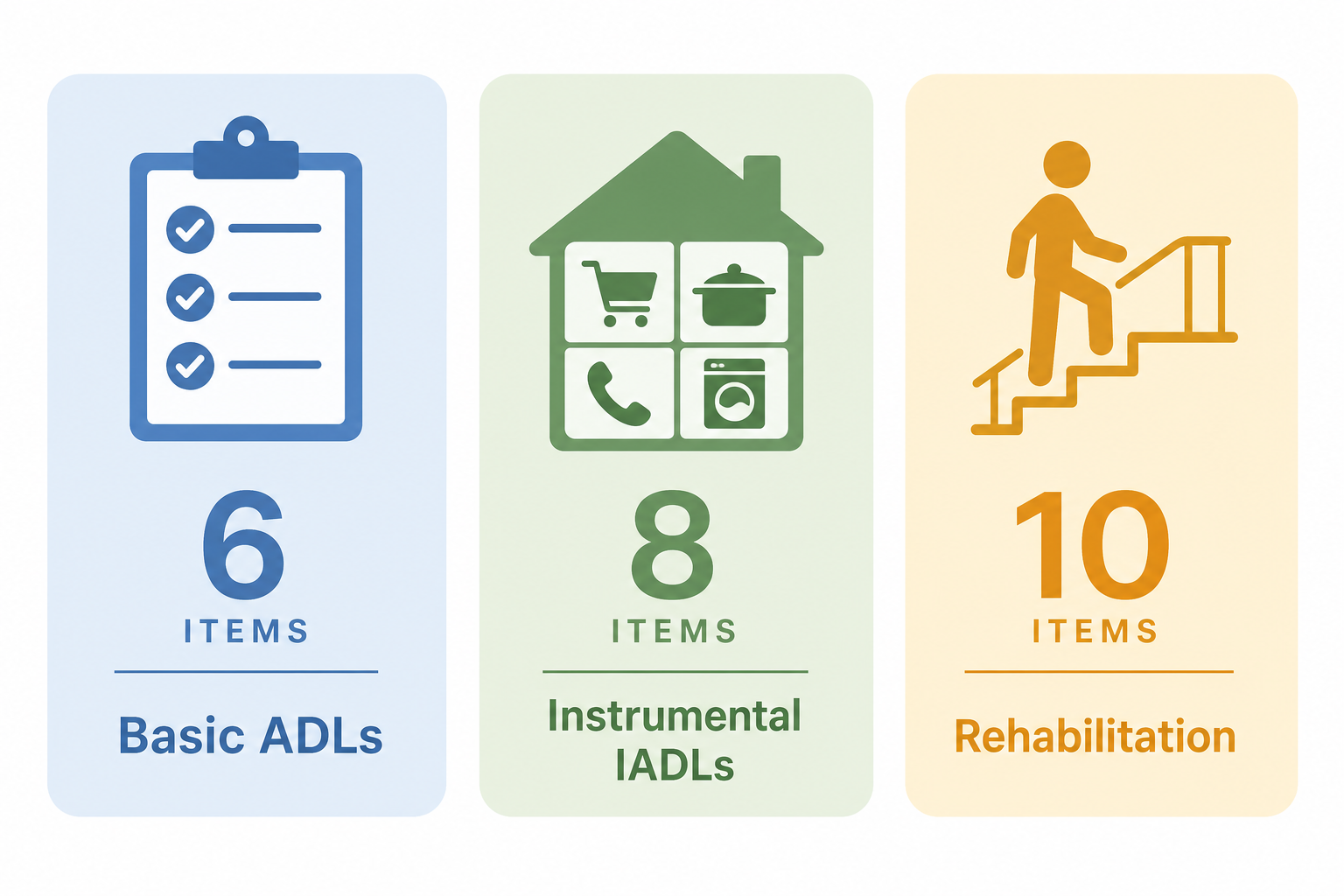
| Tool | Items | Score Range | What It Measures | Primary Use Setting |
|---|---|---|---|---|
| Katz Index of Independence in ADL | 6 | 0–6 | Basic ADLs: bathing, dressing, toileting, transferring, continence, feeding | Broad clinical use: hospital, primary care, discharge planning, insurance |
| Lawton Instrumental ADL Scale | 8 | 0–8 | IADLs: telephone use, shopping, meal preparation, housekeeping, laundry, transportation, medications, finances | Outpatient, community, long-term care; tracking change over time |
| Barthel Index | 10 | 0–20 | Basic ADLs plus mobility and stair use; more granular than Katz | Rehabilitation, post-acute, inpatient settings |
Katz Index of Independence in ADL
The Katz Index is the most widely used brief clinical tool for assessing basic ADLs. It scores each of the six domains as independent or dependent, producing a total score from 0 to 6. A score of 6 indicates full independence across all basic self-care tasks. A score of 4 indicates moderate impairment. A score of 2 or below indicates severe functional impairment and typically signals that significant daily care support is needed.
Its brevity makes it practical for use across nearly every care setting — primary care offices, hospital admission and discharge, long-term care facilities, and insurance assessments. Because it uses consistent language and scoring, it also creates a common reference point when care transitions between settings or providers.
Lawton Instrumental ADL Scale
The Lawton Scale assesses the eight IADL domains and scores each on a range from dependent to independent, with a total possible score of 8 (full independence) and 0 (complete dependence). Its particular strength is tracking change over time — a score that drops from 7 to 5 over six months tells a clinician something meaningful about the trajectory of a person's functional status, even if no single domain has collapsed entirely.
The Lawton Scale is used most frequently in outpatient and community settings, in geriatric assessments, and as part of the documentation required for long-term care insurance claims and VA benefit applications.
Barthel Index
The Barthel Index covers ten functional items — including mobility and stair use in addition to the basic ADLs — and scores them on a scale from 0 (maximum dependency) to 20 (maximum independence). Its finer granularity makes it sensitive to smaller functional changes that the Katz Index might not capture, which is why it is the standard tool in rehabilitation and post-acute settings.
If your family member is recovering from a stroke, hip fracture, or orthopedic surgery, the Barthel Index is likely the tool their rehabilitation team is using to track progress and set discharge criteria.
Who Conducts Formal ADL Assessments — and When
Formal ADL assessments are conducted by licensed professionals, each with a distinct role in the assessment process:
- Occupational therapists (OTs): Have the deepest specialized expertise in ADL and IADL assessment, particularly in the home environment. An OT's in-home evaluation goes beyond scoring — it identifies specific task breakdowns, environmental barriers, and adaptive strategies. OT findings directly inform home modification recommendations and adaptive equipment needs.
- Physical therapists (PTs): Assess mobility, balance, and transfer ability as part of functional evaluation. PT assessment is particularly relevant for the transferring and ambulation ADL domains and for fall risk evaluation.
- Nurses: Conduct ADL assessments in hospital, skilled nursing, and home health settings, often using standardized tools like the Katz Index as part of routine admission or care planning documentation.
- Physicians and geriatricians: Incorporate ADL and IADL screening into geriatric assessments as part of a broader evaluation that includes cognition, nutrition, medications, and social circumstances.
Formal assessments are typically triggered by one of several circumstances:
- Hospital admission or discharge planning — to determine what level of support will be needed at home or in a care facility
- Care transitions — moving from a rehabilitation facility back home, or from home to assisted living
- Long-term care insurance claims — the insurer requires formal documentation of ADL dependency to activate benefits
- VA Aid and Attendance benefit applications — the VA requires evidence of ADL need
- Family or physician concern — when observable changes prompt a structured evaluation rather than waiting for a crisis
What Family Caregivers Can Observe at Home
Family members often notice functional changes before a formal assessment ever occurs — sometimes months before a clinical appointment. Structured informal observation using the ADL/IADL framework makes those observations more accurate, more communicable to healthcare providers, and more useful for care planning.
IADL warning signs to watch for across visits:
- Unopened mail, unpaid bills, or unusual financial activity
- Pill bottles that are not being depleted at the expected rate, or confusion about which medications to take
- Spoiled food in the refrigerator, skipped meals, or unexplained weight loss
- Stopped driving, or reports of close calls or traffic incidents
- A home that is noticeably less clean or more cluttered than usual
- Difficulty using a phone, following a recipe, or completing tasks that were previously routine
Basic ADL warning signs to watch for:
- Changes in personal hygiene — unwashed hair, body odor, or infrequent bathing
- Clothing inappropriate for the weather or season, or wearing the same clothes repeatedly
- Visible difficulty rising from a chair, unsteady movement, or slow and cautious walking
- Signs of incontinence, such as odor or evidence of accidents
- Difficulty managing utensils, spilling food, or taking much longer to finish meals
How ADL Assessment Connects to Next Steps
ADL and IADL assessment is not an endpoint — it is a starting point for care decisions. Understanding what assessment results mean for each type of decision helps caregivers move from information to action.
- Requesting an occupational therapy evaluation: If you have observed IADL or ADL changes, asking the older adult's physician for an OT referral is often the most useful next step. An OT's in-home assessment will identify specific functional limitations and recommend adaptive equipment, home modifications, and compensatory strategies tailored to the individual's actual environment.
- Home care planning: The number and type of ADLs requiring assistance determines what kind of home care is needed — whether that is a home health aide for personal care tasks, a companion for IADL support, or skilled nursing for medical needs. Being able to describe ADL limitations specifically helps home care agencies match the right level of service.
- Assisted living level-of-care pricing: Most assisted living communities use ADL dependency counts to set monthly care fees. Understanding the ADL framework before touring communities helps families interpret the pricing structure and ask informed questions about what is included at each care level.
- Initiating a long-term care insurance claim: Most policies require formal documentation of ADL dependency — typically from a licensed professional — to activate benefits. Contacting the insurer early to understand their specific documentation requirements, and then requesting a formal OT or physician assessment, is the standard process.
- Communicating with physicians and discharge planners: Using ADL and IADL language when describing a family member's functional status — rather than general statements like "she's been struggling" — makes the clinical picture clearer and leads to more specific care recommendations.
Browse more in the Glossary.