
How to Reduce CO2 Exposure at Home for Dementia Prevention
A practical, room-by-room guide for caregivers on reducing indoor CO2 levels using simple interventions like strategic window use, exhaust fans, air purifiers, and CO2 monitors — an emerging modifiable risk factor that may help protect an older adult's brain health.
If a parent’s bedroom feels stale at 10 p.m., the first useful question is not whether the whole house needs a renovation. It is simpler: where is exhaled air building up, and what can be changed tonight without adding another appointment, medication, or expensive project?
Before going further, make the safety distinction clearly. Carbon dioxide, written as CO2, is the gas people breathe out. Indoors, high CO2 usually points to weak ventilation and a room where exhaled air is accumulating. Carbon monoxide, written as CO, is different: it is an acutely poisonous combustion gas from sources such as malfunctioning furnaces, gas appliances, fireplaces, or attached garages. CO requires working carbon monoxide alarms and emergency seriousness. Do not use a CO2 monitor as a substitute for CO alarms.
For brain-health and dementia-prevention planning, the practical goal is not to chase perfect air. It is to lower stale-air conditions repeatedly in the rooms where an older adult sleeps, rests, cooks, and sits with other people. CO2 itself is part of the picture; so are fine particles, cooking pollution, moisture, odors, and other indoor pollutants that often rise when ventilation is poor.
Why This Is Worth Doing
The evidence is not yet a neat clinical-trial answer for older adults with dementia. Much of the controlled CO2-and-cognition research comes from healthy working-age adults. Still, it is hard to ignore because the day-to-day outcome is exactly what caregivers notice first: alertness, decision-making, speed, and the ability to stay settled. The 2024 Lancet Commission’s addition of air pollution as a modifiable dementia risk factor also gives indoor air a clearer place in prevention conversations.
In the Harvard COGfx study, cognitive scores were 15% lower at 950 ppm CO2, and scores were 61% to 101% higher under better ventilation conditions compared with conventional conditions with higher volatile organic compounds and lower ventilation.[1] Berkeley Lab also reported impaired decision-making performance at 1,000 ppm CO2 in a controlled exposure study.[2] Those are not dementia-prevention trials, but they make stale air less vague. They suggest that the stuffiness caregivers complain about may correspond to measurable changes in thinking.
Older-adult evidence is more indirect but still relevant. A Chinese longitudinal study found that higher indoor ventilation frequency was significantly associated with lower risk of cognitive impairment among older adults.[3] A 2026 in-home HEPA filtration trial found that adults over 40 completed cognitive tests 12% faster after one month of HEPA air purifier use, while indoor PM2.5 fell by 52%.[4] That trial does not prove that purifiers prevent dementia. It does show that changing home air conditions can coincide with a measurable short-term cognitive improvement.
Long-term outdoor air pollution research also supports taking indoor air seriously. A 2025 meta-analysis in The Lancet Planetary Health included 32 studies and more than 26 million participants; it found that each 5 μg/m³ increase in PM2.5 exposure was associated with an 8% higher dementia risk.[5] That finding is about long-term air pollution exposure, not bedroom CO2 alone. But for a caregiver deciding whether to open a window, run an exhaust fan, or add filtration, it pushes the same practical direction: reduce the polluted air a person breathes for hours at a time.
Start With a Quick Stale-Air Walkthrough
You can begin without buying anything. Walk through the home at the times when the older adult actually uses each room. A room that feels fine at noon may be stale after the bedroom door has been closed all night, after three relatives sit in the living room for an evening, or after cooking with the kitchen window shut.
- Check the bedroom first thing in the morning, before opening windows or doors.
- Notice whether the living room feels stuffier after visitors, TV time, or naps.
- Run kitchen and bathroom exhaust fans and confirm whether air seems to leave the room rather than simply make noise.
- Look for closed interior doors, blocked vents, heavy curtains over windows, or furniture pushed against air returns.
- Watch for headaches, sleepiness, irritability, or evening confusion that repeatedly appears in the same closed room, while remembering that symptoms like these can have many medical causes.
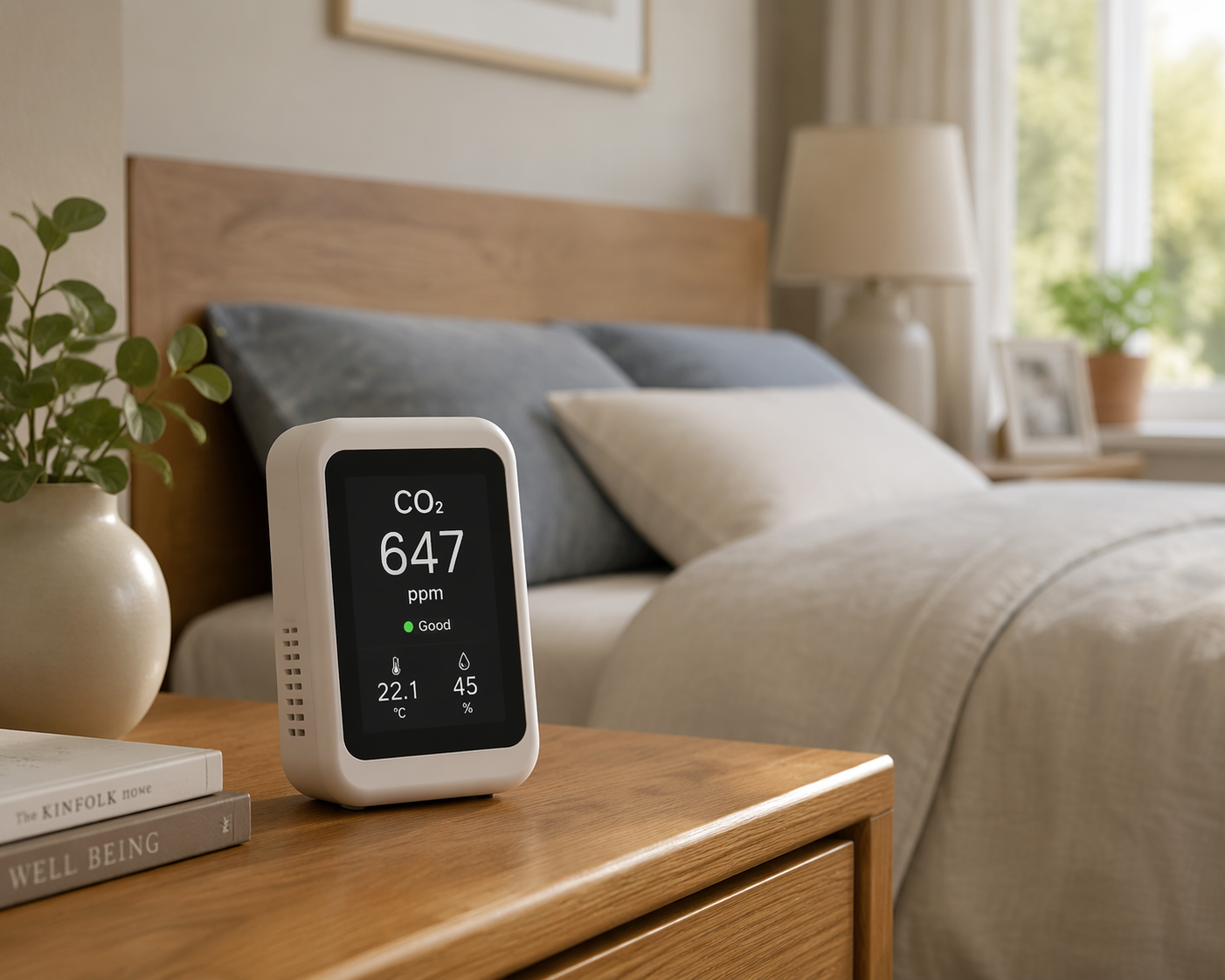
A CO2 monitor can make this less dependent on guesswork. Choose one with a real-time numerical display, easy-to-read screen, and simple logging if you want to compare overnight readings. Place it away from a person’s direct breath, open windows, supply vents, air purifiers, and humidifiers. A nightstand or dresser can work if it is not right beside someone’s face. The point is not to create another device to babysit; it is to learn which rooms need action and when.
| Room or situation | What usually drives buildup | First action to try |
|---|---|---|
| Bedroom overnight | Closed door, closed windows, one or two people breathing for hours | Crack a window if safe, open the door, or create a short pre-sleep and morning airing routine |
| Living room | Long sitting periods, visitors, closed windows, poor air movement | Ventilate before and after gatherings; keep supply and return vents clear |
| Kitchen | Cooking particles, combustion if gas is used, heat and moisture | Use a vented range hood or exhaust fan during cooking and for a short period afterward |
| Bathroom | Moisture, odors, weak exhaust, door kept shut | Run the fan during bathing and afterward; verify that it vents properly |
| Small closed rooms | One person resting or working behind a shut door | Open the door between uses and avoid using the smallest room for long visits |
Bedroom: Protect the Longest Stretch of Air
The bedroom deserves extra attention because it can hold the longest uninterrupted exposure. Eight hours with a closed door and closed windows is different from twenty minutes in a hallway. If two people sleep in the room, or if a caregiver sleeps nearby, CO2 can rise faster. If the older adult naps there during the day, the room may never get a proper reset.
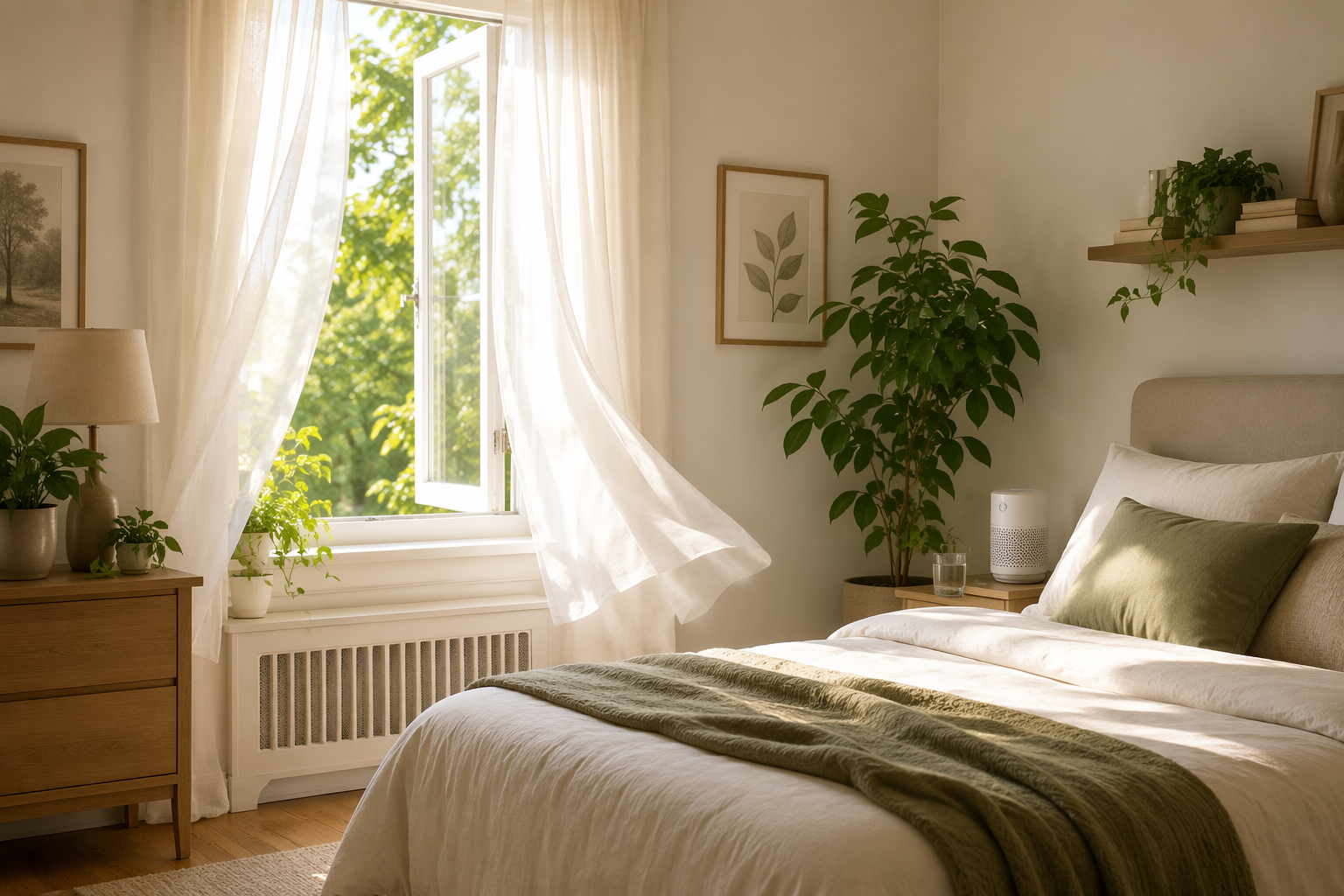
Start with the least disruptive changes. Open the bedroom door while the person is getting ready for bed, then again in the morning. If outdoor conditions are safe and tolerable, crack a window for a short period before sleep or after waking. If security, wildfire smoke, traffic pollution, pollen, noise, or temperature make open windows unsafe, do not force it; use shorter airing periods when outdoor air is better, and lean more heavily on whole-home ventilation, exhaust timing, and filtration for particles.
A bedroom CO2 monitor is most useful when it answers a specific question: does the room stay stale overnight? Check it after the person has been asleep for several hours or first thing in the morning. If readings are consistently higher after the door is closed, try one change at a time: door open a few inches, window cracked briefly, fan used to move air between rooms, or HVAC fan circulation if the system supports it. Then compare the pattern. Caregivers do not need lab precision; they need to know whether the room improves.
This is where one small Alzheimer’s case study feels uncomfortably familiar. In a REHVA Journal report, nocturnal restlessness in one Alzheimer patient stopped when bedroom CO2 was kept below about 750–800 ppm.[6] That is an exploratory single-patient case, not proof that lowering CO2 resolves nighttime behaviors in dementia. Still, it gives caregivers a practical hypothesis worth testing gently: if restlessness is worse in a closed bedroom, improve the air before assuming the only answer is another medication or a harder nighttime routine.
Do not create a fall risk while trying to fix air. Avoid cords across walking paths, unstable window props, fans on the floor near nighttime bathroom routes, or monitor alarms that startle someone awake. If a parent gets cold easily, use timed airing rather than leaving a window open all night. If wandering is a concern, window and door safety comes first.
Living Room: Manage People, Time, and Air Movement
The living room is often where good cognitive hours are spent: morning coffee, television, phone calls, visitors, physical therapy exercises, or a favorite chair by the window. It is also where CO2 can climb quietly because everyone is sitting still and nobody wants to make the room drafty.
Ventilate before the room is crowded, not only afterward. If family is coming over, air out the room for a short period before they arrive when outdoor conditions allow. During the visit, a slightly open window, open interior door, or running HVAC fan can help dilute exhaled air. After the visit, reset the room again. This matters most when an older adult stays in the same chair while everyone else comes and goes.
A CO2 monitor in the living room can help families see that occupancy matters. The number may look reasonable when one person is reading alone and climb when several people sit together with windows closed. That does not mean family visits are bad. It means the room needs more air exchange during the visit, especially if the older adult becomes sleepy or foggy after long gatherings.
This is also a reasonable place for an air purifier, with one important caveat: a purifier does not remove CO2 in the way ventilation does. HEPA filtration targets particles, including fine particulate pollution. Carbon filters can help with some gases and odors depending on the filter design and saturation. If you use a purifier, choose it by room size, noise level, filter type, replacement cost, and whether the older adult will tolerate it running. A loud machine that gets turned off every evening is not much of an intervention.
Kitchen: Use Exhaust Before the Air Spreads
Kitchen air is not only a CO2 issue. Cooking can add particles, moisture, odors, and, with combustion appliances, additional pollutants. The kitchen also shares air with the rest of the home, so a smoky or under-ventilated dinner can become a living-room and bedroom problem later.
Turn on the range hood or exhaust fan before cooking starts, not after the room already smells heavy. Use the back burners when that improves capture by the hood. Keep the fan running for a short period after cooking. If the range hood recirculates through a filter instead of venting outdoors, it may reduce some grease and odor, but it is not the same as exhausting pollutants outside.
When outdoor air is safe, a small window opening can help the exhaust fan work better by giving replacement air a path into the home. If the fan is noisy, greasy, or weak, cleaning the filter may be the fastest improvement. If a gas flame burns oddly, appliances smell wrong, or CO alarms sound, treat that as a safety issue rather than an indoor-air optimization project.
Bathroom and Laundry Areas: Check the Fans Everyone Ignores
Bathroom fans are easy to overestimate because noise feels like proof. What matters is whether the fan actually removes moist air. Run it during showers and baths and leave it on afterward. If the mirror stays wet for a long time, odors linger, or dust clings heavily to the grille, the fan may need cleaning or repair.
Bathrooms and laundry spaces also affect caregiver workload. Damp air can feed musty smells, and musty rooms often lead families to mask odors instead of ventilating. For a person with memory loss, strong fragrances may be irritating or confusing. It is better to remove moisture and stale air than to cover it.
Small Closed Rooms, Cars, and Visitor Days
Any small enclosed space can become a stale-air pocket: a den used for naps, a craft room, a basement TV area, or a room where a paid caregiver sits with a parent for several hours. The smaller the room and the longer the door stays closed, the more attention it deserves.
- Use larger rooms for long visits when possible.
- Leave interior doors open between uses so rooms can dilute with the rest of the home.
- Avoid seating several visitors around an older adult in the smallest room just because it is cozy.
- Air out rooms after paid-care shifts, family meetings, or long card games.
- In cars, use fresh-air mode periodically instead of recirculation for the whole ride, unless outdoor air quality or traffic fumes make that a poor choice.
How to Use Monitors Without Letting Them Run the House
A CO2 monitor is a decision tool, not a moral scoreboard. Its job is to show patterns: the bedroom climbs overnight, the living room climbs with visitors, the den gets stale when the door is closed. Once you know the pattern, you can stop checking constantly and use the fix that works.
- Look for a clear real-time display that a tired caregiver can read quickly.
- Place it at breathing height when practical, but not directly in someone’s breath stream.
- Use it in the bedroom for several nights before deciding whether a change helped.
- Move it room to room if buying several monitors is not realistic.
- Avoid alarm-heavy setups if beeping will upset the older adult.
For air purifiers, keep the distinction just as clear. HEPA filtration can reduce particles; it does not replace outdoor air exchange for CO2. A purifier with a carbon component may help with some gases and odors, but carbon filters need replacement and vary widely. If the main problem is a closed bedroom with rising CO2, ventilation is still the central fix. If the problem is particles from outdoor pollution, cooking, or general indoor dust, filtration becomes more important.
When Simple Fixes Are Not Enough
Some homes fight back. Windows may be painted shut, outdoor air may be unsafe for long stretches, bedrooms may overheat, or the HVAC system may barely move air to the room where a parent sleeps. At that point, it may be time to think beyond daily habits.
Next-level options can include HVAC balancing, better bathroom or kitchen exhaust, adding properly sized filtration, improving air returns, or considering energy recovery ventilators or other mechanical ventilation upgrades. Those belong in the same mental category as other home modifications: useful when the home’s layout or systems keep creating the same health problem despite reasonable routines.
If money is limited, spend first on the changes that affect the most exposure: the bedroom overnight, the main sitting area, and cooking exhaust. A beautiful gadget in a hallway will not help much if the parent sleeps behind a closed door in stale air every night.
What This Can and Cannot Promise
Reducing indoor CO2 exposure is not a guaranteed dementia-prevention treatment. Direct clinical-trial evidence in older adults with dementia is still emerging, and it would be wrong to claim that a monitor, open window, or purifier prevents Alzheimer’s disease. The stronger claim is practical and more modest: stale indoor air is measurable, often changeable, and tied to cognitive performance and cognitive-risk evidence closely enough to deserve attention.
For caregivers, that is enough to act without overpromising. Open the bedroom when it is safe. Use the exhaust fan before cooking smoke spreads. Air out the living room after visitors. Add HEPA filtration where particles are a concern. Use a CO2 monitor to find the rooms that need help, then stop making yourself check everything all day. The standard is repeated, observable improvement in the air your parent breathes during the hours that matter most.
References
- Associations of Cognitive Function Scores with Carbon Dioxide, Ventilation, and Volatile Organic Compound Exposures in Office Workers — Environmental Health Perspectives, 2016.
- Elevated Indoor Carbon Dioxide Impairs Decision-Making Performance — Berkeley Lab, 2012.
- Association between indoor ventilation frequency and cognitive impairment among older adults — BMC Geriatrics, 2022.
- Effect of HEPA filtration air purifiers on cognitive function — Scientific Reports, 2026.
- Long-term air pollution exposure and incident dementia — The Lancet Planetary Health, 2025.
- Effect of CO2 on restlessness of an Alzheimer patient — REHVA Journal, 2015.
Related reading
Noticed something outdated or inaccurate on this page? Flag a correction. We review every report against CDC, NIA, and AARP HomeFit guidance before updating a page.
Part of the Fall Prevention section.