
Glossary entry
Is It Safe for Someone With Dementia to Drive?
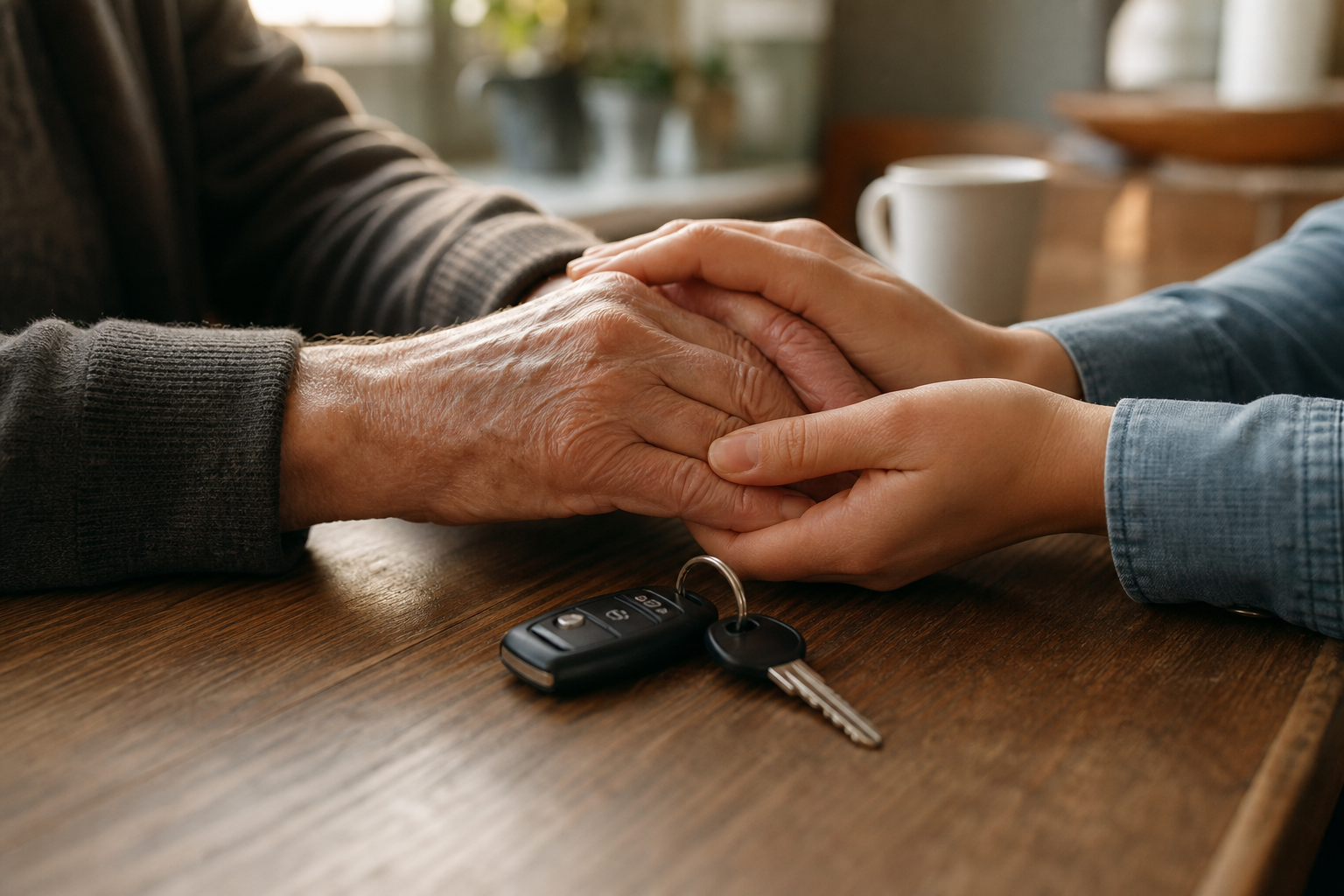
The Short Answer: It Depends on the Stage
A dementia diagnosis does not automatically end a person's driving privileges. In the early stages of Alzheimer's disease or another form of dementia, some people are still able to drive safely — at least on familiar local routes, in daylight, and under limited conditions. But the risk is meaningfully elevated even in mild stages, and dementia is a progressive disease. Driving ability will decline. That means the day of diagnosis is also the day to begin monitoring, planning, and preparing for the conversation that lies ahead.
Why Dementia Affects Driving Ability
Safe driving is a complex cognitive task. It requires a driver to process visual information, make split-second decisions, monitor multiple moving objects at once, remember where they are going, and respond quickly to unexpected changes. Dementia progressively erodes the brain functions that make all of this possible.
The specific abilities that dementia affects include:
- Reaction time — the speed at which a driver can respond to a sudden hazard, such as a child running into the street or a car stopping abruptly ahead.
- Decision-making — the ability to judge when it is safe to turn, merge, or proceed through an intersection.
- Spatial processing — the ability to judge distances between vehicles, gauge lane width, and navigate turns accurately.
- Short-term memory — the ability to remember a destination, follow a route, or recall whether a traffic light was red or green moments ago.
- Multitasking — the ability to monitor mirrors, road signs, pedestrians, and other vehicles simultaneously while controlling the vehicle.
- Visual processing — the ability to accurately interpret what is seen, including reading signs and recognizing hazards in peripheral vision.
One additional factor makes this particularly challenging for caregivers: some people with dementia lose the ability to recognize their own cognitive decline. This is not stubbornness or denial — it is a symptom of the disease itself, in which the brain's capacity for self-assessment is impaired. A person experiencing this may genuinely believe they are driving as well as they always have, even when observable evidence suggests otherwise. This is why external monitoring by caregivers is not optional — it is essential.
A Stage-Based Safety Framework
The appropriate response to dementia and driving depends significantly on where the person is in the progression of the disease. A clear two-tier framework applies:
| Dementia Stage | Driving Status | Recommended Action |
|---|---|---|
| Early / Mild | May still be able to drive safely under limited conditions | Arrange a professional driving evaluation immediately; monitor closely; begin limiting driving conditions; plan for cessation; reassess every six months |
| Moderate or Severe | Should not drive — the disease has progressed beyond safe driving capacity | Driving must stop; no professional evaluation is needed to justify this; focus on alternative transportation and last-resort strategies if the person resists |
For early-stage cases, the American Academy of Neurology recommends that people with mild dementia strongly consider discontinuing driving. Research published in Neurology found that patients with mild Alzheimer's disease became unsafe drivers after an average of approximately 11 months, while those with very mild disease remained safe drivers for an average of about 1.7 years — though individual variation was significant. These figures are from a 2008 study and should be understood as background context for the stage-based framework, not as current statistics that apply to any individual.
Warning Signs to Watch For
Caregivers are often in the best position to observe early warning signs — both behind the wheel and in everyday behavior at home. These two categories of signs are closely linked: out-of-car behaviors that reflect declining cognitive function are reliable predictors of in-car risk.
In-Car Warning Signs
- Getting lost on familiar routes they have driven for years
- Failing to observe stop signs, traffic lights, or lane markings
- Confusing the brake and gas pedals
- Drifting between lanes or straddling lane lines
- Driving significantly faster or slower than the flow of traffic
- Becoming confused or hesitant at intersections
- New unexplained dents, scrapes, or damage on the vehicle
- Difficulty parking or misjudging the width of the car in tight spaces
Out-of-Car Behavioral Signs
These are behaviors you may notice at home or in daily life that signal the cognitive and physical decline that makes driving unsafe:
- Becoming less coordinated in everyday movements
- Difficulty judging distances or spatial relationships (for example, misjudging how far away an object is)
- Getting disoriented or confused in familiar places, such as their own neighborhood
- Increasing difficulty doing two things at once — following a conversation while cooking, for example
- Significant memory loss for recent events, such as forgetting appointments or conversations from earlier the same day
- Mood swings, increased anxiety, or agitation that was not previously characteristic
- Difficulty making decisions or taking noticeably longer to respond to simple questions
If you are observing several of these signs together, that is a signal to act — not to wait for an incident on the road.
Professional Driving Evaluation: What It Is and Who Does It
For early-stage or borderline cases, a professional driving evaluation is the most objective tool available. This is not a standard DMV road test or license reexamination. It is a medically grounded clinical assessment conducted by an occupational therapist with specialized driving rehabilitation training — a professional who evaluates driving capacity from a medical standpoint, assessing how a specific cognitive or physical condition affects safety behind the wheel.
A clinical driving evaluation typically assesses:
- Reaction time and the ability to respond quickly to unexpected events
- Cognitive skills including attention, memory, and judgment
- The ability to multitask while controlling a vehicle
- Physical coordination and strength
- Visual processing skills and visual acuity
- Sensation and motor control in the arms and legs
For someone with a progressive diagnosis like Alzheimer's disease, the specialist understands that the goal is not rehabilitation — the skills will not improve. In these cases, the evaluation shifts toward family education, safety planning, and helping everyone involved understand what the current level of risk actually is.
For individuals who pass an initial evaluation, the recommended cadence is re-evaluation every six months. Because dementia is progressive, passing today does not mean the situation will be the same in six months. The objective of ongoing monitoring is to detect a change before it becomes a crisis on the road.
Having the Conversation About Driving
Driving represents far more than transportation — it is tied to independence, identity, and dignity. Expect this conversation to be difficult, and expect to have it more than once. Framing it as an ongoing dialogue rather than a single confrontation will serve everyone better.
- Start early, before a crisis forces the issue. The best time to introduce the topic is while the person still has enough capacity to participate in the decision and to understand the reasoning.
- Involve the physician directly. Ask the doctor to raise the driving question at the next appointment. A recommendation — or a written letter or prescription stating that the person should not drive — from a physician often carries significantly more weight than the same message from a family member.
- Consider a driving contract. When the person is still in the early stage of the disease, ask them to sign an agreement that gives you permission to help them stop driving when the time comes. This is a planning tool, not a legal document — but it creates a shared understanding while the person still has the capacity to make that commitment.
- Appeal to their sense of responsibility. Many people respond more to the idea of protecting others — passengers, pedestrians, other drivers — than to arguments focused on their own limitations.
- Expect multiple conversations. The Alzheimer's Association is clear that this is typically the first of many discussions, not a single event. Resistance is normal and does not mean the conversation failed.
- Begin planning alternative transportation before driving stops. Introducing alternatives early — even if the person is still driving — reduces the emotional impact when driving does end, because the transition feels less abrupt.
When Persuasion Fails: Last-Resort Strategies
When a person with dementia continues to drive despite clear safety concerns and repeated conversations, caregivers sometimes need to take more direct action. These strategies are practical tools for protecting safety — not punishments — and are endorsed by the Alzheimer's Association and other leading dementia care organizations.
- Hide the car keys or replace them with a non-functional set that looks similar.
- Disable the vehicle by removing a battery cable so the car will not start.
- Ask a mechanic to install a "kill switch" — a hidden device that must be engaged before the car will start — and keep the switch location private.
- Move the vehicle out of sight, such as parking it at a neighbor's home or in a different location.
- Sell the vehicle, which removes the option entirely and eliminates daily visual reminders of what has been lost.
These steps may feel extreme, but when someone with moderate or advancing dementia insists on driving, the risk to that person and to everyone else on the road is real. Taking action is an act of care, not control.
Alternative Transportation Options

Losing the ability to drive does not have to mean losing independence. Planning transportation alternatives early — ideally in parallel with early driving limitations rather than after driving stops — makes the transition significantly less disruptive.
- Family and friend coordination. For many families, this is the primary solution — building a rotating schedule of drivers among family members, neighbors, and friends. Creating a shared calendar or group text thread can help distribute the responsibility.
- Paratransit. Under the Americans with Disabilities Act, public transit agencies that operate fixed-route bus or rail service are required to provide complementary paratransit service for riders who cannot use fixed-route transit due to a disability. Paratransit is curb-to-curb, wheelchair accessible, and available in most metropolitan areas — but it requires advance booking and eligibility determination.
- Microtransit. On-demand shared rides that do not require fixed-route eligibility. Availability varies significantly by location.
- Non-Emergency Medical Transportation (NEMT). Medicaid covers transportation to and from medical appointments for eligible individuals through NEMT programs. If the person with dementia is enrolled in Medicaid, this benefit may cover a significant portion of medical-related travel.
- Volunteer driver programs. Many communities have nonprofit or faith-based volunteer driver programs that provide free or low-cost door-through-door transportation — meaning a volunteer helps the person from inside their home to inside the destination, not just curb to curb. Some volunteer drivers have training in dementia care. Contact your local Area Agency on Aging to ask about programs in your area.
- Rideshare with phone-based access. For people with dementia who do not use smartphones, phone-based services exist that allow a caregiver or family member to call and book a rideshare on behalf of the rider. These services can be a practical bridge for early-stage individuals who are comfortable with supervised outings.
US State Laws: What Caregivers Should Know
Driving laws related to dementia vary significantly from state to state. The most important distinction to understand is between states that require mandatory physician reporting and states where reporting is voluntary.
A small number of states require physicians to report a dementia diagnosis directly to the DMV. California, Illinois, and Pennsylvania are confirmed examples of states with mandatory physician reporting requirements. In California, for instance, a reported driver with dementia must undergo a driver medical evaluation, and drivers with moderate or severe dementia are not eligible for reexamination — their driving privilege is revoked. Drivers with mild dementia may undergo reexamination, and if they pass, the DMV schedules reassessment within six to twelve months.
In most other states, physicians, family members, neighbors, or law enforcement can file a request for DMV review or reexamination — but no one is legally required to do so. Nearly all states have some process for requesting a driving reexamination when there is a concern about a driver's fitness.
When to Involve the Doctor — and What to Ask
The person's physician is one of the most valuable allies a caregiver has in the driving conversation. A family member raising the driving question may be dismissed or argued with. The same message from a trusted doctor often lands differently.
- Before the appointment, contact the doctor's office privately to share your specific concerns. Describe the warning signs you have observed — in-car and out-of-car — so the physician has context before the visit.
- Ask the physician to raise the driving question directly during the appointment. Many physicians will do this as part of routine dementia care if they know the family is concerned.
- Request a written letter or prescription stating that the person should not drive. This written recommendation is often more persuasive than a verbal conversation, and it gives the caregiver something concrete to reference in future discussions.
- Ask for a referral to an occupational therapy driving rehabilitation specialist if the physician agrees that a formal evaluation is appropriate for the person's current stage.
Browse more in the Glossary.