
Clinical term
What Do the 2026 Cholesterol Guidelines Mean for Seniors?
Last verified 2026-07-29
If you are over 75, the new cholesterol guidelines do not mean you automatically need to start a statin tomorrow morning. They do mean your doctor may bring up cholesterol medicine more often, especially if you are between 76 and 79 and have never had a heart attack or stroke.
That situation is called primary prevention: trying to prevent a first heart attack, stroke, or other cardiovascular event. The 2026 ACC/AHA cholesterol guideline extended primary-prevention statin recommendations through age 79, restored specific LDL cholesterol targets, and added once-in-a-lifetime testing for lipoprotein(a), usually written as Lp(a).[1]

The size of the change is why many older adults are hearing about it. A JAMA analysis reported on July 20, 2026, estimated that 99.1% of adults ages 70 to 79 would now be eligible for statin therapy for primary prevention under the 2026 guideline framework.[2] That is a modeling estimate, not a command to treat every person in that age group. Still, it changes the conversation from “this may apply to some people” to “this may come up at almost every checkup.”
What Changed in 2026
For seniors, three parts of the 2026 cholesterol guideline matter most. They are easy to name, but not always easy to apply to a real person with arthritis, kidney disease, several prescriptions, and a strong preference not to add another pill.
| Change | Plain-language meaning | What it does not decide |
|---|---|---|
| Primary-prevention statin recommendations now extend through age 79 | Doctors may consider statins for more adults in their 70s who have not yet had a heart attack or stroke. | It does not mean every person over 75 should start a statin. |
| LDL targets are back | Your doctor may discuss a specific LDL cholesterol goal instead of only saying your cholesterol is “better” or “worse.” | It does not mean the most aggressive target is right for every older adult. |
| Once-in-a-lifetime Lp(a) testing is recommended | A simple blood test can look for an inherited cholesterol-related risk factor many people have never been checked for. | It does not mean high Lp(a) is your fault or that lifestyle changes can lower it. |
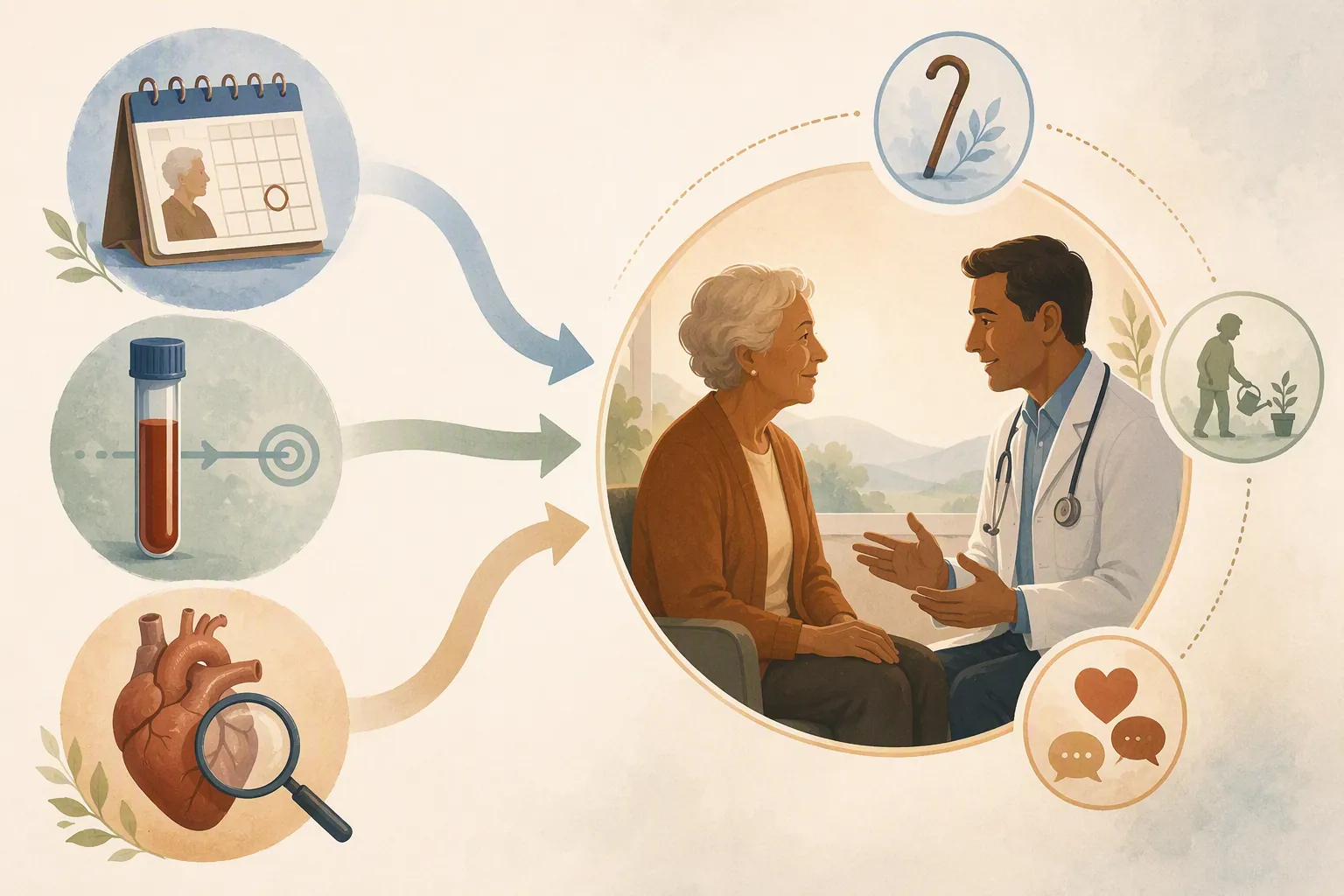
1. Statin eligibility expanded through age 79
The biggest practical change is the age range. Earlier risk tools and recommendations left many older adults in a gray zone. The 2026 guideline uses the PREVENT risk calculator through age 79 and allows more adults in their 70s to be considered for statins for primary prevention.[1]
PREVENT is the newer cardiovascular risk calculator used in the guideline. It replaces the older pooled cohort equations, provides both 10-year and 30-year estimates, and produces risk estimates that are reported to be 40% to 50% lower than the older calculator. In the 2026 framework, borderline 10-year risk begins at 3%.[1]
For ages 76 to 79, the recommendation is not written as a simple yes-or-no rule. It is a weaker, individualized recommendation, which means the doctor and patient are supposed to weigh the likely benefit against frailty, daily function, other illnesses, side effects, pill burden, and personal goals.[1]
2. LDL targets are back
LDL cholesterol is the “bad cholesterol” number many people recognize from their lab report. The 2018 AHA/ACC cholesterol guideline moved away from explicit LDL targets. The 2026 guideline brought them back: less than 100 mg/dL for borderline or intermediate risk, less than 70 mg/dL for high risk, and less than 55 mg/dL for very high risk.[1]
That is helpful because it gives patients a concrete question to ask: “What LDL goal are you using for me?” It also makes treatment conversations less foggy. If your LDL is 118 mg/dL, the next step depends very much on whether your doctor thinks your goal is under 100, under 70, or something more cautious because of age, frailty, or side effects.
Targets are not marching orders. A target can clarify the aim of treatment, but it does not erase the person sitting in the exam room. For an active 76-year-old who walks daily and has few medicines, an LDL goal may lead to one conversation. For an 82-year-old with falls, memory changes, poor appetite, and a long medication list, the same LDL number may lead to a different one.
3. Lp(a) testing is now a once-in-a-lifetime recommendation
Lp(a), pronounced “L-p-little-a,” is an inherited cholesterol-related particle that can raise cardiovascular risk even when the rest of the cholesterol panel looks acceptable. The 2026 guideline recommends universal Lp(a) testing once in a lifetime.[1]
About 1 in 5 people have high Lp(a), defined as at least 125 nmol/L, and high Lp(a) independently raises cardiovascular risk by roughly 1.4-fold.[4] Many seniors have never had this test because it was not part of the usual yearly cholesterol panel.
This is one place where blame should stay out of the room. High Lp(a) usually does not improve with diet, exercise, or statins.[4] Healthy habits still matter for overall heart health, but a high Lp(a) result is not proof that someone failed at eating well or walking enough.
What This Means if You Are Over 75
The 2026 ACC/AHA guideline gives the broad cholesterol framework. For the older-adult part of the conversation, the 2025 National Lipid Association and American Geriatrics Society expert consensus is especially important because it focuses on adults older than 75. That consensus supports considering statin therapy in adults over 75 with LDL-C from 70 to 189 mg/dL and no life-limiting illness, while emphasizing individualized decisions.[3]
The phrase “individualized decision” can sound like a polite way to say “no one knows.” In an office visit, it should be more specific than that. It should mean someone asks what the patient can still do, what conditions already compete for attention, how long it would take for prevention to matter, what side effects would be unacceptable, and whether the patient wants a more preventive or more minimalist approach.
A 76-year-old who drives, gardens, manages their own medicines, and has high calculated risk may reasonably decide to start a statin after discussing benefits and side effects. A 78-year-old with severe frailty, repeated hospitalizations, and trouble swallowing pills may reasonably make a different decision. The guideline change puts both people into the conversation; it does not make them the same patient.
Starting, Continuing, Switching, or Waiting
Many seniors are not asking only, “Should I start a statin?” They are asking more ordinary and more useful questions: “Should I keep taking this?” “Is my dose still right?” “Could this muscle pain be related?” “If I could not tolerate one statin, is there another option?”
If you already take a statin
Do not stop it just because the news changed. Continuing a statin is generally recommended when it is tolerated, and statin discontinuation has been linked with increased heart-failure hospitalizations and cardiovascular events.[5]
That does not mean a statin can never be stopped. It means stopping should be a decision, not a quiet disappearance from the pillbox. Bring up new muscle symptoms, weakness, appetite changes, confusion about dosing, or concerns about interactions. A clinician can check whether the statin is likely involved, whether the dose should change, or whether another medication is a better fit.
If you have never taken one
Ask your doctor whether the new age range changes your risk category under PREVENT. If you are 76 to 79, also ask how much weight they are giving to function, frailty, other diagnoses, kidney or liver issues, and the medicines you already take.
A useful statin conversation includes the expected benefit, the likely time frame for benefit, the starting dose, what side effects to watch for, and what the plan is if the first choice does not agree with you. “Try it and see” is not enough unless someone also tells you what to watch for and when to call.
If you could not tolerate a statin
Statin intolerance should be taken seriously, but it should also be described clearly. Which statin caused the problem? What dose? What symptom? How soon did it start? Did it improve after stopping? Those details help the clinician decide whether to try a different statin, a lower dose, a different schedule, or a non-statin medicine.
Ezetimibe is one possible non-statin option. The EWTOPIA 75 trial supports ezetimibe monotherapy as a primary-prevention option specifically in adults older than 75 who cannot tolerate statins.[6] It is not a reason to skip the statin discussion entirely, but it gives doctors and patients another route when statins are not workable.
Where CAC Scoring May Fit
A CAC score is a coronary artery calcium score. It is an imaging test that looks for calcified plaque in the heart arteries. In older adults, the 2026 guideline gives CAC scoring a Class 2b role for reclassifying risk, meaning it may be considered in selected situations.[1]
A CAC score of zero can sometimes support deferring medication, especially when the decision is uncertain. But it is not a universal escape hatch, and it is not needed for every person. The test adds the most value when the patient and clinician are truly stuck between reasonable choices.
Questions to Bring to the Appointment
A folded medication list is more useful than a worried memory of a news headline. Bring your current prescriptions, over-the-counter medicines, supplements, and any past notes about statin side effects. If an adult child or caregiver helps manage appointments, bring the person who knows what actually happens with the pillbox at home.
- “Does the 2026 age range change my risk category or your recommendation for me?”
- “Am I being considered for primary prevention, or have I already had a heart-related event that puts me in a different category?”
- “What LDL target are you using for me: under 100, under 70, under 55, or something else based on my situation?”
- “Have I ever had Lp(a) tested? If not, should we do the once-in-a-lifetime test?”
- “How are you weighing frailty, walking ability, memory, kidney function, other illnesses, and the medicines I already take?”
- “If I start or change a medicine, what side effects should make me call, and when will we recheck labs or symptoms?”
For a caregiver, one more question often matters: “What would make us stop or change course?” That answer should be clear before a new prescription is added. It keeps prevention from turning into one more unexplained pill that everyone is afraid to question later.
A Few Terms You May Hear
| Term | What it means |
|---|---|
| Primary prevention | Treatment meant to prevent a first heart attack, stroke, or cardiovascular event. |
| LDL-C | Low-density lipoprotein cholesterol, often called “bad cholesterol.” |
| Lp(a) | An inherited cholesterol-related particle that can raise cardiovascular risk and is usually checked once in a lifetime. |
| PREVENT calculator | The newer risk calculator used in the 2026 guideline through age 79. |
| CAC score | A coronary artery calcium score, an imaging test that may help clarify risk when the treatment decision is uncertain. |
| Shared decision-making | A structured conversation that weighs medical risk alongside frailty, function, side effects, life expectancy, and patient preferences. |
The PREVENTABLE and STAREE trials are still expected to inform future recommendations for older adults, but their results were not yet published as of July 2026.[3] That is a good reason to leave room for future updates. It is not a good reason to ignore today’s appointment.
For now, the most responsible next step is modest and concrete: bring your medication list, ask whether the 2026 cholesterol guidelines change your risk discussion, ask what LDL target your doctor is using, ask whether you have ever had Lp(a) tested, and ask how your strength, daily function, other illnesses, side effects, and personal goals should shape the decision.
References
- ACC/AHA 2026 Guideline (official release), newsroom.heart.org / ACC.org.
- JAMA analysis showing 99.1% statin eligibility in ages 70–79, CNN / Michigan IHPI, July 20, 2026.
- Managing Hypercholesterolemia in Adults Older Than 75 Years, National Lipid Association / American Geriatrics Society, 2025.
- 2026 Dyslipidemia Guidelines, Family Heart Foundation.
- Cholesterol Guidelines Are Changing, University Hospitals, May 2026.
- Dyslipidemia in Older Adults, JACC, May 2026.
Browse more in the Glossary.