
Glossary entry
Will the 2027 Social Security COLA Cover Home Safety Costs?
Last verified 2026-07-30
This is not financial or legal advice. Medicare/Medicaid and benefits rules vary by state and change over time — verify current rules with your state Medicaid office or Area Agency on Aging.
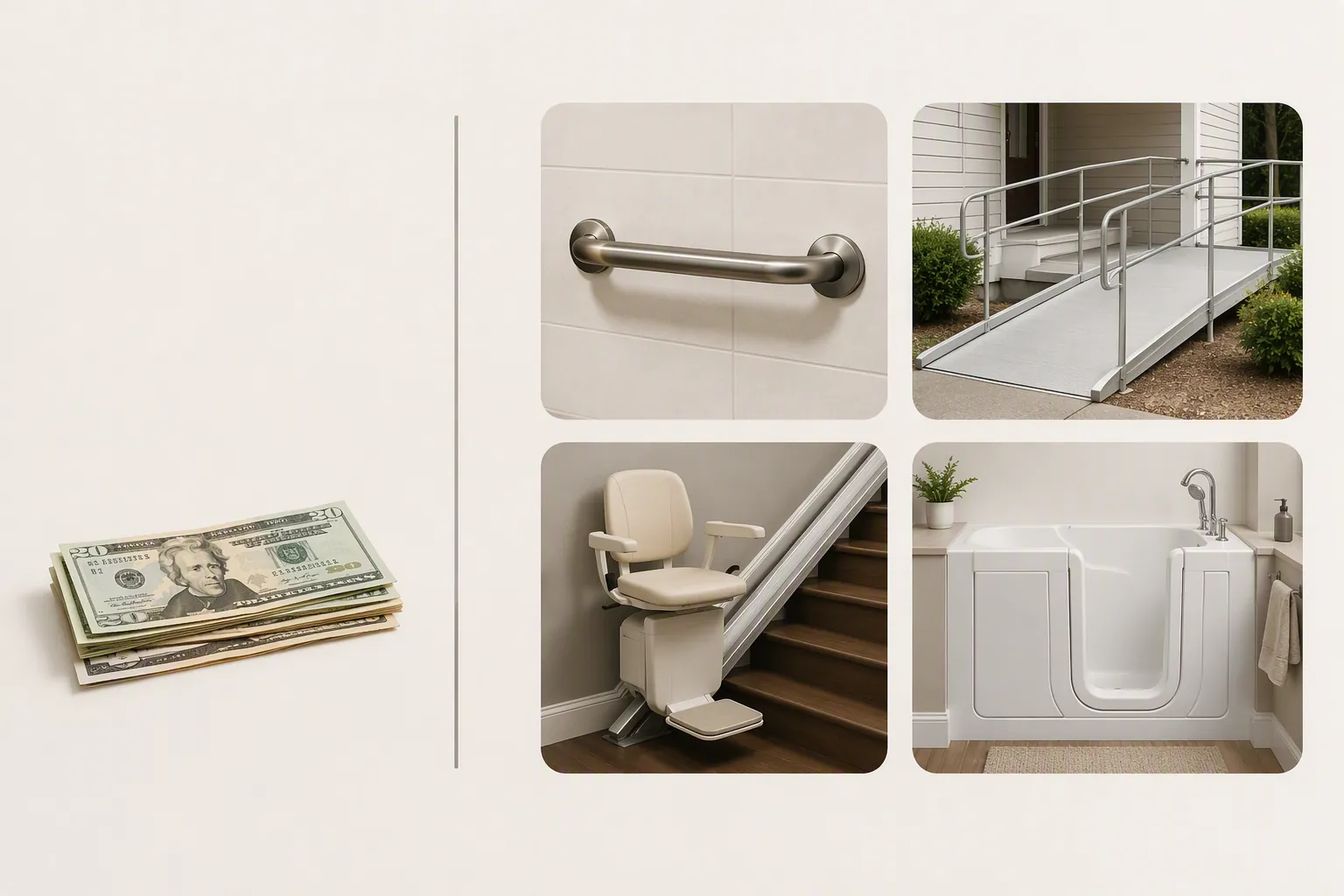
A 2027 Social Security COLA forecast for retirees of about $75 a month sounds useful until it is placed next to one installed safety item. A single grab bar installation can run about $150 to $500, so one month of the projected increase may not cover even half of that small bathroom change. A ramp, stairlift, or walk-in tub is a different order of problem.

As of late July 2026, the serious estimates are clustered but not final: AARP is discussing a 3.6% estimate, The Senior Citizens League is tracking 3.8%, and CNBC Select cites an analyst estimate of 3.7%.[1][2][3] The official 2027 COLA will not be announced until mid-October 2026, after September CPI-W data is available, so families should treat every dollar figure in this article as a planning estimate, not a confirmed benefit amount.[1]
Still, planning estimates matter when a parent is waiting on a safer shower entry or a handrail that should already be installed. On the June 2026 average retired-worker benefit of $2,084, a 3.6% COLA would add roughly $75 a month, raising the average retired-worker benefit to about $2,159.[1] That is welcome money. It is not a home-modification budget.
What the forecasted COLA actually buys
The first mistake is to compare the COLA percentage with a project price. A 3.6% or 3.8% increase does not install anything. The usable question is smaller: how many dollars appear in the monthly check, how much may be absorbed by Medicare, and what is left when a contractor gives a real estimate?
| Planning item | Estimated amount | Caregiver meaning |
|---|---|---|
| Gross monthly COLA on the June 2026 average retired-worker benefit | About $75/month at 3.6% | Enough to soften bills, but not enough to pay for most safety projects in one month |
| Gross annual increase before Medicare offset | About $900/year | More useful if deliberately reserved, but still below many mobility modifications |
| Projected Medicare Part B premium effect | About $6.60/month of the increase may be consumed | The money available for home safety may be closer to $68.40/month, or about $820.80/year |
| Grab bar installation | $150–$500 | One month of the increase may cover part of one installation; annual savings may cover several modest items |
| Ramp | $1,000–$3,000 | The annual net COLA may not cover even the low end |
| Stairlift | $2,000–$5,000 | One monthly increase covers only a small fraction; even a full year of the increase may fall short |
| Walk-in tub | $3,000–$10,000 | Usually far beyond what the COLA can solve by itself |
The Medicare line deserves special attention because families often budget from the headline COLA and forget that some of the increase may never feel available. The 2026 Medicare Trustees Report projection, as reported by Kiplinger, puts the 2027 Part B premium at $209.50 per month; under that projection, about $6.60 of the estimated $75 monthly Social Security increase is already absorbed before a family assigns the money to a grab bar, ramp, or caregiver hours.[4]
That leaves a rough net planning figure of $68.40 per month, or about $820.80 over a year. That can help pay back a small urgent repair or create a dedicated safety fund. It does not turn a stairlift into a Social Security-funded purchase.
Why the range matters, even if the estimates are close
A 3.6% forecast and a 3.8% forecast feel close when they appear in a headline. At the kitchen-table level, the difference is modest, but the uncertainty still matters because no family should promise a parent that a specific 2027 increase is guaranteed before the official announcement.
The direction is clearer than the exact number. The projected 2027 adjustment is higher than the 2.8% COLA for 2026, which means many retirees may see a larger percentage increase than they received the prior year.[5] But the increase is still being measured against monthly living costs, medical premiums, and home-safety needs that arrive in whole invoices, not neat percentages.
It also matters which benefit amount a source uses. Some estimates discuss all Social Security beneficiaries; others focus on retired workers; some use a different reference month. That is why one article may show a different dollar increase from another even when the COLA percentage is similar. For a parent’s actual budget, use the parent’s current benefit letter, not the national average.
Put the parent’s own benefit letter into the math
For a quick caregiver estimate, use the current monthly Social Security benefit before any 2027 adjustment and multiply it by the forecast range. This is not a final benefit calculation, but it is enough to stop wishful budgeting.
Parent's current monthly benefit × 0.036 = low-end estimated monthly COLA
Parent's current monthly benefit × 0.038 = high-end estimated monthly COLA
Estimated monthly COLA − possible Medicare premium increase = rough amount available for other needs
If the parent receives less than the average retired-worker benefit, the dollar increase will be lower. If the parent receives more, it will be higher. The forecast percentage is national; the invoice for a ramp is local.
This is also where families should separate recurring needs from one-time projects. A $68 to $75 monthly increase can help with toiletries, utilities, rides, or a small emergency fund. A home modification often requires a larger amount at once. If the safety problem is urgent, waiting twelve months to accumulate the COLA can be more expensive than finding another funding source now.
Start with the highest-risk home changes, not the most visible ones
The projected COLA is too small to scatter across every annoyance in the house. It should be treated as one line item inside a larger safety plan. The first dollars should go toward the places where a fall, missed medication, or blocked exit would change the parent’s life quickly.
- Bathroom entry, showering, and toilet transfers: grab bars, non-slip surfaces, shower seating, handheld shower controls, and safer lighting.
- Stairs and level changes: handrails, stair lighting, threshold fixes, ramps, or stairlift evaluation when stairs are no longer realistic.
- Night routes: bed-to-bathroom path, floor clutter, lighting, rugs, pets, and cords.
- Entries and exits: locks, steps, railings, door width, weather exposure, and emergency access.
If you have not walked the house in that order, do that before spending the COLA. A room-by-room review is a better starting point than buying the one product a neighbor mentioned. CareWise Guide’s Room-by-Room Home Safety Assessment Checklist can help turn a vague worry into a ranked list, and the room-by-room prioritization guide is the next step when there are more problems than cash.
Bathroom work deserves particular care because it is often both urgent and easy to underestimate. A grab bar sounds simple until the wall needs proper backing, the tub edge is too high, or the safest answer is not a tub at all. For that decision point, use a bathroom-specific resource such as Bathroom Modifications for Aging in Place before committing the parent’s limited monthly increase to a product that may not solve the actual transfer risk.
Where to look when the COLA falls short
The hard part is that the best funding source may not be the one with the simplest name. Medicare is often the first place families look, but home modifications are frequently handled through other programs, local agencies, state Medicaid waiver structures, veterans benefits, or housing-related grants. None of these should be treated as automatic. Eligibility, waiting lists, covered items, income rules, homeownership rules, and documentation vary.

A practical search usually starts with these categories:
- HUD-related home modification grants or housing programs: especially worth checking for low-income homeowners, renters in subsidized housing, or repairs tied to basic habitability and accessibility.
- Older Americans Act services through the local Area Agency on Aging: useful for referrals, care coordination, minor home-safety supports, transportation, meals, caregiver support, and local program navigation.
- State Medicaid home- and community-based services waivers: potentially relevant when a parent needs help remaining at home instead of entering a facility, but rules differ sharply by state.
- VA benefits and veterans programs: important when the parent or spouse has qualifying military service.
- Local nonprofit, county, city, or utility programs: sometimes available for ramps, weatherization, repairs, fall prevention, or accessibility work.
- Property tax relief or deferral programs: not a contractor grant, but sometimes a way to free cash flow for safety work.
The fastest path is not to call every program at random. First, write down the parent’s county, income range, homeownership or rental status, Medicaid status, veteran status, and the exact safety problem. Then call the local Area Agency on Aging and ask which programs in that county fund or refer for that specific modification. CareWise Guide’s 7 Funding Sources for Home Modifications When Medicare Won’t Pay is the better place to compare those options before paying out of pocket.
If property taxes are part of the pressure, do not ignore that side of the budget. Relief programs do not install a ramp directly, but reducing or delaying a large housing expense can make a safety project possible. Start with How Property Tax Relief for Seniors Funds Home Safety in 2026 if the parent owns the home and cash flow is tight.
When a contractor estimate is bigger than the family can interpret
Some bids are straightforward: install two properly anchored grab bars, improve lighting, remove a threshold. Others signal that the family may need a specialist before spending money. If the estimate includes major layout changes, stair access, repeated fall history, dementia-related wandering, unsafe transfers, or disagreement between siblings about what is necessary, a Certified Aging-in-Place Specialist or occupational therapy-informed assessment may prevent an expensive mismatch.
For that fork in the road, the CAPS specialist red-flag guide is a useful screen. The goal is not to professionalize every small fix. It is to avoid using a small COLA increase as a down payment on the wrong larger project.
Home care changes the scale of the problem
Home modifications are usually one-time costs. Home care is recurring, which makes the COLA gap more serious. A $68 to $75 monthly increase may help pay for a small portion of help at home, but it should not be mistaken for a care plan. Even a few hours a week can outgrow the increase quickly.
This matters when a family is choosing between modifying the home, adding paid help, or considering assisted living. The right comparison is not “Can the COLA help?” It can. The right comparison is whether the parent’s full monthly budget can support the number of care hours needed. For that calculation, use Home Care vs. Assisted Living: The 40-Hour Break-Even Point before assuming that staying home is always the cheaper option.
A safer way to talk about the COLA with a parent
The conversation can go badly if it sounds like the adult child is already claiming the parent’s increase. The parent may be relieved by the extra money. They may also feel embarrassed that the increase still does not cover much. Both reactions can be true.
A better opening is specific and limited:
- “It looks like your Social Security may go up next year, but the final number is not official yet.”
- “Before we count on it, let’s see what Medicare may take and what would actually be left each month.”
- “I’m not trying to take the increase away from you. I want us to use a small part of the budget to prevent a fall that could take away more independence.”
- “Let’s pick the one safety fix that matters most first, then see whether any program can help pay for it.”
That frame keeps control with the parent while still naming the risk. It also gives the adult child permission to investigate funding without turning the COLA into a family argument.
Use the COLA as one small line item
The forecasted 2027 Social Security COLA is useful. It may be higher than the 2026 adjustment, and for a retiree who depends heavily on the monthly check, roughly $75 before offsets is not nothing. But it is not enough to carry common home-safety costs on its own.
Use the increase as one small line item. Prioritize the highest-risk modification first. Check HUD-related programs, Older Americans Act services, Medicaid waiver options, VA benefits if applicable, local programs, and property tax relief before paying the full amount out of pocket. This article is benefits-literacy and home-safety budgeting information, not financial, legal, tax, or benefits eligibility advice; final decisions should be checked against the parent’s actual benefit notice, state rules, program administrators, and qualified professionals when needed.
References
- Social Security COLA 2027 Increase Estimate, AARP
- COLA Watch, The Senior Citizens League
- Social Security COLA 2027, CNBC Select
- Medicare 2027: How Much Premiums Are Set to Rise, Kiplinger
- 2.8% 2026 Cost-of-Living Adjustment, The Senior Citizens League
Browse more in the Glossary.