
Product term
Do supplements for aging muscle repair and strength work?
Last verified 2026-07-25
Supplements for aging muscle repair and strength in seniors can help, but the useful answer is narrower than most labels suggest. A powder or capsule may improve the conditions for muscle maintenance: more total protein, enough leucine to trigger muscle protein synthesis, better creatine stores for training, or correction of low vitamin D. It still cannot do the work of repeated sit-to-stands, step-ups, bands, weights, or supervised strength training.
That distinction matters because age-related muscle loss is not a small problem. After age 50, muscle mass declines by roughly 1% to 2% per year, and sarcopenia affects about half of adults over 80.[1] When a parent starts pushing off both armrests, hesitating at curbs, or avoiding stairs, the question is not whether a supplement can “support muscle repair” in the abstract. The question is whether it helps with strength, gait speed, chair rise, lean mass, or fall risk.

The short answer
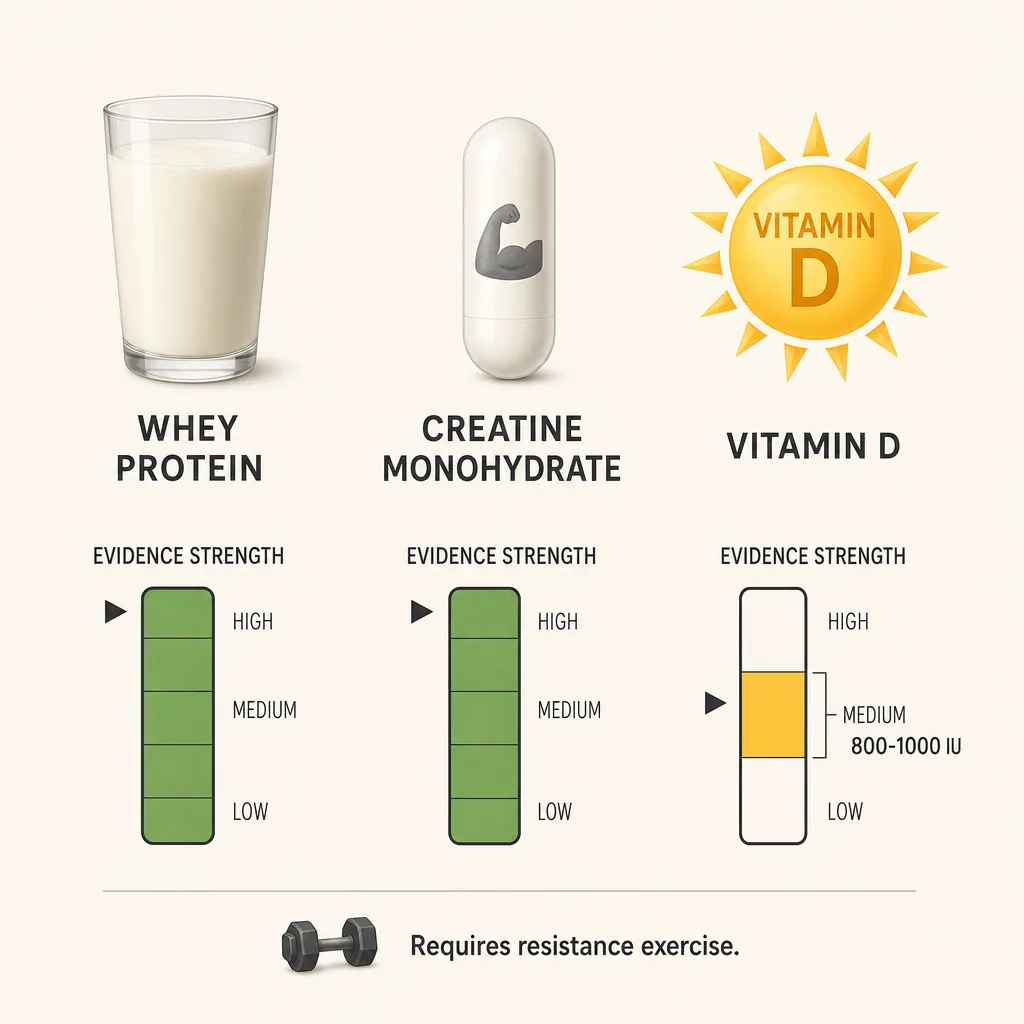
Protein, creatine monohydrate, and vitamin D have the strongest support among common supplements for older adults, but they are not interchangeable.
| Supplement | Best-supported role | What it does not prove |
|---|---|---|
| Protein, especially whey with enough leucine | Helps older adults reach higher daily protein needs and stimulate muscle protein synthesis | Protein alone has not reliably shown strength gains without resistance exercise |
| Creatine monohydrate | Can add to lean mass and strength gains when paired with resistance training | It is not appropriate to start casually in older adults with kidney disease or impaired kidney function |
| Vitamin D | May help fall-risk reduction in a narrow 800-1,000 IU/day range, especially when deficiency or risk is relevant | Higher doses are not automatically better, and fall-prevention evidence is mixed |
| Omega-3s, HMB, combination products | Promising in selected studies or sarcopenic groups | Not first-line replacements for protein adequacy, training, and medical assessment |
A useful supplement plan starts with the outcome. If the goal is to rise from a chair with less help, walk faster, regain leg strength, or lower fall risk, the evidence has to be read differently than if the goal is only to improve a blood marker.
Why protein is necessary but not enough
Protein is the least exotic option and often the most neglected one. Harvard Health cites a study of about 12,000 adults showing that roughly 46% of adults 51 and older did not meet even the standard 0.8 g/kg/day recommended dietary allowance.[1] That lower RDA was not designed as an optimal muscle-building target for an older adult already losing strength.
Many aging-muscle recommendations now discuss a higher range: about 1.2 to 2.2 g/kg/day for older adults, depending on health status, activity, and clinical context.[1] The reason is anabolic resistance. Older muscle does not respond to the same protein dose as strongly as younger muscle, so a small breakfast, a skipped lunch, and a large but low-protein dinner can leave the body under-supplied for much of the day.
Leucine is one reason whey protein gets so much attention. A meal generally needs about 2.5 to 3 g of leucine to trigger muscle protein synthesis, and whey naturally contains about 10% to 11% leucine by weight.[1] That does not make plant proteins useless. It does mean that smaller, lower-leucine servings may not produce the same signal unless the total protein amount or amino-acid profile is adjusted.
The uncomfortable part is that a stronger muscle-building signal is not the same thing as stronger legs. In a 2026 Tufts randomized trial of 141 adults ages 65 and older, whey protein supplementation increased IGF-1, a hormone involved in muscle building, but did not improve muscle strength when used without resistance exercise.[2] That trial should not be stretched into “protein does nothing.” It does show why a label claim about muscle repair should not be treated as proof that a person will stand, walk, or climb better.
What protein can reasonably do
- Help close a real intake gap when appetite, chewing problems, illness, or meal fatigue make full meals difficult.
- Make each meal more likely to reach a muscle-protein-synthesis threshold, especially when whey or leucine-rich foods are used.
- Support the response to resistance exercise rather than replace it.
- Provide a practical bridge on days when cooking a protein-rich meal is not realistic.
For a caregiver, the first protein question is not which tub looks most clinical. It is whether breakfast, lunch, and dinner actually contain enough high-quality protein to matter. If they do not, supplementation may be useful. If they already do, adding more powder may only add cost, fullness, or digestive annoyance.
Creatine is not just a gym supplement
Creatine monohydrate has a different job from protein. Protein supplies building blocks. Creatine helps muscles recycle energy during short, repeated efforts: standing from a chair, climbing a few steps, doing a set of leg presses, or pushing through a resistance-band session. That is why the evidence is strongest when creatine is paired with resistance training rather than taken as a stand-alone strength substitute.
In adults 50 and older, creatine plus resistance training has been associated with about 3 pounds of additional lean mass and improvements in measures such as leg press strength, gait speed, and chair-rise performance.[3] Those are the kinds of outcomes that matter at home. A small gain in chair-rise ability can change who needs help getting off the toilet at night or who avoids the low couch in the living room.
The usual dose discussed for older adults is simple: 3 to 5 g/day of creatine monohydrate.[3] The Mayo Clinic describes that range as safe for healthy older adults with normal kidney function.[3] The last clause is not filler. Older adults with kidney disease, reduced kidney function, or uncertain kidney labs should not start creatine without clinician guidance.
There is also emerging interest in creatine beyond muscle, including reaction time and mental fatigue, but those findings should not pull the decision away from the better-supported use: helping older adults get more out of strength training.[3] For most families, the practical decision is whether the person can safely do some form of progressive resistance work and whether kidney function makes creatine a reasonable add-on.
Vitamin D helps only within a narrower lane
Vitamin D is where supplement advice most often gets too confident. It is connected to muscle function, bone health, and falls, so it feels like an obvious answer. The dose and the person’s baseline status matter more than that simple story suggests.
A 2024 BMC Geriatrics network meta-analysis of 35 randomized controlled trials with 58,937 participants found that vitamin D in the 800 to 1,000 IU/day range was associated with a 15% to 22% reduction in fall risk.[4] The same analysis reported that doses above 1,000 IU/day were associated with increased fall risk.[4] That is a useful warning against the common “more must be better” instinct.
At the same time, vitamin D for fall prevention remains contested. A 2024 USPSTF draft conclusion found no net benefit from vitamin D supplementation for fall prevention. Read together, the safest conclusion is modest: vitamin D may be worth discussing when deficiency, bone health, low intake, limited sun exposure, or fall risk is part of the picture, but it should not be treated as a general high-dose fall-prevention shortcut.
For families, this is one of the places where individualized medical context matters. A vitamin D blood level, medication list, calcium intake, kidney stone history, osteoporosis risk, and fall history can change the decision. The answer is not to ignore vitamin D; it is to keep the dose disciplined and tie the reason for taking it to a real risk, not a vague anti-aging promise.
Resistance exercise is the condition that makes the evidence matter
No supplement reverses sarcopenia by letting the muscle stay idle. The muscle has to receive a reason to adapt. That reason can be formal strength training, supervised physical therapy, machines at a senior center, resistance bands, repeated sit-to-stands, step-ups, or carefully progressed body-weight work. The format matters less than whether the effort is safe, repeated, and gradually challenging.
This is also where dismissive advice fails. “Just exercise” does not help much when an older adult has knee pain, fear of falling, low appetite, poor sleep, neuropathy, or early frailty. The more useful sequence is to make exercise possible: enough protein to recover, enough supervision to feel safe, enough resistance to stimulate adaptation, and enough consistency to see whether function changes.
For someone who cannot lift heavy weights, lower-load resistance methods may still be relevant. The key is not chasing a gym ideal; it is finding a strength stimulus the person will actually repeat. Families comparing options can also look at approaches such as blood flow restriction training for seniors when standard resistance training is limited by pain or weakness.
What about omega-3s, HMB, and combination supplements?
Omega-3s and HMB appear often in muscle-loss marketing, and they are not fantasy ingredients. The better answer is that they are still secondary. Human clinical studies suggest promise in some settings, but the evidence is not strong enough to put them ahead of protein adequacy, resistance exercise, creatine when appropriate, and careful vitamin D use.[5]
Combination products deserve a slightly different reading. Supplements combining whey protein, leucine, and vitamin D have shown some of the strongest evidence for improving lean mass and function in sarcopenic older adults.[5] That makes biological sense: the product is trying to solve more than one bottleneck at once. It also makes the label harder to judge, because the benefit may come from the combination, the population studied, the exercise context, or the correction of a deficiency rather than from every ingredient being independently powerful.
A combination product is not automatically better than a simple plan. If it hides low protein per serving behind a long ingredient list, uses high-dose vitamin D without a clear reason, or costs enough to displace real food and physical therapy, it is solving the wrong problem.
A practical way to judge a supplement claim
- Ask what outcome improved: lean mass, strength, gait speed, chair-rise time, falls, or only a lab marker.
- Check whether the study involved older adults, not only young athletes.
- Look for resistance training in the study design; many benefits depend on it.
- Keep doses specific: protein based on body weight and meal pattern, creatine usually 3 to 5 g/day, vitamin D generally not pushed above the sensible range without a medical reason.
- Treat kidney disease, impaired kidney function, recurrent falls, major weight loss, and suspected deficiency as reasons for individualized assessment.
If the main problem is poor appetite and low protein intake, start with meals and protein. If the person is doing resistance training and has normal kidney function, creatine may be a reasonable add-on. If vitamin D is low or fall risk is being reviewed, discuss a disciplined dose rather than assuming a higher dose is safer. If falls, gait changes, weak grip, or balance problems are appearing alongside memory or neurologic symptoms, muscle supplements should not delay a broader fall-risk evaluation.
The most caregiver-useful answer is conditional, not cynical. Supplements can support aging muscle repair and strength in seniors when they address a real gap and are paired with strength work. Protein helps supply and signal. Creatine can help training produce more usable strength. Vitamin D may help in the right range and context. None of them replaces the repeated practice of asking the legs to work.
References
- Muscle loss and protein needs in older adults — Harvard Health
- In Older Adults, Adding Whey Protein Doesn't Make More Muscle — Tufts Now, May 2026
- Creatine Beyond the Gym: What Older Adults Should Know — Mayo Clinic Store
- Effect of vitamin D, calcium, or combined supplementation on fall prevention: a systematic review and updated network meta-analysis — BMC Geriatrics, 2024
- The Effects of Protein and Supplements on Sarcopenia in Human Clinical Studies — PMC / J Microbiol Biotechnol
Browse more in the Glossary.