
Clinical term
Do aging muscles turn to fat? What really happens
Last verified 2026-08-04
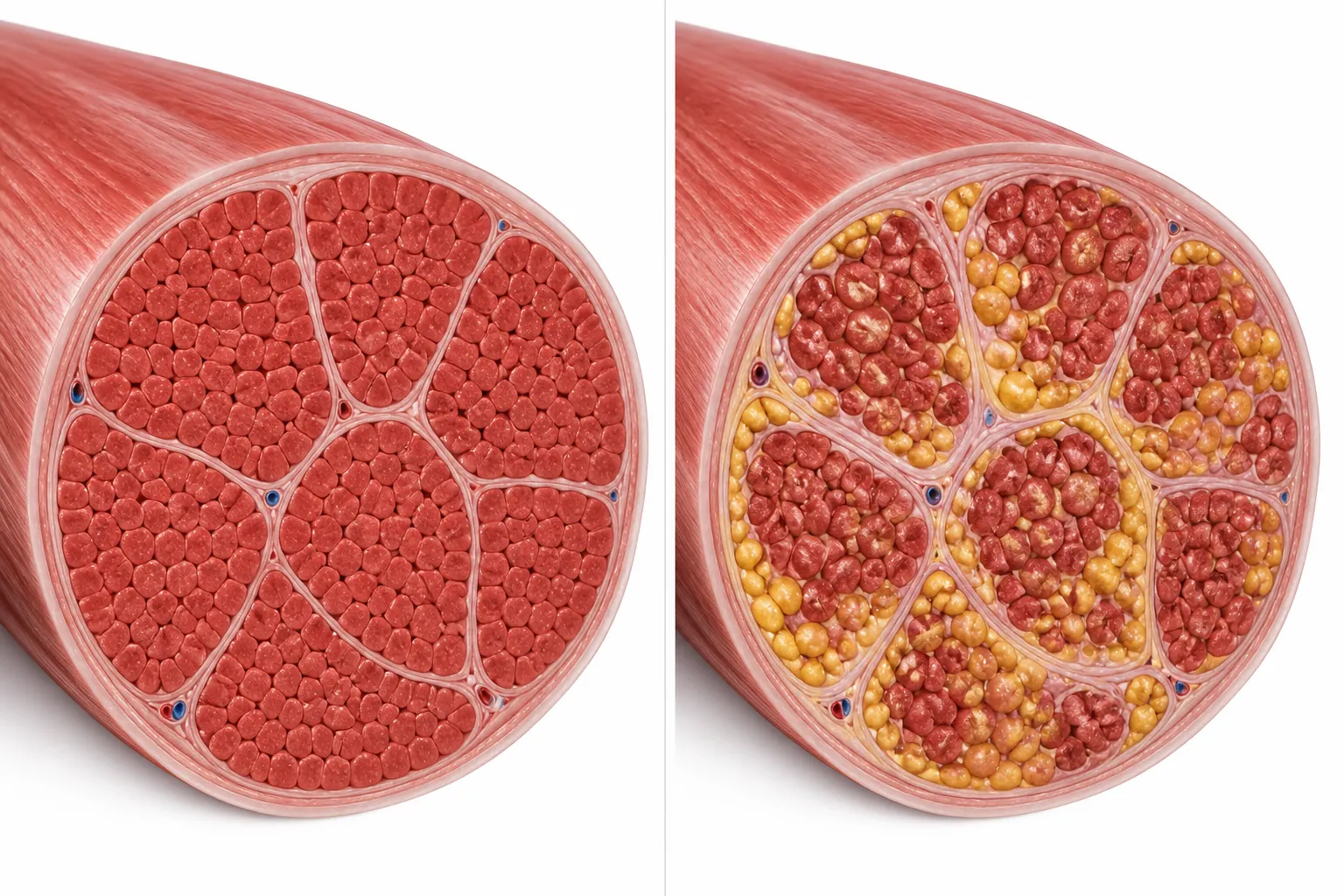
Aging muscles do not literally turn into fat. Muscle cells and fat cells are different tissues; one does not convert into the other. The phrase “muscle turns to fat” usually describes something real, but the real change is different: older muscles can lose fiber size and number, while fat begins to collect inside and between the remaining muscle fibers. That fatty infiltration is called myosteatosis, and it helps explain why an arm or thigh may look softer, feel weaker, or tire sooner even when the scale has not changed much.[1][2]
That distinction matters because the problem is not just appearance. A softer leg can mean less useful force for standing up from a chair. A smaller calf or thigh can mean less reserve when stepping over a threshold, catching a toe on a rug, or recovering from a sideways stumble. The question is not only why aging muscles seem to turn to fat, but what that change does to strength, walking, balance, and fall risk.
What is really happening inside aging muscle
Healthy skeletal muscle is not just bulk. It is working tissue that contracts, steadies joints, helps control movement, and responds to daily use. With aging, illness, inactivity, or a combination of those pressures, some muscle fibers shrink and some muscle tissue is lost. At the same time, fat can accumulate within the muscle structure itself. Researchers describe this as fat appearing between muscle fibers and within muscle cells, rather than muscle tissue changing identity.[1][2]
That is why two people can have the same-looking thigh size but different strength. One thigh may contain more contractile muscle tissue; another may contain less muscle and more fat infiltration. The outside measurement does not tell the whole story. Muscle quality — how much useful force the tissue can produce — becomes as important as muscle quantity.
Myosteatosis is especially important because it helps explain weakness that is not fully accounted for by muscle size alone. The 2024 review in Physiological Reports describes myosteatosis as a contributor to impaired skeletal muscle function in older adults, including poorer muscle quality and reduced physical performance.[1] A 2026 review likewise identifies fatty infiltration of skeletal muscle as an important feature of aging muscle and links it with declines in muscle function.[2]
For a family member watching day to day, this may show up long before anyone uses a medical term. An older adult may push harder on the chair arms to stand, pause at the kitchen counter before walking, or avoid stairs because the legs feel unreliable. Those are not cosmetic complaints. They are clues about whether the muscles are still doing their safety work.
Why the myth feels true when the scale barely moves
The “muscle turns to fat” idea persists because the visible pattern can be confusing. An older adult may notice thinner arms, less firm thighs, or a rounder middle while body weight looks familiar. From the outside, it can seem as if one tissue simply changed into another.
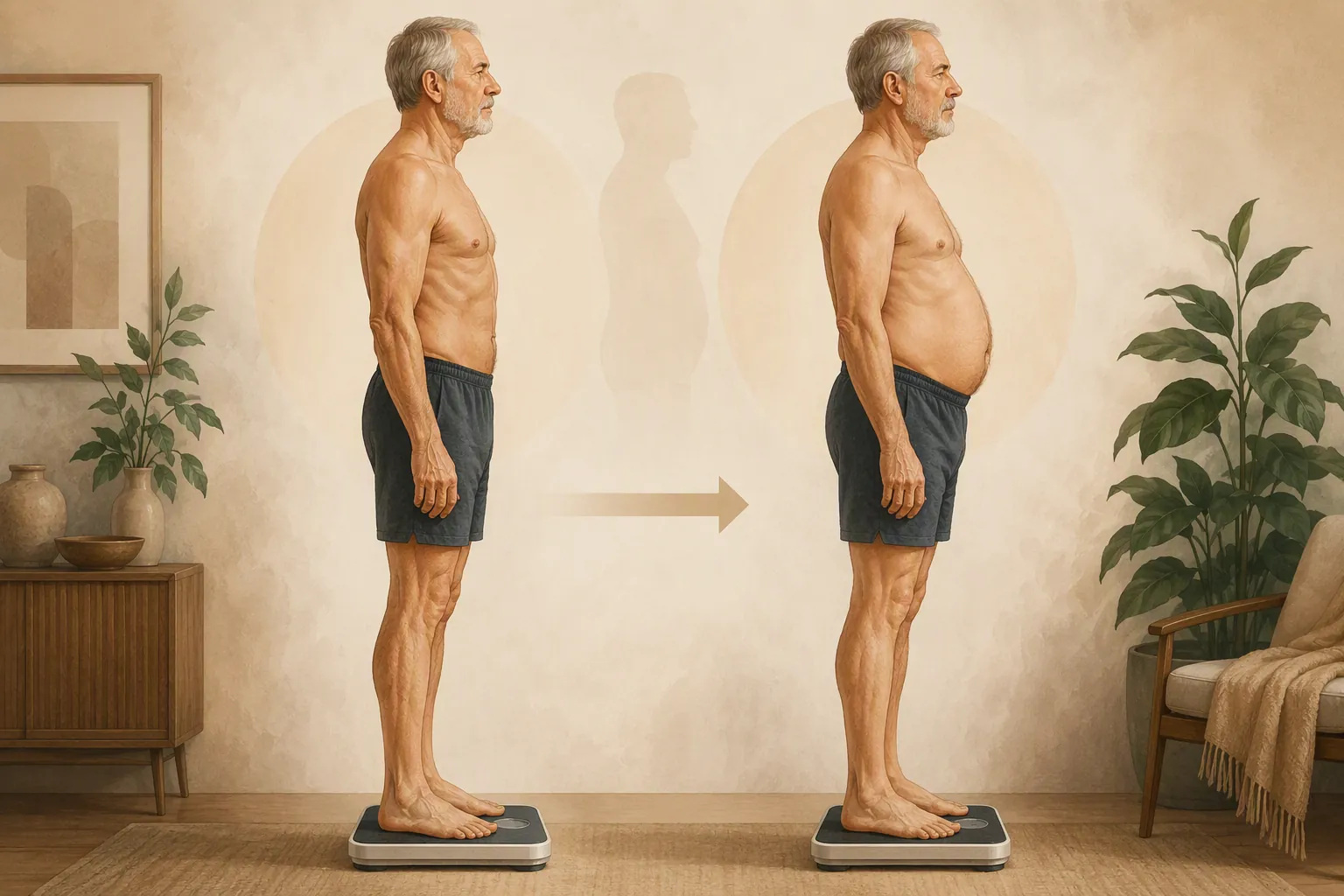
A steadier explanation is that several changes can happen at once:
- Muscle fibers may shrink or be lost, leaving less contractile tissue available for movement.
- Fat may infiltrate the remaining muscle, reducing muscle quality even when the limb does not look dramatically smaller.[1][2]
- Body fat may become more noticeable around the trunk, so the waist or midsection changes more than the scale suggests.
- Lower activity after pain, surgery, illness, fear of falling, or simple routine changes can speed the loss of strength.
Weight alone is a poor alarm bell for this process. A person can lose muscle and gain or redistribute fat without a dramatic change in total pounds. That is one reason a bathroom scale may reassure a family while the person’s walking, stair climbing, or chair rise is quietly getting harder.
The safety issue is muscle quality, not just softer-looking limbs
Fatty infiltration inside muscle is easy to miss because it is hidden. No one can see myosteatosis by glancing at a forearm across the dinner table. But its effects can appear in ordinary movements: slower walking, more effort rising from a low seat, shorter steps, less confidence turning, or needing a hand on the wall in a narrow hallway.
This is where the myth can become harmful. If everyone shrugs and says, “That’s just fat replacing muscle,” the family may treat the change as mysterious and irreversible. If they understand it as loss of muscle tissue plus poorer muscle quality, the next question becomes more useful: what can still be trained, supported, or protected?
The reviews on aging muscle describe fatty infiltration as more than a storage issue. It is associated with reduced skeletal muscle function, and that reduced function matters for physical performance in older adults.[1][2] In practical terms, a muscle with more fat infiltration may not generate force as effectively as healthier muscle tissue. The person may still have a leg that looks present and normal in clothing, but the leg may deliver less strength when the body suddenly needs it.
Falls often happen in that gap between ordinary movement and sudden demand. Standing up from a chair is ordinary until the knees buckle slightly. Walking to the bathroom is ordinary until a foot catches on a rug edge. Carrying a laundry basket is ordinary until the person has to turn quickly. Stronger, better-quality muscle gives the body more room to correct those small disruptions.
How to prevent or slow the change
Prevention starts with using the muscle and feeding the muscle. That does not mean every older adult needs a gym routine or a high-protein diet copied from someone else. It means the plan should match the mechanism: if muscle is shrinking and becoming fattier inside, the body needs repeated strength challenge and enough protein to support muscle maintenance.
Resistance training is the main movement lever
Walking is valuable, but walking alone may not be enough to rebuild strength in the hips, thighs, calves, back, and arms. Resistance training asks muscles to work against a load. The load can be body weight, resistance bands, hand weights, weight machines, or carefully chosen household movements. The important part is that the muscles are challenged repeatedly and progressively, within the person’s medical and balance limits.
For fall prevention, the most useful exercises are often the plainest ones: sit-to-stand practice, supported heel raises, step-ups, hip strengthening, rowing or pulling motions for the upper back, and supervised balance work. A person who cannot rise from a chair without pushing hard through both arms does not need a complicated program before that problem is addressed. They need a safe way to practice the exact strength they are losing.
A clinician, physical therapist, or qualified trainer can help decide where to begin, especially after a fall, joint replacement, heart event, neurological diagnosis, osteoporosis diagnosis, or long period of inactivity. The right starting point may be very gentle. What matters is not intensity on day one; it is finding a level the person can repeat safely and build from.
Protein adequacy supports the training signal
Muscle also needs raw material. Protein adequacy matters because resistance work sends a signal to maintain or build muscle, but the body still needs enough dietary protein to respond. For some older adults, the issue is not knowing protein matters; it is that appetite is lower, chewing is harder, cooking feels tiring, or meals have drifted toward toast, tea, soup, and snacks.
A practical first look is meal pattern, not a perfect calculation. Does breakfast contain a meaningful protein food, or only coffee and toast? Does lunch include eggs, yogurt, fish, poultry, beans, tofu, cottage cheese, or another protein source the person will actually eat? Is dinner substantial enough, or does fatigue make it the weakest meal of the day? These questions are often more useful at home than debating supplements immediately.
Protein changes should still be individualized. People with kidney disease, swallowing problems, major digestive issues, unintended weight loss, diabetes, or complex medication schedules should ask their clinician or dietitian what is appropriate. The goal is to support muscle, not to create a new health problem by following generic advice.
Watch function more closely than weight
The scale can still be useful, especially when weight changes quickly or unintentionally. But for aging muscle, families should also watch function. Can the person stand from a dining chair without rocking several times? Can they walk across a room at a steady pace? Are they avoiding stairs they used to manage? Do they reach for furniture more often? Have they stopped carrying groceries, gardening, or going out because the legs feel uncertain?
Those observations deserve attention even if weight is stable. They are the signs that muscle change is affecting daily safety.
When to bring it up with a clinician
A gradual change in firmness or shape can be common with aging, but sudden weakness, rapid muscle loss, new trouble walking, repeated falls, unexplained weight loss, pain, numbness, or one-sided weakness should be discussed promptly with a health professional. Those changes may involve more than normal aging muscle.
For slower changes, the most useful appointment notes are concrete: how many times the person has fallen or nearly fallen, whether they can stand from a chair without using their hands, how far they can walk before stopping, what activities they have given up, and what they typically eat in a day. That information gives the clinician more to work with than “my legs look different.”
The clear answer is this: aging muscle does not turn into fat. Aging can make muscle smaller and fattier inside, and that can reduce strength, slow movement, and make falls more likely. The hopeful part is equally practical. This decline is common, but it is not simply inevitable. Strengthening work and adequate protein can help slow or improve it when they are matched to the person’s health status and done consistently.
References
- The effects of myosteatosis on skeletal muscle function in older adults, Physiological Reports, 2024.
- The important role of fatty infiltration of skeletal muscle in aging, PubMed, 2026.
Browse more in the Glossary.