
Clinical term
ALS Signs in Elderly That Are Not Normal Aging
Last verified 2026-07-27
The worry usually starts in a small, ordinary moment: an older parent catches a toe on the hallway rug again, drops a coffee mug from the same hand twice in one week, starts slurring certain words, or seems to be favoring one side of the body. Someone says, “He’s just getting older.” Someone else says, “Let’s not make a big thing of it.” And often, that is reasonable. Most weakness in older adults is not ALS.
But ALS signs and symptoms in an elderly parent are worth asking about carefully when the pattern is painless, progressive, more obvious on one side than the other, and not accompanied by numbness. The American Medical Association’s interview with ALS specialists describes this as a key distinction: ALS weakness is typically painless and progressive, and if numbness or pain is present in the same area, that points away from ALS and toward another cause that still deserves evaluation.[1]

That distinction matters because ALS can be missed in older adults. In one late-onset ALS study, 51% of cases were diagnosed after age 70, and the authors noted that ALS is often not considered in elderly people.[2] At the same time, ALS remains rare: the CDC National ALS Registry estimates that about 35,000 people in the United States are living with ALS, with most people diagnosed between ages 55 and 75.[3] So the goal is not to turn every stumble into an emergency. It is to stop putting a persistent one-sided change into the vague box labeled “aging” when it needs a clinician’s eyes.
The Pattern That Is Less Like Normal Aging
Normal age-related muscle loss, often called sarcopenia, tends to be gradual. It usually shows up as reduced strength and endurance on both sides of the body rather than one hand, one foot, or one side suddenly falling behind. A parent may rise more slowly from a chair, need more effort on stairs, or tire sooner during errands. Those changes can still affect safety and independence, but they usually do not announce themselves as one ankle failing to lift or one hand losing function while the other remains normal.
ALS weakness has a different feel to it at the family-observation level. It may begin in one limb, progress over weeks to months, and come with muscle twitching or cramps. Cleveland Clinic describes ALS as a progressive disease involving muscle weakness, twitching, and cramping, while NINDS notes that symptoms often begin in a hand, foot, arm, or leg before spreading.[4][5]
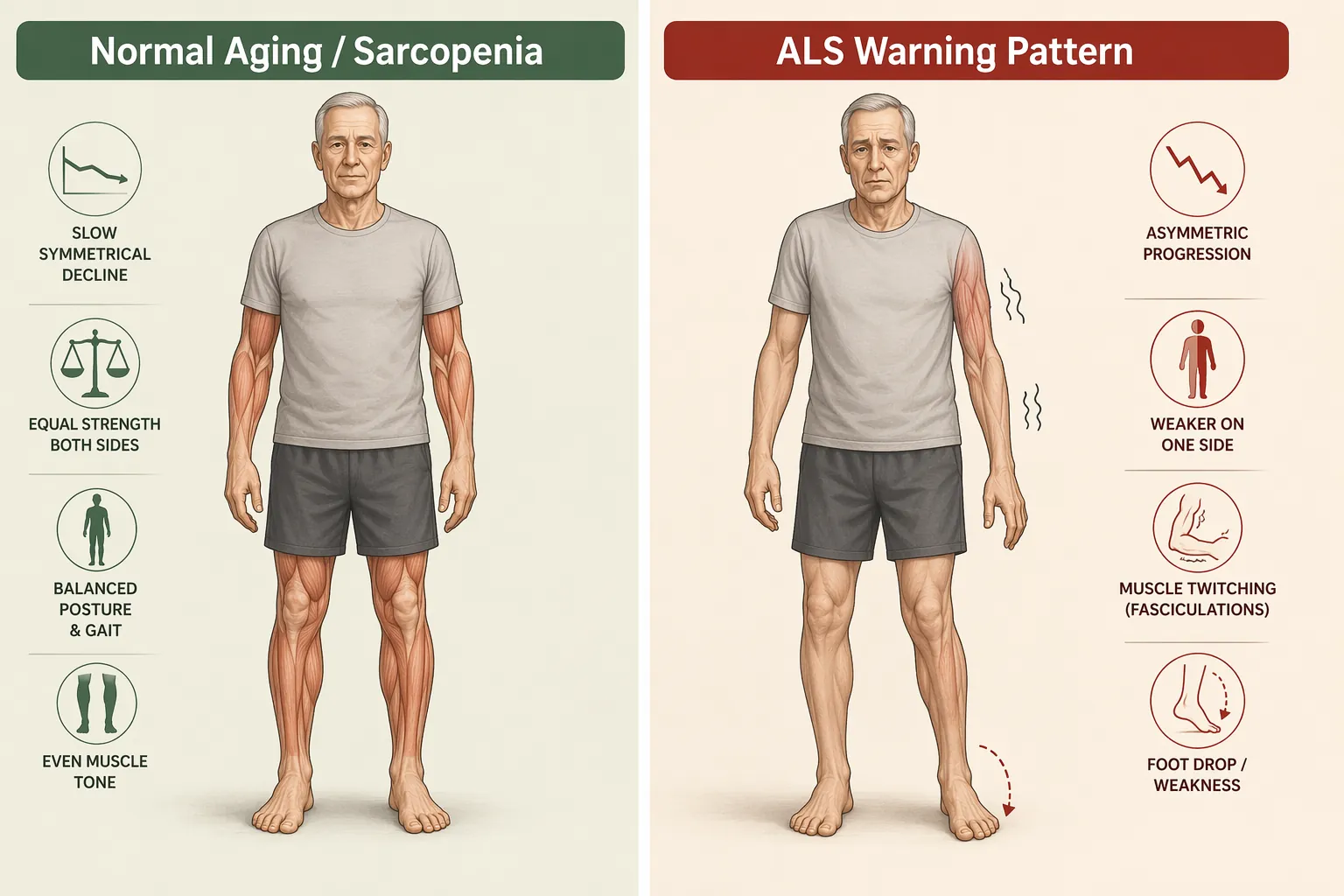
| What you notice | More consistent with routine aging or common causes | More concerning for an ALS-like pattern |
|---|---|---|
| Strength change | Slow loss of strength on both sides | Weakness that starts or remains worse on one side |
| Pain | Painful joints, sore knees, hip pain, back pain, or pain-limited movement | Painless weakness that keeps progressing |
| Sensation | Numbness, tingling, burning, or “pins and needles” suggesting another nerve problem | Weakness without numbness in the same area |
| Walking | General slowness, cautious steps, reduced stamina | Toe catching, foot slapping, or foot drop from weak ankle lifting |
| Hands | Both hands weaker with age or arthritis pain | One hand dropping objects, losing grip, or struggling with buttons |
| Muscle activity | General deconditioning without visible twitching | Twitching or cramps along with progressive weakness |
| Time course | Very gradual change over years | Measurable decline over weeks to months |
The table is not a home diagnostic tool. It is a way to keep the family conversation honest. “Mom is weaker” is too broad. “Mom’s right foot has started catching, she does not have numbness, and it has worsened since spring” is information a clinician can use.
Foot Drop Is Not Just Clumsiness
Foot drop deserves special attention because it can look deceptively ordinary. An older adult starts tripping over flat flooring, scuffing one shoe, catching the toe on thresholds, or lifting the knee higher to clear the foot. The issue is not carelessness. The ankle is not lifting the front of the foot well enough during walking.
Mayo Clinic lists tripping and falling, weakness in the legs or feet, and trouble walking as possible ALS symptoms.[6] The AMA interview also describes foot drop as an early sign: the foot catches because the muscles that lift it are weak.[1] In an older home, that one mechanical change can turn a loose rug, a doorway threshold, or a dim hallway into a fall risk before anyone has a diagnosis.
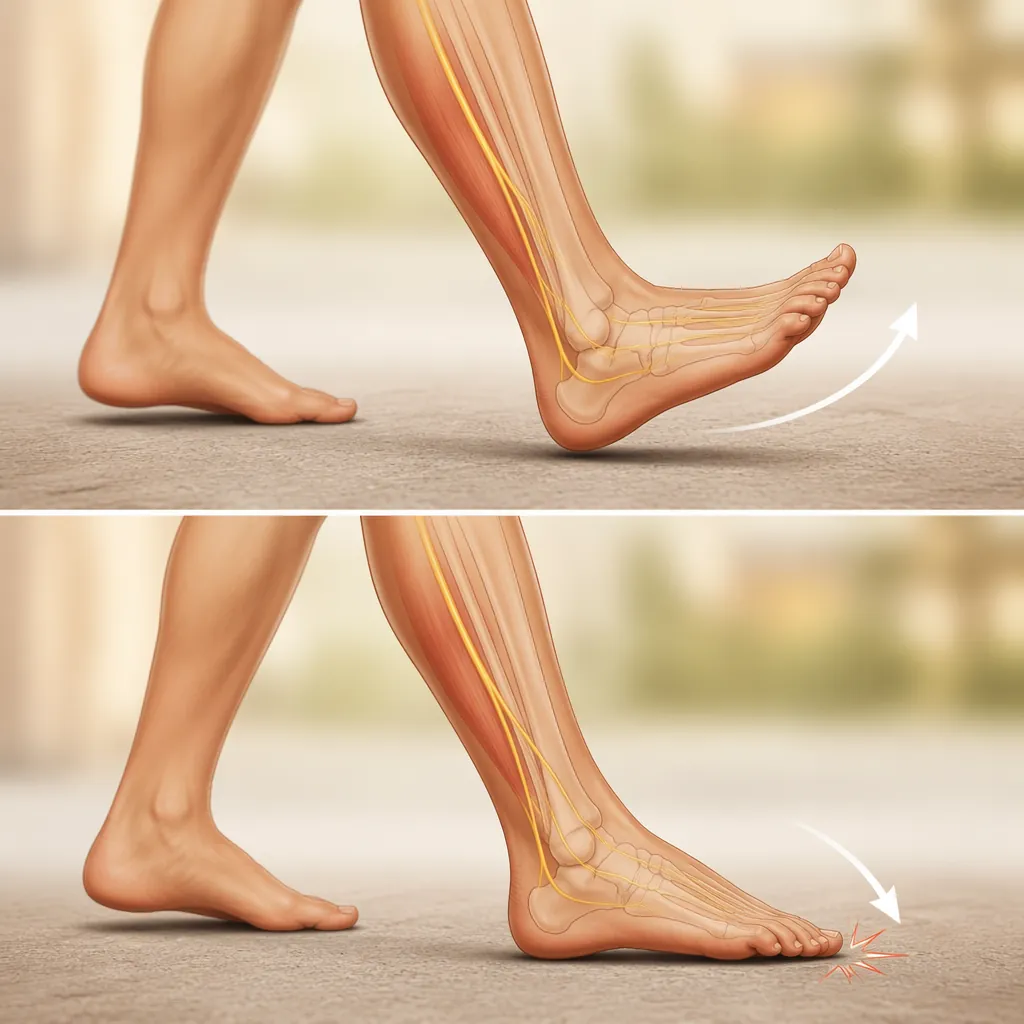
There are many causes of foot drop besides ALS, including other nerve or spine problems. That is exactly why it should be evaluated rather than explained away. While the appointment is being arranged, the practical work is immediate: clear walking paths, remove loose rugs, improve lighting, watch thresholds, and consider whether a cane, walker, or foot-drop brace should be discussed with a clinician or physical therapist.
Hand Weakness, Twitching, Cramps, and Speech Changes
ALS can also begin in the hands. A parent may struggle with keys, buttons, utensils, handwriting, or opening jars. Again, the detail that matters is the pattern. Arthritis often announces itself with pain, stiffness, swelling, or joint limitation. ALS-type weakness is more suspicious when one hand simply stops doing its job well, without pain or numbness explaining the change.
Muscle twitching, called fasciculations, can be frightening to notice, but twitching alone does not mean ALS. People can have benign twitching for many reasons. Twitching becomes more concerning when it appears with progressive weakness, cramps, and loss of function. NINDS includes muscle cramps and twitching among ALS symptoms, along with weakness that may start in a limb and gradually spread.[5]
Speech and swallowing changes should also be taken seriously, especially when they persist or progress. Mayo Clinic lists trouble speaking, trouble swallowing, and slurred speech among ALS symptoms.[6] In real family life, this may sound like a parent mumbling more, tiring while talking, coughing during meals, avoiding certain foods, or being harder to understand on the phone. Those changes have many possible explanations, but they are not changes to monitor casually for months without medical input.
What Points Away From ALS
Some symptoms make ALS less likely, even though they may still need care. Numbness, tingling, burning, or loss of sensation in the same area as the weakness points toward other nerve problems rather than ALS. Pain in the joint or limb that limits movement also points away from ALS as the primary explanation, because ALS weakness is characteristically painless.[1]
Deconditioning can be powerful in older adults. A hospitalization, infection, grief period, medication change, or months of reduced activity can leave someone weaker and less steady. Sarcopenia can make standing from a chair, carrying groceries, and climbing stairs harder. Arthritis can change gait because the person is avoiding pain. Neuropathy can make the feet feel numb or unreliable. These are not “nothing.” They are just different patterns, and many are treatable or manageable once named.
- More like sarcopenia: both legs weaker over a long period, slower walking, lower stamina, no clear one-sided failure.
- More like arthritis: pain, stiffness, swelling, or limited joint movement drives the change.
- More like neuropathy: numbness, tingling, burning, or reduced sensation affects walking or grip.
- More concerning for neurology review: painless weakness, one-sided onset, foot drop, twitching or cramps with weakness, or speech and swallowing changes.
When to Call the Doctor, and When to Ask About Neurology
Start with the primary care clinician if the change is new, progressive, or affecting safety. Bring observations, not a self-diagnosis. It helps to write down when the change began, which side is affected, whether pain or numbness is present, whether falls or near-falls have happened, and what daily tasks have changed.
Ask specifically whether a neurology referral is appropriate when weakness is painless, asymmetric, and worsening; when one foot is repeatedly catching; when one hand is losing function without pain or numbness; when twitching or cramps accompany weakness; or when speech or swallowing changes are progressing. A neurologist can examine strength, reflexes, sensation, coordination, and related signs in a way a family cannot reproduce at home.
If there are sudden stroke-like symptoms, severe new confusion, sudden facial droop, sudden inability to speak, sudden one-sided paralysis, chest pain, or trouble breathing, that is emergency care, not a routine referral question. ALS is typically progressive rather than sudden, so abrupt changes need urgent evaluation for other causes.
Why Earlier Evaluation Still Matters
There is no cure for ALS, but earlier evaluation can still change care. NINDS notes that riluzole can help slow disease progression, and multidisciplinary care can support breathing, nutrition, mobility, communication, and quality of life.[5] Cleveland Clinic reports that about 30% of people with ALS live five years or more after diagnosis, and 10% to 20% live 10 years or more.[4] Those years are not abstract when a family needs time to plan safer walking routes, bathing support, mobility equipment, communication help, and caregiver backup.
One contextual note is worth keeping in mind: veterans have a higher risk of ALS than the general population, according to the CDC National ALS Registry.[3] That does not mean a veteran with weakness has ALS. It means the detail belongs in the medical history rather than being left out of the conversation.
What to Do While You Are Waiting for Answers
Families often feel stuck between two bad choices: panic or dismiss it. There is a steadier middle. Document the pattern for two to four weeks if the situation is not urgent, or sooner if falls, swallowing problems, or rapid decline are present. Use simple notes: “right toe caught on kitchen threshold twice,” “dropped fork from right hand,” “speech harder to understand in evening,” “no numbness,” “knee pain present,” or “left foot feels tingling.”
At the same time, reduce fall hazards now. Do not wait for a diagnosis to remove loose rugs, add night lights, check footwear, clear cords, install grab bars where needed, or ask about a mobility aid. If foot drop is suspected, a clinician or physical therapist can advise whether bracing or gait support is appropriate.
Most weakness in older adults is not ALS. But painless, progressive, one-sided weakness; repeated toe-catching or foot drop; twitching and cramps without numbness; and measurable decline over weeks to months should not be filed under “just aging.” Write down what is changing, make the home safer today, and ask a clinician whether neurology should be involved.
References
- What doctors wish patients knew about ALS, American Medical Association.
- ALS in the elderly: A population-based study on clinical presentation, prognosis and genetic implications, PubMed, 2018.
- About Amyotrophic Lateral Sclerosis (ALS), CDC National ALS Registry.
- Amyotrophic Lateral Sclerosis (ALS), Cleveland Clinic.
- Amyotrophic Lateral Sclerosis (ALS), National Institute of Neurological Disorders and Stroke.
- Amyotrophic lateral sclerosis (ALS) - Symptoms and causes, Mayo Clinic.
Browse more in the Glossary.