
Clinical term
12 Warning Signs Your Elderly Loved One Is Animal Hoarding
Last verified 2026-07-25
At the doorway, the question is not whether your mother, father, aunt, or neighbor has “too many” pets. Some older adults live safely with several animals: the floors are clean enough to walk on, the animals have food and water, veterinary problems are being handled, and the person can still bathe, eat, sleep, and move through the home.
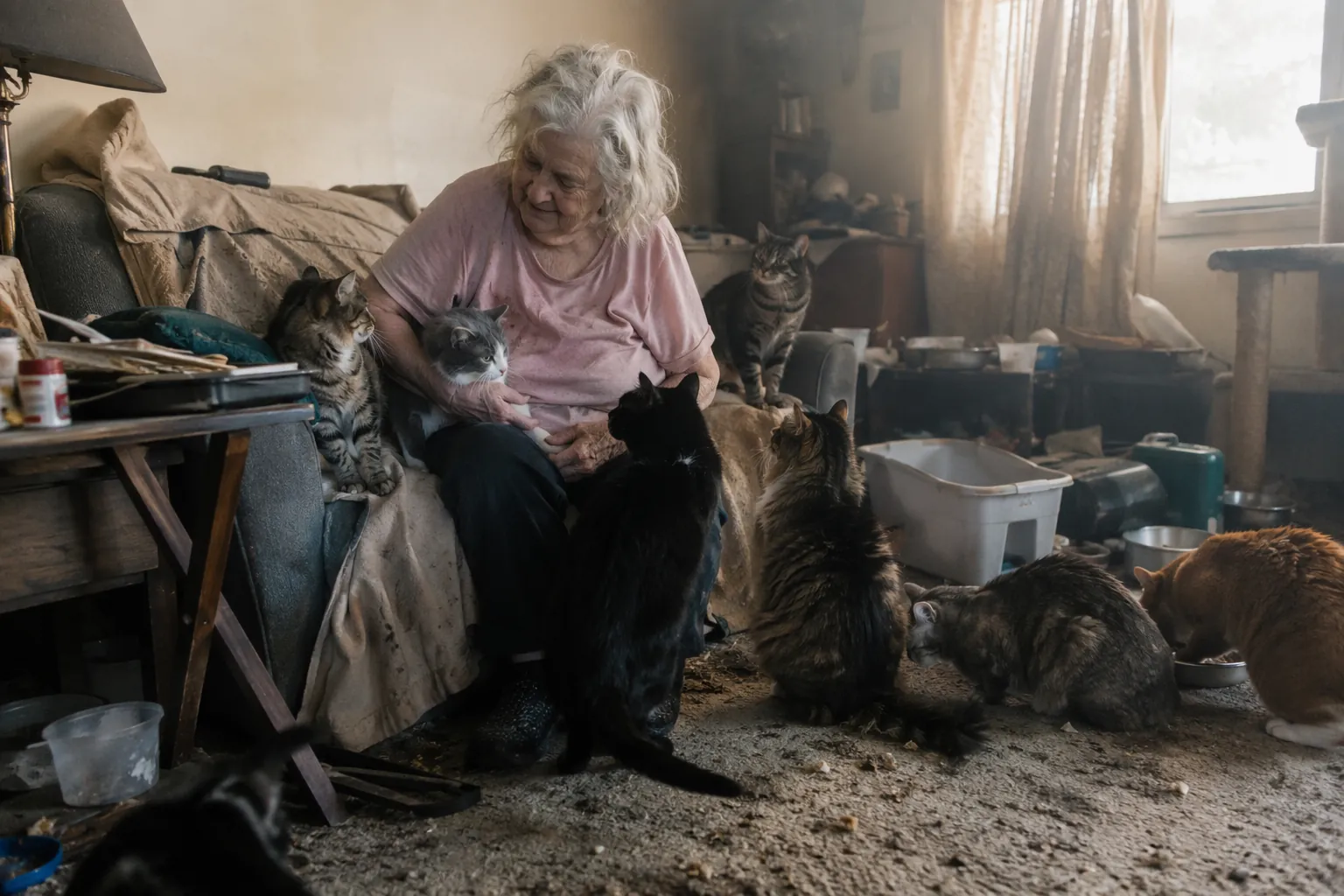
Animal hoarding starts to look different. You notice the smell before anyone explains it away. You step around waste, stacked supplies, or blocked doors. The person insists every animal is fine while one is limping, coughing, thin, matted, or hiding. The house tells a different story than the owner does.
Use a simple threshold: if you see three or more warning signs, especially across more than one category, stop treating it as a private family disagreement. Document what you observe, verify the local reporting contacts for Adult Protective Services and animal control, and make the call. You do not have to prove a diagnosis before asking professionals to check safety.
First, Separate Many Pets From Hoarding
The cleanest line comes from the Hoarding of Animals Research Consortium criteria: animal hoarding involves accumulating more animals than can be cared for, failing to provide minimum nutrition, sanitation, or veterinary care, and denying that inability despite evidence. That three-part gate matters because it protects competent multi-pet households from being mislabeled, while making unsafe homes harder to excuse as a lifestyle choice.[1]
In older adults, this pattern is not rare enough to dismiss as an odd family story. A systematic review found that more than 70% of identified animal hoarders were women aged 55 or older, and roughly half were 55 or older overall. The same review cautioned that prevalence estimates vary and likely undercount cases that never reach authorities, so the numbers should be read as a signal, not a complete census.[2]
The 12 Warning Signs to Count
Do not count only animals. Count conditions. The strongest pattern usually crosses three areas: the home environment, the animals’ condition, and the older adult’s own care or behavior.
| Category | What to Look For | Why It Matters |
|---|---|---|
| Home environment | Odor, waste, blocked movement, fire hazards | Shows whether the home can still support safe daily living |
| Animal condition | Illness, injuries, crowding, lack of food or water, dead animals | Shows whether minimum care is failing |
| Personal or behavioral signs | Denial, isolation, self-neglect, refusal of help | Shows whether the older adult can recognize and correct the danger |
Home Environment Signs
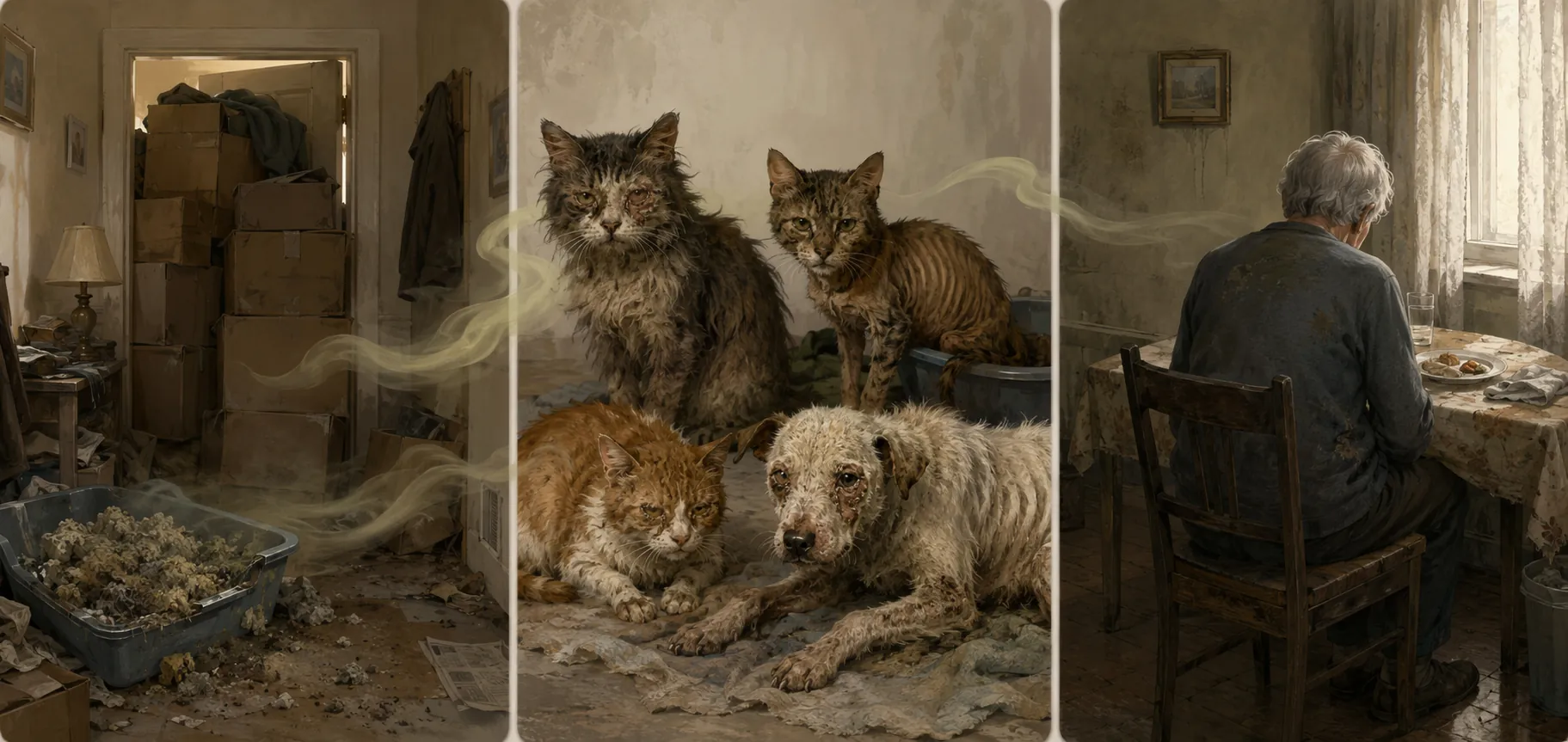
- Strong ammonia or waste odor. A sharp urine smell that burns the nose, makes your eyes water, causes coughing, or leaves you dizzy is not just unpleasant. Animal-hoarding homes can reach ammonia levels reported as high as 152 ppm, far above a 25 ppm safety threshold cited in animal-hoarding materials. For an older adult, dizziness and breathing irritation can turn an already unsafe home into a fall and respiratory risk.[3]
- Unsanitary floors, furniture, bedding, or food areas. Look for feces, urine, old vomit, stained bedding, insect activity, spoiled food, or litter boxes that are no longer being emptied. ASPCA materials report that 93% of animal-hoarding residences have unsanitary interiors, which is why this sign carries so much weight.[4]
- Blocked pathways, exits, vents, or stairs. A narrow trail from chair to bathroom may look manageable to someone who lives there every day, but it is a fall route. Bags of food, cages, newspapers, boxes, carriers, and waste can block exits or heaters. ASPCA materials report defined fire hazards in 70% of animal-hoarding residences, and 16% are later condemned.[4]
- Rooms or appliances no longer usable for normal living. The kitchen may be too dirty to prepare food, the bathtub may be used for animal supplies, a bedroom may be closed off because of waste, or the washer may no longer function under the load of soiled blankets. The practical question is whether the person can still cook, bathe, sleep, and move safely.
Animal Condition Signs
- Animals appear sick, injured, thin, matted, or untreated. You are not diagnosing the animal. You are noticing visible problems: open sores, limping, coughing, eye discharge, hair loss, severe matting, extreme thinness, or animals too weak to move normally. A systematic review found diseased, dying, or dead animals present in 80% of animal-hoarding cases.[2]
- Food and water are missing, dirty, or impossible to monitor. Empty bowls, green or slimy water, torn-open bags, animals fighting over food, or a senior who cannot say which animals have eaten today all point to care failure. This is where a large number of animals becomes different from an organized rescue or foster home.
- Animals are reproducing or arriving faster than care improves. Litters appear, new animals keep coming in, or the owner says they are “just keeping them until homes are found,” but no animals leave and no vet plan exists. The household is no longer stabilizing; it is expanding past the person’s capacity.
- Dead animals are present or death is minimized. A dead animal in a cage, freezer, carrier, closet, yard, or room is an emergency-level warning sign. It also changes the conversation: this is no longer about whether someone loves animals. It is about whether living beings are dying without care.
Personal and Behavioral Signs
- The older adult denies obvious conditions. They may say the smell is normal, the animals are fine, the mess happened only today, or no one else understands. Denial is part of the HARC threshold when it persists despite visible evidence of failed care.[1]
- Personal hygiene, nutrition, or medical care is slipping. Notice unwashed clothing, body odor, missed medications, untreated wounds, weight loss, dehydration, spoiled food, or a person who feeds animals before eating themselves. Fairfax County’s older-adult guidance lists poor nutrition, unkempt appearance, and untreated medical issues among signs that may accompany animal hoarding; broader elder-abuse research identifies self-neglect as the most common form reported to Adult Protective Services.[5][6]
- The person becomes secretive, isolated, or hostile to visits. They may stop letting family past the doorway, cancel repairs, refuse home health visits, or move conversations outside. Shame, fear of losing animals, depression, and cognitive decline can all sit underneath this behavior, but the effect is the same: no one can verify safety.
- They keep acquiring animals after complaints, illness, falls, or warnings. A fall over supplies, a neighbor complaint, a vet warning, or a family cleanup should change behavior. If the number of animals keeps rising afterward, the person may not be able to use consequences to self-correct.
Why the Same Signs Are More Dangerous for an Older Adult
The danger is not only the number of cats, dogs, birds, rabbits, or other animals. It is the way animal care failure stacks on top of aging: weaker balance, slower reaction time, respiratory disease, poor vision, medication side effects, memory loss, and reduced ability to clean or repair the home.
Ammonia odor is a good example. A younger visitor may leave with a headache. An older adult who already has COPD, asthma, heart disease, dizziness, or poor balance may be living in that air every day. If the smell makes someone lightheaded, the next problem may be a fall on a narrow pathway, not just a dirty room.
Blocked exits deserve the same seriousness. Animal supplies and clutter can turn a small kitchen fire, space-heater problem, or emergency medical call into a trapped-person event. When responders cannot get a stretcher through the hallway, the home has crossed from messy to unsafe.
What May Be Driving It
Animal hoarding in an elderly person should raise concern for medical and psychiatric problems, not just bad judgment. Reviews describe dementia, depression, psychosis, obsessive-compulsive symptoms, and other neuropsychiatric conditions among common explanations. “Noah syndrome” is used for animal hoarding with squalor, particularly in older adults, and should prompt medical evaluation as well as animal-welfare intervention.[7]
That does not mean every older adult with animal hoarding has dementia, or that family members should diagnose them at the kitchen table. It means the safest response is wider than removing animals. Someone needs to assess cognition, mood, self-care, home safety, and the animals’ condition.
Isolation is often the quiet accelerant. A pet may be the last steady relationship in the house. Taking that bond seriously matters. But love for animals does not clean a litter box, treat an infection, unblock a doorway, or make a dizzy older adult safe on a contaminated floor.
How to Use the Three-Sign Threshold
One sign may call for a careful follow-up visit. Two signs should make you document and check in again soon. Three or more signs, especially across categories, should move you from concern to action.
| What You Observe | How to Treat It |
|---|---|
| Only multiple pets, but clean home, healthy animals, and organized care | Do not label it hoarding based on number alone |
| One warning sign, such as mild odor or a missed litter box | Recheck soon and look for change over time |
| Two warning signs in one category | Document details and ask specific safety questions |
| Three or more signs across home, animal, and personal categories | Contact local APS or animal control for a safety check |
| Dead animals, severe illness, blocked exits, or unsafe air | Treat as urgent; contact local authorities promptly |
Documentation does not need to be dramatic. Write the date, what you saw, what you smelled, which rooms were blocked, whether food or water was available, what the person said, and whether any animal appeared sick or dead. If it is safe and legal where you are, take photos. Do not trespass, threaten, or stage a family confrontation that leaves the older adult more isolated after you leave.
Reporting procedures vary by state, county, and city. In many places, Adult Protective Services handles elder self-neglect and animal control or humane law enforcement handles animal welfare. Some situations need both. If you are unsure, call one local agency and ask which office receives reports for an older adult living in unsafe conditions with animals.
What Not to Wait For
Do not wait until the person agrees that the home is unsafe. Denial is one of the features that separates hoarding from ordinary overextension. Do not wait until every animal is visibly sick. Do not wait for a fall, a fire, an eviction notice, or a neighbor’s complaint to become the first outside intervention.
Also do not make the argument about whether the person is cruel. Many older adults in these homes believe they are rescuing animals, protecting them from shelters, or preserving the only companionship they have. The immediate question is narrower and more practical: can this person provide minimum care while remaining safe in the home?
If your answer is no, and you can point to three or more observable signs, make the safety call. Use the facts you can stand behind: odor, waste, blocked exits, visible animal illness, missing food or water, self-neglect, denial, and change since the last visit. Labels can wait. Breathing, walking, eating, bathing, and basic animal care cannot.
References
- The Reality of Animal Hoarding, Psychology Today
- Animal hoarding: a systematic review
- Animal Hoarding Facts, Animal Legal Defense Fund
- Animal Hoarding, ASPCA
- How to Recognize and Report Animal Hoarding, Fairfax County Family Services, June 2025
- Understanding the human aspects of animal hoarding
- Noah Syndrome: A Review Regarding Animal Hoarding with Squalor
Browse more in the Glossary.