
Clinical term
How Anti-Aging Diet Tips for Seniors Can Prevent Falls
Last verified 2026-07-27
If “anti-aging diet tips for seniors” means anything useful, it should help answer a plain question: what can an older adult eat to stay strong enough to get up from a chair, steady enough to walk across the room, and protected enough that one fall does not become a life-changing fracture?
That moves the conversation away from glossy longevity claims and toward muscle, bone, and balance. The most practical starting point is not a long list of “superfoods.” It is five nutrients with targets a family can actually check against breakfast, lunch, dinner, lab work, and a medication list.
| Nutrient | Practical target | Why it matters for falls |
|---|---|---|
| Protein | 1.0–1.5 g/kg body weight/day; often easier when spread across meals, about 25–30 g per meal | Supports muscle mass and strength, including the strength needed for standing, walking, and recovering from a stumble |
| Vitamin D | Serum 25(OH)D target of at least 75 nmol/L; CDC STEADI guidance includes 1000–2000 IU vitamin D3 daily | Helps muscle function and bone health; low status is linked with higher fall and fracture risk |
| Calcium | 1000–1200 mg/day | Supports bone strength; works closely with protein and vitamin D in fracture prevention |
| Vitamin K1 | At least 100 μg/day, mainly from green vegetables | Supports bone-related proteins and is linked in cohort research with fewer injurious falls and hip fractures |
| Dietary nitrate | At least 84 mg/day from vegetables such as spinach, arugula, and beetroot | May support muscle function and mobility measures, especially when it comes from vegetables |
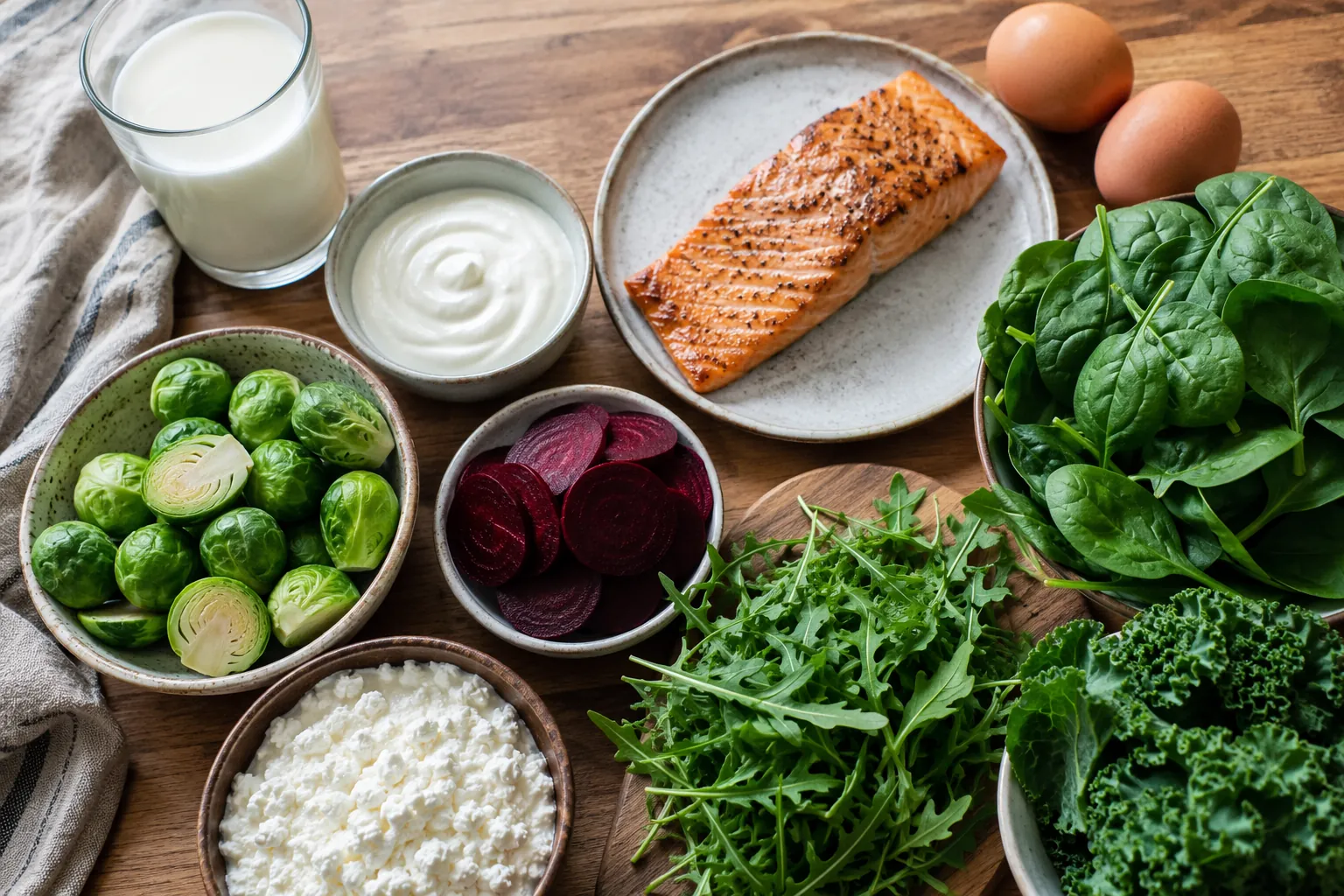
Protein Is the Meal-by-Meal Problem
Protein advice becomes useful only when it leaves the slogan stage. “Eat more protein” does not tell anyone what to buy, cook, or serve to a parent who says half a sandwich is enough. The musculoskeletal nutrition review summarizes expert recommendations of 1.0–1.5 grams of protein per kilogram of body weight per day for older adults, with 25–30 grams per meal often used as a practical distribution target.[1]
For a 150-pound person, that daily range is roughly 68–102 grams of protein. That is more than many older adults will reach by accident. A cup of Greek yogurt at breakfast, eggs or cottage cheese at lunch, fish or poultry at dinner, and legumes where they fit may be more realistic than expecting one large evening meal to do all the work.
The reason to care is not cosmetic muscle. Falls often happen in ordinary transitions: standing up too quickly, turning in the bathroom, stepping over a threshold, catching a toe on a rug. Muscle gives an older person more reserve in those moments. Poor intake can also follow a fall, because pain, fear, and reduced mobility make shopping, cooking, and eating harder. That is one way a small fall can start a larger decline.
Protein targets still need judgment. Kidney disease, swallowing problems, poor dentition, nausea, and unintended weight loss change the plan. If an older adult has chronic kidney disease or has been told to limit protein, the target should come from the clinician or dietitian who knows the labs, not from a general article.
Calcium and Protein Have the Strongest Real-World Food Trial
The most convincing food example here is not a boutique supplement study. It is a cluster randomized trial in 7,195 aged-care residents in Australia, with a mean age of about 86, where facilities increased residents’ intake of calcium and protein mainly through additional milk, yogurt, and cheese.[3]
In the intervention group, average intake rose to about 1,142 mg of calcium and 69 grams of protein per day. Compared with usual care, the intervention was associated with 33% fewer fractures, 46% fewer hip fractures, and 11% fewer falls.[3]
That trial matters because it used ordinary foods in a setting where frailty is not theoretical. Aged-care residents are not perfect eaters with perfect appetites. They are exactly the kind of people for whom nutrition advice usually runs into the real world: preferences, routines, staff time, chewing, medications, and limited reserves.
Calcium’s common target for older adults is 1000–1200 mg per day.[1] Dairy foods are one efficient route, but they are not the only route. Fortified foods, calcium-set tofu, canned fish with edible bones, and some greens can contribute. The practical question is whether the full day adds up, not whether one food has a health halo.
There are limits. Lactose intolerance, constipation, kidney stones, kidney disease, and supplement use all deserve attention. Calcium from food and calcium from pills are not the same planning problem. Before adding high-dose calcium supplements, an older adult should review the total intake and medical history with a clinician.
Vitamin D Needs a Blood Level, Not Guesswork
Vitamin D is where many families need two separate pieces of information: the blood level and the daily plan. The musculoskeletal review identifies a serum 25-hydroxyvitamin D level of at least 75 nmol/L as a useful target in this context.[1] CDC STEADI materials also include vitamin D3 supplementation of 1000–2000 IU per day as part of fall-prevention guidance for older adults.[2]
A cohort study of community-dwelling older women reported that those with serum 25(OH)D of at least 75 nmol/L had a 24% lower fall risk and a 30% lower risk of fracture-related hospitalization than those below that threshold.[4] That is an association, not proof that simply adding vitamin D will produce the same reduction for every person. It does, however, give a measurable boundary that is more useful than “get some sun.”
Food alone often does not solve vitamin D. Fatty fish, fortified milk, and fortified foods help, but sunlight exposure, skin changes with age, geography, season, and time indoors all affect status. For many older adults, the practical path is to ask whether a 25(OH)D blood test is appropriate and whether a daily D3 dose fits the medication list and medical history.
More is not automatically better. Very high supplemental doses can create problems, especially when combined with calcium or when kidney function is impaired. Vitamin D belongs in the plan, but it still belongs in the medication-and-lab conversation.
Vitamin K1: Useful, but Medication-Sensitive
Vitamin K1 is where a vegetable recommendation can be both sensible and unsafe if handled carelessly. The intake target used in this fall-and-fracture evidence is at least 100 micrograms per day, commonly supplied by green vegetables such as spinach, kale, collards, and Brussels sprouts.[1]
In one study of older women, vitamin K1 intake of at least 100 micrograms per day was associated with a 27% lower hazard of injurious falls.[5] In a related study, intake at that same threshold was associated with a 49% lower hazard of hip fracture.[6] These are observational findings, so they should not be read as a guarantee that greens prevent falls. People who eat more vegetables may differ in other ways too.
Still, the target is practical. A small serving of cooked greens can move the day meaningfully. The harder part is consistency. For someone taking warfarin, sudden large changes in vitamin K intake can interfere with anticoagulation management. The usual issue is not that vitamin K foods are forbidden; it is that intake should be steady and coordinated with the prescriber or anticoagulation clinic.
Dietary Nitrate Points Back to Vegetables, Not Energy Drinks
Dietary nitrate is easy to misunderstand because the word sounds like a supplement label. In this context, the useful source is vegetables: spinach, arugula, beetroot, and similar foods. The threshold highlighted in the musculoskeletal review is at least 84 mg per day.[1]
A study in older women linked nitrate intake at or above 84 mg per day with 35% lower odds of weak grip strength and 28% lower odds of slow timed-up-and-go performance.[7] Grip strength and timed-up-and-go are not the same thing as a fall outcome, but they are relevant because they measure physical function that shows up in daily life.
This is a good example of how narrow the conclusion should be. The evidence supports vegetable nitrate as part of a muscle-function pattern. It does not mean an older adult should chase nitrate powders or concentrated beet products, especially if blood pressure medications, kidney disease, or swallowing difficulty are in the picture.
Vegetables Earn Their Place Without Being Magical
A broader vegetable pattern supports the same direction. In a cohort study, older women eating at least three servings of vegetables per day had a 41% lower risk of an injurious fall and a 39% lower risk of hip fracture compared with those eating fewer than two servings per day.[8]
Again, this is observational. It cannot prove that adding one serving of vegetables will cause a specific fall-risk reduction. But it does make the vegetable advice more concrete. Greens help with vitamin K1. Spinach, arugula, and beetroot help with dietary nitrate. Vegetables also tend to travel well with the rest of the plan: eggs with spinach, soup with beans and greens, salmon with Brussels sprouts, yogurt and a simple side salad at lunch.
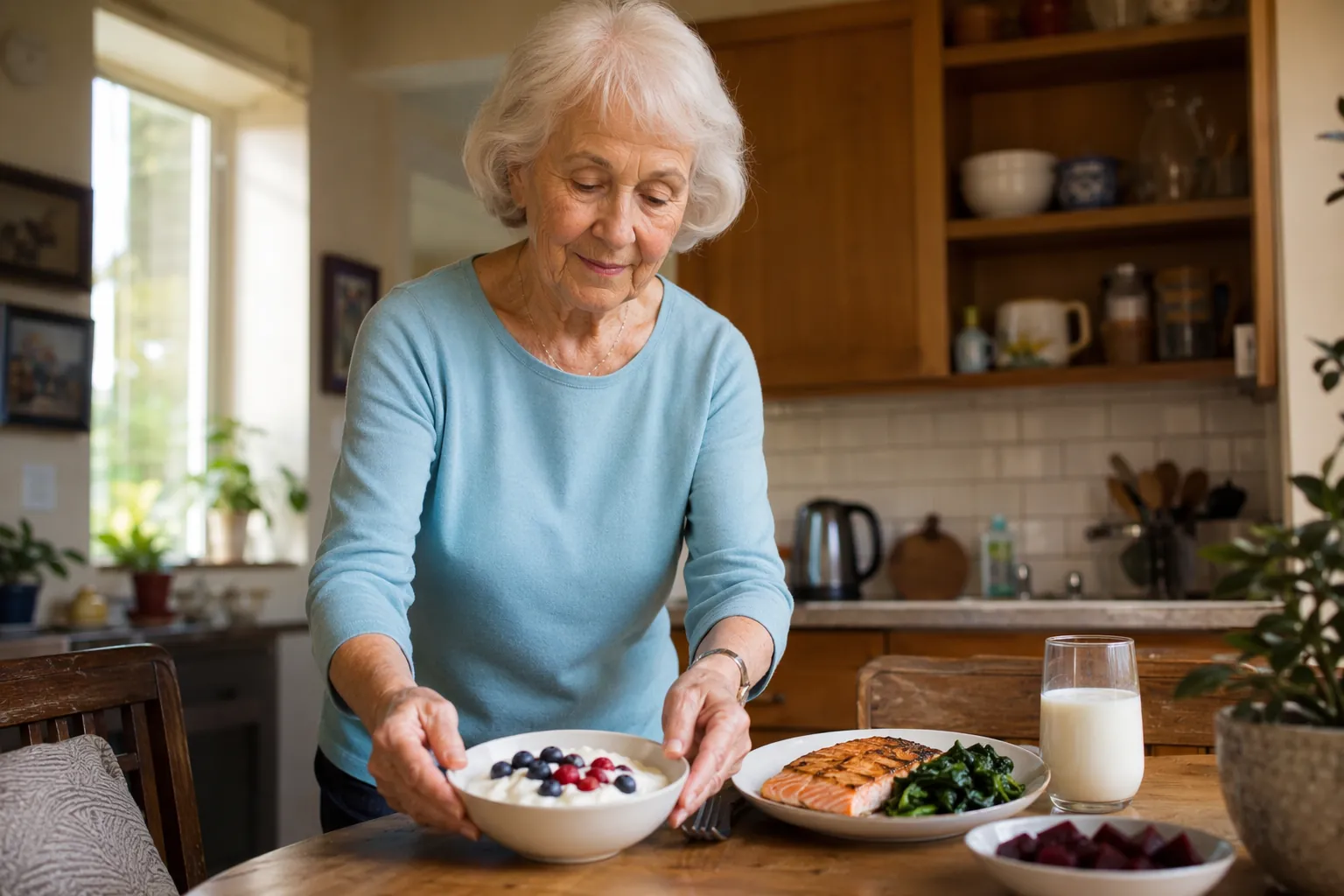
What This Looks Like in a Real Day
A fall-prevention diet does not need to look like a new personality. It needs repeatable meals that do not collapse when appetite is low or the caregiver is tired. The targets are easier to reach when each meal has a job.
- Breakfast: Greek yogurt or eggs, plus fruit; add fortified milk if tolerated.
- Lunch: cottage cheese, tuna, chicken, tofu, beans, or lentil soup; add spinach, kale, or another green vegetable.
- Dinner: fish, poultry, legumes, tofu, or eggs; pair with Brussels sprouts, beetroot, arugula, or cooked greens.
- Snack if meals are small: milk, yogurt, cheese, a smoothie, or a protein-rich soft food that the person will actually eat.
The best plan may be softer foods, smaller portions, or more frequent eating. If chewing is poor, “eat chicken breast” may fail while yogurt, eggs, fish, tofu, cottage cheese, or blended soups work. If the older adult resists being managed, changing one meal may be better than turning the whole kitchen into a nutrition project.
Who Should Pause Before Changing the Diet
The nutrient targets are a starting point, not a license to ignore medical details. Several common situations need a clinician or dietitian before major changes:
- Warfarin or other anticoagulation management, especially before increasing vitamin K1-rich greens.
- Chronic kidney disease, kidney stones, or instructions to limit protein, potassium, phosphorus, calcium, or fluids.
- Swallowing difficulty, coughing during meals, recurrent pneumonia, or unexplained weight loss.
- Use of calcium, vitamin D, protein powders, or other supplements that may duplicate what is already in the diet.
- Poor appetite, depression, memory changes, or new difficulty shopping and cooking.
These cautions do not make nutrition less important. They make it more personal. A safe plan for one older adult may be the wrong plan for another with the same age and the same fall history.
Food Helps Most When It Joins the Rest of Fall Prevention
The stronger claim is not that diet prevents falls by itself. It does not replace vision checks, medication review, strength and balance exercise, assistive devices, footwear, home hazard reduction, or a structured fall-risk screen such as the STEADI approach.[2]
But diet is one of the few fall-prevention tools that shows up three times a day. Protein helps protect muscle. Calcium and vitamin D support bone. Vitamin K1 and nitrate-rich vegetables add a practical vegetable target tied to fall, fracture, and physical-function research. For a senior trying to stay independent, those are better anti-aging diet tips than any promise on the front of a supplement bottle.
References
- Nutritional strategies to optimise musculoskeletal health for fall and fracture prevention, PMC.
- STEADI: Older Adult Fall Prevention, Centers for Disease Control and Prevention.
- Effect of dietary sources of calcium and protein on hip fractures and falls in older adults in residential care: cluster randomised controlled trial, BMJ, 2021.
- Serum 25-hydroxyvitamin D and falls in older women, PubMed, 2021.
- Vitamin K1 intake and injurious falls in older women, PubMed, 2022.
- Vitamin K1 intake and hip fracture risk in older women, PubMed, 2023.
- Dietary nitrate intake is positively associated with muscle function in older women, PubMed, 2019.
- Vegetable intake, injurious falls, and fracture risk in older women, PubMed, 2018.
Browse more in the Glossary.