
Clinical term
What Is the Best Intermittent Fasting Schedule for Older Adult Brain Health?
Last verified 2026-07-27
For most adults over 55 who are asking about the best intermittent fasting schedule for older adult brain health, the most sensible starting point is a 13- to 14-hour overnight fast: for example, eating breakfast around 8 a.m. and finishing dinner by about 6 or 7 p.m. It is not the most dramatic fasting plan, and that is partly why it works as a default. AARP reported 74% compliance with 13-plus-hour overnight fasting among older adults, and both AARP and the Alzheimer’s Drug Discovery Foundation point to this general duration as a practical option rather than pushing older adults toward longer fasts as a first move.[1][2]
That answer may feel less exciting than 16:8 or the twice-weekly low-calorie 5:2 plan. But for brain health after 55, the schedule has to clear more than one bar. It should have at least some credible evidence behind it, leave enough room for protein and calcium, avoid scrambling medication timing, and be realistic for someone who may already be managing sleep, blood pressure, glucose, appetite changes, or caregiving routines.

The common schedules, compared for brain health after 55
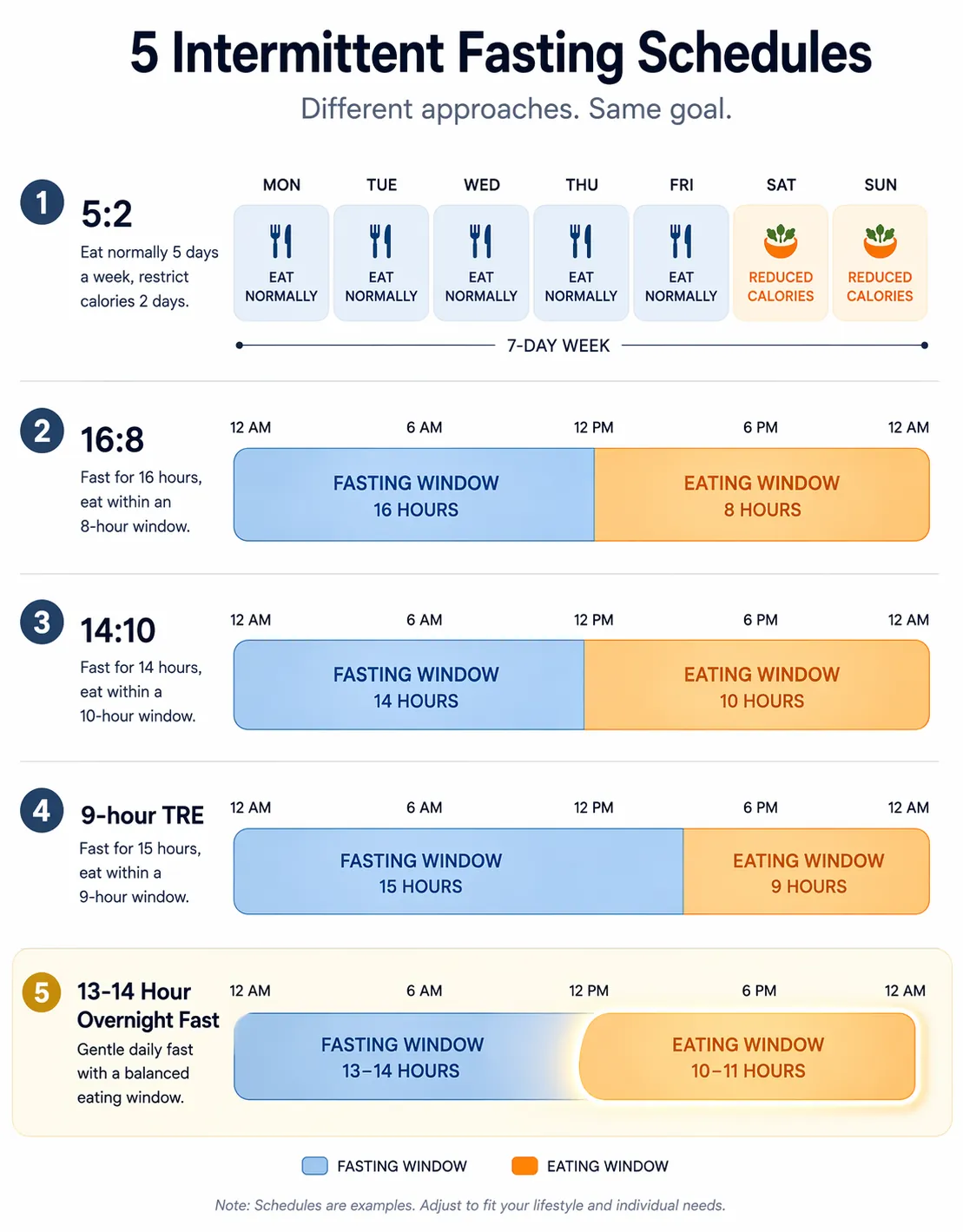
The schedules people usually compare are not interchangeable. Some reduce calories on certain days. Some compress all meals into a short daily window. Some simply lengthen the normal overnight fast. For an older adult, those differences matter because the “fasting” part is only half the plan; the eating window still has to carry the day’s nutrition.
| Schedule | What it usually means | Brain-health evidence in older adults | Practical judgment for most adults 55+ |
|---|---|---|---|
| 13–14 hour overnight fast | A longer overnight pause from food, such as eating between about 8 a.m. and 6–7 p.m. | Supported as a practical duration by AARP and the Alzheimer’s Drug Discovery Foundation; not the most intensive cognitive-trial schedule, but compatible with the broader meal-timing evidence.[1][2] | Best default to discuss with a clinician because it leaves room for regular meals, protein, calcium, hydration, and medication routines. |
| 14:10 | A 14-hour fast and 10-hour eating window, such as 8 a.m.–6 p.m. | Close to the 13–14 hour sweet spot; it is easier to adapt than 16:8 and may be a reasonable version of overnight fasting. | Often practical if dinner can be kept earlier without shrinking meals too much. |
| 5:2 intermittent fasting | Two very low-calorie days per week, about 480 kcal in the NIH/NIA trial, with five unrestricted days. | An 8-week NIH/NIA trial in 40 adults over 55 with insulin resistance found improvements in executive function and memory and reduced MRI-based BrainAGE gap.[3] | Interesting brain data, but the low-calorie days make it a plan for medical supervision, not a casual starting point. |
| 9-hour time-restricted eating | A short daily eating window; the Rutgers pilot used roughly 10 a.m.–6 p.m. with no food for 4 hours before bed. | A preliminary Rutgers pilot in 47 women ages 50–79 reported modest improvements in spatial planning and problem-solving compared with a roughly 12-hour window, even with equivalent weight loss.[4] | Promising but still preliminary; the short window may be difficult for older adults who need evenly spaced meals or medications with food. |
| 16:8 | A 16-hour fast and 8-hour eating window. | Popular online, but not the safest default for this age group. AARP cites a 20,000-person study linking 16-plus-hour daily fasting with more than double heart-disease mortality and notes concern that an 8-hour window may be too tight for protein and calcium needs.[1] | Use caution. This may fit some medically supervised people, but it should not be treated as the standard brain-health schedule for older adults. |
Why the strongest brain signals do not automatically make the best everyday schedule
The NIH/NIA 5:2 trial deserves attention because it studied actual older adults rather than relying on animal mechanisms or general weight-loss claims. The participants were adults over 55 with insulin resistance. Over 8 weeks, the 5:2 intermittent fasting group followed two very low-calorie days of about 480 kcal and five unrestricted days. Researchers reported improvements in executive function and memory and a reduction in the MRI-based BrainAGE gap.[3]
That is meaningful, but it is also narrow. The study was small, short, and conducted in people with insulin resistance. It does not prove that a normal-weight 72-year-old without insulin resistance should start two very low-calorie days per week. It also does not remove the practical problem: on a 480 kcal day, there is very little room for protein, calcium-rich foods, fiber, and the ordinary meals that many medications assume will happen.
The Rutgers 9-hour time-restricted eating pilot is also worth watching. It involved 47 women ages 50–79 and compared a shorter daily eating window, described as about 10 a.m. to 6 p.m. with no food for 4 hours before bed, against a roughly 12-hour window. Researchers reported modest gains in spatial planning and problem-solving, and the finding was notable because weight loss was similar between groups.[4]
Still, this is preliminary conference-presented research, not a settled clinical rule. A short eating window can be hard to square with morning medicines, evening medicines, appetite that is better earlier or later in the day, and the basic task of eating enough. The result is interesting; it is not a reason to tell most older adults to compress the day into a 9-hour window without individualized advice.
The broader research base points in the same cautious direction. A 2024 systematic review of eight studies including 4,006 participants found that a 10-hour time-restricted eating pattern was associated with lower odds of cognitive impairment, and that regular intermittent fasting over 3 years was linked with improved cognition in people with mild cognitive impairment. But the review also called for more randomized controlled trials, and not every included finding pointed the same way.[5]
Why 13–14 hours is the practical sweet spot
A 13- to 14-hour overnight fast usually means moving calories out of the late evening, not skipping half the day. A person might eat breakfast at 8 a.m., lunch at noon, and dinner finished by 6:30 p.m. Another person might use 7:30 a.m. to 6 p.m. The important feature is the overnight stretch, not a rigid clock rule.
This matters because older adults are not just trying to endure a fast. They are trying to maintain muscle, bone health, energy, and medication stability while possibly lowering long-term brain-health risk. A shorter eating window can make the day feel efficient on paper while making real meals harder to complete. If breakfast disappears, protein often disappears with it. If dinner is rushed, calcium-rich foods and vegetables may be the first things left behind.
The 74% compliance figure reported by AARP is not a minor detail.[1] A brain-health plan that people can actually follow has a different value from a stricter plan that breaks down after a few weeks. The 13–14 hour pattern also leaves a clinician more room to adjust around common realities: a pill that must be taken with breakfast, a diuretic that affects morning routines, a diabetes medicine that changes hypoglycemia risk, or a person whose appetite is already reduced.
It also has a cleaner safety margin than 16:8. The 8-hour window in 16:8 can work for some people, but it asks more of the eater. Meals need to be larger, better planned, or more nutrient-dense. For a healthy younger adult, that may be manageable. For an older adult who is trying to preserve muscle and bone, it is a real constraint.
A simple version to discuss
- Finish dinner by about 6 or 7 p.m.
- Keep the overnight fast until breakfast, around 7 or 8 a.m.
- Keep regular meals inside the eating window instead of replacing meals with snacks.
- Do not move or skip medications to make the fasting window look cleaner.
- If weight is already low, appetite is poor, or meals are difficult, treat fasting as a medical question before trying it.
Where 16:8 fits—and why it should not be the default
The 16:8 schedule is popular because it is easy to describe: fast for 16 hours, eat during 8. Popularity is not the same as suitability for older adults trying to protect brain health.
AARP cites a study of 20,000 people that linked daily fasting periods of 16 hours or more with more than double the risk of death from heart disease.[1] That kind of finding should not be read as proof that 16:8 causes heart-disease death; observational signals can be affected by who chooses the behavior and why. But it is enough to argue against making 16:8 the casual default for older adults, especially when the same article raises the practical concern that an 8-hour eating window may be too tight for getting enough protein and calcium.[1]
There may be older adults who use 16:8 safely under medical supervision, particularly if they have a strong metabolic reason and a nutrition plan that is actually adequate. That is different from recommending it broadly for memory protection.
Medication and health conditions can change the answer
Intermittent fasting is not just a meal-timing preference when medications are involved. Harvard Health has warned that older adults should be cautious with intermittent fasting, particularly when they have medical conditions or take medications that could be affected by changes in eating patterns.[6] CenterWell similarly advises seniors, including those on diabetes, blood pressure, or heart medications, to consult a physician before trying intermittent fasting.[7]
That advice is especially relevant for people using insulin or other glucose-lowering medications, people who feel lightheaded when meals are delayed, people on blood pressure medicines, and anyone with a history of falls. It also applies to older adults with frailty, low body weight, recent unintentional weight loss, poor appetite, swallowing problems, or difficulty shopping and cooking. In those situations, the risk of eating too little can outweigh the theoretical benefit of a longer fast.
ApoE ε4 is another reason not to overpromise
People with a strong family history of Alzheimer’s disease often want a sharper answer: if fasting may help the brain, should they be more aggressive? The current evidence does not support that leap. A follow-up analysis of the NIH trial found that cognitive benefits appeared in non-carriers of ApoE ε4, while ApoE ε4 carriers showed no cognitive improvement and had increased cerebrospinal fluid biomarkers.[8]
That does not mean ApoE ε4 carriers should never use time-restricted eating. It means family-history concerns are a reason for a more careful clinician conversation, not a reason to copy a stricter plan from the internet. Genotype, metabolic health, nutrition status, and medication use may all affect whether fasting is reasonable and what kind.
The decision boundary
For most older adults interested in brain health, the schedule to start discussing is a 13- to 14-hour overnight fast, not an aggressive fasting plan. It is long enough to be a real meal-timing change and practical enough to preserve the meals that carry protein, calcium, fiber, fluids, and medications.
The answer changes when diabetes medicines, blood pressure or heart medications, frailty, low body weight, poor appetite, nutrition concerns, fall risk, or strong Alzheimer’s family-history questions enter the picture. In those cases, the best intermittent fasting schedule is not a self-selected window; it is the one a clinician can fit around the person’s actual health risks.
Promising evidence exists for stricter schedules, especially the NIH/NIA 5:2 trial and the Rutgers short-window pilot. But the best schedule for everyday older-adult brain health is the one with enough evidence to be credible and enough safety margin to be livable.
References
- Meal Timing for Older Adults, AARP, Apr. 2026
- Time Restricted Eating, Alzheimer’s Drug Discovery Foundation
- Examining Brain Responses to Intermittent Fasting and Healthy Diet in Older Adults, NIH Intramural Research Program
- Restricted eating hours may reduce cognitive decline in older age, researchers find, The Guardian, Jul. 26, 2026
- Intermittent fasting and cognitive function: a systematic review, Preventive Medicine Reports, 2024
- Is intermittent fasting safe for older adults?, Harvard Health Publishing, 2020
- Intermittent Fasting for Seniors: Safe or Risky, CenterWell Primary Care, 2025
- Alzheimer’s & Dementia 2025 follow-up paper on the NIH intermittent fasting trial, Alzheimer’s & Dementia, 2025
Browse more in the Glossary.