
Clinical term
Take These Steps to Protect Older Adults From Bourbon Virus
Last verified 2026-07-31
Bourbon virus is worth taking seriously for an older adult without making it sound common. The CDC describes it as a rare tick-borne virus, with only six confirmed human cases reported since it was first identified in Kansas in 2014. There is no vaccine and no specific antiviral treatment; care is supportive, such as IV fluids, fever and pain control, and hospitalization when illness becomes severe.[1]
That combination changes the family math. A rare infection can still matter when the person at risk is 70 or 80, has diabetes or heart disease, spends spring and summer in the garden, and may not see a tick behind a knee or at the waistband. The goal is not to turn every walk through the yard into a medical event. It is to make tick-bite prevention ordinary enough that it actually happens.
The timing also matters. In April 2026, CDC reported that weekly emergency department visits for tick bites were higher than usual and were the highest for that time of year since 2017.[2] A 2026 Long Island case involving a 67-year-old man brought Bourbon virus into the news again, but one case in New York should not be treated as proof that the virus is now established locally. It is better understood as a reminder that tick exposure is not only a rural problem, and that older adults need a practical routine before the bite happens.[3]

How serious is Bourbon virus for older adults?
The honest answer is narrow: there are too few confirmed Bourbon virus cases to calculate a reliable age-specific death rate. Six confirmed cases cannot support sweeping claims about who will become severely ill. But the cases that have become public include older adults with health conditions, and the illness can progress beyond a simple fever.
CDC lists possible symptoms as fever, tiredness, rash, headache, body aches, nausea, and vomiting. Laboratory findings can include low white blood cell and platelet counts.[1] Those symptoms overlap with other tick-borne illnesses, which is one reason families should avoid trying to identify the illness at home based on a symptom list.
The gravity marker is the Kansas fatal case: a 63-year-old man with diabetes developed severe illness after Bourbon virus infection and required extracorporeal membrane oxygenation, or ECMO, during care.[4] That does not mean Bourbon virus is likely after a tick bite. It does mean that in an older adult with comorbidities, worsening fever and weakness after possible tick exposure should not be waved off as “probably just summer fatigue.”
Where does the risk come from?
Bourbon virus is believed to spread through tick bites, and the lone star tick is the tick most closely associated with transmission. CDC surveillance shows the lone star tick’s established range across much of the eastern, southeastern, and south-central United States, with surveillance indicating expansion in parts of the country.[5]
This is where families can overread the map. A tick’s presence in a state does not mean Bourbon virus is common there, and a single human case does not prove steady local transmission. The more useful conclusion is simpler: if an older adult lives, gardens, walks, hunts, golfs, or keeps pets in tick habitat, prevention should be routine.
There is also some evidence that infections may be missed. A 2022 study found Bourbon virus-specific neutralizing antibodies in 0.7% of 440 serum samples from people in the St. Louis area.[6] That finding suggests some infections may go unrecognized, but it came from one urban-area cohort and should not be stretched into a national estimate.
A prevention routine that works for real yards and real bodies
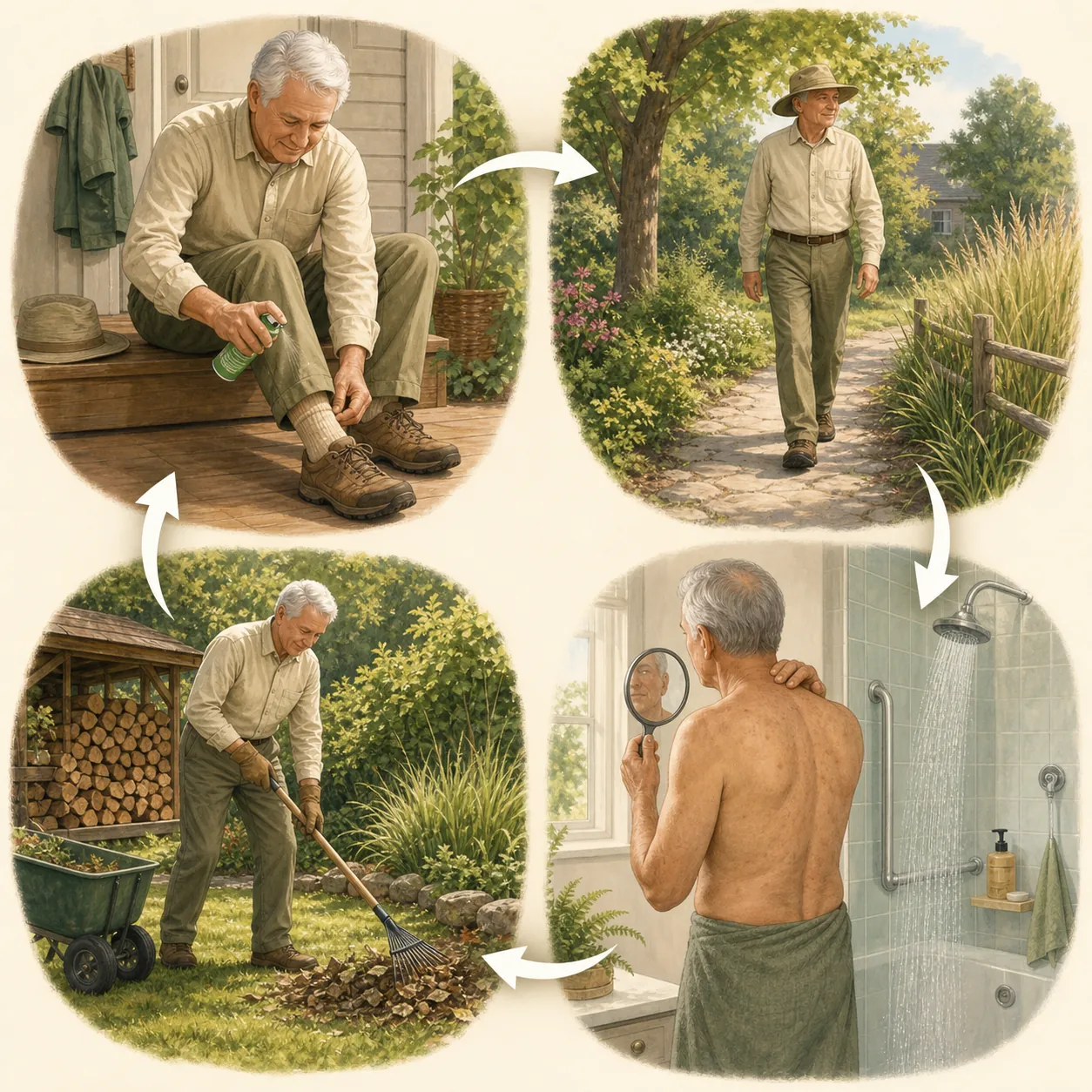
The best Bourbon virus prevention tips are the same unglamorous tick-bite steps families often mean to do and then skip. For an older adult, the routine has to account for heat tolerance, balance, stiff knees, limited vision, pets, and the fact that yardwork often starts as “I’m only going out for ten minutes.”
| When | What to do | Why it matters for older adults |
|---|---|---|
| Before going outside | Use EPA-registered repellent; wear light-colored long sleeves and pants when tolerable; tuck pants into socks for brushy areas; consider permethrin-treated clothing. | The easiest tick check is the bite that never happens. |
| While outdoors | Stay on clear paths; avoid tall grass, brush, and leaf litter; sit on a chair or bench instead of directly on grass. | Small route choices reduce exposure without taking away the walk, garden, or porch time. |
| After coming inside | Shower soon; check clothing, skin folds, scalp, waistband, ankles, and behind knees; use a mirror or helper when needed. | Many older adults cannot safely bend or twist enough to inspect every high-risk spot. |
| Around the home | Keep grass short; clear leaf litter; move wood piles and brush away from sitting areas; create clearer borders between lawn and woods. | Property maintenance reduces the number of daily tick encounters. |
CDC recommends using EPA-registered insect repellents, treating clothing and gear with products containing 0.5% permethrin, avoiding wooded and brushy areas with high grass and leaf litter, walking in the center of trails, checking clothing and the body for ticks, showering after being outdoors, and taking steps to reduce ticks in the yard.[7]
Before going outside
Put repellent where ticks actually climb: shoes, socks, ankles, lower legs, cuffs, and the outside of gardening gloves. If your parent uses a cane, walker, kneeling bench, or garden cart, keep repellent near that gear instead of in a bathroom cabinet where it will be forgotten.
Long sleeves and long pants help, but summer heat is real. A parent who refuses heavy clothing in July may still tolerate a light-colored sun shirt, thin hiking pants, tall socks, or a dedicated pair of treated gardening pants. The practical standard is not perfect coverage; it is better coverage that the person will actually wear.
- Keep one bottle of repellent by the door used for yardwork, not in a distant storage area.
- Choose light-colored clothing so crawling ticks are easier to see.
- Use permethrin only on clothing and gear, following the product label; do not apply it directly to skin.
- Set aside a “tick-safe” yard outfit so prevention does not require a new decision every time.
While outdoors
Most families do not need to ban gardening or walks. They need to notice the spots where ticks are waiting: tall grass along the fence, brush at the edge of a wooded lot, leaf litter beside the shed, and the overgrown path to the compost pile. A clear path is not just a fall-prevention feature; it is tick prevention too.
For an older adult who loves outdoor projects, the biggest risk may be the “quick job.” Picking up sticks after dinner, pulling weeds near the wood line, or filling a bird feeder can happen without repellent because it feels too brief to count. It counts. The routine should apply to short trips as well as planned yardwork.
After coming inside
The after-outdoor check is where older adults often need help, even when they are fully independent. Ankles, sock lines, behind the knees, groin, waistband, underarms, back, scalp, and behind the ears are not equally easy to inspect. A handheld mirror helps some people; others need a spouse, adult child, or home aide to check the places they cannot see.
Clothing should be checked too. If the person can safely shower soon after coming inside, that adds another opportunity to find crawling ticks before they attach. If showering immediately is unrealistic because of mobility limits or fatigue, build the check around the routine that already exists: changing clothes, taking evening medications, or getting ready for bed.
Pets deserve a place in the routine. Dogs and outdoor cats can bring ticks into the house, including onto couches and beds. Tick prevention for pets should be discussed with a veterinarian, especially in homes where an older adult sits with a pet after it has been in grass or brush.
In the yard
Yard maintenance is prevention, not vanity. Keep grass mowed, clear leaf litter from sitting areas and walkways, trim brush along paths, and move wood piles or unused equipment away from the places where people sit, garden, and enter the house. On wooded properties, a maintained border between lawn and brush can make everyday exposure less likely.
This is also where adult children quietly become safety managers. If a parent still maintains a large yard, the question is not only whether he can run the mower. It is whether the brush line is creeping toward the garden, whether the compost path is overgrown, and whether the person doing the work is protected while doing it. Families already thinking through aging-in-place hazards can fold tick exposure into broader home and yard safety planning.
When should an older adult get medical care after a tick bite?
A tick bite by itself does not mean Bourbon virus, and most tick bites do not lead to Bourbon virus. But an older adult should get clinician guidance if symptoms appear after a tick exposure, especially fever, unusual fatigue, rash, headache, body aches, nausea, vomiting, or worsening weakness. Low blood counts are not something a family can assess at home, but they are part of why a clinician may order testing when the story and symptoms fit.[1]
The threshold should be lower when the person has diabetes, heart disease, kidney disease, immune suppression, cancer treatment, frailty, confusion, dehydration risk, or a history of severe reactions to infection. It should also be lower when the older adult is not improving, is eating or drinking less, becomes short of breath, seems newly confused, has a spreading rash, or cannot get out of bed as usual.
It helps to bring concrete information to the appointment: when the tick was found, where it was attached, whether it was removed fully, where the person had been outdoors, when symptoms started, and what medications or immune-suppressing treatments the person uses. If the tick was saved safely in a sealed bag or container, ask the clinician whether it is useful; do not delay care to look for it.
Is there any treatment if Bourbon virus is suspected?
There is no vaccine and no specific treatment for Bourbon virus. Medical care is supportive, and severe illness may require hospitalization.[1] That is the main reason prevention carries so much weight. With some infections, a family can reasonably think, “If it happens, there is a standard treatment.” Bourbon virus does not offer that reassurance.
Experimental research should not be confused with available care. Washington University School of Medicine reported that the flu drugs favipiravir and molnupiravir were effective against Bourbon virus in mice, but that was mouse-model research, not a human treatment trial and not an approved Bourbon virus therapy.[8]
What should families do this week?
Start with the next outdoor trip, not a complete lifestyle overhaul. Put repellent by the door. Choose the clothing that will actually be worn. Clear the path used most often. Decide who checks the places the older adult cannot see. Make pet checks part of coming inside. Write down the symptoms that should trigger a call to a clinician so nobody has to decide from scratch while someone is feverish and weak.
Bourbon virus remains extremely rare, and the science is still incomplete. That is exactly why the prevention plan should be boring, repeatable, and built into ordinary outdoor routines. When there is no vaccine, no specific treatment, and uneven surveillance, the reliable work is still the work families can do before the tick bite.
References
- About Bourbon Virus. CDC.
- CDC Data Show Weekly ER Visits for Tick Bites Higher than Usual. CDC Newsroom. April 23, 2026.
- Is Tick Season Getting Worse? Risks for Older Adults. AARP. May 8, 2026.
- Lethal Case of Bourbon Virus Leading to Shock and ECMO Utilization. PMC. 2026.
- Lone Star Tick Surveillance. CDC.
- Detection of Bourbon Virus-Specific Serum Neutralizing Antibodies in Human Serum in Missouri, USA. mSphere. 2022.
- Preventing Tick Bites. CDC.
- Deadly tick-borne virus cured with experimental flu drug, in mice. Washington University School of Medicine.
Browse more in the Glossary.