
Clinical term
Recognizing Brain Cancer Symptoms in Elderly Parents
Last verified 2026-07-26
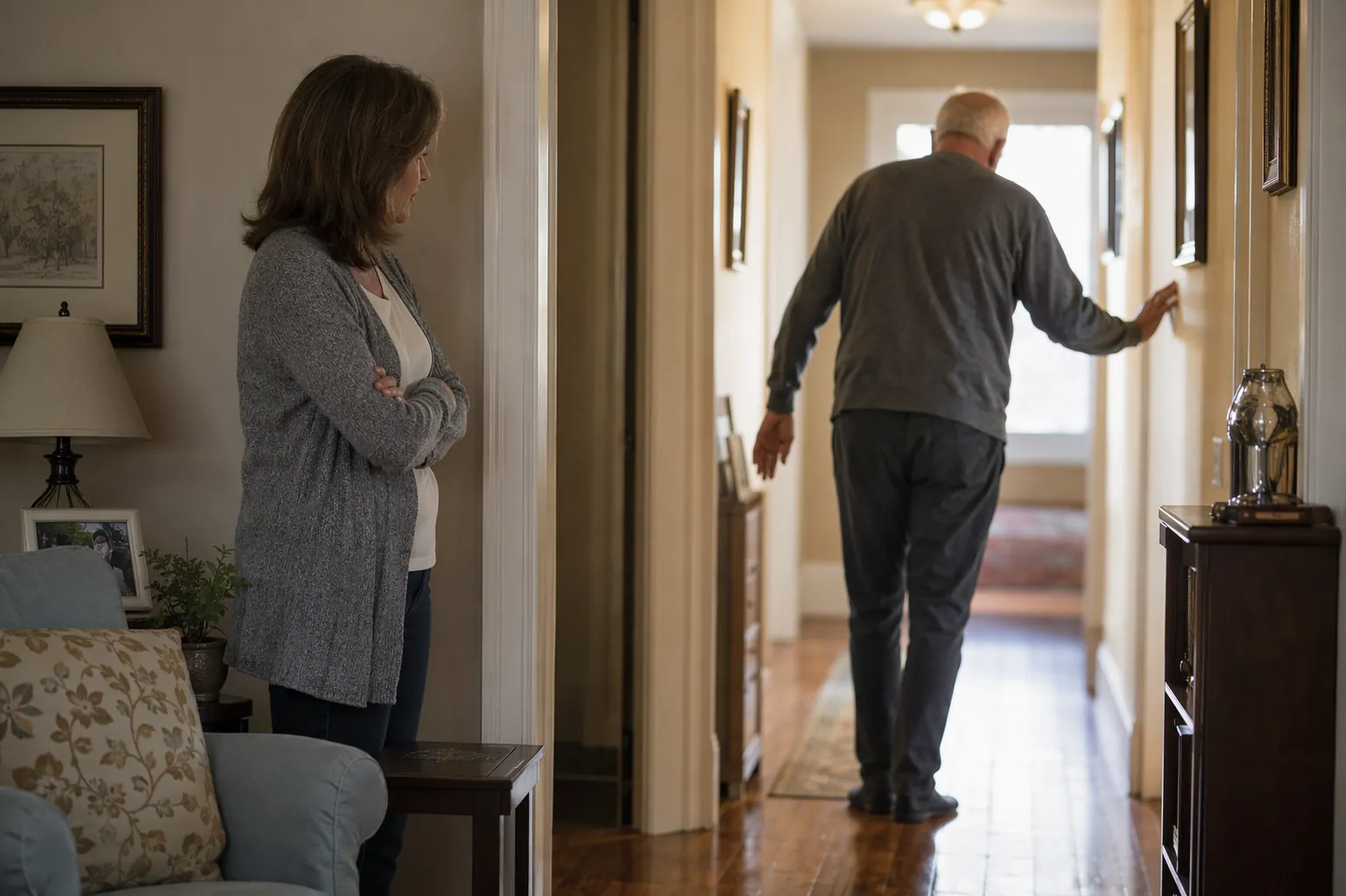
An elderly parent who reaches for the hallway wall once is not automatically showing brain cancer symptoms. A parent who becomes unsteady, more confused, weaker on one side, or visually off over weeks to months is different. That pattern deserves medical attention, especially when the family has already started changing routines around it: walking behind them on the stairs, reminding them where the chair is, or quietly removing rugs after a near fall.
The hard part is that many brain tumor symptoms in older adults sit in the same neighborhood as aging, medication side effects, dementia, dehydration, poor sleep, or general frailty. Mayo Clinic has warned that older adults with glioblastoma may mistake confusion, memory loss, balance difficulty, and vision problems for the normal aging process, which can delay diagnosis.[1] That does not mean every stumble points to a tumor. It means a clustered, changing pattern should not be waved away as “just age” without evaluation.
The pattern matters more than one symptom
A single symptom is often too vague to interpret at home. Fatigue can come from poor sleep. Dizziness can follow a new blood pressure medication. Memory lapses can appear during grief, infection, or stress. The concern rises when symptoms arrive together, intensify, or change the way a parent moves through the house.
For brain cancer symptoms in elderly parents, the practical question is not “Can this symptom happen with a tumor?” Many symptoms can. The better question is: “Is this a new neurological pattern that is increasing fall risk or changing daily function?”
- Balance problems plus new confusion: a parent gets lost in familiar rooms, misjudges furniture, or cannot follow the usual sequence of standing, turning, and sitting.
- Weakness plus vision changes: they drag a foot, miss the chair arm, bump into doorframes, or say the room looks different.
- Progressive cognitive decline plus headaches: they seem slower, more disoriented, or less able to plan, and headaches are becoming part of the pattern.
- One-sided weakness, a new seizure, or sudden major neurological change: these are sharper red flags and should not wait for a routine appointment.
Time course matters. A parent who has walked more slowly for several years may need a fall-risk assessment, strength work, medication review, or vision check. A parent who has changed noticeably over several weeks or months needs a more urgent medical explanation. The Conversation reported in 2025 that early brain tumor symptoms may be dismissed by both patients and general practitioners as everyday issues such as stress or aging, contributing to diagnostic delays of two to three months.[2]
How a brain tumor can increase fall risk
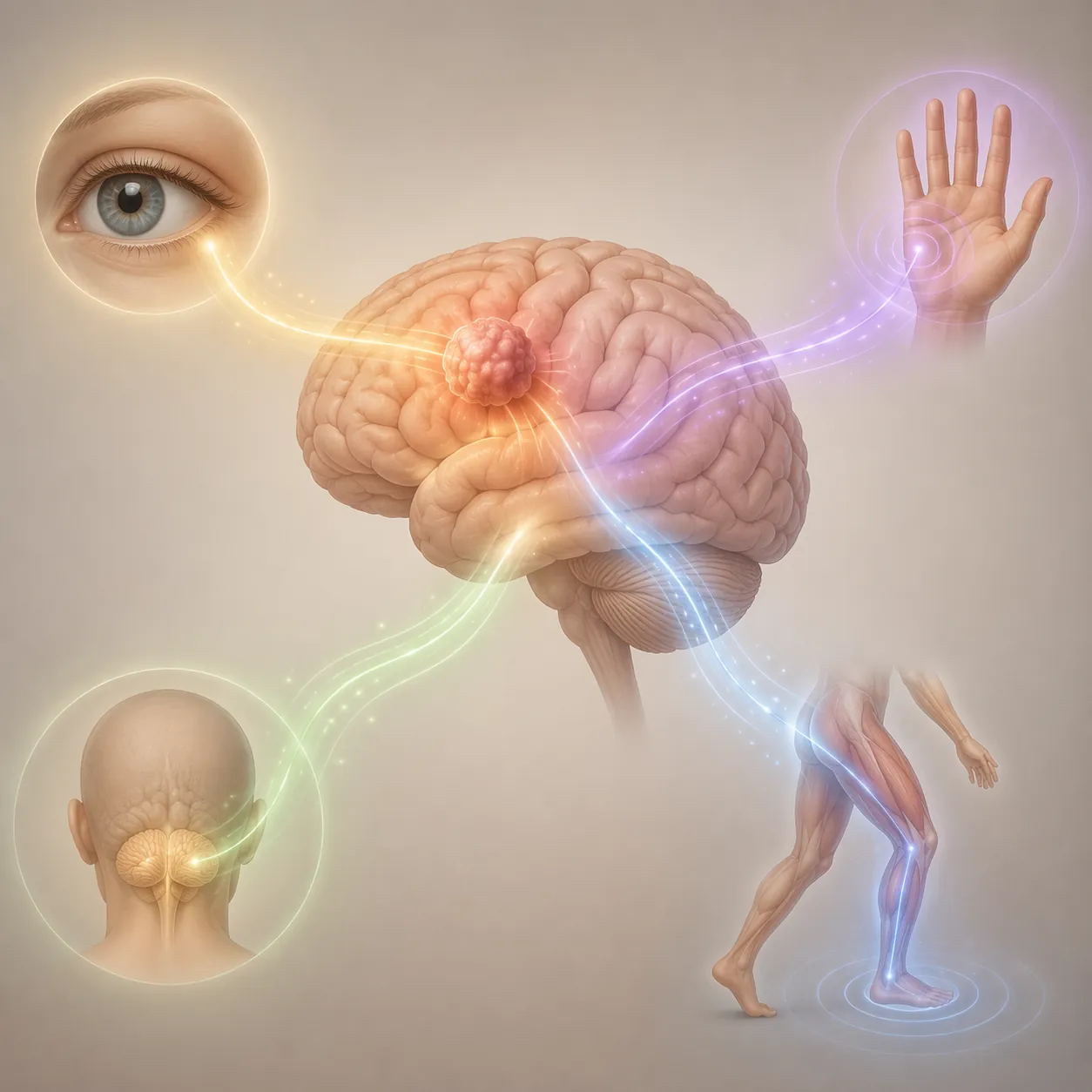
Brain tumors can affect balance and movement in several ways. The National Brain Tumor Society describes balance problems through four broad mechanisms: cerebellar involvement, vision challenges, sensory problems, and generalized weakness.[3] Those categories are useful because they translate a frightening diagnosis into things a caregiver may actually see at home.
Balance control can change
When the parts of the brain involved in coordination are affected, walking can look less automatic. A parent may widen their stance, veer to one side, hesitate before stepping over a threshold, or need more contact with walls and furniture. The first sign may not be a dramatic collapse. It may be that the hallway now requires concentration.
Vision can become unreliable
Vision trouble is easy to misfile as cataracts, old glasses, or poor lighting. But new visual changes paired with stumbling, confusion, or weakness are more concerning. A parent may miss objects on one side, misjudge the edge of a step, reach past a cup, or seem startled by furniture that has always been there.
Sensation and spatial awareness can shift
Some falls happen because the body is not reporting position accurately. A parent may not feel where a foot lands, may place weight poorly, or may seem unsure how far away the floor or chair is. If this appears alongside new confusion or one-sided weakness, it becomes more than a simple “getting older” story.
Weakness and fatigue can narrow the safety margin
General weakness does not have to be dramatic to create danger. A parent who can no longer rise from a chair cleanly may start rocking forward, twisting, or grabbing unstable furniture. The National Brain Tumor Society notes that intrinsic fall risk factors for people with brain tumors can include changes in walking pattern, dizziness with position change, cognitive decline, vision changes, fatigue, and weakness.[3]
One statistic is worth keeping narrow: more than 70% of malignant glioma patients experience motor dysfunction during the disease course, according to a Neuro-Oncology Practice study cited by the National Brain Tumor Society.[3] That figure should not be stretched to all brain tumors. It does, however, support the basic point that movement changes are not a side issue in malignant glioma; they can be central to how the disease affects daily safety.
Headaches, seizures, and cognitive changes deserve sharper sorting
Headaches are common in life and common in medical anxiety, so they need careful handling. Mayo Clinic says headaches occur in about half of people with brain tumors and are often worse in the morning or when waking from sleep.[4] That does not mean an older adult’s morning headache is a brain tumor. It does mean a new headache pattern should be taken more seriously when it travels with neurological changes: new imbalance, vision trouble, vomiting, confusion, personality change, weakness, or seizures.
Cognitive symptoms are especially easy to minimize. Families may already be braced for dementia, so they absorb each new mistake into that expectation. But cognitive change from a brain tumor may show up as a change in pace, judgment, attention, personality, or ability to complete familiar tasks. If the same parent is also falling, bumping into things, complaining of headaches, or showing weakness, the pattern needs a clinician’s eyes.
Older age is exactly where this confusion becomes more likely. A review on primary brain tumors in older adults reported that incidence peaks at ages 75 to 84, at 63.75 per 100,000 person-years, which is also an age range where dementia, balance decline, and frailty are common competing explanations.[5] The overlap is not a reason to panic. It is a reason to be precise about what changed and when.
Not every brain tumor is malignant, and not every tumor-related symptom has the same outlook. Some primary brain tumors in older adults, including meningiomas, may cause symptoms through pressure on nearby brain structures rather than invasive cancer behavior.[5] The practical point for a caregiver is still the same: symptoms that look like “aging” can sometimes have a specific medical cause, and delay can cost function even when the condition is treatable.
When to seek emergency care
This article is not medical advice and cannot diagnose a brain tumor. It is a triage guide for deciding when a parent’s symptom pattern has crossed the line from “watch closely” to “get medical help now.” When symptoms are sudden, severe, or seizure-like, it is safer to treat them as an emergency rather than wait to see whether they pass.
- Call emergency services or go to the ER for a new seizure, even if the parent seems better afterward.
- Use emergency care for sudden one-sided weakness, facial drooping, trouble speaking, sudden confusion, or a sudden inability to walk normally.
- Seek emergency care for a sudden severe headache, especially if it is unlike prior headaches or occurs with vomiting, weakness, confusion, vision change, or loss of consciousness.
- Treat a fall with head injury, new neurological symptoms, or unusual sleepiness afterward as urgent.
Some of these emergency signs can also point to stroke or other serious neurological problems. The home job is not to sort those diagnoses. The home job is to recognize that sudden neurological change is not a “wait until Monday” situation.
When to call promptly for medical evaluation
The more common caregiver dilemma is not the dramatic emergency. It is the parent who is still walking, still talking, still insisting nothing is wrong, but is no longer moving through the day the same way. That is where documentation matters.
Call the primary care clinician promptly, and ask whether neurological evaluation or imaging is appropriate, when two or more of these changes are new, worsening, or progressing over weeks to months:
- Increasing unsteadiness, veering, shuffling, or needing walls and furniture for balance.
- New confusion, memory loss, personality change, poor judgment, or trouble completing familiar routines.
- Weakness, especially if it is stronger on one side or changes how the parent rises, walks, grips, or uses stairs.
- New vision complaints, bumping into objects, reaching inaccurately, or misjudging steps and chairs.
- A new or changing headache pattern, especially headaches that are worse on waking or appear with other neurological symptoms.
- New dizziness with position changes, unusual fatigue, or a noticeable decline in walking endurance when paired with cognitive or movement changes.
A useful call to the doctor is specific. Instead of saying, “Mom seems off,” say, “Over the last six weeks she has started holding the wall in the hallway, missed the chair twice when sitting, complained of morning headaches three times, and seems confused about familiar steps in her routine.” That kind of timeline helps the clinician separate a vague worry from a progressive neurological pattern.
| What you observe | Why it matters | Reasonable next step |
|---|---|---|
| One slow change over years | May fit aging, frailty, arthritis, vision loss, medication effects, or other chronic issues | Document it and raise it at a routine visit or fall-risk assessment |
| Two or more changes over weeks to months | Pattern is less reassuring, especially if balance, cognition, weakness, headaches, or vision are involved | Call promptly and ask whether neurological evaluation is needed |
| New seizure, sudden one-sided weakness, sudden severe headache, or sudden major confusion | Could signal a serious neurological emergency | Use emergency care now |
What to do while waiting for the appointment
While waiting for medical advice, reduce the chance that the next clue is a broken hip. This does not replace evaluation; it buys safety while the evaluation is being arranged.
- Write down the first date you noticed each symptom, what has worsened, and whether changes are constant or come and go.
- List recent medication changes, infections, dehydration, poor sleep, alcohol use, or missed meals, because these can also affect balance and thinking.
- Remove loose rugs, clear walking paths, improve lighting, and discourage stair use when the parent is tired or confused.
- Watch transfers closely: getting out of bed, standing from a chair, turning in the bathroom, and stepping into the shower are common moments when weakness and confusion show up.
- Do not let embarrassment erase the pattern. If a parent denies symptoms, describe observable events calmly: missed chair, wall support, new headache timing, or one-sided weakness.
There is a difference between watching and waiting. Watching means recording what is happening, reducing fall hazards, and getting the pattern in front of a clinician. Waiting means hoping the pattern will explain itself after the family has already seen enough to be concerned.
The calm threshold
Brain cancer symptoms in elderly parents are not identified from one awkward step or one forgotten word. The threshold is a cluster: balance change with confusion, weakness with vision trouble, progressive cognitive decline with a new headache pattern, or any sudden seizure-like or one-sided neurological change.
For clustered symptoms progressing over weeks to months, call promptly and ask for medical evaluation, including whether a neurology referral is appropriate. For sudden severe headache, new seizure, sudden one-sided weakness, sudden trouble speaking, or abrupt major confusion, use emergency care. While waiting, document the timeline and make the home safer for a parent whose balance may already be compromised.
References
- Glioblastoma in older adults: Improving survival and quality of life, Mayo Clinic, Dec. 21, 2021.
- The seven symptoms that can delay brain tumour diagnosis – and why early detection matters, The Conversation, 2025.
- Improving Balance and Preventing Falls, National Brain Tumor Society, Jan. 2024.
- Brain tumor - Symptoms and causes, Mayo Clinic.
- Primary Brain Tumors in the Elderly, NIH / PMC.
Browse more in the Glossary.