
Clinical term
Bryan Johnson's Free Balance Test: Fall Risk in 30 Seconds
Last verified 2026-07-31
Of Bryan Johnson’s anti-aging tips, the one-leg balance test is the rare one that costs nothing, takes up to 30 seconds, and may actually start a useful conversation about fall risk. Johnson presents it as a quick way to estimate “biological age,” but for an older adult at home, the safer way to use it is simpler: as a balance screen, not a diagnosis.[1]
That distinction matters. A short balance time can be a reason to talk with a doctor or physical therapist. It is not proof that someone is frail, “old for their age,” or destined to fall. The test is most helpful when it makes a quiet problem visible early enough to act on it.
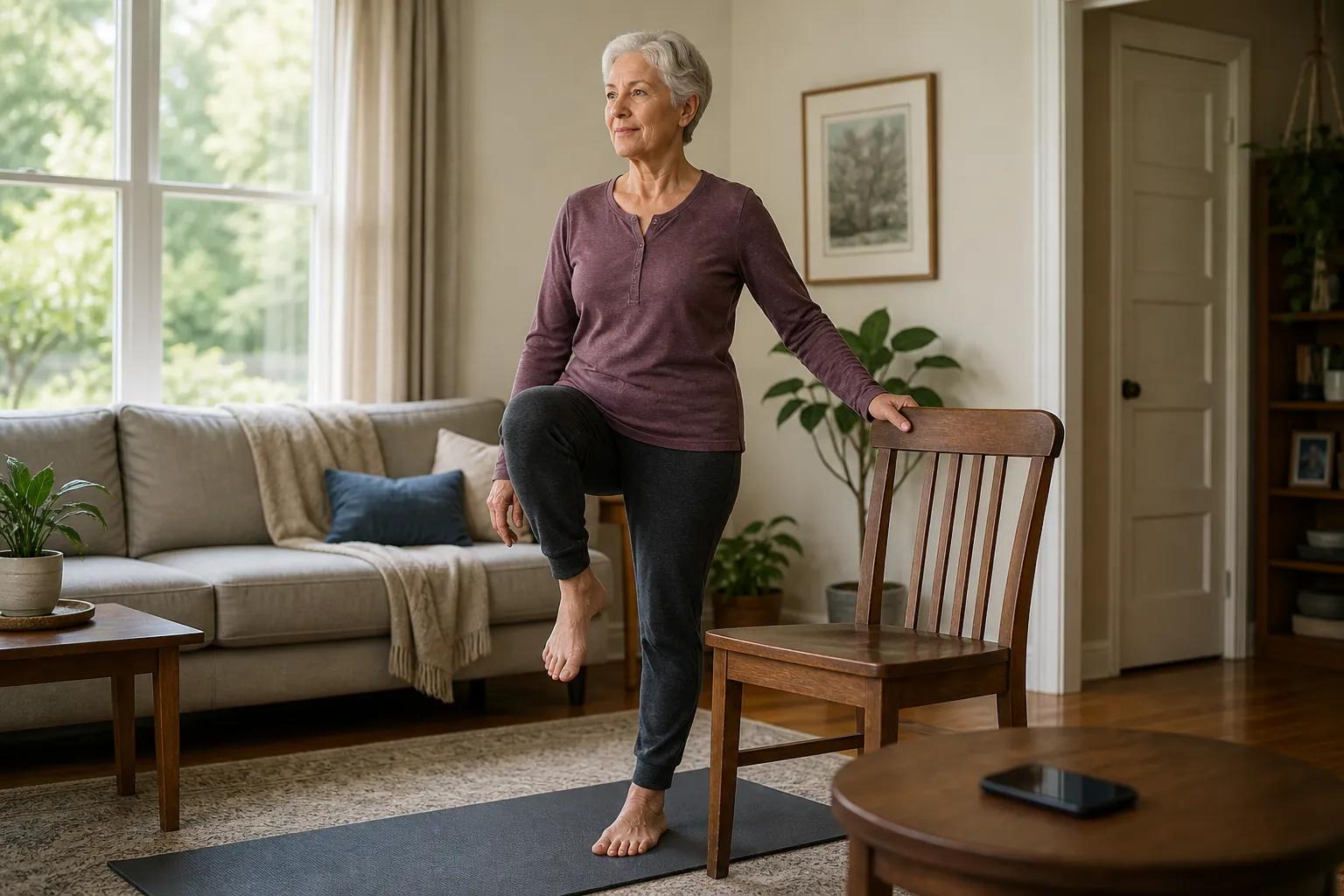
Before you time anything, make the test fall-safe
The most important part of this test happens before the clock starts. If someone falls while trying to “prove” their balance, the test has failed its purpose.
- Do it barefoot on a dry, non-slip surface.
- Stand next to a sturdy chair, countertop, or wall within arm’s reach.
- Keep a phone or timer ready before lifting a foot.
- Have another person nearby if you already feel unsteady, have had recent falls, or are nervous about closing your eyes.
- Stop immediately if you feel dizzy, unsafe, or as if you need to grab for support.
Johnson’s version and later health coverage both emphasize basic safety: barefoot testing, a stable surface, a timer, and support nearby.[1][2] For older adults, that is not fine print. It is the test.
How to do the one-leg balance test at home
Use this as a calm screen, not a dare. If closing your eyes feels unsafe, do not force it. Make a note that the eyes-closed version was not safe to attempt, and bring that information to a clinician.
- Stand upright near your support surface, with your feet flat and your timer ready.
- Choose one leg to stand on. If one side is known to be weaker or painful, start with the safer side.
- Lift the other foot slightly off the floor.
- If safe, close your eyes and start the timer.
- Stop the timer when your raised foot touches down, you open your eyes, you grab the chair or wall, or you feel unsafe.
- Do not keep going past 30 seconds. The point is not endurance; it is a quick screen.
Write down the time, the side tested, and anything that affected the result: shoes accidentally left on, a slippery floor, a pet walking by, dizziness, pain, or needing to touch the chair. Those notes are often more useful than the number alone.
What Bryan Johnson says the seconds mean
Johnson’s published framework maps the time you can stand on one leg, eyes closed, to broad “biological age” ranges. These ranges are memorable, which is why they travel well online. They should be read as Johnson’s interpretation, not as a clinical standard.
| Eyes-closed one-leg time | Johnson’s published biological-age range |
|---|---|
| 0–7 seconds | About 60–80 years |
| 7–15 seconds | About 40–60 years |
| 15–30 seconds | About 20–40 years |
The table is useful only if it does not become a label. A 72-year-old who stands for 6 seconds has not diagnosed themselves as biologically 80. A 65-year-old who reaches 30 seconds has not proven they have low fall risk. The result is a prompt to look more closely at balance, strength, medication effects, vision, foot pain, blood pressure changes, home hazards, and confidence while moving.
What the research supports — and what it does not
The reason this test deserves attention is not that it turns a stopwatch into a true biological-age calculator. It is that one-leg balance appears to be a meaningful functional measure in older adults.
A 2024 Mayo Clinic study of adults over 50 found that one-leg standing time declined more steeply with age than the other functional measures tested, including grip strength, gait speed, and chair-rise performance. The study also treated one-leg balance as relevant to frailty, independence, and fall status in older adults.[3]
That is a strong reason to care about the result. It is not the same as proving Johnson’s exact seconds-to-age chart. The Mayo finding supports one-leg standing time as a practical balance and function signal in adults over 50; it does not validate a specific conversion from seconds to biological age.
Cleveland Clinic’s caution is the right guardrail here: the one-leg test is “not a complete balance evaluation on its own” and is “far from a perfect indication of longevity.”[2] That does not make the test useless. It puts it in the right category: a free screen that can reveal when a more complete assessment is worth doing.
How to respond to your result
If you reach 15–30 seconds
That is reassuring, especially if the test was done safely and without grabbing support. It does not mean falls are impossible. Balance is only one part of fall risk, and real homes add complications: stairs, rugs, poor lighting, pets, medication side effects, illness, dehydration, and rushing to the bathroom at night.
If the result is much worse than it used to be, or if you feel less steady during daily tasks, the number still deserves attention. A “good” test on one quiet afternoon should not overrule what you are noticing in the kitchen, shower, yard, or hallway.
If you land in the 7–15 second range
Treat this as a yellow light. Repeat it another day with the same safe setup, especially if the first attempt was affected by distraction, fatigue, pain, or nerves. If the result is consistently in this range, or if daily movement already feels less secure, it is reasonable to ask a clinician whether a formal balance check would help.
For an adult child, this is often the least confrontational way to raise the subject. The conversation does not have to begin with “I’m worried you’re going to fall.” It can begin with, “I saw this free balance screen. Want to try it together, with the chair right there?”
If you are at 0–7 seconds, cannot close your eyes safely, or need to grab support
Do not keep practicing the test in a risky way. A low score, an aborted attempt, or a strong need to hold on is enough information for the day. The next step is not to push harder; it is to get a fuller look at why balance is limited.

A doctor or physical therapist can evaluate more than one-leg standing time: walking pattern, leg strength, reaction to turning, vision concerns, medication effects, blood pressure changes, foot and ankle problems, dizziness, and fear of falling. That matters because two people can get the same stopwatch result for very different reasons.
Balance training may improve performance. Coverage of Johnson’s test notes options such as tai chi and physical therapy as ways people may work on balance, especially when a screen suggests weakness or instability.[2] For an older adult with a low score, supervised guidance is usually safer than improvising harder balance drills at home.
FAQ
Is this really an anti-aging test?
Only in a loose, functional sense. Balance tends to change with age, and one-leg standing time can reflect important physical capacity. But “biological age” can mean many things, including lab-based measures that this test does not assess. At home, it is more accurate to call this a balance and fall-risk screen.
Should I test both legs?
If it is safe, testing both sides can be informative because one side may be weaker, more painful, or less steady. Keep support within reach for both attempts. If one side feels unsafe, skip that side and mention it during a clinical visit.
How often should I repeat it?
There is no need to turn it into a daily scorecard. Repeat it when you want a simple comparison under similar conditions, after starting balance training, or after noticing a change in steadiness. If the number drops suddenly, or if the test starts feeling unsafe, that change is more important than any single score.
What if I am afraid to try it?
That is already useful information. Fear of losing balance can change how someone moves through the house, avoids stairs, showers, shops, or gets out for social plans. If the test feels too risky even with a chair nearby, skip it and ask for a formal balance assessment instead.
What should caregivers do after a concerning result?
Start with the least dramatic useful step: write down the result, note whether the person felt dizzy or unsteady, and suggest bringing it up at the next medical appointment. If there has already been a fall, near-fall, new weakness, new dizziness, or a sudden change in walking, do not wait for a routine visit.
It also makes sense to pair the result with a home safety look-through: lighting, loose rugs, bathroom grab points, footwear, cluttered walking paths, and frequently used items stored too high or too low. The balance test tells you the person may have less margin for error; the home environment often determines how costly that small loss of margin becomes.
The useful takeaway
Bryan Johnson helped popularize a free test that can make balance risk visible in under a minute. That is worth keeping. The part to set aside is the temptation to treat the stopwatch as a verdict on biological age.
Use the one-leg balance test as a low-cost screening signal. If the result is steady, keep it as a baseline. If it is borderline, repeat it safely and watch for changes. If it is low, unsafe, or paired with real-world unsteadiness, bring it to a doctor or physical therapist and look seriously at fall-prevention and mobility support.
References
Browse more in the Glossary.