
Product term
Which 2027 Car Safety Features Protect Older Drivers Most?
Last verified 2026-07-26
The useful way to compare car safety features for elderly drivers in 2027 models is not to ask which vehicle has the longest technology list. It is to ask which features meet the crashes older drivers are actually more likely to face: intersections, left turns, backing, side impacts, and moments when a driver looks in the right direction but misses what is there.
That distinction matters at the dealership. For drivers 80 and older, intersections account for 43% of fatal crashes, compared with 24% for drivers ages 16 to 59. IIHS also identifies inadequate surveillance—often described as looking but not seeing—as the most frequent error among crash-involved drivers 70 and older.[1] Those two facts move blind-spot monitoring, left-turn assist, and automatic emergency braking out of the “nice to have” pile and into the features worth confirming on the exact vehicle being purchased.
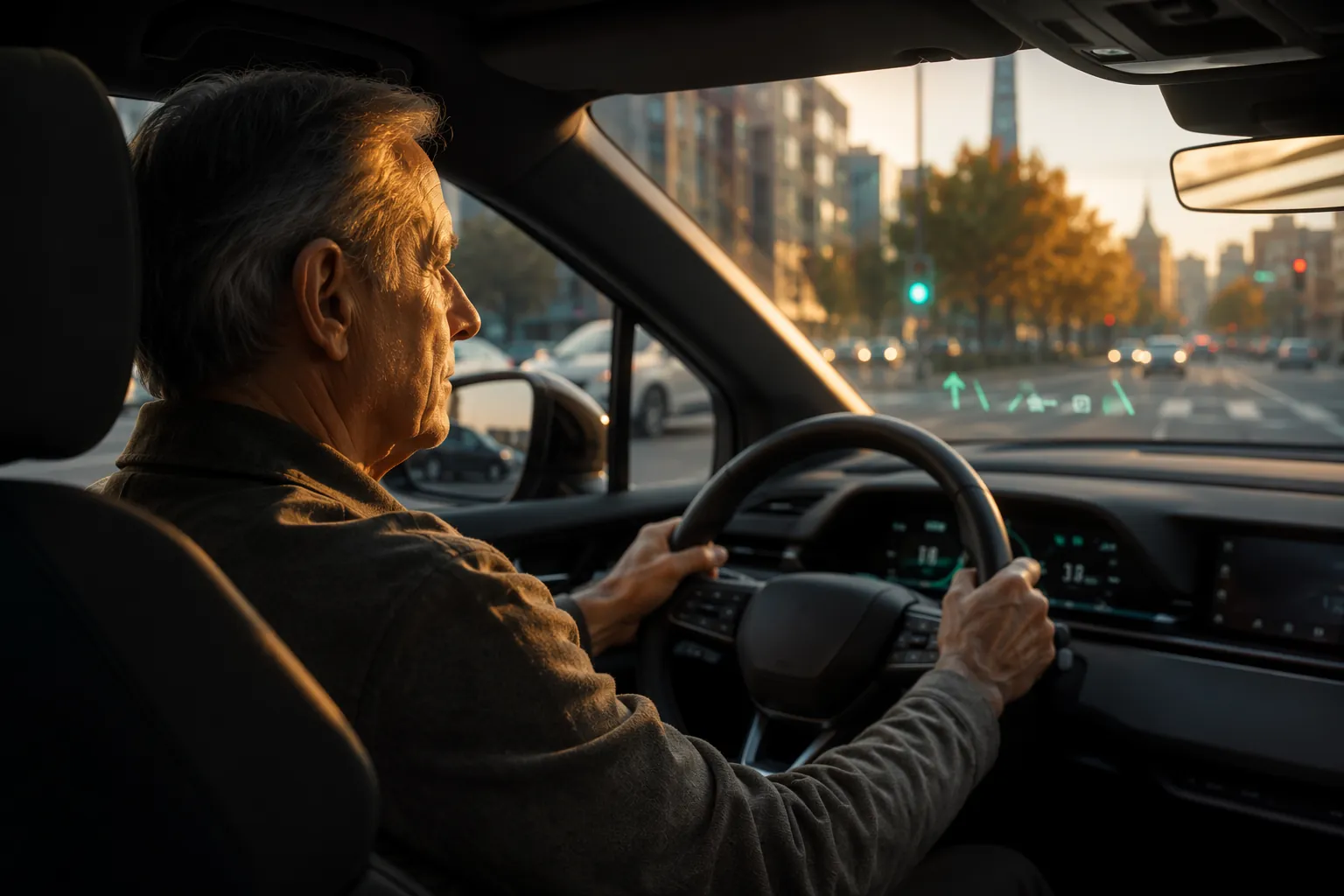
This does not mean older adults are unsafe drivers as a group, or that a new car can settle every question about fitness to drive. It means the best safety package is the one that supports the driver at the specific points where aging vision, slower scanning, limited neck rotation, and frailer bodies can turn an ordinary errand into a severe crash.
Start With The Crash Pattern, Not The Brochure
A 2027 model may advertise driver assistance, collision avoidance, parking help, lane support, camera views, and connected alerts. Some of those features may be bundled together. Some may be standard on one trim and optional on another. Some may be renamed by the manufacturer. The practical sorting question is simpler: what situation does this feature change?
| Older-driver risk to think about | Safety feature that directly addresses it | What to verify before buying |
|---|---|---|
| Intersection and left-turn crashes | Left-turn assist, automatic emergency braking, forward collision warning | Whether the system works during turns across traffic, not only straight-ahead driving |
| Looking but not seeing nearby vehicles | Blind-spot monitoring and rear cross-traffic alert | Whether the alerts are visible, audible, and understandable to the driver |
| Rear-end crashes | Automatic emergency braking and forward collision warning | Whether AEB is standard and active at the speeds the driver commonly uses |
| Backing crashes | Rear automatic braking, rearview camera, rear parking sensors | Whether the driver can interpret the camera view and will respond to alerts |
| Side-impact injury and fatality risk | Side-curtain airbags with head and torso protection | Whether occupant protection is included for the seating positions that matter |
This is where an older vehicle becomes part of the safety question. IIHS has found that older drivers tend to drive older vehicles that lack modern occupant protection.[1] For a family replacing a long-kept sedan or compact SUV, the upgrade may not be about chasing novelty. It may be the first time the driver gets crash-avoidance alerts, stronger side-impact protection, or a camera view that was never available in the old car.
Automatic Emergency Braking Is Most Useful When It Is More Than A Warning
Automatic emergency braking, usually called AEB, watches ahead of the vehicle and can apply the brakes if the driver does not react quickly enough to a possible collision. Forward collision warning is related, but weaker: it alerts the driver; AEB can intervene.
AARP cites Mazda vehicle safety compliance manager Jennifer Morrison saying AEB prevents approximately half of all rear-end crashes.[2] That is not the same as saying it prevents half of all crashes for older drivers. It means AEB has strong value in one common crash type, especially when a driver is delayed by distraction, glare, traffic complexity, or slower reaction time.
For an older driver, the buying question is not just “does it have AEB?” It is “when does it work?” Some systems are better at vehicle detection than pedestrian or cyclist detection. Some operate across a broader speed range than others. Some give a warning first; others brake more assertively. A short test drive cannot prove how the system will perform in a real emergency, but it can show whether the warning sound startles the driver, whether the dashboard message is readable, and whether the salesperson can explain the system without vague reassurance.
AEB also belongs in the intersection conversation, but carefully. Basic forward AEB is mainly about what is ahead. It should not be assumed to protect a driver making a left turn across oncoming traffic unless the manufacturer specifically says the vehicle has intersection or turning support. That difference is worth asking about by name.
Blind-Spot Monitoring Helps With The Error Families Actually Worry About
Blind-spot monitoring does a plain job: it alerts the driver when another vehicle is in a zone that may be hard to see in the mirrors or over the shoulder. For someone with stiff neck movement, reduced peripheral vision, or less confidence merging, that small light in the side mirror can matter.
Its importance comes from the crash record. If inadequate surveillance is the most frequent error among crash-involved drivers 70 and older, a feature that supports scanning is not cosmetic.[1] It does not excuse the driver from looking. It gives the driver another cue at the moment when a missed vehicle can become a sideswipe, merge crash, or intersection conflict.
The feature is only useful if the older driver notices and trusts it. During a test drive, watch for practical details: Is the mirror icon large enough? Is the warning tone too soft or too sharp? Does the driver understand the difference between a steady light and an urgent alert? Can the driver still see the mirror comfortably after the seat has been adjusted for safe pedal reach?
This is also where technology adoption becomes more than a statistic. In the AAA Foundation’s LongROAD research from 2018–2020, only 22% of older drivers had forward collision warning and 19% had blind spot warning in their vehicles. More concerning, older drivers with greater cognitive concerns used available technologies less.[3] A feature buried in a settings menu, misunderstood after delivery, or turned off because it is annoying is not protecting anyone.
Left-Turn Assist Deserves A Direct Question
Left turns across traffic ask a driver to judge speed, distance, gaps, pedestrians, signal timing, and the vehicle’s own acceleration all at once. That is demanding at any age. For an older driver who still handles familiar roads well but hesitates at busy intersections, a turn-specific safety feature may be more relevant than a long list of convenience technology.
Left-turn assist, sometimes described under intersection assistance or junction support, is designed to help detect an oncoming vehicle when the driver is turning left. Depending on the system, it may warn, brake, or both. The important point is that it addresses the intersection pattern directly rather than treating every forward crash the same way.
Because naming varies, shoppers should avoid assuming that “driver assist,” “collision mitigation,” or “safety suite” includes left-turn help. Ask the dealer to show the feature in the official equipment list for that exact VIN or order sheet. If the answer is a general statement about the brand’s safety technology, keep asking until the turning function is identified or ruled out.
Rear Cameras, Parking Sensors, And Rear Automatic Braking Solve A Different Problem
Backing crashes are not the same as highway crashes, and the right tools are different. A rearview camera shows what is behind the vehicle. Rear parking sensors warn as the vehicle approaches an object. Rear cross-traffic alert watches for traffic approaching from the side while backing out. Rear automatic braking can apply the brakes if the driver does not stop in time.
IIHS research found rearview cameras and rear parking sensors to be especially effective for drivers 70 and older in preventing police-reported backing crashes.[1] That makes these features especially practical for drivers who still do most of their travel close to home: grocery lots, medical offices, driveways, church parking lots, and apartment garages.
Rear automatic braking is worth special attention because it does not rely only on the driver interpreting the screen quickly. A camera can help only if the driver looks at it, understands the image, and reacts. Sensors can help only if the driver hears and respects the warning. Rear automatic braking adds a last layer when the driver is late.
Still, fit matters. If the screen is low, washed out by sunlight, cluttered with too many guide lines, or hard to read through bifocals, the camera may not help as much as expected. The same is true if the driver turns the alert volume down because it feels irritating. A parking-lot test is not a formality; it is part of the purchase decision.
Side-Curtain Airbags Are Not Driver Assistance, But They May Be Crucial
Some of the most important protection in a 2027 vehicle will never beep, flash, or appear in a sales demonstration. Side-curtain airbags deploy from the roof area along the side windows during certain side impacts and rollovers. Side torso airbags may deploy from the seat or door area to protect the chest and abdomen.
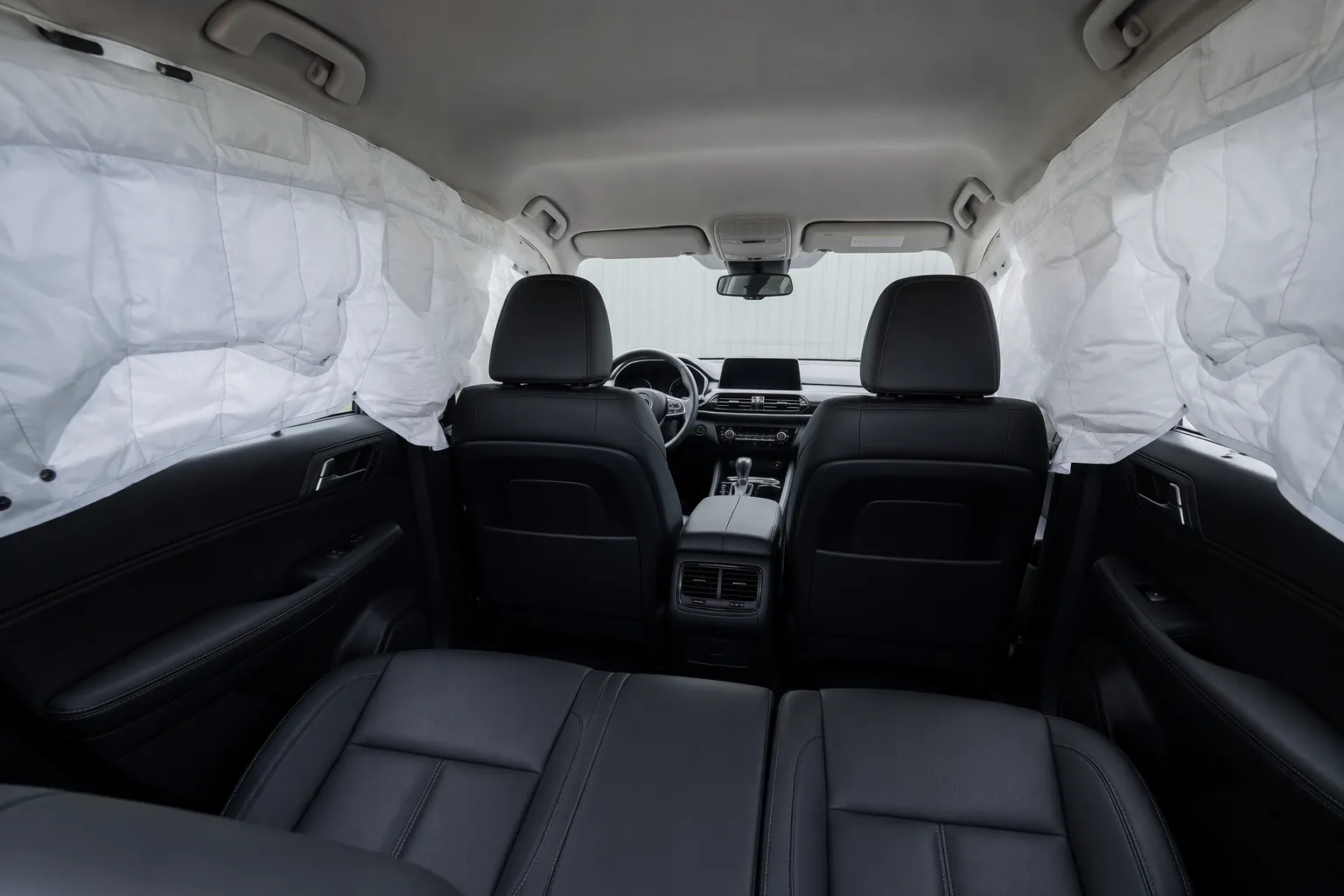
This matters because older bodies are less forgiving in a crash. A NHTSA analysis published in 2013 found that side airbags with head and torso protection reduced fatalities in nearside impacts by 45% for front-seat occupants 70 and older, compared with 30% for occupants ages 13 to 49.[4] That figure is dated, and newer designs may differ, but it is still directly relevant to the question families face: if a side impact happens, what protection is around the driver?
Unlike blind-spot monitoring or AEB, airbags do not prevent the crash. They reduce injury risk after the crash has begun. That is why they should not be treated as interchangeable with driver-assistance features. For an older driver, both sides of the safety equation matter: avoid the crash when possible, and protect the body when avoidance fails.
Lane Keeping And Adaptive Cruise Are Secondary Unless They Match The Driver’s Real Use
Lane departure warning, lane keeping assist, adaptive cruise control, and similar highway features can be helpful, especially for drivers who still travel on faster roads. IIHS has estimated that front crash prevention, blind spot detection, and lane departure warning together could address roughly one-fifth of older drivers’ annual crash involvements, 18% of their injuries, and a quarter of their fatalities.[1]
The reason these features do not lead the list here is not that they are unimportant. It is that many older drivers reduce night driving, highway driving, or long-distance trips before they give up local driving. If the driver’s riskiest moments are left turns near home, backing out of angled parking, and merging into busy suburban traffic, a highway-centered feature should not distract from the systems that address those situations more directly.
What 2027 Model Announcements Can And Cannot Tell You
Dealer and manufacturer pages for upcoming model years are useful for seeing where the market is headed. For example, dealer material for the 2027 Subaru Ascent describes advanced safety features as part of the model’s appeal.[5] That kind of announcement is a starting point, not proof that a particular feature will be standard on the trim sitting in front of you.
Model-year information can change before final release. Packages can shift. A feature may be standard on a higher trim, optional in a bundle, unavailable with a certain configuration, or present under a brand-specific name. For a caregiver helping with the purchase, the safest habit is to move from the advertisement to the window sticker, then to the owner’s manual, then to a live explanation in the car.
How To Verify The Right Features Before Buying
The best 2027 safety package for an older driver is not the one with the most acronyms. It is the one the driver will actually use, on the roads they actually drive, in the situations most likely to hurt them.
- Prioritize intersection and left-turn protection if the driver hesitates, misjudges gaps, or avoids busy crossings.
- Prioritize blind-spot monitoring if shoulder checks are limited or lane changes have become stressful.
- Prioritize AEB and forward collision warning if traffic stops, glare, or delayed reactions are realistic concerns.
- Prioritize rear automatic braking, rearview cameras, and parking sensors if most driving involves lots, driveways, and short local trips.
- Prioritize side-curtain and torso airbag protection because older occupants may face higher injury risk once a crash occurs.
Then test the human side. Have the older driver sit in the car with the seat, mirrors, steering wheel, and display adjusted properly. Ask them to explain what the blind-spot light means, what sound the parking sensor makes, how to tell whether AEB is on, and where to find the safety settings. If the answer is confusion, that is not a personal failure. It is a delivery problem that needs solving before the car goes home.
Technology should support safer mobility, not become a polite way to avoid harder conversations. If driving at night, handling complex intersections, or responding to fast-moving traffic is no longer safe, a newer vehicle does not erase that. But when an older adult is still driving appropriately, the right safety features can preserve ordinary independence with fewer unprotected moments.
For 2027 models, the features worth pressing hardest on are the ones that match the real crash map: left-turn and intersection support, blind-spot monitoring, automatic emergency braking, rear automatic braking with camera and sensor support, and side-curtain airbags with head and torso protection.
References
- Older Drivers — IIHS
- 5 Car Safety Systems Older Drivers Should Not Skip — AARP, May 2024
- In-Vehicle Technology Use and Associated Factors Among Older Drivers — AAA Foundation for Traffic Safety
- Older Drivers — Countermeasures That Work — NHTSA
- Advanced Safety Features of the 2027 Subaru Ascent — Wayne Subaru, July 16, 2026
Browse more in the Glossary.