
Glossary entry
7 Common Retirement Tax Mistakes Seniors Should Avoid
Last verified 2026-07-26
This is not financial or legal advice. Medicare/Medicaid and benefits rules vary by state and change over time — verify current rules with your state Medicaid office or Area Agency on Aging.
Retirement has a funny way of removing the paycheck and leaving the paperwork. The tax trouble usually does not arrive with a dramatic investment mistake. It shows up as a missed deadline, a form nobody opened, a Medicare premium notice that seems to come from nowhere, or an April tax bill that makes everyone at the kitchen table quiet.
Start with the mistake that is easiest to put in dollars: a missed required minimum distribution. If a retiree was supposed to take a $15,000 RMD and missed it, the excise tax can be 25%, or $3,750. If corrected in time under the SECURE 2.0 rules, that penalty may drop to 10%, or $1,500. That is still real money for a calendar mistake, but it is much better than letting the notice sit in a pile of unopened envelopes.[1]

That is the standard for this checklist. These are not clever tax maneuvers. They are the common retirement tax mistakes seniors should avoid because each one has a consequence, a deadline, or a threshold that can be checked before it becomes expensive.
The Seven Checks Worth Doing Every Year
| Mistake | What to Check Before Year-End |
|---|---|
| Missing an RMD | Confirm whether an RMD is due, from which accounts, and by what deadline. |
| Assuming Social Security is tax-free | Estimate combined income before filing season, especially after IRA withdrawals or pension income. |
| Skipping withholding | Set up tax withholding or estimated payments instead of waiting until April. |
| Ignoring Medicare IRMAA | Check whether a large withdrawal or conversion could raise Medicare premiums two years later. |
| Misunderstanding the new senior deduction | Confirm eligibility, income phaseouts, and the temporary 2025–2028 window. |
| Making Roth conversions in isolation | Look at tax brackets, Social Security taxation, and Medicare premiums together. |
| Forgetting state tax rules | Review state treatment of retirement income, especially after moving. |
1. Missing a Required Minimum Distribution
An RMD is not a suggestion from the brokerage firm. It is the minimum amount the tax rules require many retirees to withdraw from certain retirement accounts once they reach the applicable age. Schwab’s 2026 RMD guidance notes that SECURE 2.0 changed both the RMD age rules and the penalty structure, including the reduction from a 25% excise tax to 10% when a missed RMD is corrected within the allowed correction window.[1]

The practical fix is plain: keep a yearly RMD folder or spreadsheet with each IRA, inherited IRA, and workplace retirement account listed separately. Do not assume one custodian knows about every account. If a bank, brokerage, or old employer plan sends a notice, read it before December gets crowded.
For households where an adult child is helping, this is one of the first places to look. Ask three questions: Is an RMD due this year? Has it already been taken? Was it calculated using the correct prior-year account balance and life expectancy factor? If the answer is unclear, call the custodian or a tax professional early enough that December 31 is not doing all the work.
If an RMD was missed, do not wait for a penalty notice to explain itself. Correct the distribution as soon as possible and ask a qualified tax professional how to report the correction and request any available penalty relief. The difference between acting quickly and ignoring the problem can be measured in hundreds or thousands of dollars.
2. Assuming Social Security Will Not Be Taxed
A lot of retirees remember hearing that Social Security is a benefit, not a paycheck, and then they make the wrong leap: no paycheck means no tax. That is how April surprises happen.
Under the federal rules, up to 85% of Social Security benefits may be taxable depending on “combined income,” a measure that includes adjusted gross income, nontaxable interest, and half of Social Security benefits. The key federal thresholds begin at $25,000 for single filers and $32,000 for married couples filing jointly, and those thresholds are not indexed for inflation.[2]
That last detail matters. A threshold that does not move with inflation catches more ordinary households over time. A pension, IRA withdrawal, part-time wages, taxable interest, or capital gain can push more of a Social Security benefit into taxable territory. Kiplinger’s retirement tax coverage also flags Social Security taxation as a continuing trap for retirees who do not estimate income before filing season.[3]
The yearly check is simple enough to do before the holidays: estimate total income, add half of annual Social Security benefits, and see whether the household is likely to cross the federal combined-income thresholds. The result does not have to be perfect in October. It just needs to be close enough to prevent the sentence nobody wants to hear in April: “We should have withheld something.”
3. Forgetting to Withhold Taxes After the Paycheck Stops
Working years hide a useful habit: taxes come out before the money hits the checking account. Retirement often breaks that habit. Social Security may arrive with no federal withholding. IRA withdrawals may be taken with too little withheld. Some pension checks withhold, others do not withhold enough for the whole household picture.
Investopedia and Kiplinger both identify withholding and estimated-payment gaps as a common filing problem for retirees, especially in the first year after leaving work.[2][4]
There are two ordinary fixes. For pensions and many retirement distributions, retirees can use Form W-4P to request withholding. For Social Security, voluntary federal income tax withholding can be arranged instead of waiting until the return is filed. Some households use quarterly estimated payments instead. The right choice depends on cash flow and total tax picture, but doing nothing is the choice most likely to create a penalty or a springtime scramble.
- Check whether federal tax is being withheld from each pension, IRA distribution, annuity, and Social Security payment.
- Compare withholding against last year’s total tax, not just against one monthly payment.
- Revisit withholding after a spouse dies, a pension changes, an IRA withdrawal increases, or a home is sold.
- Keep copies of withholding elections with the annual tax folder so the person helping later can see what was requested.
4. Taking a Large Withdrawal Without Looking at Medicare IRMAA
IRMAA is one of the retirement rules that feels unfair if nobody warned you about the timing. The income-related monthly adjustment amount can raise Medicare Part B and Part D premiums when income crosses certain thresholds. For 2026, IRMAA begins above $109,000 for single filers and $218,000 for married couples filing jointly. The 2026 surcharges add $81.20 to $487.00 per month to Part B and $14.50 to $91.00 per month to Part D, depending on income tier.[5]
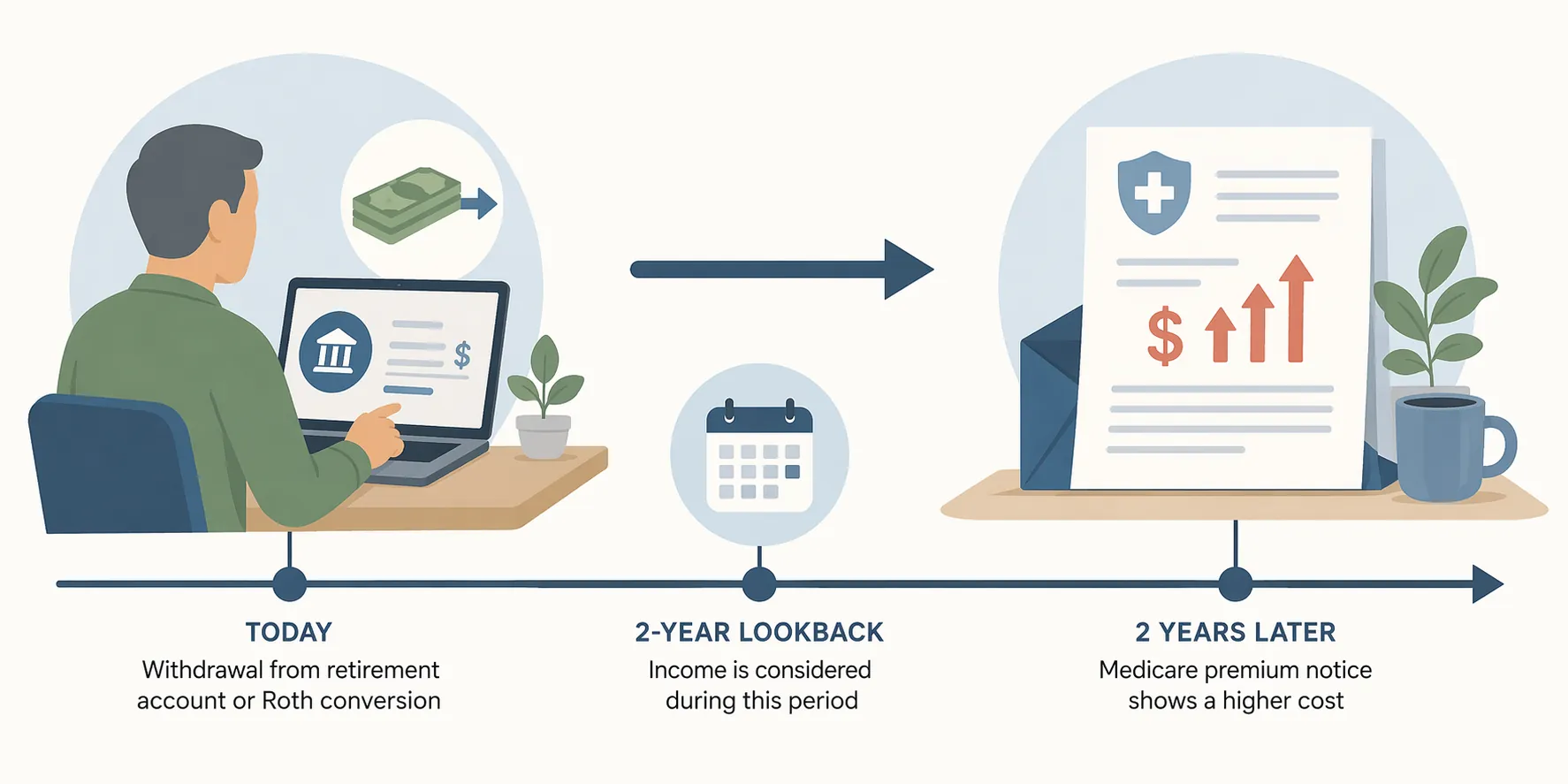
The part that catches families is the lookback. A large IRA withdrawal or Roth conversion can raise modified adjusted gross income for one year, and Medicare premiums may reflect that income two years later. Someone may make a perfectly reasonable withdrawal to replace a roof, buy a car, help a child, or convert part of an IRA to a Roth account, then receive a Medicare notice later and not connect the two events.
Before any unusually large taxable withdrawal, check three things on the same piece of paper: the current-year tax bracket, how much Social Security may become taxable, and whether income could cross an IRMAA threshold. The 2026 IRMAA dollar figures are current for this year, but Medicare brackets and surcharges are updated annually, so they should be checked again for 2027 and later.[5]
5. Believing the New Senior Deduction Solves Everything
The new senior deduction is useful, but it has already produced too much loose talk. It does not mean Social Security taxation disappeared. It does not mean every older taxpayer gets the full amount. It does not mean the rule lasts forever.
The IRS says the enhanced deduction for seniors is available for tax years 2025 through 2028. It is up to $6,000 per eligible individual, or up to $12,000 for a married couple when both spouses qualify. The deduction phases out above $75,000 of modified adjusted gross income for single filers and $150,000 for married couples filing jointly.[6]
That is worth checking, especially for households close to the phaseout range. But it should not be used as permission to ignore withholding, RMDs, or Social Security taxation. A deduction can reduce taxable income; it does not erase the need to calculate income correctly in the first place.
For 2026 planning, mark this rule as current but temporary. A household that qualifies this year may not qualify after a large IRA distribution, home sale gain, or Roth conversion. A household that does not qualify for the full deduction may still qualify for a partial amount, depending on the phaseout. This is exactly the sort of line item to confirm before filing, not after hearing a neighbor’s version of the rule.
6. Treating Roth Conversions as a Stand-Alone Decision
A Roth conversion can be a legitimate planning tool, but it is not a kitchen-table shortcut. Converting money from a traditional retirement account to a Roth account generally creates taxable income in the conversion year. Investopedia flags Roth conversion mistakes as one of the filing problems retirees can run into when they do not account for the tax impact.[2]
The mistake is not “doing a Roth conversion.” The mistake is doing one without checking what else the income touches. A conversion can increase taxable income, make more Social Security taxable, reduce or phase out deductions, and raise the risk of IRMAA surcharges later. If a widow, widower, or adult child is helping with the paperwork, this is not the place to guess from an online calculator and hope.
A safer rule is to price the conversion before making it. Ask what the conversion adds to federal taxable income, whether state tax applies, whether estimated payments or withholding should be increased, and whether Medicare premiums could be affected. If those answers are not clear, the conversion can wait until a tax professional runs the numbers.
7. Forgetting That State Taxes Have Their Own Rules
Federal tax rules get most of the attention because the forms are familiar. State rules are where retirees can still get surprised, especially after moving, becoming widowed, selling a home, or changing the mix of pension, IRA, and Social Security income. ElderLife Financial includes state tax surprises among common senior tax mistakes, with the practical warning that retirement income treatment varies by state.[7]
This is not a place for a one-size-fits-all chart. State tax treatment changes, and states draw different lines around pensions, retirement-account withdrawals, Social Security, property taxes, credits, and residency. The useful annual habit is to check the current state tax agency guidance or ask the preparer directly: “What retirement income is taxable in this state this year?”
For anyone helping a parent, also check whether the address on file is still correct with Social Security, Medicare, banks, brokerage firms, pension administrators, and the state tax department. A missing tax form or notice can become a bigger problem than the tax rule itself.
A Practical Year-End Rhythm
CareWise Guide is not a tax advisory site, and this article is general education, not financial, legal, or tax advice. Retirement tax decisions can depend on filing status, account type, state residency, Medicare status, survivor benefits, and prior-year income. When the situation is not straightforward, ask a qualified tax professional before acting.
Still, a household can prevent many expensive surprises with one yearly review before December gets away:
- Confirm whether any RMD is due and whether it has been taken.
- Estimate combined income to see how much Social Security may be taxable.
- Review withholding from pensions, IRA distributions, annuities, and Social Security.
- Check whether large withdrawals, Roth conversions, or capital gains could affect IRMAA.
- Confirm eligibility for the temporary senior deduction using current-year income.
- Review state tax rules and keep copies of notices, 1099s, SSA forms, and Medicare letters.
The costly part of retirement taxes is often not the tax code being mysterious. It is the small timing rule, the unchecked threshold, or the missing withholding election that nobody noticed until the bill arrived.
References
- Required Minimum Distributions: What's New in 2026, Schwab
- 6 Tax Filing Mistakes Retirees Make, Investopedia
- 5 Retirement Tax Traps to Watch in 2026, Kiplinger
- 7 Tax Blunders to Avoid in Your First Year of Retirement, Kiplinger
- Medicare Premiums 2026: IRMAA Brackets and Surcharges, Kiplinger
- Check your eligibility for the new enhanced deduction for seniors, IRS, July 2, 2026
- 5 Common Tax Mistakes Seniors Make, ElderLife Financial
Browse more in the Glossary.