
Clinical term
Do Creatine Supplements Work for Senior Muscle Strength?
Last verified 2026-07-27
Quick answer: yes, if it comes with strength work
If the question is whether creatine can help an older adult’s legs get stronger enough to matter for daily movement, the answer is conditional. Creatine monohydrate can help adults over 50 gain a little more strength and lean tissue when it is paired with resistance training. In a 2025 meta-analysis of 8 randomized controlled trials involving 482 adults over 50, creatine plus resistance training improved lower-limb strength more than resistance training alone, with a standardized mean difference of 0.29, and also improved lean tissue mass, with a standardized mean difference of 0.27.[1]
That does not mean creatine is a fall-prevention pill. The useful part is the pairing: stronger legs from repeated, safe muscle work, with creatine helping some people train a bit more effectively. Without regular strength work, the evidence does not support expecting meaningful muscle gains from creatine alone.[1]
- Best-supported form: creatine monohydrate.
- Common dose: 3–5 grams per day; loading is optional, not required.[2]
- Best-supported use: alongside resistance training, not as a substitute for it.[1]
- Most relevant possible benefit for older adults: modest improvement in lower-body strength and lean tissue mass.[1]
- Main safety boundary: anyone with kidney disease, complex medical problems, or multiple medications should speak with a clinician before using it.[2]
What creatine is, in plain terms
Creatine is a compound the body makes and stores mostly in muscle. It helps replenish quick energy during short bursts of effort—the kind used when standing from a chair, climbing a step, or doing a set of controlled leg exercises. Creatine monohydrate is the form most commonly studied and recommended in consumer medical guidance.[2]
Food intake matters a little. People who eat meat or fish typically get about 1–2 grams of creatine per day from diet, while vegetarians get much less and vegans get nearly none. That does not automatically mean a vegetarian or vegan older adult will respond more, but it does mean their starting point may be different.[2]
The evidence is strongest for legs, not vague “vitality” claims
The Liu et al. meta-analysis is useful because it asked the practical question: in adults over 50 doing resistance training, does adding creatine improve strength and lean tissue more than training alone? The answer was yes, but not dramatically. The lower-limb strength improvement was statistically significant and modest, which is exactly the kind of finding worth taking seriously without turning it into a miracle claim.[1]
The same review found a signal that interventions lasting up to 32 weeks showed the strongest lean-mass benefit, with an SMD of 0.57, while longer continuous use appeared to show diminishing returns. That is interesting, but it should not be treated as a settled rule for every older adult. Most of the randomized trials in the review had fewer than 100 participants, so the pattern needs replication in larger studies before anyone builds a precise timetable around it.[1]
The condition that matters: creatine plus resistance training
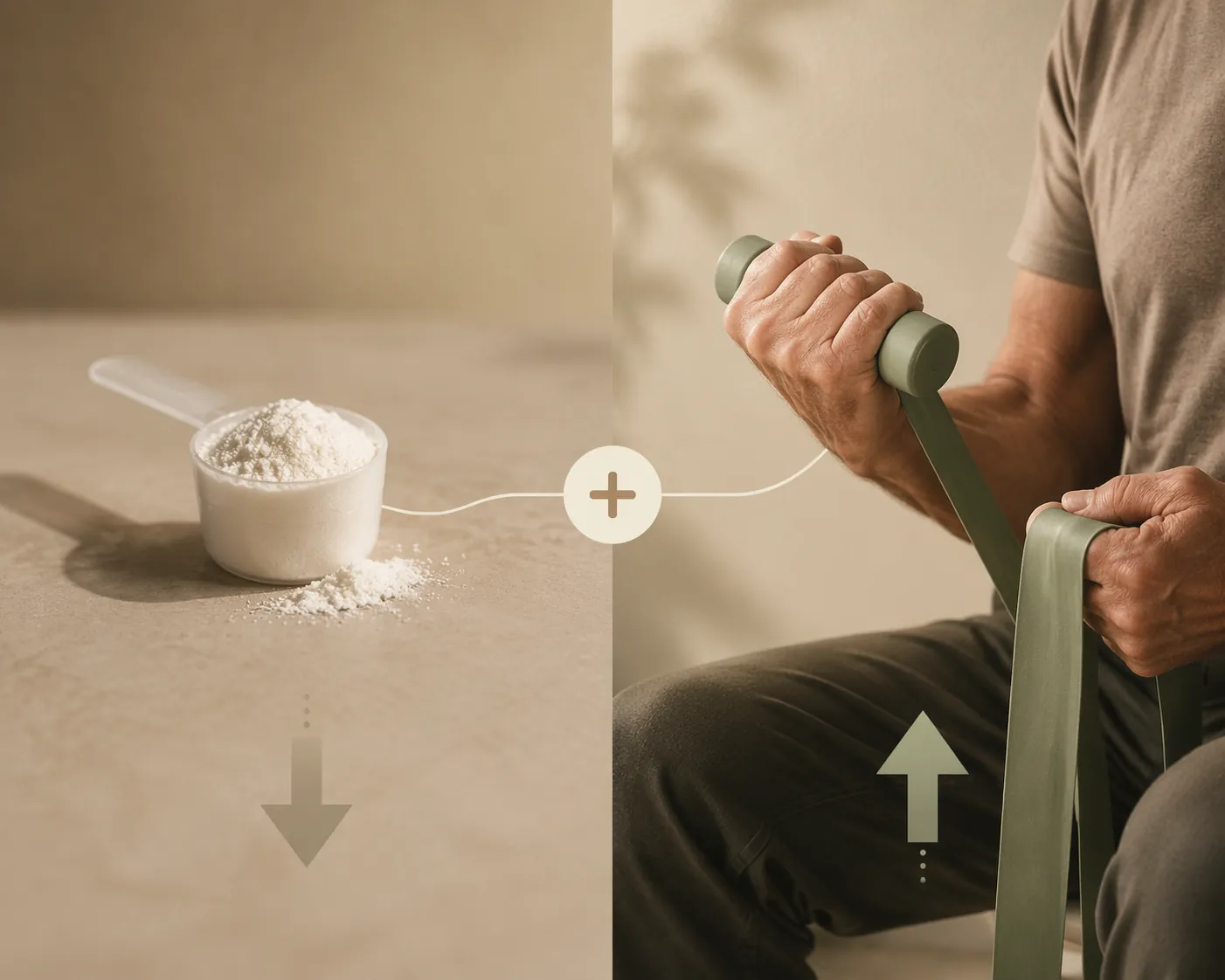
This is the part that cannot be softened: creatine helps most plausibly when the muscles are being asked to work. For an older adult, “resistance training” does not have to mean a gym, heavy barbells, or athletic coaching. It may be supervised sit-to-stands, step-ups, heel raises, resistance-band work, or machine exercises chosen by a physical therapist or qualified trainer.
The reason is simple. Creatine can support short bursts of muscular effort, but the body still needs the repeated signal to adapt. The legs get stronger because they practice producing force safely and progressively. A scoop of powder does not teach the hips, knees, ankles, and balance system how to rise from a low chair or recover after a stumble.

For someone who is frail, recently hospitalized, or afraid of falling during exercise, the first step is not buying a supplement. It is getting a safe strength plan. That may mean asking a clinician for a physical therapy referral, using a sturdy chair, working near a counter, or having someone nearby during early sessions.
How leg strength connects to fall risk
Falls are not caused by one thing, and no supplement can remove the need to check vision, medications, footwear, home hazards, dizziness, and balance. Still, lower-body strength belongs near the center of the conversation. Stronger legs help with the ordinary moments where falls often become more likely: standing up, turning, stepping over a threshold, using stairs, and correcting after a small loss of balance.
The fall-risk link should be stated carefully. Creatine itself has not been shown to “prevent falls” as a standalone intervention. But increases in leg strength matter: a 5–8% increase in leg strength is associated with approximately 20% lower odds of falling.[1]
That is why the lower-limb finding in the meta-analysis is more relevant for many older adults than a broad claim about “healthy aging.” If creatine helps someone get a little more out of a safe leg-strengthening program, the benefit may show up in movements that protect independence.
How much creatine do older adults usually take?
A typical dose is 3–5 grams per day of creatine monohydrate. Some protocols use a short “loading” period, but loading is optional; many people simply take the daily maintenance dose consistently.[2]
There is no special reason, for this purpose, to start with complicated blends, stimulant formulas, or bodybuilding-style stacks. If a clinician agrees that creatine is reasonable, the plain monohydrate form is the practical starting point. It can be mixed into water or another drink, and the main habit is daily consistency while the strength plan is happening.
Safety: generally reassuring is not the same as automatic
For healthy adults, creatine monohydrate is generally described as well tolerated when used at recommended doses, and major medical sources now discuss it as relevant beyond athletic performance.[2][3] A March 2025 Northeastern University review also framed creatine as a supplement with evidence for older adults, while still emphasizing that it is not a cure-all and should be used with appropriate caution.[4]
The kidney question deserves more than a quick reassurance. People with pre-existing kidney disease should avoid creatine unless their clinician specifically advises and monitors it. Anyone with reduced kidney function, uncertain kidney labs, multiple chronic conditions, or a long medication list should ask before starting.[2][5]
This caution is not the same as saying creatine damages healthy kidneys at standard doses. WebMD’s older-adult safety summary addresses kidney concerns and distinguishes healthy adults from people who already have kidney problems.[5] That distinction matters, especially for seniors who may not know their current kidney function.
Common side effects can include temporary weight gain from water retention and digestive upset such as bloating, cramping, or diarrhea, especially with larger amounts. Taking the smaller daily dose rather than a loading protocol may be easier for some people to tolerate.[2][5]
There is also a limits-of-evidence issue. The strength data are encouraging, but many trials are small, and safety evidence is thinner for adults over 80, people with several serious medical conditions, and those taking multiple medications. It is reasonable for a healthy 62-year-old and a medically complex 86-year-old to have different risk discussions.
Who should ask a doctor first?
- Anyone with known kidney disease or reduced kidney function.
- Anyone who has not had kidney labs checked recently and has diabetes, high blood pressure, or other conditions that can affect kidney health.
- Adults taking multiple prescription medications or diuretics.
- Adults over 80 or anyone who is frail, recently hospitalized, or losing weight unintentionally.
- Anyone preparing for surgery or being treated for a serious chronic illness.
This article is general health information, not medical advice. A clinician can help decide whether creatine fits the person’s kidney function, medication list, fall history, and strength plan.
What about memory or brain benefits?
Creatine is sometimes promoted for cognition, but those claims are less settled than the evidence for strength when paired with resistance training. For a senior worried about falls, the better-supported reason to discuss creatine is muscle function, not memory enhancement.[4]
What timeline is realistic?
The studies reviewed by Liu et al. did not prove a single “best” duration for every older adult. The strongest lean-mass signal appeared in interventions up to 32 weeks, but that finding came from one meta-analysis and needs more confirmation.[1]
In practice, progress should be judged by function as much as by muscle measurements: standing from a chair with less help, walking with more confidence, climbing a step more safely, or completing a prescribed exercise set with better control. If none of those are improving, creatine is not the first thing to adjust—the strength plan, medical issues, pain, nutrition, sleep, and fear of falling may need attention.
Bottom line
Creatine monohydrate is a reasonable supplement for many older adults to discuss with a clinician as part of a strength plan. The best evidence supports 3–5 grams per day combined with resistance training for modest improvements in lower-body strength and lean tissue mass. It is not a standalone fall-prevention strategy, and it is not automatically appropriate for people with kidney disease, complex medical problems, or uncertain medication interactions.
References
- Effects of creatine supplementation combined with resistance training on lean tissue mass and muscle strength in older adults: a systematic review and meta-analysis, European Review of Aging and Physical Activity, 2025.
- What is creatine? Potential benefits and risks of this popular supplement, Harvard Health.
- Creatine Beyond the Gym: What Older Adults and Non-Athletes Should Know, Mayo Clinic.
- Is creatine safe and effective for older adults?, Northeastern University, March 21, 2025.
- Is Creatine Safe for Older Adults?, WebMD.
Browse more in the Glossary.