
Clinical term
Why Dehydration Is the Real Cyclospora Risk for Older Adults
Last verified 2026-08-02

The quiet danger in cyclosporiasis is often sitting in plain view: the half-finished cup, the long stretch without a bathroom trip, the older adult who does not feel thirsty while watery diarrhea keeps pulling fluid and salts out of the body. When families search for cyclospora infection risks for an older parent, the most useful answer is not a parasite lesson. It is a hydration-and-strength plan.
AARP’s cyclosporiasis guidance names dehydration from prolonged watery diarrhea as the primary concern for older adults, and Stanford infectious disease expert David Relman warns that extreme diarrhea can cause dangerous dehydration, electrolyte imbalance, kidney-damage risk, and up to 10% weight loss, making it “potentially very serious” for older people [1][2]. The mismatch is that thirst becomes a weaker alarm with age. AARP geriatricians note that thirst drops sharply after about age 80, while total body water falls to roughly 40% to 45% in older adults [3].
So the home job is physical and measurable: replace fluid and electrolytes, track whether the body is keeping up, stop home care when named warning signs appear, then rebuild food and strength slowly enough to prevent a fall.
This article is for home monitoring and caregiver planning. It is not a diagnosis or a substitute for medical advice. Older adults with heart failure, kidney disease, diabetes, diuretic use, blood-pressure medicines, or potassium-affecting medicines should involve a clinician early rather than trying to force a generic fluid target.
The home protocol, before the details
| Caregiver task | What to do at home | When it stops being home care |
|---|---|---|
| Replace | Offer small, frequent sips of oral rehydration solution, especially after loose stools. | If fluids cannot stay down, urine drops off, or dizziness/confusion appears, escalate. |
| Choose drinks | Use ORS for replacement. Use water as support, not the only drink. Avoid sugary, alcoholic, caffeinated, and carbonated drinks. | If the person has kidney, heart, diabetes, or medication concerns, ask a clinician what ORS and volume are safe. |
| Monitor | Track loose stools, fluid taken, urine timing and color, vomiting, mental status, dry mouth, pulse/racing heart, and standing/walking ability. | No urine for about 8 hours, trouble waking, confusion, dark urine, fainting, or inability to stand/walk safely needs urgent help. |
| Escalate | Call sooner for dizziness, confusion, decreased urination, dry mouth, or rapid heartbeat after 1–2 days; also for more than 6–8 stools per day or no improvement after 2–3 days. | Use emergency care for severe dehydration signs, inability to keep fluids down, high fever, or worsening weakness. |
| Recover | Continue fluids, small bland meals, and fall precautions after diarrhea improves. | Weakness, dizziness on standing, or poor intake means the recovery window is still open. |
A simple paper log works better than memory. Put times next to drinks, stools, urine, vomiting, and standing attempts. The point is not to police the older adult; it is to make the pattern visible before weakness becomes a bathroom fall.
How much fluid: use ranges, not one magic number
The most annoying part of diarrhea care is also the honest part: reputable sources do not give one single adult rehydration dose. They are describing different illness severity, settings, and assumptions. That matters for an older adult whose heart, kidneys, sodium level, and medicines may not tolerate either under-hydration or overcorrection.
| Source or setting | Fluid amount stated | How to use it |
|---|---|---|
| Quebec gastroenteritis guidance | 100–240 mL of rehydration solution after each loose stool | Useful as a stool-by-stool replacement target when the person can sip steadily [4]. |
| StatPearls adult dehydration guidance | 1–2 L of ORS over the first 4 hours | A clinical rehydration range; use caution in older adults and those at risk from excess water or sodium shifts [5]. |
| Banner Health adult diarrhea/vomiting guidance | 2–4 L over 3–4 hours for adults | A larger adult range that may be too aggressive for some frail older adults without clinician guidance [6]. |
| Emergency Care BC oral rehydration guidance | About 3–4 L over 24 hours for less severe disease | A daylong range that fits slower, ongoing oral replacement when symptoms are less severe [7]. |
| Baseline daily fluid context | About 48 oz/day in AARP guidance; National Academies adequate intake of 9 cups/day for women and 13 cups/day for men age 51+; ESPEN guidance of 1.6–2.0 L/day for adults 65+ | These are baseline hydration references, not diarrhea replacement doses [3][8][9]. |
At the bedside, start smaller than the final daily total sounds. Offer a few swallows every few minutes, or a small measured amount on a schedule, especially after each loose stool. If a full glass makes nausea worse, back down to teaspoons or small sips and repeat. The caregiver’s job is not to win one big drink; it is to keep fluid moving in without triggering vomiting.
Do not push large volumes blindly in someone with heart failure, kidney disease, swelling, shortness of breath, low-sodium history, diuretics, ACE inhibitors, ARBs, spironolactone, potassium supplements, or diabetes. StatPearls warns that older adults need a cautious fluid approach and that excess water can contribute to hyponatremia, while NIDDK advises older adults to talk with a clinician before using oral rehydration solutions [5][10].
What to drink: ORS replaces; plain water only supports

Watery diarrhea is not only water loss. It also drains sodium and other electrolytes. That is why plain water can be helpful but incomplete. Backus Hospital’s Healthwise guidance notes that plain water lacks electrolytes and may not be absorbed as well during dehydration, and both Healthwise and Banner Health caution that soda, fruit juice, and many sports drinks have too much sugar or the wrong electrolyte balance for true rehydration [11][6].
A commercial oral rehydration solution is the cleanest default when the person can drink by mouth. Emergency Care BC describes WHO-type ORS as containing about 75 mEq/L sodium, 75 mmol/L glucose, and an osmolarity of about 245 mOsm/L [7]. That balance is the point: glucose and sodium together help the gut absorb fluid.
Homemade ORS should only be made with exact measurements, not a guessed spoonful. StatPearls gives one formula as 1 teaspoon salt plus 6 teaspoons sugar in 1 liter of water; Banner Health gives 4 cups water plus 6 teaspoons sugar plus 1/2 teaspoon salt; Quebec also emphasizes measured preparation for rehydration solution [5][6][4]. If there is any doubt about measuring, use a commercial product.
My working rule for families is this: ORS is the replacement drink, broth or diluted juice can add variety if tolerated and medically appropriate, plain water can sit beside them, and sugary, caffeinated, alcoholic, and carbonated drinks should stay out of the sickroom. StatPearls specifically advises avoiding caffeine, alcohol, and carbonated drinks during oral rehydration [5].
The monitoring that turns worry into decisions

Ask less “Are you thirsty?” and watch more “What has the body done in the last few hours?” The useful signals are repeatable: urine, mental status, mouth dryness, pulse, dizziness on standing, and the ability to get safely from bed to bathroom.
- Urine timing: A well-hydrated adult typically urinates every 2–3 hours, and urine should be close to tap-water color rather than dark yellow or brown [3].
- Urine amount: a clinical hydration goal is at least 0.5 mL/kg/hour, which is not something most families measure exactly at home but helps explain why long gaps without urination matter [5].
- Fluid tolerance: note whether sips stay down, whether nausea increases after drinking, and whether vomiting interrupts replacement.
- Mental status: write down new confusion, unusual sleepiness, slower responses, agitation, or not seeming like themselves.
- Standing response: dizziness on standing, faintness, needing to grab furniture, or a racing heart after standing are not just “being tired.”
- Mobility: Banner Health lists difficulty standing or walking, fainting, and trouble waking as red flags in older adults with dehydration risk [6].
A hallway count is sometimes the safest count. If the older adult values privacy, agree on a system: they tell you when they urinate, you mark the time, and nobody needs to discuss more than necessary unless the pattern turns unsafe.
When to call, and when to stop improvising
Home fluids are a bridge, not a loyalty test. The line to cross is lower for an older adult because dehydration can worsen kidney function, blood pressure control, diabetes control, medication side effects, and fall risk before the diarrhea looks dramatic.
Call a clinician sooner
- Dizziness, confusion, decreased urination, dry mouth, or rapid heartbeat after 1–2 days of illness, as advised by AARP-cited geriatrician Luis Marcos [1].
- More than 6–8 stools per day, or no improvement after 2–3 days, using AARP-cited gastroenterologist David Fisher’s threshold [1].
- Dizziness on standing or a racing heart, which Johns Hopkins infectious disease physician Amanda Sears flags as concerning dehydration signs [12].
- Fever above 101.4°F, a threshold HealthInAging includes in diarrhea guidance for older adults [13].
Use urgent or emergency care
- No urine for about 8 hours.
- Unable to keep fluids down for more than 12 hours.
- Symptoms persisting beyond 2 days with dehydration concern, which Banner Health lists among reasons to seek emergency care [6].
- Confusion, dizziness, or dark urine, which Cleveland Clinic lists as dehydration warning signs in cyclosporiasis [14].
- Trouble waking, fainting, inability to stand or walk safely, chest pain, severe weakness, or any situation where a bathroom trip cannot be made safely.
If cyclosporiasis has been diagnosed or strongly suspected, a clinician may also decide whether prescription treatment is needed. That treatment decision is separate from the caregiver’s immediate job of preventing dehydration and recognizing when oral replacement is failing.
Recovery starts before the last loose stool
The stool can improve before the body is steady. CDC notes that fatigue may continue after gastrointestinal symptoms stop, and Cleveland Clinic says most people feel better in 1–2 weeks, while occasional diarrhea can last up to a month after treatment [15][14]. That is the stretch when the older adult may look “over it” and still be weak on the way to the bathroom.
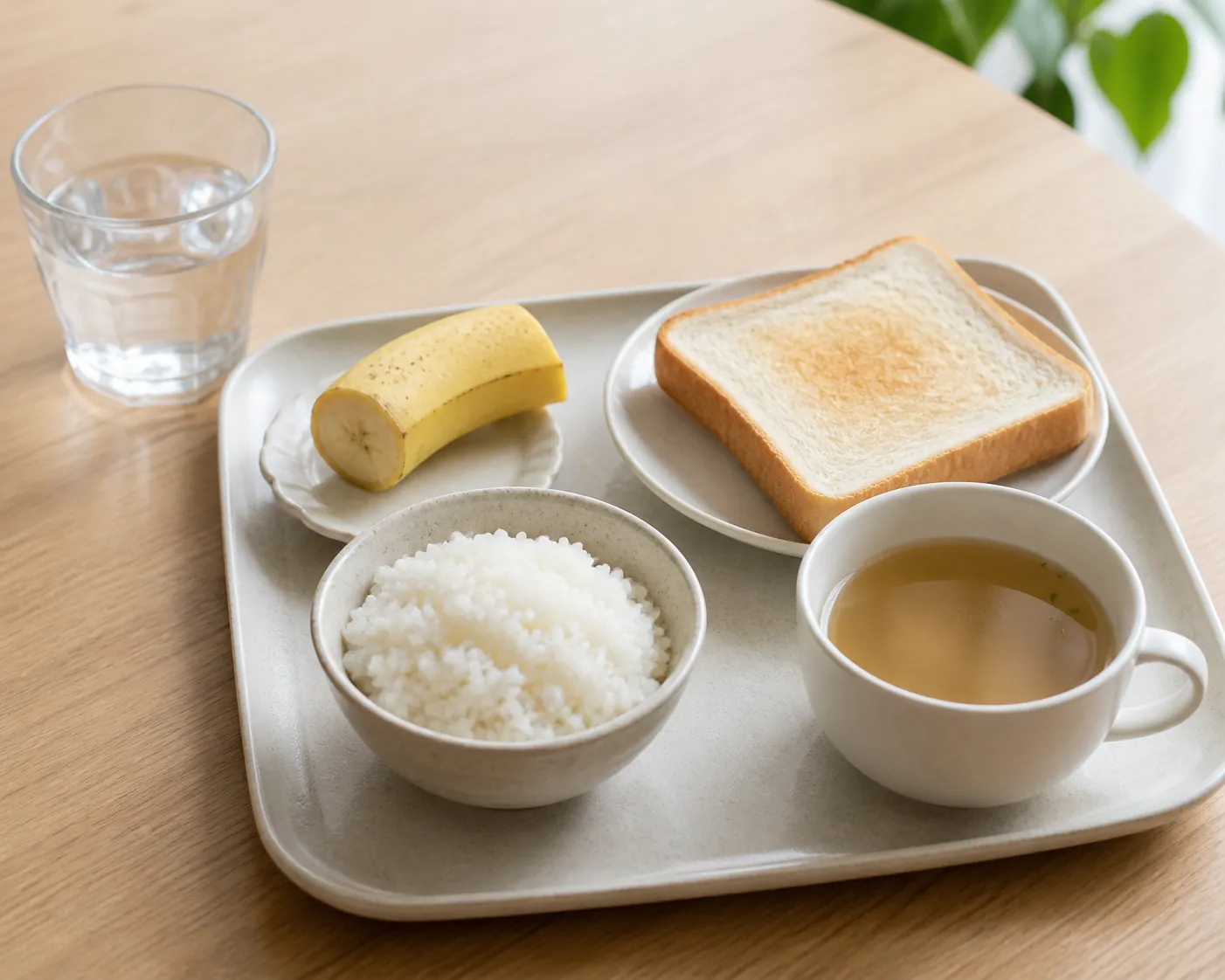
Refeeding should be plain and practical. When appetite returns, NIDDK says a normal diet can be resumed even if diarrhea continues, but many older adults do better by stepping back in gradually [10]. HealthInAging suggests small, frequent meals with bland, low-fiber foods such as bananas, rice, applesauce, mashed potatoes, dry toast, crackers, eggs, fish, poultry, cottage cheese, and yogurt, with fluids between meals rather than only with meals [13].
A clinic recommendation from Michigan Gastroenterology Institute takes a similar bland-first approach after cyclosporiasis treatment, then gradually reintroduces foods while the gut recovers over days to weeks, and sometimes longer after severe infection [16]. Treat that as a conservative feeding pattern, not as a universal rule that everyone must eat the same foods in the same order.
Potassium replacement needs special care. HealthInAging lists options such as apricot or peach nectar, bananas, and mashed or baked potatoes, but those are not casual add-ons for someone with kidney disease or medicines that raise potassium [13]. If kidney function is reduced, or if the medication list includes potassium supplements, spironolactone, ACE inhibitors, or ARBs, ask the clinician before deliberately increasing high-potassium foods or drinks.
Keep fall precautions active while strength comes back
There is not a Cyclospora study proving a specific number of high-fall-risk weeks after diarrhea. The safer conclusion is narrower: dehydration, fatigue, orthostatic dizziness, and a 1–2 week recovery timeline can overlap, so fall precautions should continue after the bathroom urgency improves.
One observational study by Hamrick and colleagues looked at 30,634 adults age 65 and older and found that 37.9% were dehydrated; dehydration was associated with falls, with an odds ratio of 1.13 and a 95% confidence interval of 1.05–1.22 [17]. That does not prove dehydration caused the falls, and it is not specific to cyclosporiasis. It does support taking dehydration-related unsteadiness seriously.
For the recovery window, keep the route from bed to bathroom lit and clear, have the person sit before standing, pause at the bedside before walking, and stay close for the first few bathroom trips after a long rest. If you want a fuller home setup, use a room-by-room fall prevention checklist and a practical fall prevention FAQ. The same dehydration-to-dizziness pattern also shows up in other illness and heat scenarios, including foodborne illness recovery and extreme heat fall risk.
The care plan ends when fluids are staying down, urine is returning to a safer pattern and lighter color, standing no longer causes dizziness or a racing heart, food is coming back without worsening symptoms, and bathroom trips are safe. Until then, the cup, the clock, and the walking path matter as much as the stool count.
References
- Cyclospora Outbreak: What Older Adults Should Know — AARP
- Cyclosporiasis diarrheal outbreak: what experts say — Stanford Medicine — July 2026
- Dehydration in Older People — AARP
- Hydrating and rehydrating when you have gastroenteritis — Gouvernement du Québec
- Adult Dehydration — StatPearls, NCBI Bookshelf
- 5 Tips to Prevent Dehydration When You Have Diarrhea or Vomiting — Banner Health
- Oral Rehydration for Adults — Treatment — Emergency Care BC
- How to Stay Hydrated for Better Health — National Council on Aging
- Nutrients hydration review — Nutrients
- Treatment for Diarrhea — NIDDK
- Rehydration drinks — Backus Hospital / Healthwise
- Cyclosporiasis Outbreak — Johns Hopkins Medicine
- Caregiver Guide: Diarrhea — HealthInAging.org
- Cyclosporiasis — Cleveland Clinic
- Symptoms of Cyclosporiasis — CDC
- How to Care for Your Digestive Health After Cyclosporiasis Treatment — Michigan Gastroenterology Institute — July 10, 2026
- Association Between Dehydration and Falls
Browse more in the Glossary.