
Clinical term
Why Dehydration Makes Cyclospora More Dangerous for Seniors
Last verified 2026-08-04
The main cyclospora outbreak risks for seniors come from dehydration, not from the parasite sounding unusual. Cyclospora can cause watery diarrhea that lasts for days and may ease up, then return. In an older adult, that can drain fluid and electrolytes fast enough to cause dizziness, blood-pressure drops, falls, kidney strain, and hospitalization.
That is why the 2026 outbreak matters at home. Public-health data from the outbreak show older adults being hospitalized at nearly twice the rate of younger patients. That does not mean every senior with diarrhea is headed to the hospital. It does mean families should stop treating several days of watery diarrhea as a routine “stomach bug” that can be waited out without a plan.
The practical question is simple: is the older adult losing more fluid than they can safely replace? If the answer might be yes, the next question is whether they are still safe getting to the bathroom. That is where cyclospora becomes a fall-prevention problem.

Why diarrhea hits older adults harder
A younger adult with diarrhea often feels thirsty, drinks, rests, and recovers without much drama. An older adult may not get the same warning signal. Aging can blunt thirst sensation, so “I’m not thirsty” is not reassuring during persistent diarrhea. It may only mean the body is not sending a strong enough alarm.
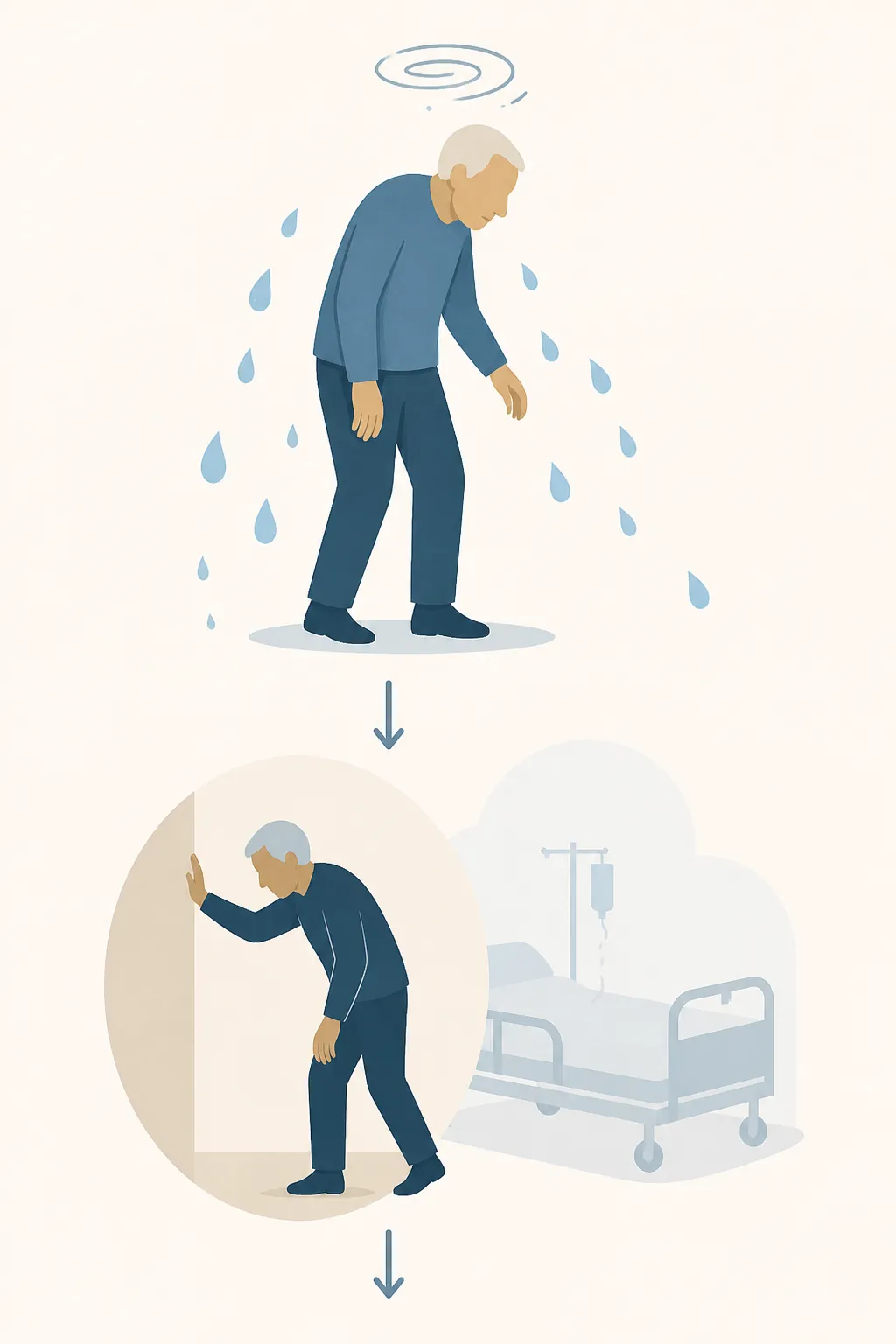
Older adults also have less reserve. A few days of watery stools can reduce the fluid circulating in the bloodstream. With less circulating volume, blood pressure can dip when the person stands up. That is the moment families often miss: the danger may show up not while the person is lying in bed, but when they get up quickly to reach the toilet.
The bathroom is already one of the worst places to get dizzy. The floor may be slick. The person may be rushing. They may be weak, half-awake, embarrassed, or trying not to ask for help. A small blood-pressure drop can turn into grabbing the sink, missing the grab bar, or going down hard.
| What is happening | What it can look like at home | Why it matters |
|---|---|---|
| Fluid and electrolyte loss | Repeated watery diarrhea, poor intake, dry mouth, unusual fatigue | The body has less reserve to maintain normal blood pressure |
| Blood pressure drops when standing | Lightheadedness, needing to sit down, bracing against the wall or sink | This is a fall warning, not just an upset-stomach symptom |
| Fall or near-fall | Stumbling on the way to the toilet, sliding off the bed, being found on the floor | Injury, head trauma, and hospitalization become real risks |
| Kidney strain | Very low urine output, worsening weakness, feeling generally unwell | Dehydration can move from uncomfortable to medically dangerous |
The outbreak detail that changes the home plan
There is a place for outbreak tracking, food-source investigations, and parasite identification. But for a family watching a parent go back and forth to the bathroom, the useful takeaway is narrower: cyclospora illness can be prolonged and watery, and that gives dehydration more time to build.
A one-time loose stool after a questionable meal is one thing. Several days of watery diarrhea in a 70-, 80-, or 90-year-old is another. The longer it continues, the less useful it is to ask only, “Do you feel sick?” A better set of questions is:
- How many times have you gone to the bathroom today?
- Are you drinking regularly, even if you do not feel thirsty?
- Are you peeing less than usual?
- Do you feel lightheaded when you sit up or stand?
- Can you get to the toilet safely every time?
Those questions are not fussy. They are how families catch the dangerous part before it becomes a fall, a kidney problem, or a rushed hospital trip.
When to call the doctor
Call a clinician when an older adult has persistent watery diarrhea, especially during a known cyclospora outbreak or after a possible food exposure. Do not wait for the person to feel thirsty. Do not wait for them to “look dehydrated.” By the time an older adult looks obviously dried out, the margin for safe home care may already be shrinking.
A doctor call is also appropriate if diarrhea eases and then returns. Relapsing symptoms can fool families into thinking the illness is ending, then restart the dehydration problem. The call does not mean the person automatically needs the emergency department. It gives a clinician a chance to decide whether testing, prescription treatment, medication adjustments, or closer monitoring are needed.
Be ready to give practical details, not just a label like “diarrhea.” Count the days. Estimate how often the person is going. Say whether they can keep fluids down, whether they are urinating normally, whether they feel dizzy standing, and whether they have had a near-fall. Those details matter more than guessing the exact germ.
A doctor call is especially important when
- The person is 65 or older and has watery diarrhea that is continuing rather than clearly improving.
- Diarrhea is interfering with normal drinking, eating, sleeping, or getting to the bathroom safely.
- The older adult says they are not thirsty but is drinking very little.
- There is new lightheadedness, weakness, or unsteadiness.
- Symptoms improve, then come back.
- The person has medical conditions or medications that make dehydration harder to tolerate.
When dizziness becomes an ER-level warning
New dizziness in a senior with ongoing diarrhea should be treated as a fall-risk signal. That does not mean panic. It means stop pretending the person can keep making solo bathroom trips as if nothing has changed.
If an older adult is too weak or dizzy to stand safely, has fainted, has fallen, seems confused, cannot keep fluids down, or is barely urinating, that moves beyond a routine call. Those are emergency-level concerns because the problem is no longer only diarrhea. It is circulation, balance, kidney perfusion, and immediate safety.
| Situation | Treat it as | Why |
|---|---|---|
| Watery diarrhea is persistent, but the person is alert, drinking, urinating, and walking steadily | Call the doctor for guidance | Cyclospora may need clinician-managed testing or treatment, and dehydration risk should be monitored |
| Diarrhea plus new dizziness when standing | Call promptly and reduce unsupervised bathroom trips | This may be a blood-pressure and fall-risk warning |
| Dizziness is severe, the person cannot stand safely, faints, falls, or seems confused | Seek emergency care | The immediate concern is safety and possible significant dehydration |
| Very low urine output, worsening weakness, or inability to keep fluids down | Seek urgent medical help | Fluid loss may be outpacing what can be managed safely at home |
The line is not whether the older adult is being “dramatic.” Many are the opposite. They underreport symptoms because they do not want a fuss. Watch function: standing, walking, drinking, peeing, thinking clearly. Function tells the truth sooner than pride does.
Testing and treatment are not do-it-yourself decisions
Cyclospora diagnosis is clinician-managed. A doctor may order stool testing when the pattern and exposure history fit. The important point for families is not to solve the laboratory side from home. The home job is to report the pattern accurately and keep the person safe while medical decisions are made.
Treatment is also a clinician decision. Some diarrheal illnesses should not be handled with random leftover medicines or whatever happens to be in the cabinet. Older adults may also take medications for blood pressure, heart disease, diabetes, kidney disease, or other conditions that change how dehydration should be handled. That is another reason persistent watery diarrhea deserves a call instead of guesswork.
What to do at home while you are monitoring
The home plan has two goals: replace fluid steadily and make bathroom trips safer. Both need to start early. Waiting until the person is shaky is how a manageable illness turns into a fall.
Push regular fluids, not thirst-based fluids
Offer small, regular amounts of fluid instead of asking, “Are you thirsty?” If the person is nauseated or does not want much, smaller sips more often may be easier than a large glass. If a clinician has given fluid limits because of heart, kidney, or other medical problems, follow that individualized advice rather than forcing large amounts.
Track output without making it complicated
You do not need a hospital chart. You do need a rough sense of whether diarrhea is continuing, whether fluid intake is improving, and whether urination is dropping off. A note on the counter or a phone log is enough. The point is to avoid the familiar evening surprise: “Actually, I think she has only peed once today.”
Treat the path to the bathroom like a fall zone
During diarrheal illness, the route from bed or chair to toilet matters. Clear throw rugs, cords, clutter, and anything the person might step around while rushing. Turn on night lights before bedtime. Keep footwear stable. If the person is dizzy, weak, or moving fast because of urgency, they should not be making repeated bathroom trips without help nearby.

Slow the stand-up
The risky moment is often the transition: lying to sitting, sitting to standing, standing to walking. Have the older adult sit at the edge of the bed or chair before standing. If they feel lightheaded, they should sit back down. This is not babying them. It is respecting the fact that fluid loss can make blood pressure less reliable.
Do not let embarrassment run the plan
Diarrhea is private, and many older adults would rather risk a rushed trip than ask for help. Families should be direct and calm: “Until the dizziness is gone, I want to know when you’re getting up.” The goal is not surveillance. The goal is preventing the bathroom-floor version of this illness.
Food safety still matters, but it is not the whole senior-risk story
During an outbreak, people naturally look for the food source. That matters for prevention and public health. At the bedside, though, knowing the suspected source does not fix the immediate risk. Once an older adult has days of watery diarrhea, the urgent work is hydration, monitoring, safe movement, and timely medical guidance.
Washing produce, following recall notices, and avoiding suspect foods can reduce exposure risk. Those steps do not replace a response plan once symptoms begin. A senior who is already dizzy from diarrhea does not need a lecture about salad greens. They need fluids, supervision, and a clinician involved if symptoms are persistent or worsening.
The bottom line for seniors
Cyclospora is dangerous for seniors because prolonged watery diarrhea can outpace an older body’s ability to compensate. Thirst may not show up strongly enough. Blood pressure may drop when the person stands. Dizziness may be the first visible sign that a fall is close.
During suspected cyclospora illness, persistent diarrhea is an urgent rehydration problem, and new dizziness is a fall warning. Treat both early.
Browse more in the Glossary.