
Clinical term
Cyclospora Outbreak Symptoms in Older Adults to Watch For
Last verified 2026-07-28
With suspected Cyclospora infection in an older adult, the symptom to watch is not only diarrhea. It is what happens after the bathroom trip: the pause before standing, the hand on the wall, the sudden need to sit back down, the new confusion that looks like fatigue but is not quite right.
That is the missed connection in many conversations about cyclospora outbreak symptoms in older adults: what to watch for. Watery diarrhea matters because it can last and drain fluid steadily. In an older body, that fluid loss can become dizziness, weakness, low blood pressure when standing, and a fall before anyone has decided the illness is “serious enough” to call.

The timing is not theoretical. In a CDC Health Alert Network advisory dated July 14, 2026, federal health officials reported 1,645 laboratory-confirmed cyclosporiasis cases across 34 states, with 141 hospitalizations. Reported patient ages ranged from 2 to 95 years, and the outbreak investigation was still current as of July 28, 2026, so counts and scope may continue to change.[1]
Those numbers do not mean Cyclospora is uniquely aggressive in older adults. The sharper concern is that prolonged diarrhea lands differently in a person with less fluid reserve, a blunted thirst response, balance problems, chronic disease, or medications that already affect fluid balance. AARP’s July 2026 reporting quoted Dr. Luis Marcos of Stony Brook Medicine warning that older adults are more vulnerable to dehydration complications, including electrolyte problems, acute kidney injury, weakness, dizziness, and falls.[2]
The Symptom Chain Caregivers Can Miss
Cyclospora infection often presents as watery diarrhea. The practical problem for caregivers is duration: untreated cyclosporiasis can last for weeks, and symptoms may seem to improve and then come back.[3] A younger adult may describe this as miserable. For an older adult, the same pattern can quietly reduce the margin of safety for walking.
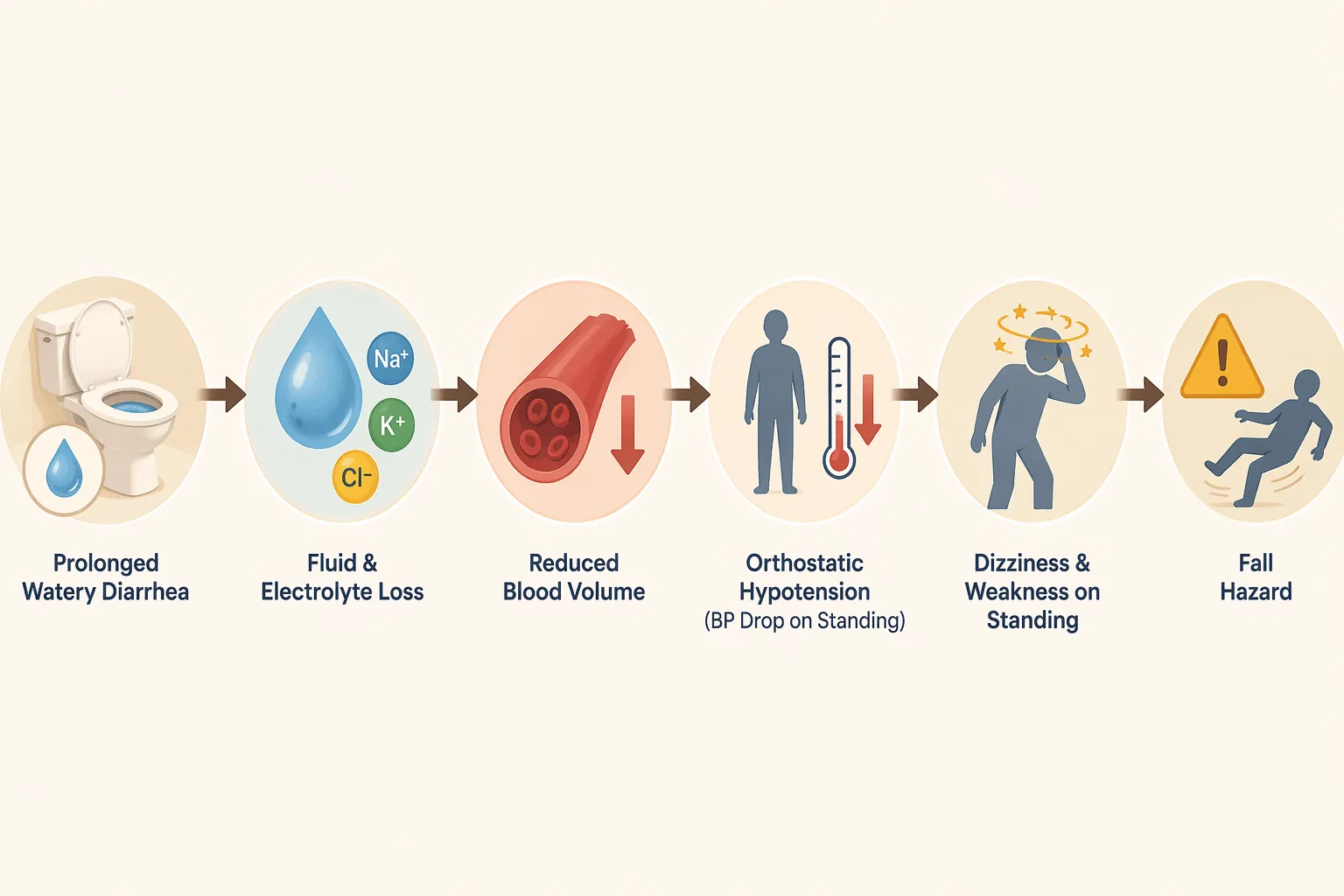
The cascade is straightforward enough to watch at home:
- Prolonged watery diarrhea removes fluid and electrolytes.
- Lower fluid volume can reduce circulating blood volume.
- When the person stands, blood pressure may drop instead of adjusting quickly.
- That drop can show up as dizziness, weakness, unsteadiness, or a need to grab furniture.
- The next bathroom trip, hallway turn, or nighttime walk can become a fall event.
This is not a Cyclospora-specific fall-rate finding; the available materials do not show a study measuring how often older adults fall during Cyclospora infection. It is an expert-supported mechanism based on dehydration, older-adult physiology, and clinical warnings. ArchWell Health’s senior-focused guidance states that dehydration from Cyclospora can increase the risk of dizziness, weakness, confusion, falls, and hospitalization.[4]
The bathroom is where the risk concentrates. A person may be rushing, tired, embarrassed, or trying not to wake anyone. The floor may be damp. They may stand quickly after sitting. If diarrhea has already lowered their fluid volume, that first upright moment can be the dangerous one.
What to Watch Beyond Stomach Symptoms
A caregiver does not need to turn the house into a clinic. The important shift is to monitor bathroom frequency and standing stability together. If one is getting worse, the other deserves attention too.
| What to track | Why it matters |
|---|---|
| Number of watery stools in a day | Frequent diarrhea is the main driver of fluid and electrolyte loss. |
| Ability to drink and keep up fluids | Falling behind on fluids can happen before an older adult feels very thirsty. |
| Dizziness or lightheadedness when standing | This can signal a blood-pressure drop after position change. |
| New weakness, wobbling, or wall-touching | These are fall-risk signs, even if the person says they are fine. |
| Confusion or unusual sleepiness | This may reflect dehydration or illness severity and should not be dismissed as ordinary fatigue. |
| Rapid heartbeat | This is one of the signs experts advise caregivers to treat as a reason to call sooner. |
The stool count gives one useful threshold. Cleveland Clinic’s Dr. Cory Fisher defines severe diarrhea as more than 6 to 8 watery stools per day.[3] That number is not a dare to wait until the eighth trip. It is a marker that fluid loss has moved into a range where an older adult may not be able to keep up safely at home.
Dizziness, confusion, or a rapid heartbeat should shorten the timeline. Dr. Marcos specifically advises older adults to call sooner when those signs appear.[2] For a caregiver, “sooner” is the useful word. Do not wait for the diarrhea to look dramatic if the person is already unsafe on their feet.
The small observations count
Older adults do not always announce dehydration clearly. Some will insist they are drinking enough because they had a few sips. Some feel embarrassed by repeated diarrhea and underreport trips. Some have a reduced thirst response, so waiting for them to say they feel thirsty can miss the point.
Watch the transitions: lying to sitting, sitting to standing, toilet to sink, bathroom to hallway. A new pause before walking, a hand sliding along the wall, or a request to “just sit for a minute” may tell you more about fall risk than another general symptom list.
When Cyclospora Symptoms Need a Prompt Call
Call a clinician promptly if an older adult with suspected or confirmed Cyclospora has severe diarrhea, cannot keep up with fluids, becomes dizzy when standing, seems confused, develops a rapid heartbeat, or becomes noticeably weaker. These are not separate concerns from the infection; they are the way the infection may become dangerous at home.
The call is also important because Cyclospora testing and treatment are not always handled like a routine stomach bug. Cleveland Clinic notes that cyclosporiasis is diagnosed with a stool test and treated with antibiotics, with trimethoprim-sulfamethoxazole listed as the preferred treatment.[3] A clinician may need to consider the person’s symptoms, exposure history, hydration status, kidney function, and medication list before deciding what comes next.
Medication review matters. AARP’s reporting notes that common senior medications, including diuretics, ACE inhibitors, metformin, and others, can affect dehydration risk, and that trimethoprim-sulfamethoxazole can interact with medications such as warfarin, metformin, ACE inhibitors, diuretics, and digoxin.[2] That does not mean treatment should be avoided. It means the prescriber needs the full medication list, including over-the-counter products and supplements.
Make Bathroom Trips Temporarily Safer
While waiting for medical guidance or for symptoms to improve, treat bathroom trips as temporary high-risk moments. This is especially true at night, after naps, and after several watery stools in a short period.
- Keep the path to the bathroom dry, lit, and free of towels, rugs, cords, or laundry.
- Encourage the person to sit at the edge of the bed or chair before standing fully.
- Stay close enough to hear or help if they are dizzy, weak, or rushing.
- Place water or clinician-approved fluids within easy reach, but do not rely on thirst alone as the signal.
- Use existing mobility aids if the person normally needs them, even for short bathroom trips.
This is not overreacting. It is matching the home routine to a temporary change in the body. A person who was steady last week may be unsteady tonight because fluid loss has changed how their blood pressure responds when they stand.
The Takeaway for Older Adults
During suspected Cyclospora infection in an older adult, do not treat diarrhea and fall risk as separate problems. Until symptoms improve and hydration and standing stability are reliable, bathroom trips and position changes deserve extra attention. Call promptly when watery diarrhea becomes frequent, fluids are not keeping up, or dizziness, confusion, rapid heartbeat, or new weakness appears.
References
- Health Alert Network (HAN) - 00531 | Investigation of Cyclosporiasis Outbreaks in the United States, CDC, July 14, 2026
- Cyclospora Outbreak: What Older Adults Should Know, AARP, July 20, 2026
- Cyclosporiasis, Cleveland Clinic
- Parasite on Produce: What Seniors Need to Know About the Cyclospora Outbreak, ArchWell Health
Browse more in the Glossary.