
Clinical term
A Cyclospora Prevention Checklist for Seniors During the Outbreak
Last verified 2026-07-27
These cyclospora prevention tips for seniors during the outbreak start with a fall-prevention concern: diarrhea can dehydrate an older adult quickly enough to cause dizziness, weakness, and a fall at home. In July 2026, AARP reported an infectious disease specialist’s warning that dehydration from cyclospora-related diarrhea can trigger those problems within 1–2 days in older adults, especially when someone is already starting from a low fluid reserve.[1]
The practical goal is not to make every meal sterile. It is to lower the chance of exposure while produce-linked cases are being investigated, and to catch dehydration before a trip from the bathroom to the bedroom becomes the dangerous part of the illness.
The Six-Part Checklist to Use Now
- Cook leafy greens, herbs, and other produce when practical; 158°F is the temperature cited for killing Cyclospora.
- Wash all produce under running water, including items labeled pre-washed, during the active outbreak.
- Favor whole heads of lettuce over bagged or pre-cut mixes when you can manage the prep.
- Scrub firm produce such as melons, cucumbers, and similar items before cutting.
- Check CDC, FDA, state health department, and recall updates before using high-risk produce.
- Monitor diarrhea, urine changes, dizziness, weakness, dry mouth, and confusion; call a doctor at the thresholds below.
At the Sink: Rinse, Separate, and Slow Down
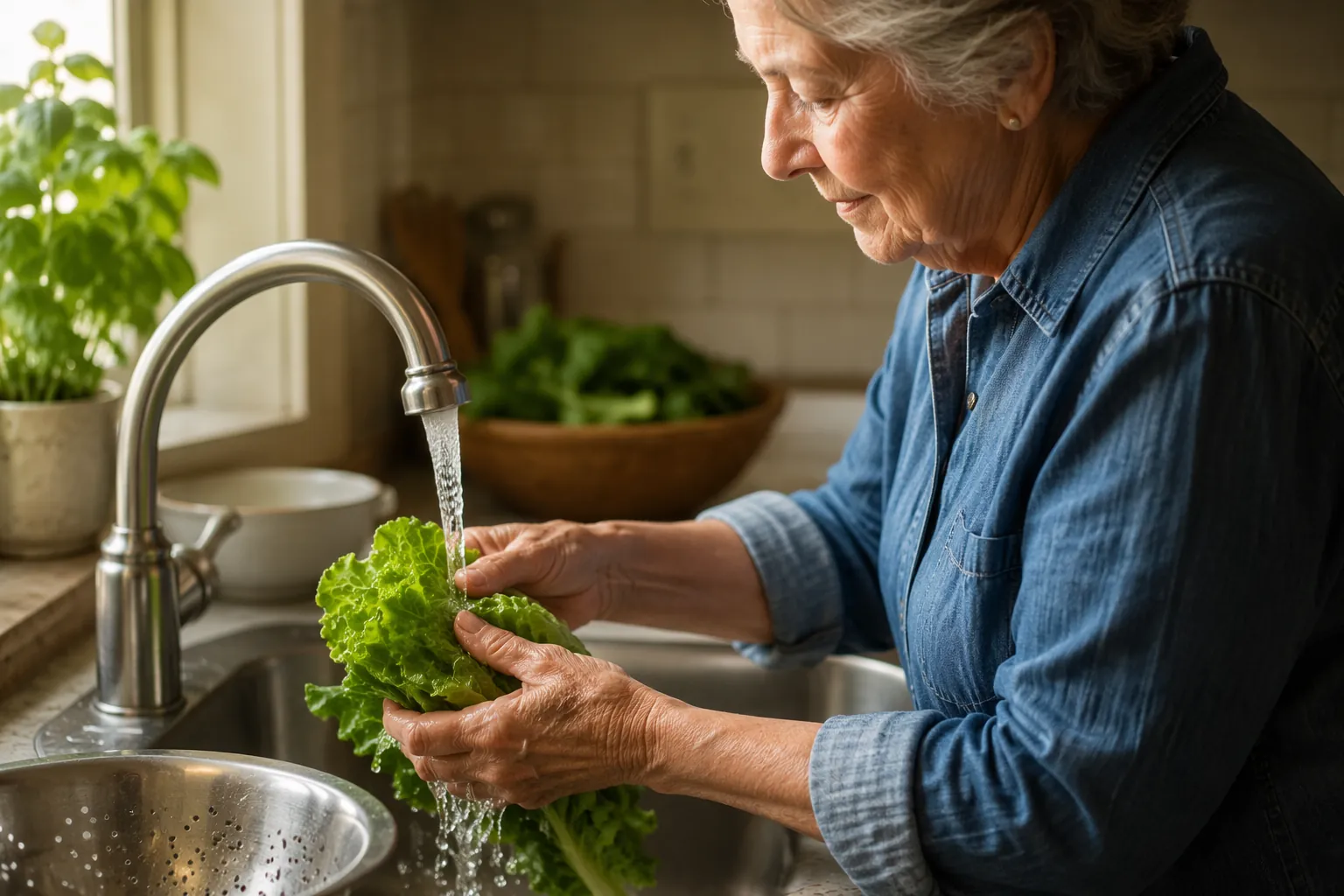
CDC’s July 2026 prevention guidance says to wash fruits and vegetables under running water, including produce with a peel, rind, or skin that will not be eaten. The same guidance also says washing can reduce Cyclospora but may not remove it completely, which is why rinsing should be treated as risk reduction rather than a guarantee.[2]
That distinction matters in a real kitchen. If an older adult has arthritis, tremor, weak grip, low vision, or limited stamina, “wash the lettuce” may be too vague to be useful. The safer version is more specific: remove outer leaves, rinse leaves separately under running water, and use a clean colander or towel so washed leaves do not sit in the same sink area as unwashed produce.
During this outbreak, even pre-washed bagged produce deserves another rinse. That does not make it risk-free, but it removes the false comfort of assuming the label has handled the current risk for you.[2]
Firm produce needs a different motion. Scrub melons, cucumbers, and similar items under running water before cutting, because a knife can carry contamination from the outside surface into the edible part. For someone with weak hands, a handled vegetable brush and a non-slip sink mat can make this more doable than trying to hold a wet melon in one hand.
When Cooking Is the Better Choice
Cooking is the most reliable step when the meal allows it. Cleveland Clinic states that heating food to 158°F kills Cyclospora, and UConn Extension gives the same 158°F threshold in its July 2026 food safety update.[3][4]
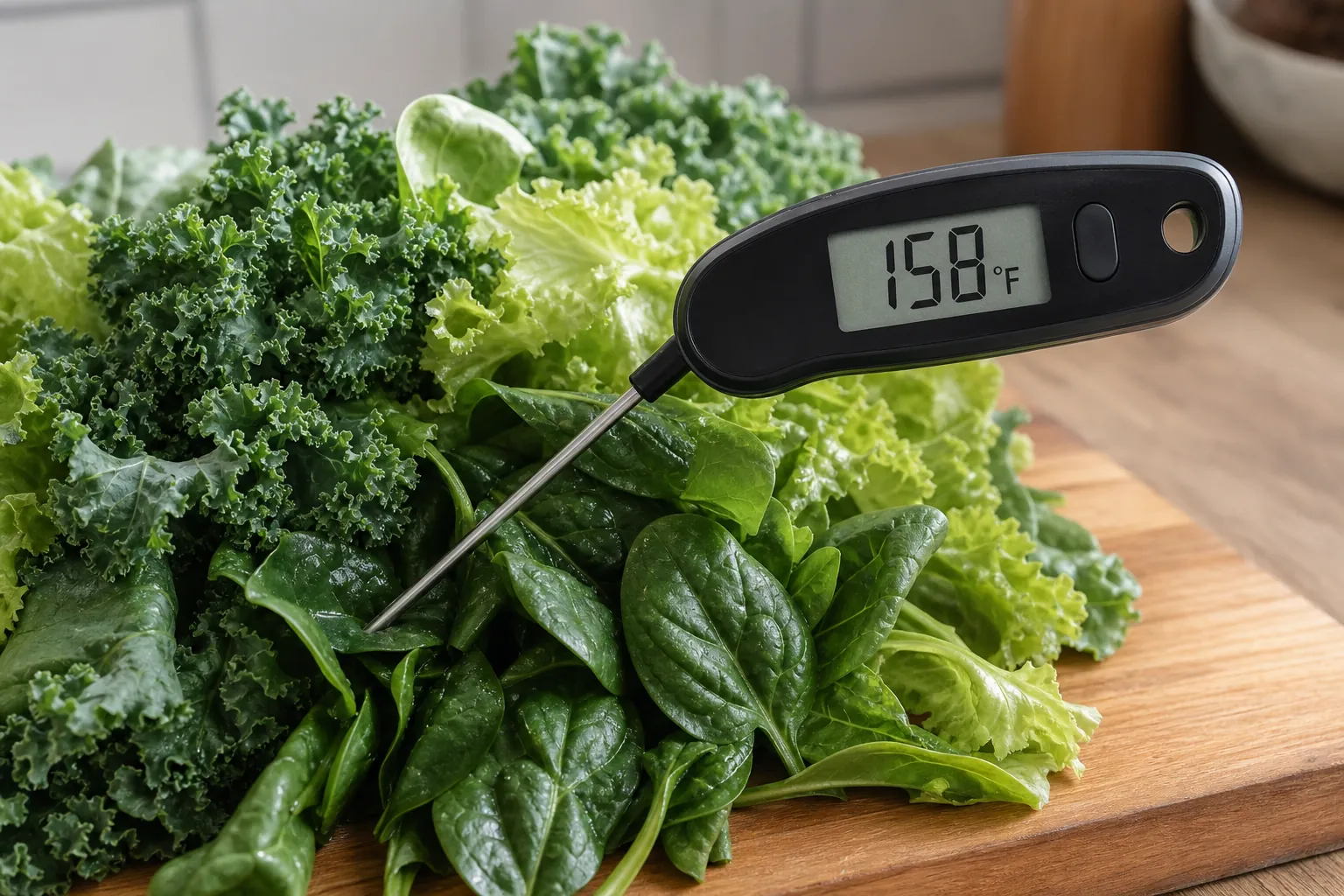
For a senior who usually eats raw greens at lunch, the simplest outbreak substitution may be cooked spinach instead of salad, sautéed greens instead of raw herbs, or soup ingredients instead of a cold chopped mix. This is not a permanent rule for every vegetable in every season. It is a practical shift while the outbreak and lettuce traceback are active.
Use a food thermometer when the food is thick enough to check. For delicate greens, the point is to cook them thoroughly rather than merely wilt them for a few seconds. If that extra step feels like too much, choose a lower-prep cooked option for now rather than relying on a rushed rinse of raw leaves.
At the Store: Whole Heads Beat Bagged Mixes During the Outbreak
Michigan health officials and UConn Extension both advised choosing whole heads of lettuce during the outbreak. Whole heads let the shopper remove outer leaves and rinse leaves individually, while pre-cut bagged mixes have already gone through more handling and are harder to inspect piece by piece.[4][5]
The tradeoff is labor. A whole head is only a better choice if the person preparing it can actually separate, rinse, dry, and store the leaves safely. If that is not realistic, cooked vegetables, frozen vegetables prepared according to package directions, or temporarily skipping raw lettuce may be safer than buying a whole head that sits unwashed until someone is tired and hungry.
| If this is the usual choice | Use this outbreak substitution |
|---|---|
| Bagged salad mix | Whole head of lettuce, outer leaves removed, leaves rinsed one by one |
| Raw spinach or leafy greens | Cooked greens heated thoroughly |
| Fresh herbs scattered raw over food | Herbs added during cooking when the recipe allows |
| Cut melon from a grab-and-go display | Whole melon scrubbed under running water before cutting, or a different fruit |
| Any recalled product | Do not eat it; follow the recall instructions |
Check Recalls Before the Produce Goes Into the Refrigerator
Recall checking should happen before produce is unpacked, not three days later when the bag is half used. Look at CDC outbreak pages, FDA recall notices, state health department alerts, and the store’s recall notices. If you are helping a parent from a distance, this is a good task to take off their plate: send a short message that says what brand, store, date, or product to avoid rather than forwarding a long government page.
Caregivers who want a simple routine can use CareWise Guide’s food recall walkthrough for older adults: How to Keep Your Aging Parent Safe From Food Recalls. The important part is to make the answer actionable: keep it, toss it, return it, or avoid buying it for now.
The Symptom Watch Is a Fall-Safety Step
Cyclospora commonly causes watery diarrhea, and untreated illness can last a month or longer with symptoms that may come and go.[3] For an older adult living alone, the dangerous home-safety sequence can be ordinary: repeated bathroom trips, less drinking to avoid more trips, standing up too quickly, dizziness, then a fall.
AARP’s July 2026 guidance says to call a doctor after 6–8 diarrheal episodes in a day, symptoms lasting more than 2–3 days, or any signs of dehydration such as dry mouth, dizziness when standing, dark urine, reduced urination, or confusion.[1]
- Dry mouth: do not wait for severe thirst; older adults may not feel thirst clearly.
- Dizziness on standing: sit down, use a stable chair or walker, and call for help before walking to the bathroom again.
- Dark urine or reduced urination: treat this as a dehydration warning, not just an inconvenience.
- Confusion: involve another person right away; this is not a symptom to self-monitor alone.
- Six to eight diarrheal episodes in one day: call the doctor even if the person is still able to drink.
- Symptoms lasting more than 2–3 days: call the doctor instead of waiting for the illness to “run its course.”
This does not make cyclospora prevention a complete fall-prevention plan. It removes one acute trigger: dehydration during a diarrheal illness. The same home habits that matter during heat waves also matter here: clear the bathroom path, keep a phone within reach, stand slowly, and do not walk while lightheaded. For related dehydration and dizziness precautions, see Cool seniors without AC and prevent falls during heat waves.
Why the 2026 Case Counts May Look Different
The numbers in outbreak stories may not match because CDC has published different counts for different scopes of investigation. CDC’s July 14, 2026 Health Alert Network notice reported 1,645 confirmed domestically acquired cyclosporiasis cases across 34 states, including 141 hospitalizations, or 9%.[6]
A separate CDC outbreak investigation page, updated July 24, 2026, described more than 1,644 cases linked to iceberg lettuce served at Taco Bell and supplied by Taylor Farms, with 94 hospitalizations.[7] Those figures are not best read as a contradiction. The broader HAN count covers domestically acquired cases across states; the narrower outbreak page focuses on cases tied to a specific lettuce traceback.
For a household deciding what to do today, the difference between those counts matters less than the shared message: produce handling and recall checking are still active tasks, and raw lettuce deserves extra caution until health officials say otherwise.
If Symptoms Start Anyway
Do not try to solve ongoing diarrhea with food washing advice after the fact. Once symptoms begin, the job changes: prevent dehydration, reduce fall risk, and call a clinician at the warning thresholds. CDC clinical care guidance says trimethoprim-sulfamethoxazole is the treatment of choice for cyclosporiasis, while Cleveland Clinic notes that prompt treatment usually resolves symptoms within 1–2 weeks.[8][3]
Medication decisions belong with the clinician, especially for older adults who may be taking blood pressure medicine, diabetes medicine, blood thinners, or other prescriptions. The practical caregiver role is to have the medication list ready, report the diarrhea count and dehydration signs clearly, and make sure the person is not walking around dizzy while waiting for advice.
A Simple Outbreak Routine for the Kitchen
- Before shopping, check current CDC, FDA, state, and store recall notices for lettuce and other named produce.
- At the store, choose whole heads over bagged lettuce if the prep is manageable; otherwise choose cooked or lower-prep alternatives.
- At home, remove outer leaves, rinse leaves separately under running water, and scrub firm produce before cutting.
- When practical, cook greens, herbs, and other produce thoroughly; use 158°F as the cited kill temperature.
- If diarrhea starts, count episodes, watch urine and dizziness changes, and call a doctor at the warning thresholds.
- Until symptoms resolve, treat bathroom trips as fall-risk moments: lights on, path clear, phone nearby, and help requested before walking while weak or lightheaded.
References
- What Older Adults Should Know About Cyclospora, AARP, July 20, 2026.
- Preventing Cyclosporiasis, CDC, July 23, 2026.
- Cyclosporiasis: Transmission, Symptoms & Treatment, Cleveland Clinic, April 14, 2026.
- Food Safety Update: Cyclospora and Cyclosporiasis, UConn Extension, July 2026.
- Recommendations on Preventing Foodborne Illness, MDHHS, July 4, 2026.
- Domestically Acquired Cyclosporiasis Cases in Multiple U.S. States, 2026, CDC HAN-00531, July 14, 2026.
- Cyclospora Outbreak Linked to Iceberg Lettuce, CDC, July 24, 2026.
- Clinical Care of Cyclosporiasis, CDC, February 27, 2024.
Browse more in the Glossary.