
Clinical term
Cyclospora Outbreak Raises Seniors' Fall Risk at Farmers Markets
Last verified 2026-07-27
For a senior who has a weekly farmers market routine, the 2026 Cyclospora outbreak does not automatically mean “stop going.” It does mean the family should stop treating the illness as only a bathroom problem. As last checked on July 27, 2026, the CDC Health Alert Network advisory reported 4,173 laboratory-confirmed domestically acquired cases of cyclosporiasis, 308 hospitalizations, and cases across 41 states in 2026.[1] Those numbers will change. The part that should change the family safety plan is more immediate: Cyclospora can cause prolonged diarrhea, and in an older adult, prolonged diarrhea can quietly become dehydration, weakness, dizziness when standing, and a fall.
That is the practical answer to the question behind farmers market safety for seniors during a Cyclospora outbreak. The market itself is not the only issue. The trip home, the next several days, the bathroom at night, and the first time an older adult stands up after repeated diarrhea may matter just as much.

The Outbreak Risk Is Real, but the Decision Is Not Just “Go” or “Don’t Go”
A farmers market can be exercise, fresh food, routine, conversation, and independence. Taking it away casually can create its own harm, especially for an older adult who still organizes part of life around choosing produce, talking to vendors, and walking familiar aisles. But independence is not the same as pretending the outbreak is background noise.
Cyclospora is a parasite that can contaminate produce. The CDC’s 2026 surveillance page reported 1,645 confirmed cases by July 14, 2026, compared with 249 during the same period in 2025, a six-fold increase.[6] The same CDC surveillance material describes an incubation period of 2 to 14 days and notes that symptoms can persist for weeks and follow a relapsing-remitting course.[6] That time pattern is important for caregivers because it does not always look like a short stomach bug that resolves neatly after a day.
A caregiver may hear, “I’m fine, it’s just diarrhea,” for several days. Then the older adult gets up from bed, feels lightheaded, grabs the sink, or sits down hard on the toilet. By then, the food-safety story has become a fall-prevention story.
Why Diarrhea Can Turn Into a Fall Risk
The missing sentence in many outbreak warnings is this: dehydration changes how safely a person can stand and move. In AARP’s coverage of Cyclospora in older adults, Dr. Luis Marcos of Stony Brook Medicine is cited on complications that can include electrolyte problems, acute kidney injury, weakness, dizziness, and falls.[2] ArchWell Health’s article for seniors also warns that risk can be compounded for older adults with diabetes, heart disease, or kidney disease.[3]
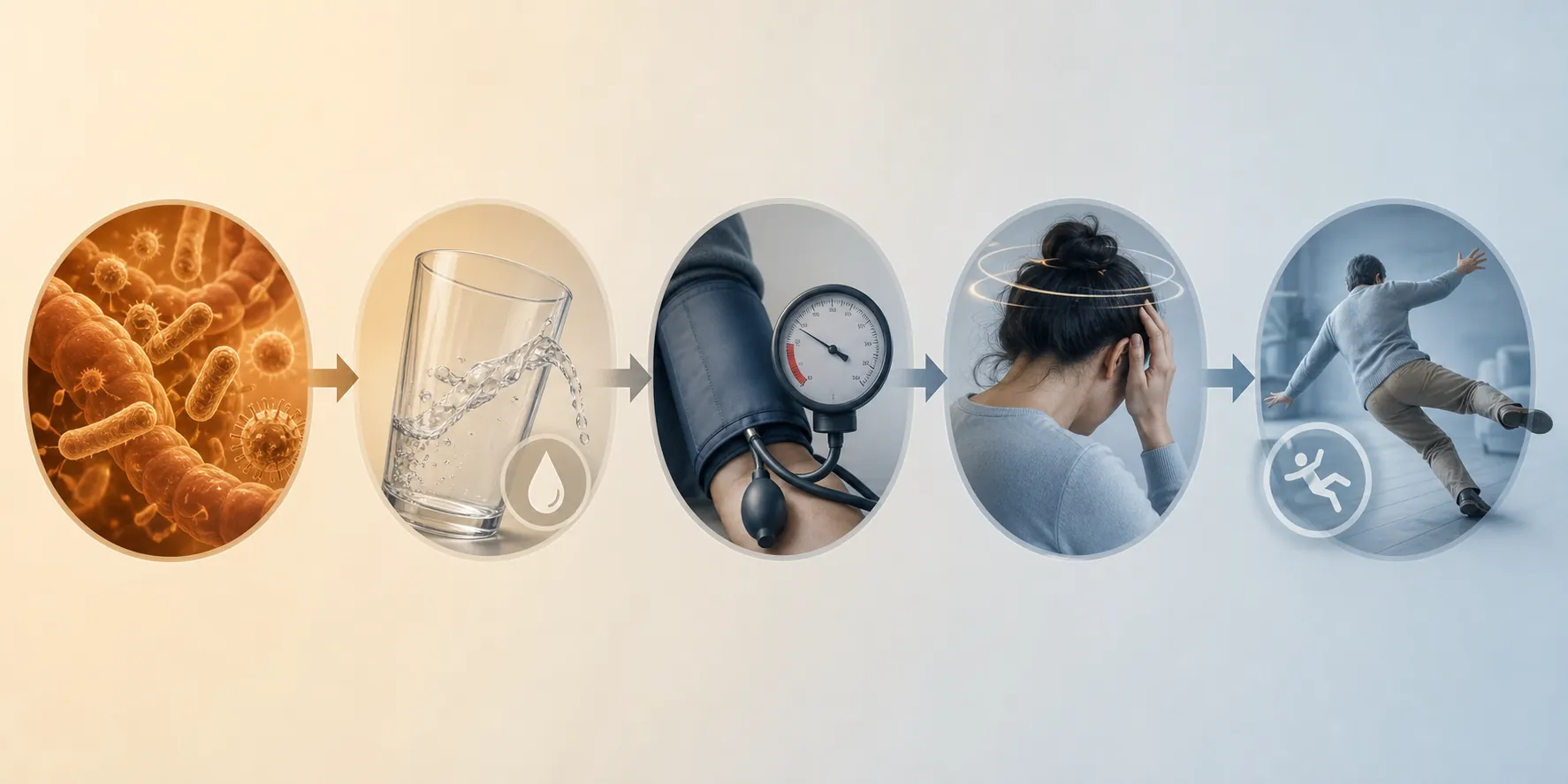
This does not mean researchers have proved Cyclospora itself directly causes falls in older adults. The safer, more accurate point is that named medical sources connect the complications of Cyclospora illness, especially dehydration and electrolyte disturbance, with weakness, dizziness, and falls.[2][3] That is enough to justify a different kind of home monitoring.
The body mechanics are straightforward. Repeated diarrhea drains fluid. Fluid loss can disturb electrolytes and lower circulating volume. When an older adult stands, blood pressure may not adjust quickly enough. The result can be orthostatic hypotension: lightheadedness, unsteadiness, or a need to sit back down. Add nighttime bathroom trips, tile floors, weaker legs, and a parent who does not want to make a fuss, and the fall risk stops being theoretical.
The risk also does not wait until someone looks severely ill. A parent may still be eating a little, answering texts, and insisting they can walk to the bathroom alone. If diarrhea continues or comes and goes over several days, that ordinary-looking independence can become unreliable for short bursts: standing from a chair, turning in a hallway, stepping into the shower, or hurrying to the toilet.
The Medication Question Is Not a Formality
One reason “call the doctor” is not enough by itself is that treatment decisions can touch medications a senior already takes. AARP notes that trimethoprim-sulfamethoxazole, often abbreviated TMP-SMX, is the typical antibiotic treatment discussed for Cyclospora, and that medication interactions can involve blood thinners, diabetes drugs, and potassium-affecting medications.[2] For an older adult, that is not a side note. It is the difference between a simple prescription conversation and a medication review that needs the clinician to know the full list.
Caregivers do not need to decide on treatment. They do need to make sure the clinic hears the relevant facts: duration of diarrhea, signs of dehydration, dizziness on standing, kidney disease, heart disease, diabetes, blood thinners, diuretics, blood pressure medicines, diabetes medicines, and any drugs that affect potassium. If the parent uses more than one prescriber, bring the medication list instead of relying on memory.
Farmers Markets Are Not Automatically Safe or Unsafe
It is tempting to sort food risk by shopping location: grocery store bad, farmers market good, or the reverse. Cyclospora does not make that division so neatly. In a Johns Hopkins Medicine Q&A, Dr. Amesh Adalja explained that contamination risk is about “where it’s grown, not the point of sale.”[4] That is a useful correction. A tomato does not become safe because it sits under a tent, and a salad green does not become dangerous simply because it came through a supermarket.
That nuance should lower panic, not lower standards. Local growers using municipal or well water may be less likely to have contaminated irrigation, according to the Johns Hopkins discussion, but that is expert interpretation rather than a controlled senior-specific study of farmers market safety.[4] The practical takeaway is modest: farmers markets may offer more opportunity to ask how produce was grown and handled, but they are not a guarantee.
For a senior who benefits from the outing, a reasonable family conversation might sound like this: keep the routine if the parent feels well, choose produce that can be cooked when possible, avoid turning sampling tables into a meal, wash hands before eating, and skip raw high-risk items during active outbreak concern if the family or clinician thinks the parent’s health status makes the consequences too high. That is different from making the market the villain.
What Washing Can and Cannot Do
Washing produce is still a sensible food-safety habit, but it should not be oversold for Cyclospora. The CDC says washing alone is not enough to kill the parasite; cooking to 158°F (70°C) or freezing is the kill step.[5] That matters for older adults because “I washed it well” can sound more protective than it really is.
| Food choice | What the evidence supports |
|---|---|
| Produce that will be cooked | Cooking to 158°F / 70°C kills Cyclospora, according to CDC prevention guidance. |
| Raw produce | Washing helps remove dirt and some germs, but CDC says washing alone is insufficient to kill Cyclospora. |
| Farmers market produce | Risk depends more on growing and contamination conditions than on the point of sale. |
| Vendor questions | They may help families understand practices, but the available sources do not provide a definitive senior-specific screening script. |
Vendor questions should stay practical and humble. A caregiver can ask whether the farm uses well or municipal water, whether produce is washed before sale, and whether the item is meant to be cooked or eaten raw. The answer may inform a choice, but it does not certify safety. If a parent has kidney disease, diabetes, heart disease, immune compromise, or a recent history of falls, the family may decide that cooked produce is the easier risk tradeoff until outbreak concern eases.
Older Adults Have Less Margin When Foodborne Illness Hits
The reason this guidance is stricter for seniors is not that older adults are fragile in a vague way. FoodSafety.gov notes that the immune system and organs become slower to recognize and clear harmful germs as people age, beginning around age 60.[7] That slower reserve matters when a parasite causes repeated fluid loss and the person already has health conditions or medications affecting blood pressure, kidneys, glucose, or electrolytes.
A younger adult may spend a miserable weekend near the bathroom and recover. A 78-year-old on blood pressure medicine and a diabetes drug may lose strength, stop drinking enough because every sip seems to trigger another bathroom trip, and become unsafe walking the same hallway they handled easily last week. The hallway did not change. The physiology did.
This is also why the first fall warning may show up as a behavior change rather than a dramatic symptom. The parent starts using furniture for support. They avoid the stairs. They say the room “tilted” when they got up. They postpone a shower. They leave a wet towel on the floor because bending feels unsteady. Those are not just signs that the person feels sick. They are clues that the home has become harder to navigate safely.
A Caregiver Monitoring Path Once Symptoms Start
Once diarrhea starts after possible exposure, the job is not to prove where the produce came from. The job is to keep the older adult hydrated, medically connected, and off the floor. Because CDC surveillance describes Cyclospora symptoms that may persist for weeks and relapse, monitoring should not stop just because one afternoon looks better.[6]
- Track duration: note when diarrhea began, whether it is improving, and whether it returns after seeming to settle.
- Watch hydration: look for reduced drinking, dry mouth, dark urine, very low urine output, or a parent avoiding fluids to reduce bathroom trips.
- Check standing safety: ask whether they feel dizzy, weak, shaky, or lightheaded when rising from bed, the toilet, or a chair.
- Make the bathroom safer immediately: improve lighting, clear rugs and clutter, keep a phone within reach, and discourage rushing.
- Prepare the medication list: include prescriptions, over-the-counter drugs, supplements, and especially blood thinners, diabetes drugs, blood pressure drugs, diuretics, and potassium-affecting medicines.
The standing-safety question deserves direct language. Instead of asking only, “Are you okay?” ask, “When you stand up, do you feel lightheaded?” “Are you holding the counter to walk?” “Did you need to sit back down after getting off the toilet?” Older adults often minimize weakness because they hear it as a loss of independence. A concrete question is harder to wave away.
When the Risk Moves From Watchful to Urgent
A clinician should be contacted for suspected Cyclospora symptoms, especially when diarrhea is prolonged, relapsing, or occurring in an older adult with diabetes, heart disease, kidney disease, immune compromise, or a complicated medication list. The medication-interaction issue around TMP-SMX is one reason not to self-manage treatment decisions.[2]
Seek urgent medical help if the older adult faints, cannot stand safely, seems confused, cannot keep up with fluids, has signs of severe dehydration, has worsening weakness, or has already fallen. In those moments, the question is no longer whether the illness came from a market item. The immediate problem is that the person may not be safe upright.
CareWise Guide’s related fall-prevention resources on dehydration monitoring, heat-related dizziness, and post-illness fall risk can help families build the broader safety plan. The same basic pathway appears in other situations too: fluid loss or poor intake, lower reserve, dizziness, and a fall during an ordinary movement. Cyclospora is one trigger, not the only one.
So Should a Senior Still Go to the Farmers Market?
If the senior is well, has no clinician-specific restriction, and can make safer produce choices, the outbreak alone does not require ending a meaningful farmers market routine. It does call for sharper choices: prefer items that can be cooked, be cautious with raw produce during outbreak concern, do not rely on washing as a kill step, and remember that contamination risk follows growing and handling conditions more than the label “farmers market” or “grocery store.”[4][5]
If symptoms begin, shift the family’s attention from the market to the hallway and bathroom. Watch for prolonged diarrhea, hydration trouble, dizziness on standing, weakness, medication concerns, and any sign that walking has become unsafe. The digestive illness may be what starts the problem. The fall may be what changes everything.
This article is for education and fall-prevention planning, not personal medical diagnosis or treatment. A clinician should guide testing, treatment, and medication decisions for an individual older adult.
References
- CDC HAN Advisory (HAN00531). Centers for Disease Control and Prevention. July 24, 2026.
- What Older Adults Should Know About Cyclospora. AARP.
- Parasite on Produce? What Seniors Need to Know. ArchWell Health.
- Cyclosporiasis Outbreak. Johns Hopkins Medicine.
- Preventing Cyclosporiasis. Centers for Disease Control and Prevention.
- Cyclosporiasis Surveillance. Centers for Disease Control and Prevention.
- The Importance of Food Safety for Older Adults. FoodSafety.gov.
Browse more in the Glossary.