
Product term
How to Record Your Elderly Parent's Life Story in 5 Simple Sessions
Last verified 2026-07-27
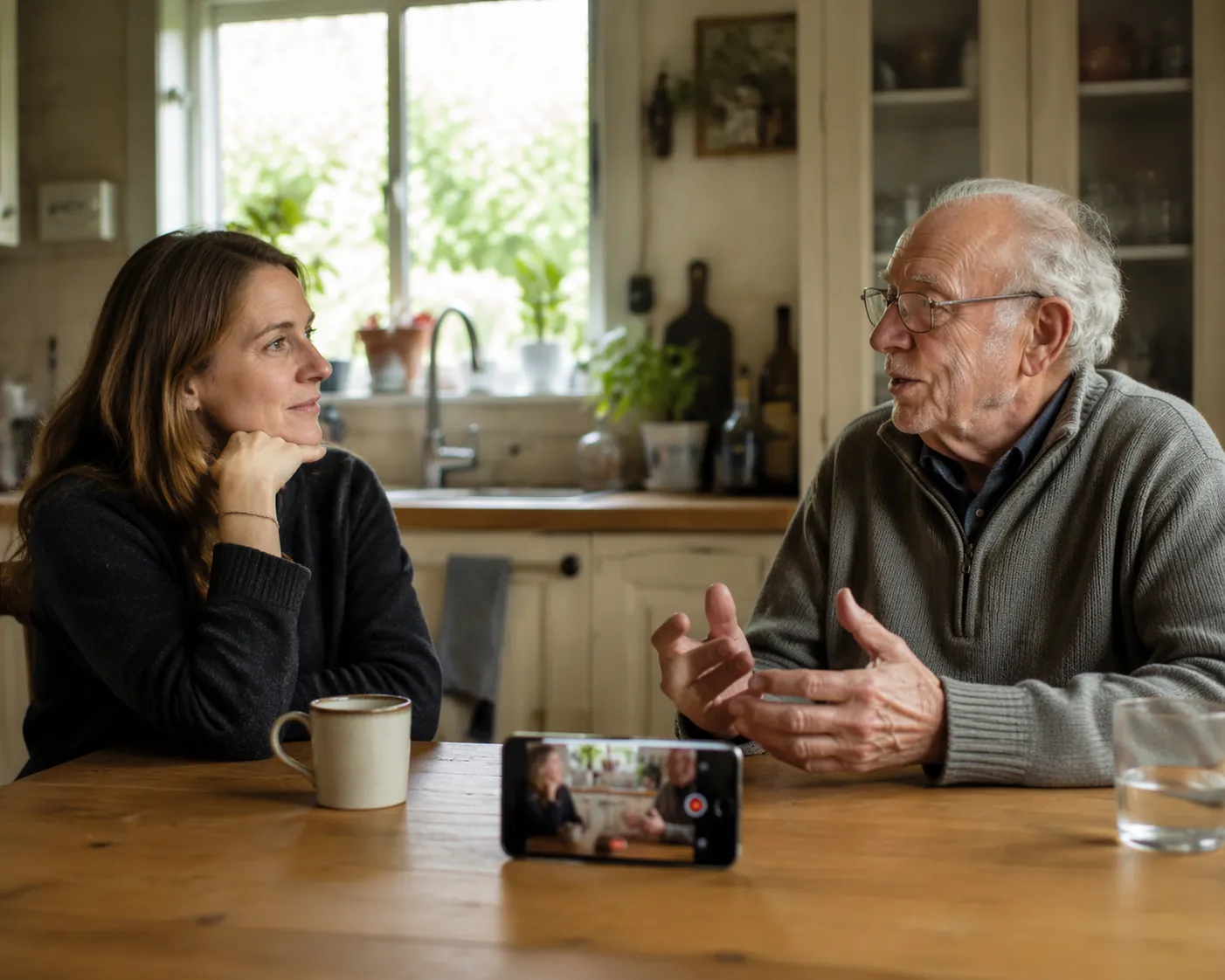
If you keep meaning to ask but never find the right moment, make the project smaller. To document an elderly parent's life story, you do not need a studio, a family reunion, or a polished list of 200 questions. A smartphone, three to five 30- to 45-minute conversations, and a few open-ended prompts are enough to capture the voice, the turns of phrase, and the details no one else can supply.
Several family-history and oral-story guides converge on the same practical starting point: use short sessions, keep the setup simple, and organize the conversations by life stage rather than trying to cover everything in one sitting.[1][2][3] That matters because the hardest part is usually not technology. It is getting past the awkward first ask.
The Whole Project at a Glance
Think of this as a weekend-startable project, not a documentary production. The first goal is one usable recording. After that, you can decide whether the family wants transcripts, a printed book, edited video, or a paid service.
| Step | What you do | Keep it simple |
|---|---|---|
| 1. Ask | Invite your parent into the project without making it sound like an examination. | Say it is something you would love the family or grandchildren to have. |
| 2. Prepare | Choose a quiet room, charge the phone, test the recording app, and write 6-8 prompts. | Do not over-plan the whole life. |
| 3. Record | Hold 3-5 sessions of about 30-45 minutes, grouped loosely by life stage. | Stop while your parent still has energy. |
| 4. Save | Rename the file right away and back it up to cloud storage. | Use a clear name like ParentName_2026-07-27_Childhood.m4a. |
| 5. Share or upgrade | Send copies to family, then decide later about transcription, editing, printing, or services. | The raw voice recording is already the heirloom. |
The 30- to 45-minute length is not magic, but it is realistic. It is long enough for a story to warm up and short enough that an older parent does not have to perform for an afternoon. LifeEcho, Storii, and The Story Keepers all recommend a similarly modest cadence rather than one marathon interview.[1][2][3]
Start With the Ask, Not the Recorder
A parent who dislikes being the center of attention may hear “I want to interview you” as too formal, or worse, as a sign that everyone thinks time is running out. The wording should lower the stakes.
Try one of these:
- “I’d love the grandchildren to have your voice telling a few stories.”
- “Could we record a little bit about when you were growing up? It doesn’t have to be the whole story.”
- “I realized I know the dates, but not what it felt like. Would you tell me some of it?”
- “Let’s just try 20 minutes. If you hate it, we stop.”
MemoirJi and MyStoryFlow both recommend framing the request as a gift for family rather than a formal documentation task, especially when a parent is reluctant.[7][8] That does not mean pushing through a hard no. Privacy, grief, illness, or old family pain may be part of the resistance. Offer control: they can skip topics, turn off the recorder, or answer only the easy questions.
Before the First Session
Use the phone you already have. A built-in voice memo app is usually enough for family use, and multiple guides put a smartphone or simple recording app at the center of the basic setup.[1][2][3] A small clip-on microphone can help if your parent speaks softly, but it is an upgrade, not a requirement.
- Charge the phone and put it in airplane mode so calls do not interrupt the recording.
- Sit close enough that the phone can catch both voices without being handled.
- Choose a soft, quiet room; kitchens can work well if appliances are off.
- Test 30 seconds of audio, play it back, and adjust before you begin.
- Write your first few questions on paper so you are not tapping the phone during the conversation.
Do not start with “Tell me your life story.” It is too big. Start with a door handle: a room, a smell, a school walk, a holiday meal, a person they can still picture. StoryCorps’ interview question guidance includes concrete prompts about childhood, important people, and remembered moments, and that style works better for family recording than a stiff timeline.[4]
A Five-Session Plan You Can Actually Finish
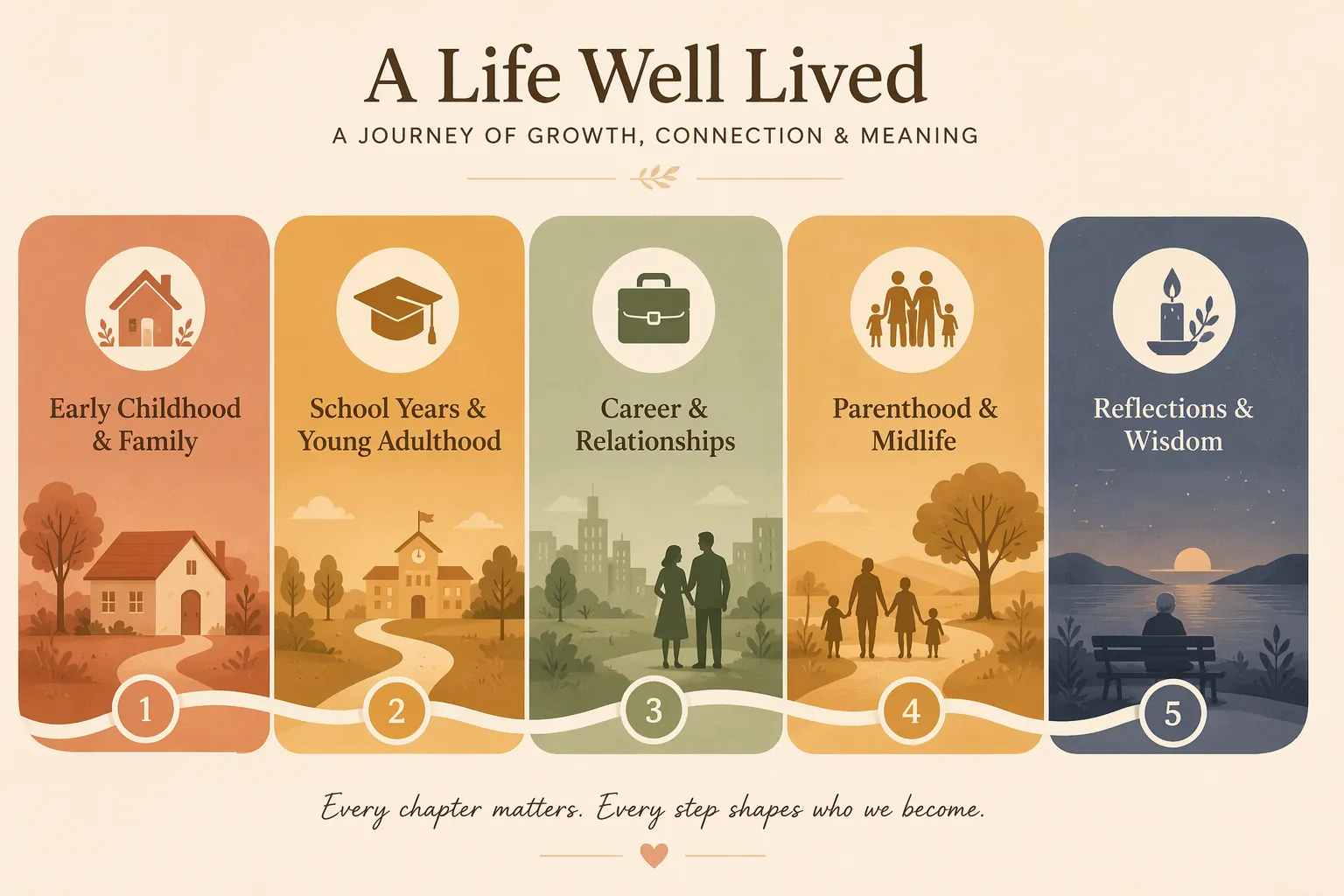
Five sessions gives the story room to breathe. Three is still enough if your parent tires easily or lives far away. The point is to divide the work so no one feels trapped at the table.
Session 1: Childhood, Home, and Family
This first conversation should feel easy. Ask about the physical world before asking for interpretation. A parent may not know how to summarize childhood, but they may remember the porch, the wallpaper, the sound of a screen door, or who sat where at dinner.
- What is one of your earliest memories?
- What did your childhood home look, sound, or smell like?
- Who was usually in the kitchen?
- What did a normal Saturday look like when you were young?
- Who in your family made you feel safe?
- Was there a family rule everyone knew, even if no one said it out loud?
If they wander into a story about a neighbor or a cousin, let it happen. The side path may be the part no photograph explains. When you need to return, do it gently: “I want to come back to your mother for a second. What was she like in the morning?”
Session 2: School Years and Becoming Independent
This session often brings out the first version of your parent as a person separate from the family they were born into. Keep the questions specific enough to avoid a resume-style answer.
- What kind of student were you?
- Was there a teacher, coach, neighbor, or older relative who changed how you saw yourself?
- What did you do with friends when no adults were organizing things?
- When did you first feel grown up?
- What did you think your life would be like when you were young?
Session 3: Work, Love, Marriage, and Major Choices
This is where dates can take over if you let them. Dates matter, but the better family record is often why someone chose one job, one city, one person, or one risk. Modern Heirloom Books’ family-history question bank leans heavily into questions about relationships, work, values, and turning points, which are the areas adult children usually wish they had asked about sooner.[5]
- What was your first paid job, and what did it teach you?
- How did you meet Mom/Dad, or the person who most shaped your adult life?
- What did you notice about them first?
- Was there a decision that changed the direction of your life?
- What did money mean in your household when you were starting out?
- What was harder than people knew at the time?
Session 4: Parenthood, Midlife, and Family Culture
If you are the adult child asking the questions, this session can feel tender or strange. You may hear a version of your own childhood that does not match yours exactly. Let the recording hold both things. You are not cross-examining a witness; you are collecting one person’s memory.
- What surprised you about becoming a parent?
- What family tradition did you try to keep?
- What did you hope your children understood, even if you did not say it well at the time?
- What were you proud of during those years?
- Was there a season that was harder than it looked from the outside?
- What do you remember about our home that you think we might have forgotten?
Session 5: Values, Regrets, Humor, and What They Want Remembered
Save the reflective questions for last, after your parent has had time to trust the rhythm. Big questions are easier when they are not the opening move.
- What are you glad you did, even though it was difficult?
- What do you wish you had worried about less?
- What makes you laugh every time you remember it?
- What family story should the grandchildren know?
- What did you learn the long way?
- How would you like people to remember you?
Some families will never get to Session 5, and that does not make the project a failure. A single good recording of your parent describing a childhood room or laughing about an old mistake may be more valuable than a complete but lifeless chronology.
Use Questions That Open Memory Instead of Testing It
The best questions do not ask your parent to prove they remember. They give the memory somewhere to land. Sensory, relational, and choice-based prompts tend to work better than “What year did that happen?” unless you are clarifying a detail after the story is already moving.
| If you want to hear about | Ask this | Avoid starting with |
|---|---|---|
| Childhood | “What did your house feel like when you walked in?” | “Give me a full timeline of your childhood.” |
| Parents and grandparents | “What is something your mother or father always said?” | “What were their birth dates?” |
| Work | “What did you learn at your first real job?” | “List every job you had.” |
| Marriage or partnership | “What did you notice about them before anyone else did?” | “What was the exact date you met?” |
| Hard seasons | “Was there a time that was harder than people realized?” | “What was the worst thing that happened?” |
| Values | “What did you try to teach us by how you lived?” | “What advice do you have?” |
When a story starts, do less. Nod. Wait. Ask “What happened next?” or “Who else was there?” If your parent pauses, do not rush to rescue the silence. People often need a few seconds to find the next piece.
If the answer is very short, try narrowing the doorway: “What was the kitchen like?” works better than “Tell me about your family.” If the answer becomes too broad, gently place a marker: “I want to hear about the move too, but before we leave this house, what do you remember about your bedroom?”
What to Do When Your Parent Does Not Want to Talk
Reluctance is not always stubbornness. A private parent may not want old grief reopened. A widowed parent may hear every question as a reminder of the person missing from the room. A proud parent may worry that being recorded means the family sees decline.
Lower the commitment. Ask for one story, not a life review. Let them choose the topic. Start while looking through a photo, recipe card, tool, military patch, quilt, or holiday ornament. Stories to Last and MemoirJi both emphasize easing resistance by making the exchange feel conversational rather than formal.[10][7]
- If they say, “My life was ordinary,” ask, “What did ordinary look like on a weekday?”
- If they say, “I don’t remember,” ask about a place, person, song, smell, or object.
- If they say, “Why do you need this?” say, “I don’t need it perfect. I just want us to have your voice.”
- If they get tired, stop. A good 18 minutes is better than a resentful hour.
Audio, Video, Books, or Services
Audio is the lowest-friction format. Video captures expression and gesture, but it adds pressure: lighting, framing, storage, and the awkwardness some people feel on camera. A printed book can be beautiful, but it should not be the reason you delay the first recording.
| Format | Best for | Tradeoff |
|---|---|---|
| Smartphone audio | Starting this week with almost no setup | You will need to label and back up files yourself |
| Smartphone video | Capturing facial expressions, gestures, and shared objects | More storage and more self-consciousness |
| Transcription | Making stories searchable and easier to quote | Automated transcripts need review, especially with names and places |
| Printed book or guided service | Families that want prompts, layout, editing, or a giftable product | Costs and timelines vary |
AARP’s August 2024 overview listed examples of legacy services and prices, including Storyworth at $99, Remento at $99-$168, No Story Lost at $1,099 and up, and Journey To Legacy at $397.[6] Those prices may have changed by Q3 2026, so treat them as a snapshot, not a current price list. The useful point is simpler: paid services are optional upgrades after the voice has been captured.
Some local libraries and community programs may also offer family-history help. Fairfax County, Virginia, for example, has described public library Family History Kits as a local resource for documenting family stories.[9] That is not a universal service, but it is worth checking your own library before assuming the only choices are do-it-yourself or expensive.
Name and Back Up the Files Before You Make Dinner
This is the unglamorous part that matters. After you finally get your parent talking, do not leave the file named “New Recording 7.” Rename it before the day ends, then back it up somewhere that is not only on the phone. LifeEcho and The Story Keepers both emphasize saving and organizing recordings promptly so the work is not lost after the conversation.[1][3]
Use a naming pattern simple enough that someone else can understand it later:
ParentName_YYYY-MM-DD_Topic.m4a
ElaineMartin_2026-07-27_ChildhoodHome.m4a
ElaineMartin_2026-08-03_SchoolAndFirstJob.m4a- Save one copy on your phone or computer.
- Upload one copy to cloud storage such as iCloud, Google Drive, or Dropbox.
- Share a copy or folder link with at least one other trusted family member.
- Keep a simple note listing the session date, topic, and any names that need spelling later.
If you plan to transcribe later, do not wait for the transcript to do the basic preservation. The audio file is the original. The transcript is a useful copy.
How Urgent Is This, Really?
There are dramatic numbers online about lost oral history and age-related memory loss. MemoirJi cites a claim that 94% of families lose oral history within three generations, and MyStoryFlow cites an estimate of about 10% memory-detail loss per year after age 65.[7][8] Those figures are useful as urgency signals, but the original evidence is not traceable from the available sources, so they should not be treated as settled research.
The practical truth does not need a dramatic statistic. Families lose details because people die, move, misplace photos, stop cooking old recipes, or assume someone else knows the story. A voice memo made this week is more reliable than a perfect plan postponed until everyone agrees on the format.
After the Last Session
When you finish the third, fourth, or fifth recording, do the same plain tasks: rename the file, back it up, write a one-line description, and share a copy. Then stop long enough to recognize that you already made something the family can keep.
Later, you can transcribe the recordings, pull favorite clips for grandchildren, make a small printed booklet, or use a service to turn the stories into a more polished keepsake. None of that has to happen before the first story is safe.
Ask soon. Record simply. Save the files where the next person can find them. The record does not have to be complete to matter; it only has to preserve the voice while the voice is still here.
References
- How to Record Your Elderly Parent's Life Story, LifeEcho
- How to Record Your Parents' Life Story, Storii
- My guide to recording your parent's life story, The Story Keepers
- Great Questions for Interviews, StoryCorps
- 56 Family History Questions for Your Parents, Modern Heirloom Books
- How to Capture You or Your Loved One's Legacy, AARP
- How to Interview Elderly Parents About Their Life Stories (When They Don't Want to Talk), MemoirJi
- Helping Seniors Tell Their Stories: A Guide for Adult Children, MyStoryFlow
- Simple Ways to Document Your Family History, Fairfax County Government
- How to Interview Your Parents to Save Their Stories, Stories to Last, 2021
Browse more in the Glossary.