
Glossary entry
How to Help Elderly Travelers During Storm Flight Delays
Last verified 2026-07-25
This is not financial or legal advice. Medicare/Medicaid and benefits rules vary by state and change over time — verify current rules with your state Medicaid office or Area Agency on Aging.
When a storm starts showing up on the forecast before an elderly traveler’s flight, the useful question is not whether the airline will be fair. It is how to handle flight delays for elderly travelers during storms when the delay may last longer than a medication window, a wheelchair attendant may be reassigned, and the person at the gate may be too tired or too polite to ask twice.
Start with the hard distinction. Weather is a major source of flight disruption: the FAA says 74.26% of delays longer than 15 minutes were weather-related in the June 2017–May 2023 period it analyzed.[1] Under DOT passenger-rights materials, weather is treated as a non-controllable event, which means airlines are not federally required to provide meals, hotels, or compensation just because a storm delayed the flight.[2] Arguing at the counter for a hotel voucher may work occasionally as customer service, but it is not the strongest place to put a frail traveler’s energy.
The stronger lever is different: disability accommodation. Under the Air Carrier Access Act rules summarized by DOT, passengers with disabilities have rights to assistance such as prompt wheelchair help, help moving through the airport, access to a Complaint Resolution Official, and protection from being left unattended for more than 30 minutes if they cannot independently move, breathe, eat, drink, or use the restroom.[3] Those rights do not vanish because the weather radar is ugly.

This is not medical or legal advice. It is a practical family plan for reducing harm: prepare before leaving home, respond at the airport with the right words, and recover afterward without turning a bad delay into a medical setback.
The Three-Phase Plan
| Phase | Main job | Decision that matters |
|---|---|---|
| Before leaving home | Assume the delay will happen and keep health, mobility, and communication needs under the traveler’s control. | Should this traveler go to the airport at all if the storm risk is already high? |
| At the airport | Use disability-related requests clearly and early instead of waiting in ordinary customer-service lines until the traveler is exhausted. | Does the traveler need wheelchair, escort, CRO, medical, or rebooking help right now? |
| After cancellation or major disruption | Choose recovery over endurance, accept useful rebooking or decline travel and pursue the refund, then document failures. | Is continuing the trip still safe? |
The first phase deserves the most attention because it is the only phase where nobody is hungry, the phone is charged, and the boarding area is not full of people trying to solve the same problem.
Before Leaving Home: Build the Trip as if the Delay Is Already Scheduled
For an older traveler, a storm delay is not only a later arrival time. It can mean missed insulin, a skipped blood-pressure dose, a walker stuck in checked baggage, a dead phone, or a connection that now requires a sprint through a terminal. AirAdvisor has reported elderly passengers missing medications, spending nights on airport floors, and being abandoned by staff during flight disruptions; those examples should be read as warning signals about what fails when a plan assumes normal operations, not as proof that every airline disruption unfolds the same way.[5]
Book the boring flight if you still have a choice. An early-morning nonstop may be less convenient for the family member doing the airport run, but it reduces the number of moving parts. DOT passenger guidance notes that earlier flights are less likely to be delayed than later flights because delays can ripple through the day.[2] A nonstop also removes the most punishing part of many elderly travel disruptions: being stranded between home and destination after a missed connection.
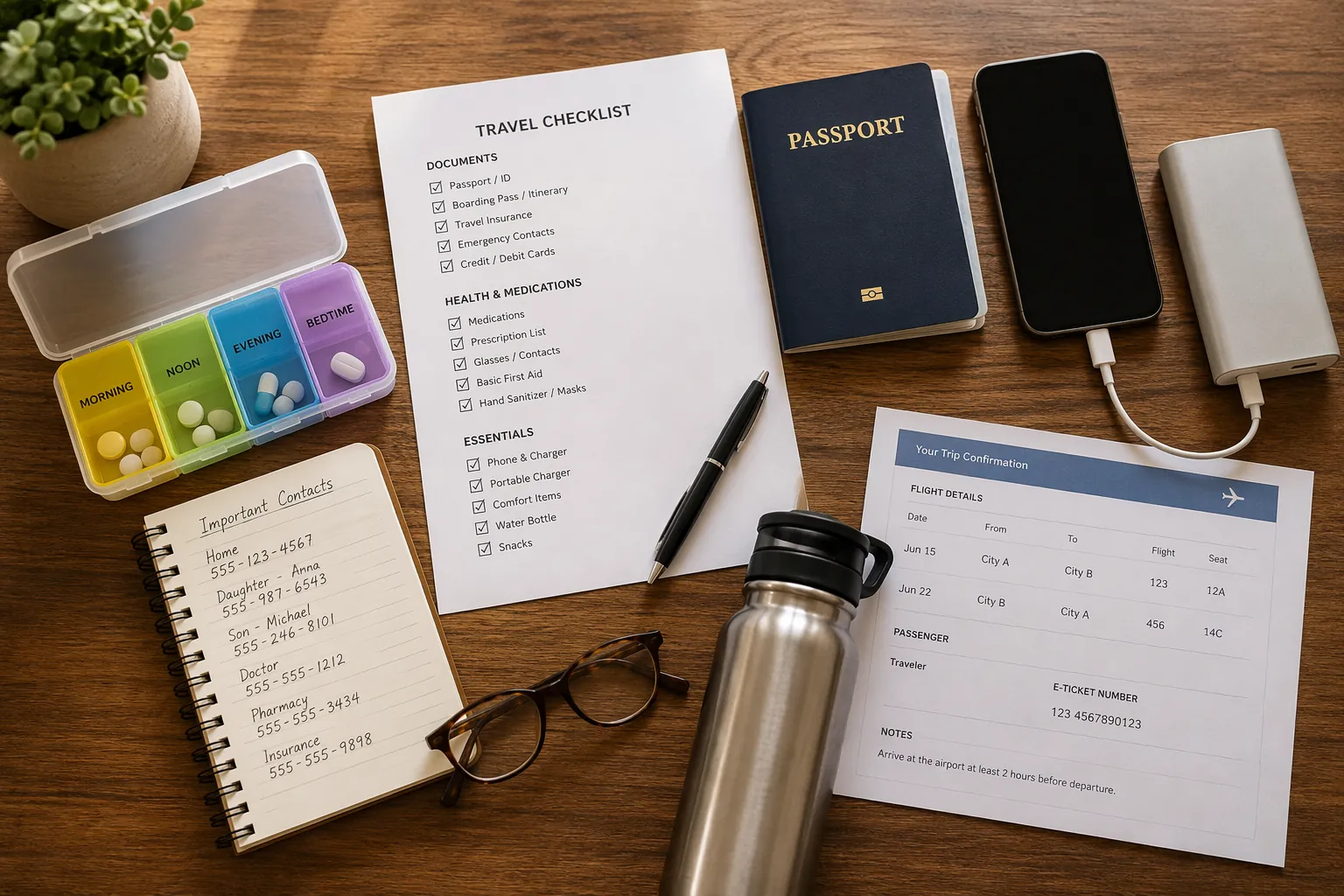
Medication does not go in checked luggage. It goes in the personal item that stays with the traveler under the seat, along with a printed medication list and extra doses in case the trip stretches overnight. DOT consumer guidance says lost or delayed checked baggage affects about 1 in 200 domestic flights, and that is too much risk for medication that has to be taken on schedule.[2]
- Pack medications in original labeled containers when possible, plus a written schedule in plain language.
- Keep glasses, hearing-aid batteries or charger, mobility-device accessories, snacks, and a refillable water bottle in the carry-on or personal item.
- Put a phone charger and charged battery pack in the same bag, not in the roller bag that may be gate-checked.
- Print the itinerary, airline confirmation number, emergency contacts, medication list, allergies, and key medical conditions.
- Give one copy to the traveler and one copy to the caregiver who is staying home.
The printed sheet matters because a storm delay is exactly when the phone battery drops, the airline app freezes, or the traveler cannot hear a gate announcement. A paper itinerary also lets a gate agent, wheelchair attendant, or sibling see the whole situation without making the older traveler recite it under stress.
Request Help Before the Airport Is Overloaded
If the traveler needs wheelchair assistance, help from check-in to the gate, help during a connection, or help from the gate to baggage claim, request it when booking and confirm it again before travel. Do not describe the need only as “my father is elderly.” Say what the person cannot safely do: “He cannot stand in a long line,” “She cannot walk from security to the gate without assistance,” or “He needs wheelchair assistance from curb to gate and again at arrival.”
That wording matters because the enforceable framework is disability-related assistance, not age-based courtesy. Many older adults dislike the word “disabled,” especially if they are independent at home. For travel purposes, the question is narrower: can this person safely move through this airport during an irregular operation without assistance? If the answer is no, the request should say so plainly.
For security screening, TSA Cares can be contacted in advance to request help for passengers who are 75 or older or who have medical conditions. Plan on making the request at least 72 hours before travel, and verify the current TSA Cares process directly with TSA before relying on it for a specific trip.
Set a No-Go Threshold Before Feelings Get Involved
Families need one decision that is made before the suitcase is zipped: what storm conditions make this trip a no-go? That threshold will vary. A healthy 76-year-old flying nonstop to visit grandchildren may choose differently from an 86-year-old with timed medication, poor hearing, and a connection through a weather-hit hub. The point is not to frighten anyone out of traveling. It is to avoid deciding at the curb, in rain, while everyone is already committed to the wrong plan.
- Do not go to the airport just to “see what happens” if the traveler cannot tolerate several hours seated in a terminal.
- Do not start a trip if the medication supply only covers the planned schedule.
- Do not rely on a tight connection during an active storm if missing it would leave the traveler alone overnight.
- Do call the airline before leaving home if the flight is already delayed, the inbound aircraft is late, or the airport is showing widespread cancellations.
If the caregiver is not traveling, assign roles before departure. One person monitors the airline app. One person keeps the traveler’s medication schedule. One person is authorized to call the airline if rebooking is needed. One person stays reachable while the traveler is in the terminal. “Everybody keep an eye on it” is how nobody notices that a gate changed.
At the Airport: Ask for the Accommodation, Not Sympathy
Once a storm delay is announced, the older traveler should not wait until exhaustion makes the need obvious. Ask early, use direct disability-related language, and repeat the request at every handoff. A useful sentence is: “I am a passenger with a disability-related mobility need. I need wheelchair assistance and help getting to the rebooking desk or gate.”
If the traveler cannot stand in the customer-service line, do not make the line the plan. Ask a gate agent for wheelchair assistance to the service desk, help reaching the new gate, or help contacting reservations. If the traveler is already in a wheelchair and the attendant disappears, the request is not “Can someone check on him when they get a chance?” It is: “He cannot move independently and cannot be left unattended. Please send wheelchair assistance now.” DOT’s disability bill of rights states that covered airlines must not leave a passenger who cannot independently move, breathe, eat, drink, or use the restroom unattended for more than 30 minutes.[3]
| Problem | Say this |
|---|---|
| Wheelchair assistance has not arrived | I requested wheelchair assistance. I have a disability-related mobility need and need prompt assistance to the gate. |
| The traveler cannot wait in a long line | This passenger cannot stand in this line because of a disability-related need. What is the accessible way to complete rebooking? |
| The attendant left an immobile traveler alone | This passenger cannot move independently and cannot be left unattended. Please send assistance now. |
| The first answer is vague or dismissive | Please connect me with the airline’s Complaint Resolution Official. |
| A family caregiver is calling from home | I am calling for an elderly passenger with a disability-related mobility need who is currently at your airport. What assistance is being provided at the gate right now? |
The Complaint Resolution Official, or CRO, is not a magic phrase, but it is a real escalation path. DOT says airlines must make a CRO available at each airport they serve during operating hours, either in person or by phone, to resolve disability-related issues.[3] Ask for the CRO when wheelchair help fails, when the traveler is stranded between gates, when staff refuse disability-related assistance, or when the proposed solution requires the older traveler to do something unsafe.
There is also a DOT Disability Hotline at 1-800-778-4838, but it is not a round-the-clock storm rescue line. DOT lists the hotline hours as Monday through Friday, 8:30 a.m. to 5:00 p.m. Eastern time.[3] Use it when the timing fits and the issue is disability-related. Outside those hours, the airport CRO and airline staff are the practical escalation path.
Rebooking: Protect the Body Before the Itinerary
During a storm, the airline may offer a route that looks acceptable on a screen and is miserable in a body: a late-night connection, a different airport, a long terminal transfer, or an overnight wait without a guaranteed place to rest. The caregiver’s job is to translate the itinerary into physical demands. How far is the new gate? How long until the next medication dose? Is the traveler expected to sleep in the terminal? Will the destination pickup person still be awake and able to help?
Weather may limit what the airline can offer. That does not mean every offer is safe to accept. A later nonstop tomorrow morning may be better than a same-day connection that strands an older adult in another city after midnight. If the traveler needs mobility assistance on the new route, ask that it be added to every segment before accepting the rebooking.
- Confirm the new flight number, departure time, arrival time, and connection city.
- Confirm wheelchair or escort assistance for each airport, not just the first departure.
- Ask whether the original seat assignment, mobility-device handling, and special service request carried over.
- Call the pickup person before accepting a late arrival.
- Check the next two medication times before agreeing to a long wait or new connection.
Food and water are not side issues. If a delay is stretching, buy the snack before the line triples. Refill the bottle before the gate changes. For travelers with diabetes, swallowing difficulties, heart failure, kidney disease, or other conditions affected by food or fluids, follow the clinician’s instructions rather than generic airport advice.
What the Airline May Owe—and What It Probably Does Not
For U.S. domestic travel, do not build the storm plan around compensation. DOT’s cancellation and delay dashboard focuses on commitments the largest U.S. airlines make for controllable disruptions, and weather is generally outside that category.[4] Individual airlines may still offer help, and it is fine to ask. Just do not let a voucher argument consume the hour when the traveler needs a restroom escort, a medication dose, or a safer rebooking.
Refunds are different. If a flight is canceled or significantly changed and the passenger does not accept the airline’s alternative transportation or travel credit, DOT says the airline must provide an automatic refund to the original form of payment, with cash refunds due within 20 days.[4] That applies even when the disruption is caused by weather. The key is that the passenger is declining the rebooking, not taking the new flight and also asking for the money back.
International trips can add another layer. EU 261 generally does not make airlines pay delay compensation for extraordinary circumstances such as severe weather, though separate care obligations may apply in some situations. If the trip involves a non-U.S. carrier, a foreign airport, or a package tour, check the specific rules before assuming the U.S. playbook answers every question.
After the Disruption: Recover First, Complain Second
Once the traveler is home, in a hotel, or safely at the destination, the first job is not paperwork. It is recovery. Get back on the medication schedule using the instructions from the prescribing clinician or pharmacist. Replace food, fluids, sleep, hearing-aid batteries, oxygen supplies, mobility-device parts, or anything else the delay disrupted. If a dose was missed or doubled, or symptoms changed during the delay, call the appropriate medical professional.
Then document what happened while details are fresh. Keep boarding passes, rebooking notices, delay or cancellation messages, baggage receipts, hotel receipts, and screenshots from the airline app. Write down approximate times, names if available, and the exact assistance requested. For a disability complaint, the useful facts are concrete: when wheelchair help was requested, when it arrived, whether the passenger was left unattended, whether a CRO was requested, and how the airline responded.
- If the traveler accepted rebooking and completed travel, focus any complaint on service failures, disability-assistance failures, or expenses the airline specifically promised to cover.
- If the traveler declined the canceled or significantly changed trip, watch for the automatic refund to the original form of payment.
- If mobility assistance failed, file with the airline and consider a DOT disability complaint using the timeline and names you wrote down.
- If checked medication, mobility equipment, or medical supplies were delayed or damaged, preserve receipts and baggage claim records.
There is a point in some storm delays when the right decision is to stop trying to salvage the itinerary. That is not giving up. For an older traveler, abandoning a trip before exhaustion becomes unsafe can be the most responsible choice in the whole plan.
Use This Before the Next Storm-Season Trip
Families cannot control storms, and they usually cannot force weather compensation. They can keep medication out of checked baggage, book routes that do not punish a slower body, request disability accommodations in the right words, escalate to a CRO when assistance fails, and choose recovery over endurance when the airport stops being safe. Print the plan, put it with the itinerary, and make sure the traveler—not just the caregiver—knows which sentence to say when the delay board turns red.
References
- FAA Weather Delay FAQ, FAA, https://www.faa.gov/nextgen/programs/weather/faq
- DOT Fly Rights, U.S. Department of Transportation, https://www.transportation.gov/airconsumer/fly-rights
- DOT Airline Passengers with Disabilities Bill of Rights, U.S. Department of Transportation, https://www.transportation.gov/airconsumer/disabilitybillofrights
- DOT Airline Cancellation and Delay Dashboard, U.S. Department of Transportation, https://www.transportation.gov/airconsumer/airline-cancellation-delay-dashboard
- AirAdvisor — How Elderly Passengers are Impacted By Flight Disruptions, AirAdvisor, https://airadvisor.com/en/flight-disruptions-impact-on-elderly-passengers
Browse more in the Glossary.