
Glossary entry
Your Guide to Energy Assistance Programs for Senior Citizens
Last verified 2026-07-29
This is not financial or legal advice. Medicare/Medicaid and benefits rules vary by state and change over time — verify current rules with your state Medicaid office or Area Agency on Aging.
Last verified: July 29, 2026. Program rules, opening dates, and dollar amounts can change by state and by funding year. This guide is for benefits-literacy information only, not legal, tax, or financial advice.
Many older adults who could use help with a heating or cooling bill never receive it. The National Council on Aging reports that LIHEAP serves about 6.7 million households each year, while also citing a reported estimate that only about 17% of eligible households receive assistance; that 17% figure comes through NCOA’s citation of Columbia University researcher Diana Hernandez and should be checked against newer data when available.[1] Still, the practical message is hard to miss: energy assistance programs for senior citizens are not reaching everyone who may qualify.
That gap matters because utility bills do not behave like optional spending. Low-income households spend about 7.2% of income on utilities, compared with about 2% for higher-income households.[2] For someone living mostly on Social Security, a winter heating bill or summer cooling bill can arrive at exactly the wrong time: after medication refills, rent, food, insurance premiums, or a repair the house could not wait on.
The first useful correction is this: you do not have to assume you are “too late” or “not poor enough” until you have checked your state’s LIHEAP rules. The income threshold may be broader than many people expect, older adults may have an earlier application window, and a shutoff notice or broken heating system may follow a separate crisis route.
What LIHEAP Can Help Pay For
LIHEAP stands for the Low Income Home Energy Assistance Program. It is the main federal program that helps low-income households pay home energy costs, but it is not handed out as one identical national benefit. The federal program is administered through states, territories, tribes, and local agencies, so the application dates, benefit amounts, documents, and crisis rules depend on where the senior lives.
In plain terms, LIHEAP may help with:
- Regular heating assistance, often used for winter heating bills or fuel deliveries.
- Cooling assistance, available in some states or seasons for electricity and air conditioning costs.
- Crisis assistance, usually for urgent situations such as disconnection threats, little fuel left, or unsafe heating equipment.
Some states also use names such as emergency home energy assistance for older adults, including programs sometimes called EHEAP. Treat those as state-level emergency categories, not as one universal federal senior program. The name matters less than the question to ask: “Is there a crisis or emergency energy program for seniors in this state, and is it open now?”
Check the Income Rule Before You Rule Yourself Out
Federal LIHEAP income eligibility is generally tied to household income at or below 150% of the federal poverty guidelines or 60% of state median income, whichever is higher, with a federal floor of 110% of the poverty guidelines.[3] That sentence is administrative, but the effect is very practical: the limit is not always the same number from one state to the next.
Pennsylvania’s published LIHEAP income limits for the 2026-2027 season give a useful example. Effective February 1, 2026, Pennsylvania lists a one-person household limit of $23,940 and a two-person household limit of $32,460.[4] A senior who sees only the monthly Social Security deposit may not immediately know whether the annual number fits. It is worth doing the arithmetic before closing the bill envelope.
Household size also matters. A widow living alone is not measured the same way as a senior couple, and a grandparent living with family may need to count household income differently depending on state rules. If income recently changed, ask the local LIHEAP office how they count it; some applications ask for recent income proof rather than last year’s tax return.
Receiving SNAP, SSI, Medicaid, or TANF can help in some states because those programs may be used to show income eligibility. But that is not the same as a guaranteed LIHEAP payment. State rules vary, and a separate LIHEAP application is usually still required.
There Is No Single “Typical” LIHEAP Payment
Benefit ranges are one reason a national shortcut can mislead people. The FY 2026 LIHEAP Clearinghouse benefit table, updated November 24, 2025, lists very different ranges by state and component: Pennsylvania heating benefits at $200 to $1,000; Florida heating and cooling benefits at $400 to $1,350; California benefits at $94 to $1,500; and Texas benefits at $1 to $12,600.[5]
| State | FY 2026 listed benefit range | Why this matters when applying |
|---|---|---|
| Pennsylvania | $200-$1,000 for heating | A senior should check both the income limit and the regular heating season rules. |
| Florida | $400-$1,350 for heating and cooling | Cooling help may matter as much as heating help, especially for older adults at home during heat. |
| California | $94-$1,500 | The range is wide enough that household need and program rules matter. |
| Texas | $1-$12,600 | A large maximum should not be read as a normal payment; the actual amount depends on state and case rules. |
A high maximum, especially in a state like Texas, should be handled carefully. It proves that benefit ranges can be broad; it does not prove that most applicants will receive that amount. The better question is what your state pays for your fuel type, household size, income, current bill, and crisis status.
Older Adults May Get an Earlier Window
Application timing can decide the whole matter. Some states open first for older adults, people with disabilities, or households with young children. Illinois, for example, opens LIHEAP applications on October 1 for older adults and people with disabilities, while the general public begins November 1, according to Citizens Utility Board guidance for the 2025-2026 season.[6] Missouri’s FY 2026 program dates table likewise lists October 1 for elderly and disabled households and November 1 for all other households.[7]
Those early windows are not courtesy details. If a senior waits until the general public opening because no one told them they had priority, they may be competing for funds later than necessary. When calling or searching online, use the exact phrase: “What is the LIHEAP opening date for seniors age 60 or older?” Then ask whether the date is for heating, cooling, crisis assistance, or all components.
Regular Help and Crisis Help Are Different Paths
Regular LIHEAP assistance is usually the standard seasonal application. Crisis assistance is for a more urgent problem. Pennsylvania’s LIHEAP page describes crisis grants for households facing situations such as a past-due or shutoff notice, broken heating equipment, or less than a 15-day supply of fuel.[4]
That distinction can save time. A senior with a manageable bill and no shutoff notice should follow the regular heating or cooling process. A senior whose heat is already off, whose electric service is scheduled for disconnection, or whose furnace has failed should say “crisis” or “emergency” at the first contact. Do not bury that fact halfway through the call.
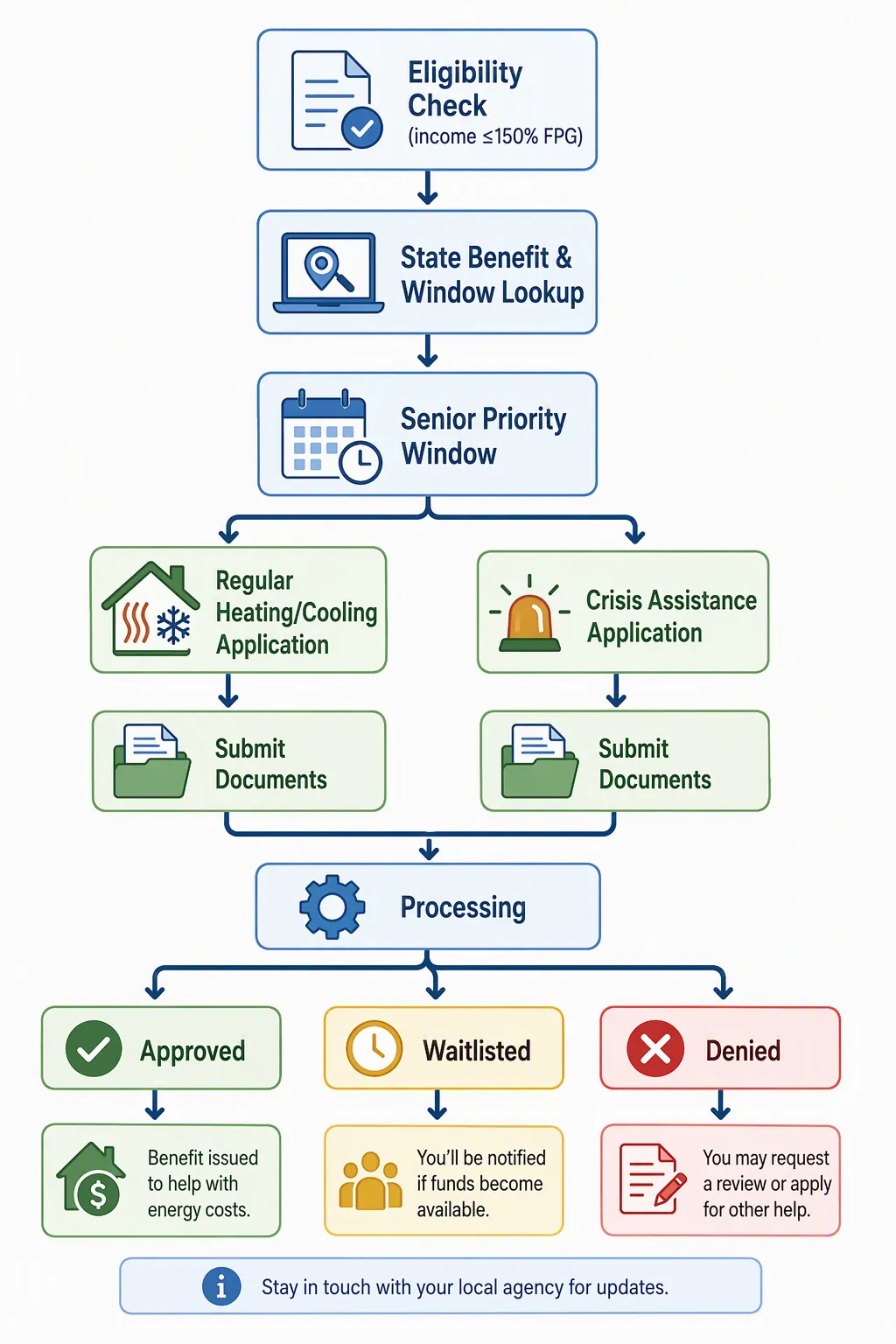
The Application Path, Without the Guesswork
The paperwork is not complicated because any one document is unusual. It becomes hard because the agency needs several ordinary papers at the same time, often when the applicant is already under pressure.
- Find the state or local LIHEAP office. Start with the state LIHEAP website, the county assistance office, BenefitsCheckUp.org, or the National Energy Assistance Referral line at 1-866-674-6327.[1]
- Check the senior opening date. Ask whether older adults can apply before the general public and whether the date differs for heating, cooling, and crisis help.
- Confirm income rules for the household. Use the state’s current-year limits, not a number copied from an old article.
- Ask which application path fits the situation. Regular seasonal help and crisis assistance may have different forms, proof, and urgency rules.
- Gather the document packet before submitting. Missing proof is one of the easiest ways for an application to stall.
- Submit through the approved channel. Depending on the state, that may be online, by mail, in person, by phone, or through a local community action agency.
- Watch for follow-up notices. A request for one missing page is not a denial, but it can become one if the deadline passes.
Documents to Put in One Folder
Citizens Utility Board guidance lists common LIHEAP application documents including proof of the last 30 days of income, the most recent utility bill, photo identification, and Social Security cards or ITINs for household members.[6] A Social Security benefit letter can help show income, but the applicant should still ask the local office what exact proof is accepted.
- Recent utility bill, including the account number and service address.
- Proof of income for the required recent period, such as Social Security, SSI, pension, wages, or unemployment proof.
- Photo ID for the applicant.
- Social Security card, ITIN, or other required identity number documentation for household members.
- Shutoff notice, past-due notice, fuel delivery statement, or repair estimate if applying for crisis help.
- Lease or proof of residence if the agency asks for it.
Caregivers can help most by reducing the back-and-forth. Put the senior’s name, date of birth, phone number, utility account number, and application confirmation number on a cover sheet. If the agency calls about a missing document, write down the caller’s name, the date, exactly what is missing, and the deadline.
After You Apply
Processing can take up to 30 days, according to Citizens Utility Board guidance.[6] That does not mean the applicant should wait silently if the bill is urgent. If there is a shutoff date, a medical need for electricity, or no safe heat, contact the LIHEAP office and the utility separately and ask what protection or crisis review is available while the application is pending.
If approved, the payment often goes directly to the utility or fuel vendor rather than to the applicant. That can be disappointing if the senior expected a check, but it is normal for this kind of benefit. Keep the approval notice and compare the account after the payment posts.
If Funds Are Exhausted, the Bill Is Still Urgent
A waitlist or closed regular program does not always end the search. Ask the LIHEAP office three separate questions: whether crisis funds are still open, whether cooling or heating funds have a different window, and whether the agency can refer the household to a local fuel fund or utility hardship program.
Charitable and utility-linked programs vary by location. Examples include the Salvation Army, Dollar Energy Fund, Oregon Energy Fund, and utility hardship plans such as Ohio’s Percentage of Income Payment Plan, which caps payments at 6% of monthly income.[8] These are not substitutes for checking LIHEAP first, but they may matter when regular funds are gone or a household needs help before the state finishes processing.
If denied, read the notice before assuming the decision is final. Some denials are about income, but others are about missing proof, wrong household information, an unsigned form, or applying through the wrong office. Ask how to appeal, whether a corrected application can be submitted, and whether crisis assistance can still be reviewed separately.
A Short Call Script for Seniors and Caregivers
When the agency phone menu is long, it helps to have the important facts ready. This wording is plain enough to use as-is:
“I am calling about LIHEAP for a household with an adult age 60 or older. I need to know the current income limit, the senior application opening date, whether heating or cooling help is open, and whether crisis assistance is available. We have a utility bill and income proof ready. If there is a shutoff notice or urgent heating or cooling problem, what should we do today?”
That call should end with a specific next step: the correct application link or office, the deadline, the document list, and what to do if a notice arrives asking for more proof. Write those down. The practical difference between available help and received help is often one date, one missing page, or one phone call made before the account reaches shutoff.
Where to Start Today
Start with the state LIHEAP office or BenefitsCheckUp.org. If you are not sure where to apply, call the National Energy Assistance Referral line at 1-866-674-6327.[1] Ask specifically about senior priority dates and crisis assistance if the bill is already past due, service is at risk, fuel is nearly gone, or heating equipment is unsafe.
References
- Energy Assistance Programs for Older Adults, National Council on Aging, https://www.ncoa.org/article/energy-assistance-benefits/
- LIHEAP and WAP: A Dynamic Duo, NASCSP, https://nascsp.org/liheap-and-wap-a-dynamic-duo-for-reducing-the-low-income-energy-burden/
- What Are the LIHEAP Income Limits?, National Council on Aging, https://www.ncoa.org/article/what-is-the-income-limit-for-liheap/
- LIHEAP, Pennsylvania Department of Human Services, https://www.pa.gov/agencies/dhs/resources/liheap
- LIHEAP Clearinghouse Benefit Levels Table, LIHEAP Clearinghouse, updated November 24, 2025, https://liheapch.acf.gov/tables/benefits.htm
- Step-by-Step Guide to Applying for LIHEAP, Citizens Utility Board, September 11, 2025, https://www.citizensutilityboard.org/blog/2025/09/11/a-step-by-step-guide-to-applying-for-liheap/
- LIHEAP Clearinghouse Program Dates Table, LIHEAP Clearinghouse, updated November 25, 2025, https://liheapch.acf.gov/tables/program_dates.htm
- Get Help with Energy Bills, USAGov, https://www.usa.gov/help-with-energy-bills
Browse more in the Glossary.