
Clinical term
Is the New Enzyme Reverse Aging Treatment for Seniors Real?
Last verified 2026-07-25
Short answer: yes, a real “reverse aging” human trial has begun. No, it is not a new enzyme reverse aging treatment for age-related diseases in seniors, and it is not a pill or injection meant to rejuvenate the whole body. The human trial now drawing attention is ER-100, a localized gene therapy being tested for vision loss from optic neuropathies, including glaucoma and non-arteritic anterior ischemic optic neuropathy, or NAION.[1][2]
That distinction matters in a real household. If an older parent has glaucoma, worsening balance, or a recent fall, a headline about an “enzyme that reverses aging” can sound as if a treatment is nearly ready. As of July 2026, it is not. The most practical reading is this: one eye-focused therapy has reached an early human safety trial, while the more enzyme-like research remains in animals or cells.
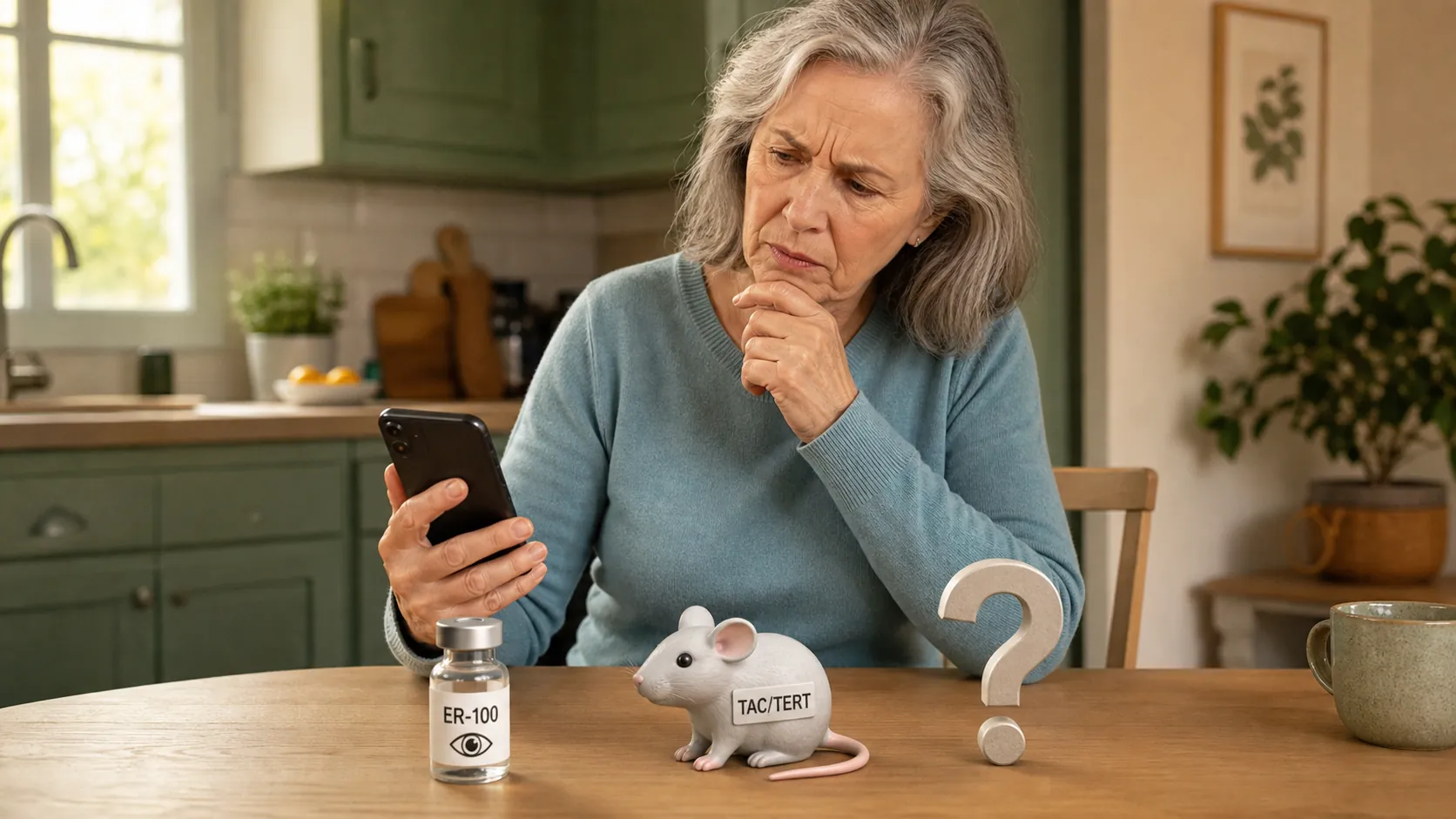
What Is Actually in Human Testing?
The concrete human-trial example is ER-100 from Life Biosciences. The company announced that the first patient was dosed on June 9, 2026, in a Phase 1 trial for optic neuropathies.[2] Business Insider described the event as the first time a reverse-aging drug had been injected into a human, which is the kind of phrase that can easily travel farther than the details behind it.[1]
ER-100 is not an enzyme. It is an AAV2-delivered gene therapy using three Yamanaka transcription factors, often abbreviated OSK. The treatment is designed with a doxycycline-controlled on/off switch, meaning the activity of the reprogramming factors can be regulated by exposure to doxycycline.[2]
The target is also narrower than many headlines imply. ER-100 is being tested in the eye for optic neuropathies, not throughout the body for general aging. The Phase 1 study is expected to enroll about 18 to 20 patients across four U.S. sites: Boston, New York City, Los Angeles, and Charleston.[1][2]
| Claim in the headline | What the 2026 evidence actually supports |
|---|---|
| A reverse-aging treatment has entered humans | Yes, ER-100 has entered a Phase 1 human trial for optic neuropathies. |
| It is an enzyme | No, ER-100 uses transcription factors delivered by gene therapy. |
| It treats aging throughout the body | No, the current human trial is localized to vision loss. |
| It is available for seniors now | No, Phase 1 testing is not the same as FDA approval or routine clinical use. |
| An approved systemic anti-aging treatment is near | Credible reporting still frames that as more than a decade away. |
Why the Eye Is the First Test Site
The eye is not a side detail. It is central to what makes this trial different from a body-wide longevity claim. ER-100 is being studied for optic neuropathies, where damage to the optic nerve can lead to serious vision loss. Life Biosciences has described preclinical primate data as part of the rationale for moving into this first human trial.[2]
For older adults, vision loss is not just a medical chart problem. Poor vision can change how someone judges a step, sees a threshold, reads a medication label, notices a throw rug, or moves through a dim hallway at night. That is why glaucoma and NAION belong in a fall-prevention conversation even if ER-100 itself remains experimental.
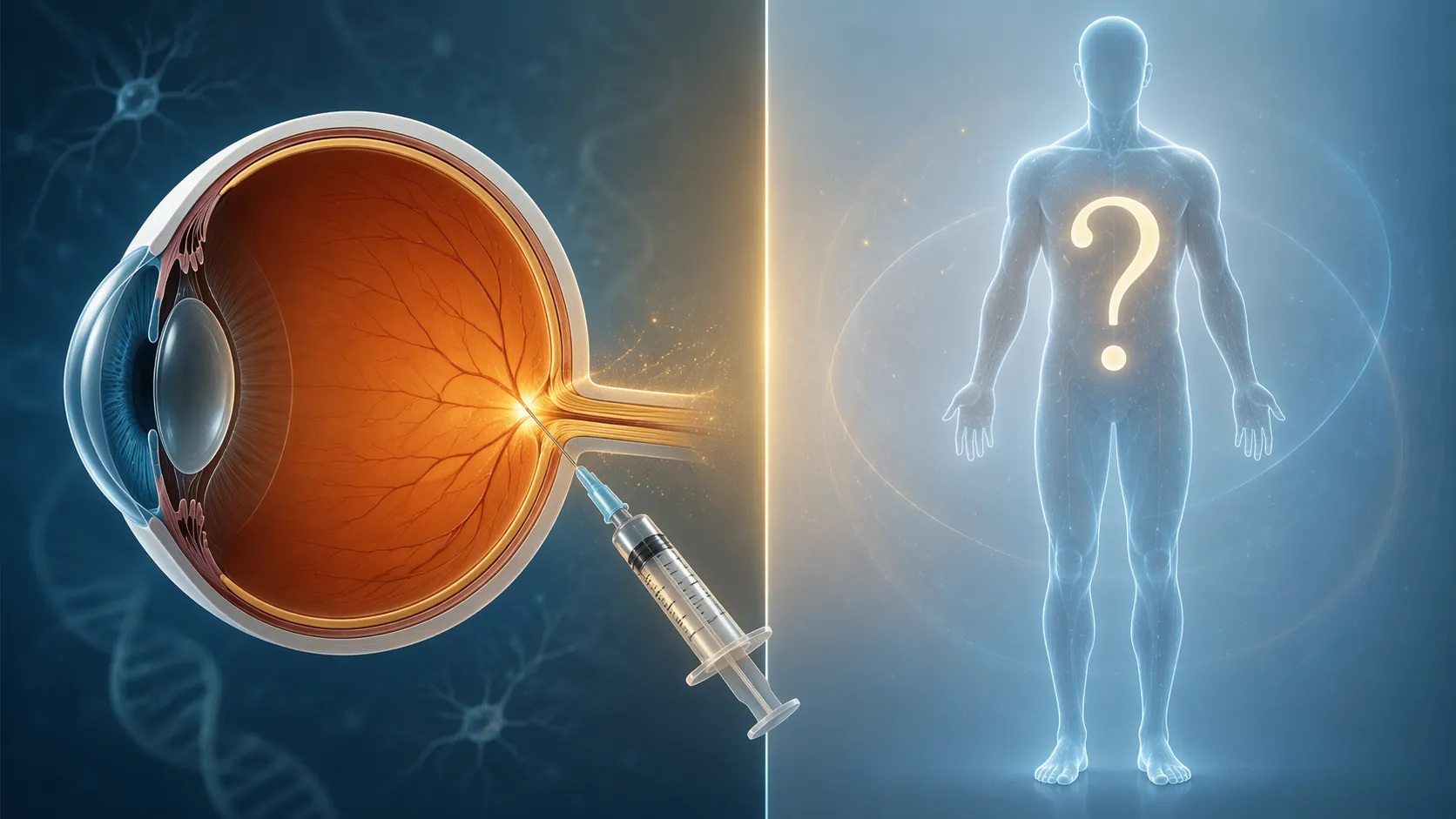
A Phase 1 trial asks a modest but essential first question: can the treatment be given to humans with an acceptable safety profile? It can collect early signals, but it cannot prove that a therapy restores vision, prevents falls, treats frailty, or reverses aging in seniors. Families should be careful not to ask a Phase 1 study to answer questions it was not built to answer.
Fortune reported in January 2026 that Life Biosciences had secured FDA clearance for what it described as the first FDA-approved partial de-aging human trial, which helps explain why ER-100 became such a visible example in longevity coverage.[3] FDA clearance to begin a trial, however, is not the same as FDA approval to market a treatment.
Where the “Enzyme” Confusion Comes From
The enzyme language most likely comes from a different research line: telomerase, especially TERT, a component connected with maintaining telomeres. Telomeres are protective structures at chromosome ends, and telomerase activity has long attracted attention in aging research. But that is not what ER-100 is.
In June 2024, MD Anderson researchers reported a small-molecule TERT-activating compound, called TAC, after screening more than 650,000 compounds. In aged mice, TAC restored TERT levels and was associated with improvements across several aging-related hallmarks, including cognition and muscle function.[4]
That is important science, but it is not a senior treatment. It was a preclinical mouse study, not a human trial. No human TAC trial has been announced in the materials provided for this article. A caregiver reading about TAC should place it on the “promising but not clinically available” shelf.
Telomerase activation also carries a caution that should not be waved away. Because telomerase is connected with cell replication, future attempts to activate it in people would need to address cancer-risk concerns directly. A finding in mice can justify more research; it does not settle safety in older adults with complicated health histories.
Other “Reverse Aging” Stories Are Not the Same Thing
Several other studies have added to the noise because they use overlapping language: rejuvenation, reprogramming, anti-aging, cellular aging, or reverse aging. They are not interchangeable.
Queen Mary University of London reported work in October 2025 involving rapalink-1, a TOR inhibitor, and an agmatinase pathway in a yeast model.[5] That is far from a treatment a physician can offer an older adult with neuropathy, cataracts, frailty, or fall risk.
Harvard-associated chemical reprogramming work has also drawn attention for testing cocktails that affect cellular aging in human cells. Scientific American and MIT Technology Review both covered the broader move toward testing rejuvenation methods in humans around early 2026, while also making clear that the field is still at an early clinical stage.[6][7]
These projects may all belong to the broad longevity conversation, but they should not be blended into one imaginary product. A yeast experiment, a mouse telomerase study, a human-cell chemical screen, and a Phase 1 eye gene-therapy trial answer different questions.
What Caregivers Can Safely Conclude in 2026
The useful answer for 2026 is neither “aging has been solved” nor “ignore all of this.” ER-100 is real and worth watching because optic nerve disease can threaten independence. The TAC enzyme-related work is real and worth watching because it points to a biological target that may matter. Neither is an available reverse-aging treatment for seniors.
- If the story says “human trial,” check whether it means a Phase 1 safety trial or an approved therapy.
- If the story says “enzyme,” check whether it is talking about telomerase/TERT rather than ER-100.
- If the story says “reverse aging,” check whether the treatment is localized to one tissue, such as the eye.
- If the story says “for seniors,” check whether older adults can actually receive it outside a trial.
Business Insider and Science Focus both frame FDA-approved systemic anti-aging treatment as more than a decade away, not around the corner.[1][8] That timeline may change as trials succeed or fail, but it is a better guide for families than a headline that turns early biology into near-term care.
For a daughter trying to help a parent stay safely at home, the next step is not to hunt for a reverse-aging enzyme. It is to keep the eye appointment, ask the clinician what vision changes mean for driving and stairs, update glasses when appropriate, improve lighting, reduce trip hazards, review medications that affect balance, and treat new vision loss as a fall-risk issue as well as an eye-health issue.
References
- The first-ever reverse-aging drug was just injected into a human, Business Insider, June 2026.
- Life Biosciences Announces First Patient Dosed in Phase 1 Trial of ER-100 for Optic Neuropathies, Life Biosciences.
- This startup has the lead in longevity, securing the first FDA-approved partial de-aging human trial, Fortune, January 2026.
- Activating molecular target reverses multiple hallmarks of aging, MD Anderson Cancer Center, June 2024.
- New drug and enzyme class found to have anti-ageing properties, Queen Mary University of London, October 2025.
- This method to reverse cellular aging is about to be tested in humans, Scientific American, January 2026.
- The first human test of a rejuvenation method will begin shortly, MIT Technology Review, January 2026.
- This new drug may have cracked the cheat code for reversing ageing, Science Focus.
Browse more in the Glossary.