
Clinical term
What Are Esophageal Cancer Symptoms in the Elderly?
Last verified 2026-07-26
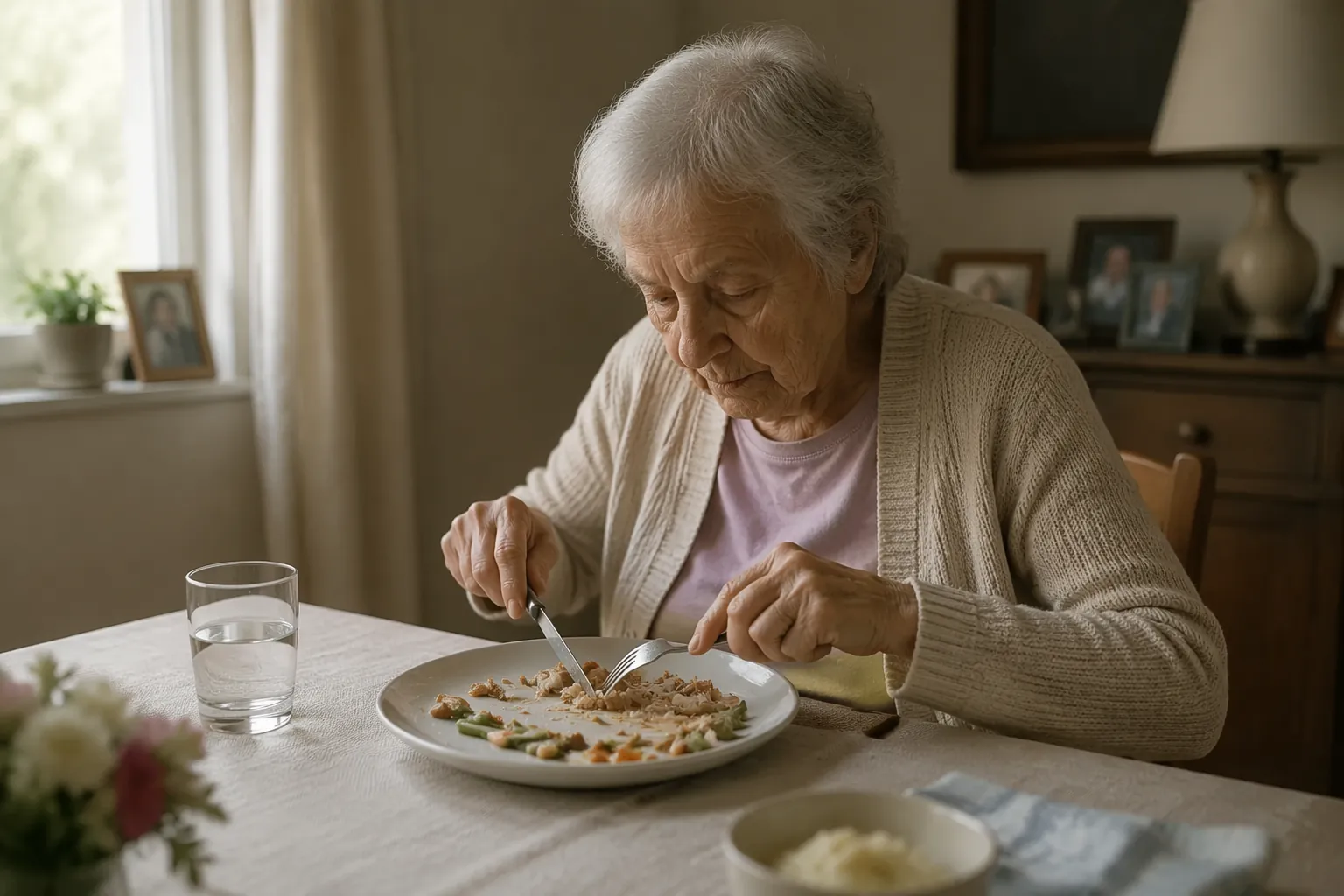
The esophageal cancer symptom families most often miss is not usually dramatic pain. It is the older person who starts cutting meat into smaller pieces, avoids bread unless it is soaked, asks for soup more often, drinks water after every bite, or leaves the tougher half of dinner untouched. Difficulty swallowing solid food is commonly one of the first warning signs, and it may worsen slowly enough that everyone in the house adjusts around it before anyone names it as a symptom.[1][2][3]
That matters because the esophagus can stretch around a growing tumor, so symptoms may take years to become obvious.[1] In an older adult, the early pattern may be written off as reflux, dental trouble, “getting picky,” or just eating less with age. Those explanations can be true. They can also delay the appointment that should have happened when swallowing changed from normal to effortful.
This article is general education, not a diagnosis or a treatment plan. New or progressive swallowing trouble, unexplained weight loss, vomiting or regurgitation, black stools, chest pressure, or breathing symptoms after meals deserve medical evaluation, especially in an older adult with long-standing reflux or Barrett’s esophagus.
The Swallowing Pattern Families Should Not Dismiss
Esophageal cancer begins in the tube that carries food from the throat to the stomach. That short description is enough for the practical question at home: when the inside of that tube narrows or stiffens, solid food usually becomes the first problem. Steak, chicken, raw vegetables, crusty bread, rice, or pills may feel stuck. A person may eat more slowly, avoid social meals, or say food “goes down funny” without calling it pain.
The warning sign is progression. Occasional trouble swallowing a dry bite is different from a change that keeps returning, moves from harder foods to softer foods, or eventually affects liquids. Mayo Clinic lists difficulty swallowing, weight loss without trying, chest pain or pressure, worsening indigestion or heartburn, coughing, and hoarseness among esophageal cancer symptoms.[2] Cleveland Clinic also notes chronic cough, vomiting or regurgitating food, black stools, anemia, and aspiration pneumonia as possible symptoms or complications.[3]
- Solids become harder to swallow, especially meat, bread, rice, or pills.
- Heartburn or indigestion worsens or stops responding to the usual medication.
- Meals take longer, portions shrink, or familiar foods disappear from the plate.
- Weight drops without an intentional diet change.
- Coughing, hoarseness, hiccups, chest burning, or regurgitation shows up around meals.
- Fatigue, anemia, black or tarry stools, or aspiration pneumonia appears without a clear explanation.
Older adults are allowed to have preferences. Not every smaller dinner is a cancer sign. The problem is when the family explanation becomes too tidy: “Dad eats soup now because chewing is easier,” “Mom’s reflux is just worse,” or “He’s 82, appetite changes.” If swallowing has changed and keeps changing, the safer move is to ask for evaluation rather than negotiate dinner around it.
Reflux Can Be a Clue, but Symptoms Alone May Not Find Cancer Early
Long-term acid reflux and Barrett’s esophagus are not the same as cancer, and most people with reflux do not have esophageal cancer. Still, a change in a familiar reflux pattern should not be ignored. MD Anderson includes worsening heartburn that does not respond to medication, painful swallowing, chronic cough, hoarseness, persistent hiccups, and reduced appetite among symptoms that can occur with esophageal cancer.[1]
There is a frustrating catch: early esophageal cancers often do not cause clear symptoms. Cleveland Clinic notes that many early esophageal cancers are found during endoscopy for another reason, often in people being checked for chronic acid reflux or Barrett’s esophagus.[3] So the absence of dramatic symptoms does not prove safety, and the presence of progressive symptoms should not wait for drama.
For a primary care visit or gastroenterology referral, the most useful family notes are plain ones: when swallowing changed, which foods cause trouble, whether liquids are involved, how much weight has been lost, whether reflux medication used to work and no longer does, and whether coughing or choking happens after meals. A vague “not eating well” is easy to minimize. A timeline is harder to wave away.
After Diagnosis, the First Question Is Not “Is This Person Too Old?”
Esophageal cancer is common enough in older adults that age cannot be treated as an unusual complication. In a systematic review and pooled analysis of elderly patients, one in three people with esophageal cancer was over 70, and one in five was over 75.[4] Yet the same review found that only 50% to 69% of elderly patients with curable-stage disease received treatment with curative intent, with age alone driving much of the disparity.[4]
That does not mean every older adult should receive aggressive therapy. It means “too old” is not an assessment. A 78-year-old who walks independently, manages daily activities, eats enough, and has controlled medical conditions is not the same patient as a 78-year-old who has repeated falls, severe weight loss, confusion, and needs help getting out of a chair. Birth year is a fact. Fitness is clinical information.

Won and Ilson, writing on localized esophageal cancer in older patients, make the same point directly: advanced age by itself should not prohibit curative esophageal cancer treatment.[5] The harder and more useful question is whether the person can tolerate the treatment being proposed, recover from it, and live with the tradeoffs.
What Functional Fitness Actually Means
Functional fitness is not a compliment like “she’s sharp” or “he’s strong for his age.” It is a structured look at how the person lives and what reserves they have. Comprehensive geriatric assessment can include medical conditions, medications, nutrition, cognition, mood, mobility, falls, social support, and activities of daily living.[4][5]
| Question | Why it matters after esophageal cancer diagnosis |
|---|---|
| Can the person bathe, dress, toilet, transfer, and eat without help? | ADLs show whether treatment recovery may be possible at home or will require substantial support. |
| Has there been recent weight loss, weakness, or dehydration? | Poor nutrition can make surgery, chemoradiation, infection, and falls harder to recover from. |
| Has the person fallen or started using furniture for balance? | Treatment-related fatigue, anemia, and poor intake can turn a near-fall into an injury. |
| Is memory or decision-making impaired? | Consent, medication schedules, feeding tube care, and symptom reporting may require a designated helper. |
| Who can drive, cook, supervise bathing, manage appointments, and stay overnight if needed? | A treatment plan that assumes invisible family labor is not really a plan. |
Tools such as the G8 screening tool, activities-of-daily-living assessment, and PACE tool are used to help identify older patients who may tolerate aggressive therapy and those who need modified plans or more support.[4][5] These tools do not make the decision for the family. They keep the decision from being reduced to a birthday.
Treatment Options Exist Across a Range, but the Tradeoffs Are Real
The National Cancer Institute describes treatment options for esophageal cancer that can include surgery, radiation therapy, chemotherapy, chemoradiation, targeted therapy, immunotherapy, laser therapy, electrocoagulation, and supportive procedures depending on cancer type, stage, location, and patient condition.[6] For an older adult, the discussion should include both cancer control and what treatment will do to swallowing, strength, independence, and care needs.
In elderly patients, definitive chemoradiation is the most frequently offered curative treatment, received by 37% to 64% in the Mantziari review, with reported clinical response rates of 48% to 78%.[4] The same evidence base needs careful reading: much of the elderly-specific data comes from retrospective cohorts, and many landmark trials excluded patients over 75, so conclusions for the very old are less certain than families may wish.[4][5]
Surgery can be curative for selected patients, but it is not a small undertaking. In the systematic review, postoperative mortality in elderly patients ranged from 0% to 24%, with a median of about 7.9%, compared with 0% to 9% and a median of about 3.4% in younger patients.[4] The wide range matters: outcomes at high-volume centers may not match outcomes everywhere, and hospital experience should be part of the family’s questions.[4]
Survival data also needs to be held with both hands. The pooled estimate for five-year survival after curative surgery in elderly patients was 29.3%, with a range from 9% to 42.9%, compared with 35.1% in younger patients.[4] The review also found that any treatment in elderly patients was associated with longer median overall survival than best supportive care alone, about 18 to 19 months versus 9 to 12 months.[4] Those numbers support offering a serious discussion, not pushing one answer.
Quality of life after treatment is not automatically worse just because someone is older. Mantziari and colleagues reported that long-term quality of life after treatment was comparable between elderly and younger patients.[4] But the discharge reality after surgery can be very different: 44% to 54% of elderly patients may require discharge to a nursing facility after surgery, compared with 6% to 16% of younger patients.[4] That is where a treatment decision becomes a family logistics decision.
Questions Worth Asking the Oncology Team
- Is this treatment curative, life-prolonging, symptom-relieving, or mainly supportive?
- Has a geriatric assessment been done, including ADLs, falls, nutrition, cognition, and medications?
- How many esophagectomies does this center perform, and what are outcomes for older adults here?
- What swallowing problems, feeding tube needs, fatigue, or infection risks should we expect?
- Where is the patient most likely to go after hospitalization: home, rehab, skilled nursing, or another setting?
- If treatment is modified because of frailty, what goal are we protecting: survival, swallowing, comfort, time at home, or independence?
Eating Becomes Care, Not Just Meals
Esophageal cancer care often enters the home through the kitchen. The person who used to make breakfast may now need someone else to notice that coffee is untouched, pills are being skipped because they are hard to swallow, or dinner has quietly become yogurt and tea. Nutrition is not a side issue; it affects strength, fall risk, treatment tolerance, wound healing, and whether the person can remain safely at home.
After esophagectomy, Memorial Sloan Kettering Cancer Center describes a staged diet progression that may begin with clear liquids around day 6, full liquids around day 10, and a soft diet around day 13, with feeding tube support used during recovery.[7] Those are protocol examples, not promises. The actual pace depends on the surgeon, complications, swallowing function, and the patient’s condition.
Soft foods are often less about babying someone and more about keeping calories possible. Cancer Research UK suggests options such as scrambled eggs, soups, mashed potatoes, smoothies, yogurts, and foods softened with sauces or gravies for people with eating problems from esophageal cancer.[8] MSKCC notes that high-calorie supplements such as Ensure or Boost may provide about 250 to 530 calories per serving, depending on the product.[7]
| Home problem | Practical response to discuss with the care team |
|---|---|
| Food feels stuck | Ask whether texture changes, swallowing evaluation, medication changes, dilation, stenting, or treatment adjustment is appropriate. |
| Meals are too tiring | Use smaller, more frequent meals and higher-calorie liquids or soft foods if approved. |
| Coughing after eating | Report it promptly; aspiration risk may need swallowing assessment or diet changes. |
| Weight is dropping | Track weight and intake; ask about dietitian support, supplements, or tube-feeding expectations. |
| Pills are hard to swallow | Ask before crushing or changing medications, because some pills should not be altered. |
A feeding tube can be emotionally loaded for families, especially when the older adult has strong feelings about independence. It helps to ask what the tube is meant to do in this specific plan. Is it temporary support after surgery? A bridge through chemoradiation? A way to reduce weight loss? Or part of comfort-focused care when swallowing is failing? The same device can mean different things depending on the goal.
Weakness, Falls, and the Bathroom at 2 a.m.
Cancer care plans often sound as if they happen in clinics. Much of the risk happens between the bed and the bathroom. Weight loss, anemia-like fatigue, dehydration, pain medication, sleep disruption, and recovery from hospitalization can all make an older adult less steady. If swallowing has been poor for weeks, the fall risk may already be present before treatment begins.
Before discharge, families should ask for a mobility assessment, not just diet instructions. Can the person stand from a chair without using both arms? Walk to the bathroom at night? Step into the shower? Manage stairs? Carry food from kitchen to table? A parent may look composed in a hospital chair and still be unsafe alone at home.
- Put a clear path from bed to bathroom, with nightlights and no loose rugs.
- Use grab bars, a shower chair, and non-slip surfaces if balance or endurance has changed.
- Plan for help with bathing, meals, laundry, transportation, and medication schedules before the first week home.
- Ask whether physical therapy, occupational therapy, home health, private-duty help, or family shifts are realistic for the expected recovery.
- Recheck the plan if weight loss, dizziness, confusion, new pain, or coughing after meals worsens.
This is also where family pressure can creep in. Wanting a parent evaluated is reasonable. Deciding that every possible treatment must be attempted is different. The older adult’s goals belong in the same room as the scan results: eating by mouth if possible, staying home, attending a family event, avoiding a nursing facility, living longer despite a difficult recovery, or choosing comfort earlier.
When Care Shifts Toward Comfort
Some people with esophageal cancer reach a point where the main goal is no longer curing or controlling the cancer but reducing suffering. That shift may come after treatment stops working, when the body is too weak for more therapy, or when the patient decides the burdens are no longer acceptable. Palliative care can be involved alongside treatment; hospice is generally considered when care is focused on comfort near the end of life.
End-stage esophageal cancer signs can include worsening cough, labored breathing, increasing hoarseness, hiccups, nausea or vomiting, bone pain, and bleeding from the esophagus.[9][10] These signs do not all appear in every person, and one symptom alone does not define the stage. They should, however, prompt a direct conversation about goals, symptom control, and whether hospice or more intensive home support is appropriate.
Comfort care may look quiet but it is still active care. When swallowing fails, medications may need non-oral routes. Mouth care, ice chips for moisture when safe, lip balm, warm blankets, positioning, and pain control can matter a great deal.[9][10] Families should not have to invent this alone at the bedside; they need a clinician or hospice team to explain what is expected and what symptoms require urgent help.
The Practical Boundary
Progressive trouble swallowing solid food is not something to file under normal aging without evaluation. Neither is unexplained weight loss, reflux that changes character, chronic cough or hoarseness around meals, regurgitation, black stools, anemia-like fatigue, or aspiration pneumonia. The appointment does not accuse anyone of having cancer; it asks a necessary question before the pattern disappears into family routine.
If esophageal cancer is diagnosed, the better question is not whether the person is too old. It is whether they are functionally fit enough for the treatment being considered, what assessment shows that, what recovery will require, and whether the plan matches their goals. Age belongs in the chart. It should not make the decision by itself.
References
- 12 Top Esophageal Cancer Symptoms & Signs — MD Anderson
- Esophageal cancer - Symptoms and causes — Mayo Clinic
- Esophageal Cancer: Symptoms, Causes & Treatment — Cleveland Clinic
- Esophageal Cancer in Elderly Patients, Current Treatment Options and Outcomes; A Systematic Review and Pooled Analysis
- Management of Localized Esophageal Cancer in the Older Patient — The Oncologist
- Treatment - Esophageal Cancer — National Cancer Institute
- Diet and Nutrition During Treatment for Esophageal Cancer — MSKCC
- Eating problems with oesophageal cancer — Cancer Research UK
- Signs and Symptoms of End Stage Esophageal Cancer — Healthline
- Signs of Dying from Esophageal Cancer — Three Oaks Hospice
Browse more in the Glossary.