
Product term
Why eye drop sterility is a senior safety issue
Last verified 2026-07-30
If a bottle of artificial tears, allergy drops, or glaucoma drops is sitting in your medicine cabinet, the question is not unreasonable: could this be dangerous? Eye drop sterility has been in the news again because, in 2026, K.C. Pharmaceuticals recalled more than 3.1 million bottles across eight product types and more than 20 brand names sold through retailers including Walgreens, CVS, and Kroger due to a “lack of assurance of sterility.” No infections had been reported from that recall in the cited update, which matters; a recall is not the same thing as an outbreak. But sterility is not a small detail with eye drops. The 2023 EzriCare outbreak involved 81 patients, including 14 with vision loss, four deaths, and four surgical eye removals, showing what severe contamination can do when it reaches vulnerable eyes. [1]
For older adults, the practical danger is not only that a bottle could leave a factory with a problem. It is also that a clean bottle can become risky during ordinary use. The moment that deserves attention is small and easy to miss: the dropper tip grazes an eyelash, bumps the eyelid, taps a finger, or is set down with the cap on a damp bathroom counter. Then the same tip is aimed back at the eye the next morning.
The dropper tip is the weak point
A 2022 review of 31 studies found that microbial contamination of in-use eye drop tips and caps ranged from 7.7% to 100% across the studies reviewed, and that contamination was generally found more often on the tip and cap than in the solution inside the bottle. [2] That finding changes the way the problem should be explained. The bottle is not just a container. Once opened and used, it has a working surface: the nozzle and the cap.
That working surface is handled under less-than-laboratory conditions. A person may wash their hands, then touch the sink faucet, pick up the bottle, remove the cap, squint into a mirror, and try to place one drop into a moving target. If the drop misses, the hand comes back for a second try. If the cap rolls onto the counter, it is often picked up and screwed back on because the routine has to continue. None of this is careless. It is what home medication use looks like.
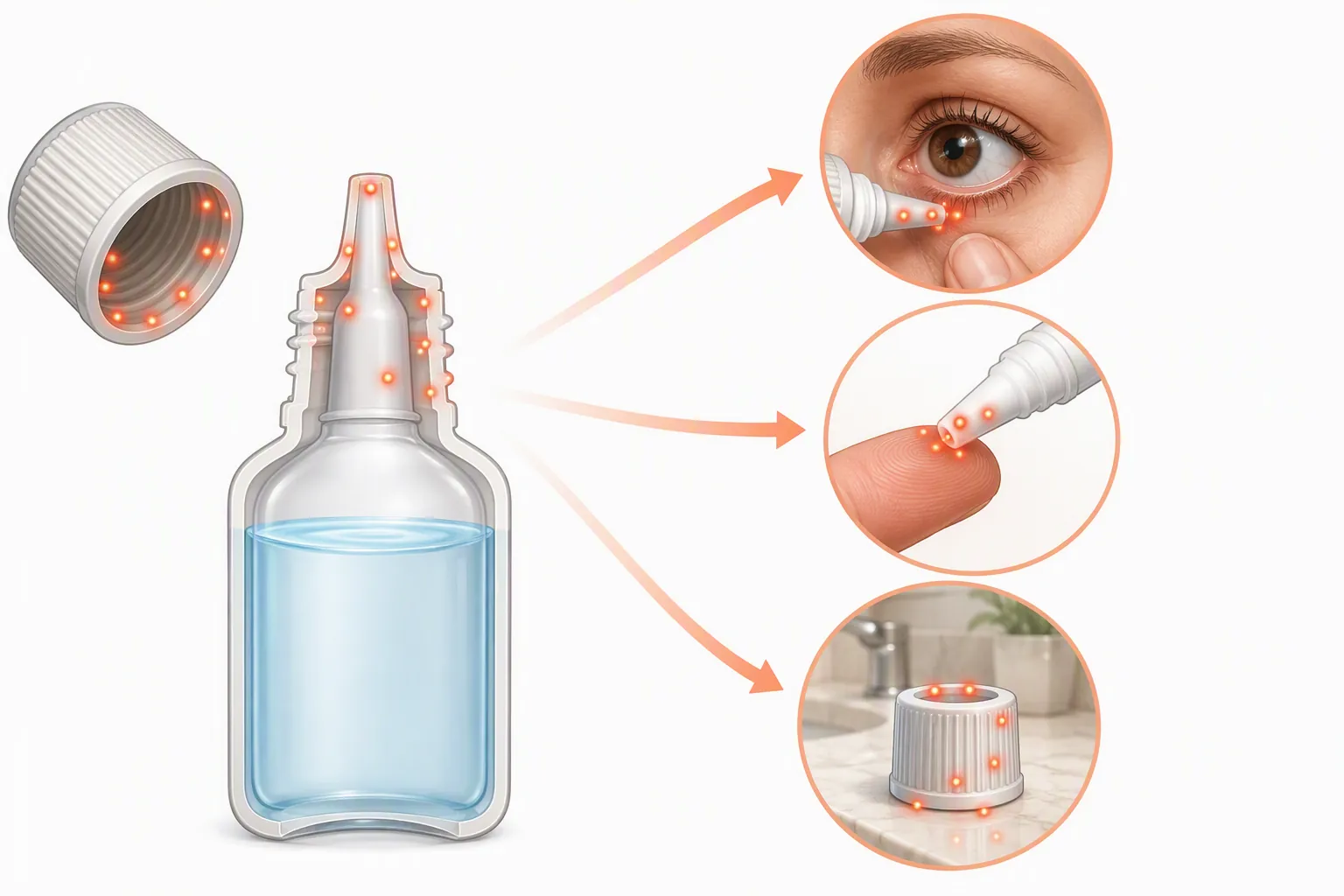
This is why the common instruction “do not touch the tip to your eye” is true but incomplete. It names the goal without acknowledging the difficulty. The tip can touch the eyelid because the bottle is too close. It can touch lashes because the user cannot see the distance clearly. It can touch fingers while the cap is being replaced. It can touch the counter if the bottle is put down uncapped. The cap matters, too, because it is what returns to the tip after each use.
Why seniors have a harder time keeping the tip clean
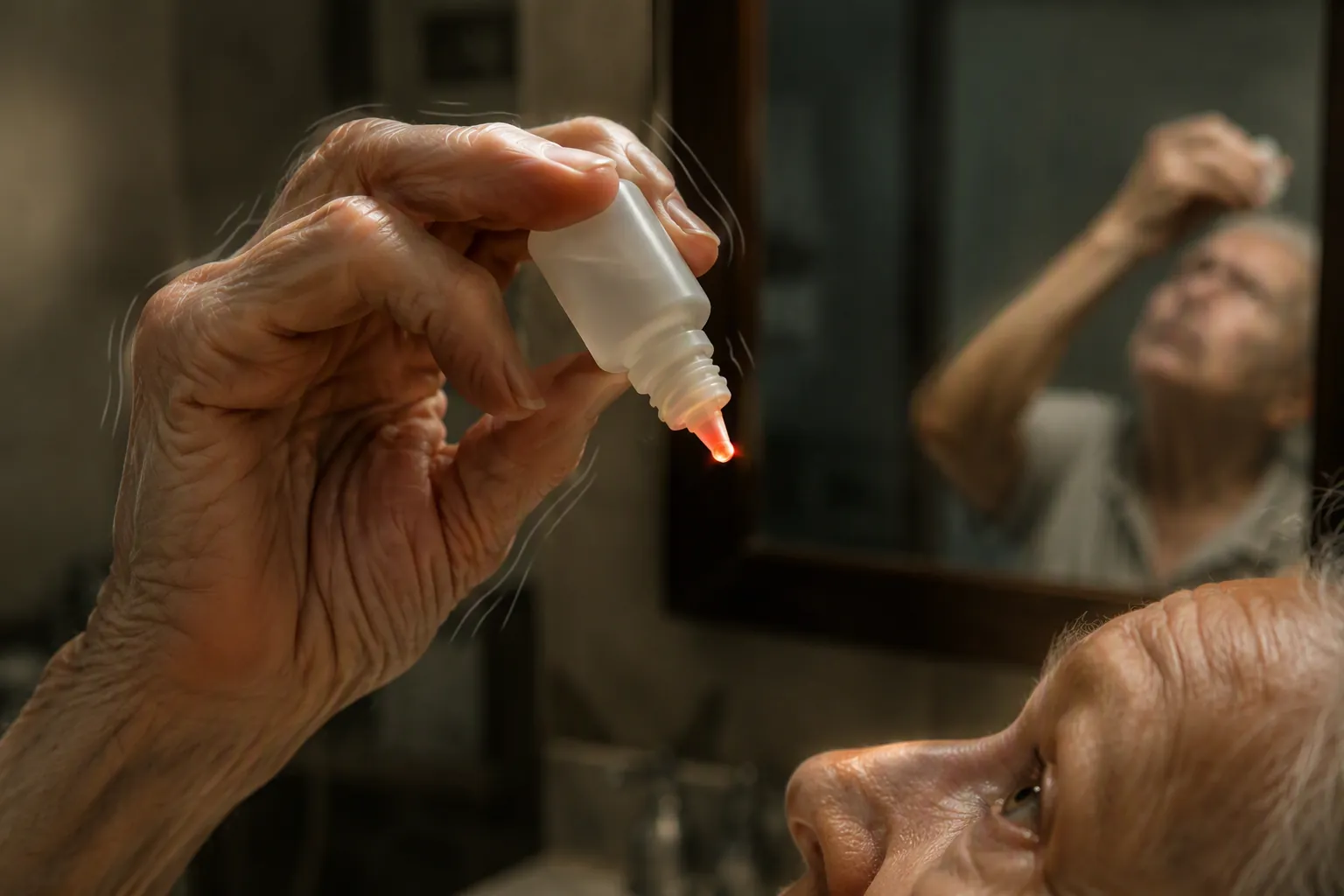
Eye drops ask for a surprising amount of coordination. The user has to remove a small cap, hold the bottle at the right angle, keep the tip suspended above the eye, pull down the lower lid or otherwise expose the eye surface, squeeze at the right moment, avoid blinking too soon, and recap the bottle without contaminating the nozzle. That is a lot to ask of hands that may be stiff, weak, numb, or mildly tremulous.
The best direct evidence on this point is not new, and it is not large, but it is hard to ignore. In a 1992 study of 43 ophthalmology outpatients aged 75 and older, fewer than one in three could successfully apply their own eye drops, and half were considered unlikely to get a drop into the conjunctival sac. [3] The study is old and small, so it should not be treated as a modern national estimate. Still, it gives a name to what many families already see at the bathroom sink: the prescription may be correct, but the delivery method may be failing.
Near vision adds another layer. Many older adults can read a label with glasses and still struggle to judge where a small plastic tip is in relation to the eye. The target is partly hidden by the brow, cheek, lashes, and mirror angle. If the drop lands on the cheek, the instinct is to move closer. Moving closer may make the next drop more accurate, but it also raises the chance that the tip brushes skin or lashes.
Grip strength matters because many bottles require a firm squeeze. A senior may squeeze and get nothing, squeeze harder, then suddenly release more than one drop. The hand may flinch after the first drop falls. The bottle may bump the lid. For a person taking glaucoma drops every day, or using lubricating drops several times a day, those small misfires are repeated opportunities for contamination.
A store shelf is not the same as FDA pre-review
Prescription eye drops and over-the-counter eye drops do not reach the market through the same pathway. The FDA explains that OTC eye drops generally do not require FDA approval before they are marketed, although they must comply with requirements such as current good manufacturing practice. [4] That distinction is important for anyone who assumes that a product sold at a major chain has been individually reviewed by the FDA before sale.
This does not mean every OTC bottle is suspect, and it does not mean seniors should stop using needed drops because of a headline. It means recalls should be checked through current FDA, pharmacy, or clinician sources rather than through old screenshots or partial brand lists. Lot numbers and product names can change as recall information is updated.
What to do with the bottles at home
Start with the recall question, because it is the most urgent and the easiest to answer. If a product has been recalled, do not keep using it while waiting to “see if anything happens.” Check the exact brand, product name, bottle size, expiration date, and lot number against current FDA recall information or ask the dispensing pharmacy to check it. If the drops are prescription medication, ask the prescriber or pharmacist what to use instead before skipping doses.
| Situation | Safer next step |
|---|---|
| The bottle matches a current recall | Stop using it and contact the pharmacy, prescriber, or retailer for replacement or disposal instructions. |
| The brand sounds familiar but the lot number is unclear | Do not guess from memory. Compare the bottle label with live recall information or ask a pharmacist to verify it. |
| The bottle is not recalled, but the tip touched the eye, fingers, skin, or counter | Avoid using that contaminated tip again until you have asked a pharmacist, prescriber, or eye-care professional what to do. |
| Drops are often missed because they are hard to aim or squeeze | Ask about caregiver assistance, a different bottle design, an administration aid, or another treatment approach. |
For bottles that are not recalled, the daily routine is where families can reduce risk. The aim is not to make the bathroom into an operating room. It is to protect the tip and cap from the most predictable sources of contamination.
- Wash hands before handling the bottle, then try not to touch the tip or inside of the cap.
- Use good lighting and a stable position. Sitting down may be safer than leaning over a sink.
- Keep the dropper tip from touching the eye, eyelid, eyelashes, face, fingers, sink, counter, tissue, or towel.
- Place the cap on a clean surface with the inside facing up, or hold it so the inside does not touch the counter.
- Recap the bottle promptly and firmly after use.
- Do not share eye drops, even within the same household.
- Do not use drops that look cloudy, discolored, or different from usual unless a clinician or pharmacist confirms that appearance is expected.
Caregiver help should be treated as a safety support, not a loss of independence. If a senior can manage pills but cannot reliably aim drops, that is not unusual. The task is physically different. A family member can steady the hand, hold the lower lid, read the label, check the expiration date, or watch whether the tip is getting too close. For someone using drops several times a day, even one supervised dose can reveal a problem that the person using the drops may not notice.
When difficulty applying drops becomes a medical issue
Missed drops and contaminated drops can both matter. A person with glaucoma, for example, may be using drops to control eye pressure. A person with severe dry eye may use lubricating drops to protect the eye surface and maintain comfort. If the bottle is too hard to squeeze, the target is too hard to see, or the tip often touches the eye, the solution is not to keep struggling silently.
An eye-care professional or pharmacist may be able to suggest a different formulation, a different bottle style, spacing between multiple drops, or an administration aid. The right option depends on the medication and the eye condition. What matters is that repeated failed attempts are information. They tell the care team that the treatment plan may look simple on paper but is not working reliably in the home.
Warning signs after using eye drops
After a recall or a suspected contamination event, it is tempting to watch for every tiny sensation. The more useful approach is to know the signs that should prompt a call to an eye-care professional. UC Davis and UT Southwestern both point patients toward the RSVP warning signs: Redness, Sudden vision changes, and Pain. [1][5]
- Redness: new, worsening, or unusual redness, especially if it does not settle quickly.
- Sudden vision changes: new blurriness, loss of vision, haziness, light sensitivity, or a change that feels abrupt.
- Pain: eye pain, deep aching, or discomfort that is more than mild irritation.
Those symptoms deserve prompt attention, particularly in an older adult or anyone with existing eye disease. Do not try to dilute the problem by adding more drops from the same bottle. Do not wait several days to see whether sudden vision changes improve on their own. Bring the bottle to the appointment or have the label available when calling.
Why this also belongs in a fall-safety conversation
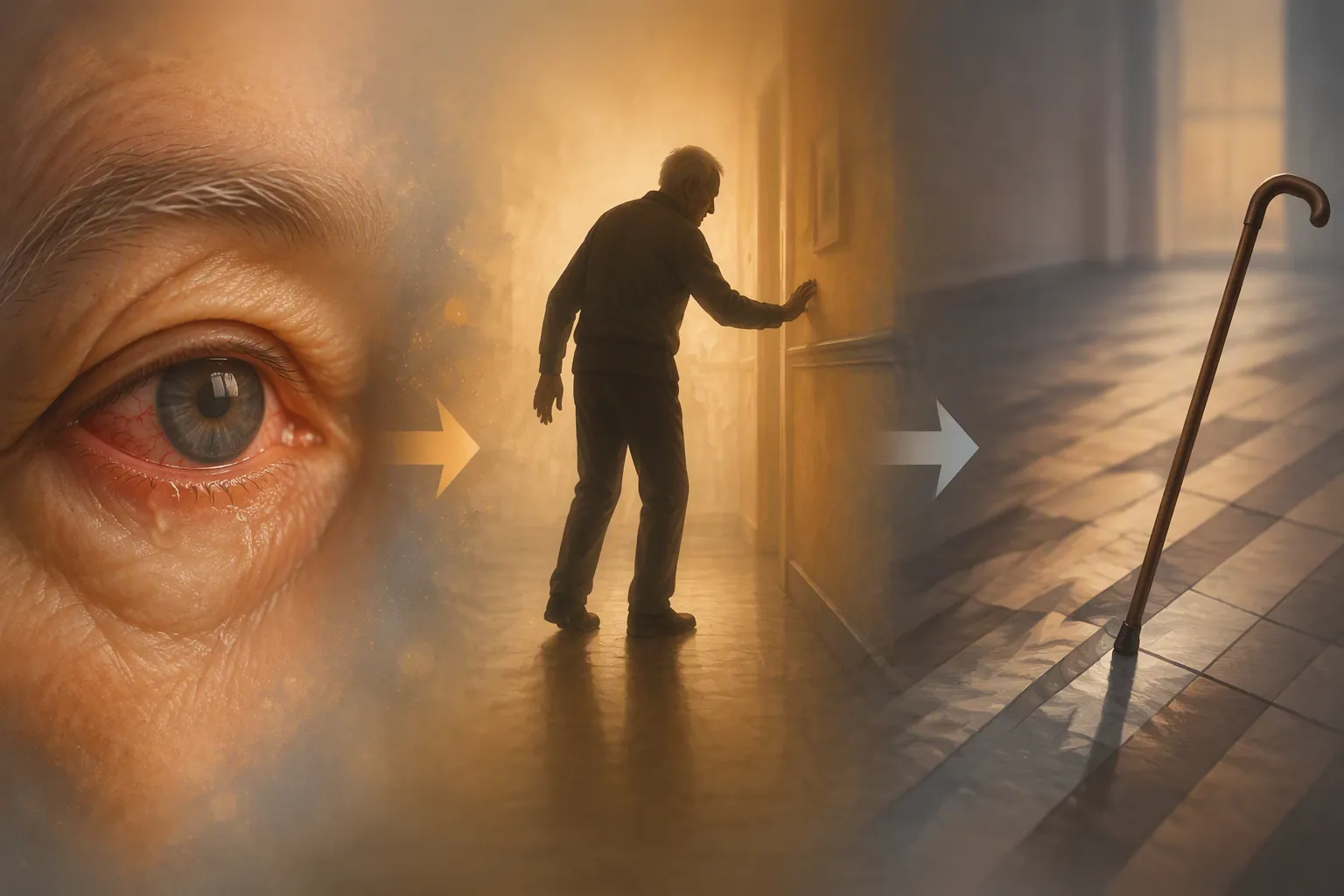
An eye infection is first an eye problem. But for a senior, vision changes can quickly become a mobility problem. Blurred vision, pain, light sensitivity, or reduced vision can make it harder to judge depth, see the edge of a step, notice a bathmat, or move confidently through a dim hallway. That does not prove that a contaminated bottle will cause a fall. It does explain why a vision-threatening infection should not be treated as a minor inconvenience.
The calm next steps are straightforward: check whether any bottle at home is under recall, stop using recalled products, protect the tip and cap during every use, ask for help if the drops are hard to apply, and call an eye-care professional promptly for RSVP symptoms: Redness, Sudden vision changes, or Pain.
References
- Eye drop recall 2026: FDA flags over 3 million bottles — UC Davis Health, April 2026
- Highlighting the Microbial Contamination of the Dropper Tip and Cap of In-Use Eye Drops — PMC, 2022
- Practical problems with eye-drops among elderly ophthalmology outpatients — PubMed, 1992
- What You Should Know about Eye Drops — FDA
- What patients need to know about the 2023 eye drop recall — UT Southwestern Medical Center
Browse more in the Glossary.