
Glossary entry
The Complete Family Legacy Checklist for Aging Parents
Last verified 2026-07-27
This is not financial or legal advice. Medicare/Medicaid and benefits rules vary by state and change over time — verify current rules with your state Medicaid office or Area Agency on Aging.
If you are trying to figure out how to preserve family legacy for elderly parents, the confusing part is usually not whether stories matter or whether paperwork matters. It is that both matter at the same time. A recorded memory does not replace an advance directive. A neatly signed will does not tell grandchildren why the holiday bread is folded a certain way. The safest place to start is a checklist that keeps the voice memo and the legal folder in the same field of view.
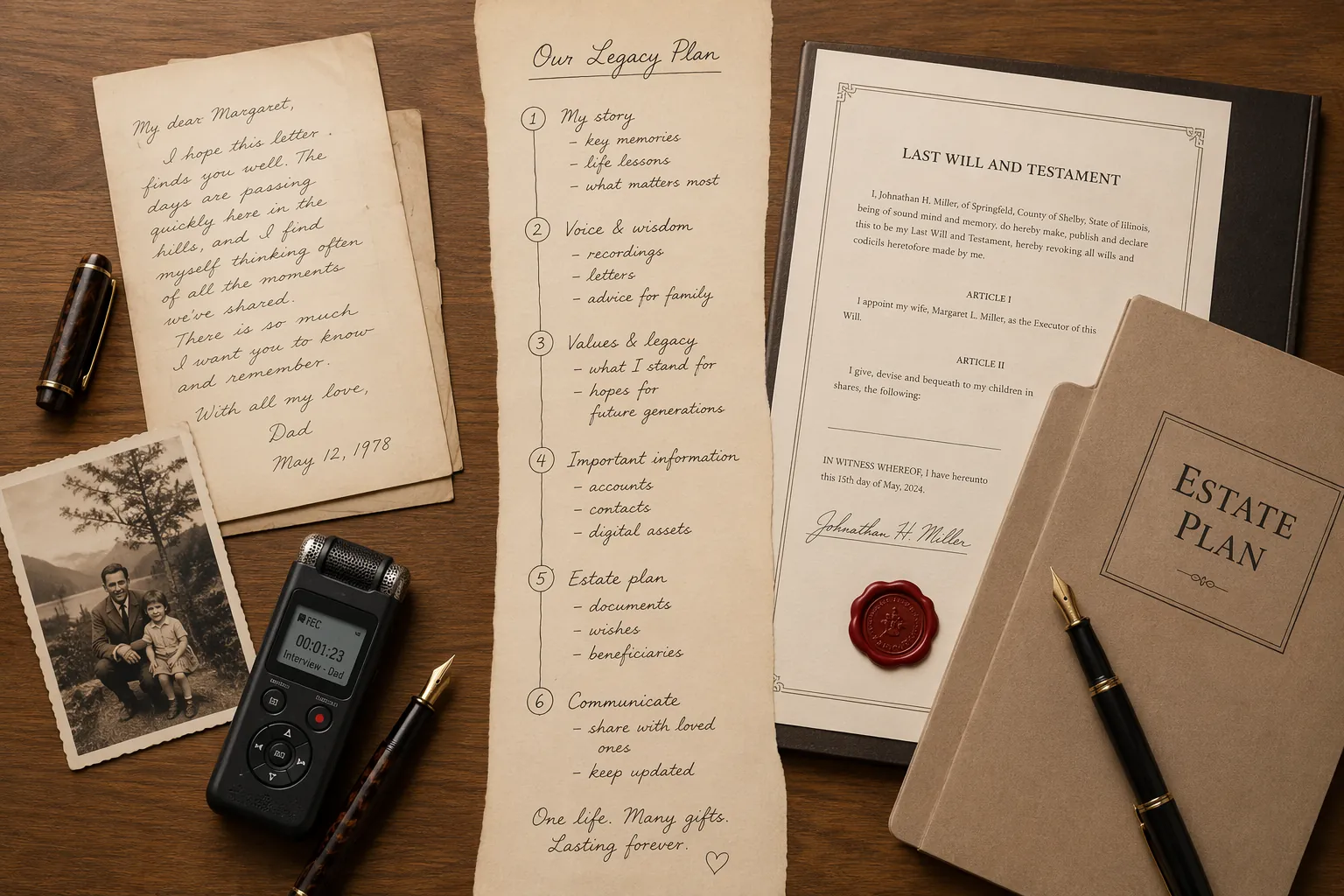
The Short Checklist: What to Preserve First
| Tier | Memory and family history tasks | Legal, financial, and wishes tasks |
|---|---|---|
| Start here | Record one 30-minute conversation; save it in one clearly labeled folder; write down names on a few important photos. | Find the current will or trust, advance directive, power of attorney documents, HIPAA authorization, and funeral wishes if they exist. |
| Next | Scan key photos and documents; label people, places, dates, and context; document heirlooms and recipes. | Review beneficiary designations, asset and debt inventory, insurance policies, account access, and professional contacts. |
| Then maintain | Back up recordings, scans, recipes, and notes using more than one storage method. | Store originals securely, share access instructions with the right people, and schedule an annual review. |
Two existing frameworks are useful, but incomplete when used alone. The National Council on Aging estate planning checklist names legal categories families should review, including a will, living trust, power of attorney, advance health care directive, and asset and debt inventory.[1] Heritage Whisper’s family legacy framework organizes memory preservation around stories, voices, photos, documents, and objects.[2] Families need both frameworks because the gaps are different: one protects authority and instructions, while the other protects meaning.
Start With One Recorded Conversation
The first legacy task should be small enough that it can happen this week. One 30-minute recorded conversation is often more useful than waiting for a perfect family archive. It captures the ordinary voice, pacing, laugh, and phrasing that no scanned document can recreate.
Use a phone, a basic recorder, or a video call recording if everyone is comfortable. Ask permission before recording. Say the date, the parent’s full name, and who is present at the beginning. Then ask questions that invite a story rather than a report. StoryCorps’ Great Questions list is a strong source for prompts such as asking about important people, proud moments, family traditions, and lessons learned.[3]
- “What was your home like when you were growing up?”
- “Who helped shape the way you think about family?”
- “What recipe, song, holiday, or saying do you hope we keep?”
- “Is there a family story people usually get wrong or leave out?”
- “What do you want the younger generation to understand about where we came from?”
NPR Life Kit’s oral history guidance is helpful because it treats interviewing as a conversation, not an interrogation: listen more than you talk, let silence do some work, and follow the story instead of forcing every question on your list.[4] That matters with aging parents because a formal “legacy interview” can start to feel like an exam. A warmer approach is to begin with one object, one photo, or one meal and let the questions come from there.
After the recording, do not leave the file trapped in a phone app. Rename it in a plain format such as “Mom_interview_childhood_2026-07-27.mp3.” Put it in a folder named “Family Legacy - Recordings.” Add a one-sentence note: who is speaking, what the conversation covers, and whether it is okay to share with family. This small administrative step is what turns a touching recording into something the family can actually find later.
Build the Memory Archive Without Turning Your Parent Into a Project
Memory preservation does not have to mean writing a full biography. AARP frames legacy storytelling as one way older adults can pass on values, memories, and identity, and notes that storytelling can support seniors’ emotional well-being.[5] For a family checklist, the practical question is simpler: what will become confusing or impossible if nobody labels it now?
Photos Need Context, Not Just Scanning
Digitizing a box of photos is useful, but a scanned image without names can become a mystery very quickly. Start with the photos your parent reacts to most strongly. On the back of the original, on a sticky note, or in the digital file name, capture the people, approximate date, place, event, and why the photo matters.
- Good label: “Lena and Marcus outside first apartment in Detroit, early 1970s, after moving from Georgia.”
- Weak label: “Grandparents old photo.”
Family Documents Need Names and Dates
Letters, military papers, naturalization papers, diplomas, newspaper clippings, and handwritten notes often sit in the same box as legal documents. Separate sentimental family-history documents from current legal and financial originals. Scan the family-history documents, label them, and write down what your parent knows about them while that context is still available.
Objects Need Provenance
An heirloom without a note can become a burden: everyone feels guilty discarding it, but nobody knows what it is. Photograph the object and write a short description: who owned it, how it came into the family, whether it has financial value, and what your parent hopes will happen to it. If the object is valuable, fragile, or disputed, treat that as a legal or estate-planning issue too, not only a sentimental one.
Recipes and Traditions Need Enough Detail to Repeat
A recipe card that says “cook until done” may be charming, but it is not enough for the person trying to make it without Grandma standing nearby. Record the missing details: pan size, texture, substitutions, brand preferences, holiday timing, who usually helped, and what the finished dish is supposed to look and smell like. For cultural or religious traditions, include the sequence of steps and the meaning behind them.
Review the Legal and Financial Legacy Before There Is a Crisis
This section is intentionally more formal. It is not because paperwork is more important than stories. It is because missing authority documents can turn a family’s wish to honor a parent into emergency administration. Use these as categories to review with an estate planning attorney, financial professional, tax professional, or health care team as appropriate. The right documents, names, and forms vary by state and by family situation.
Will or Trust
Confirm whether your parent has a current will, trust, or both. NCOA includes creating a will and considering a living trust among key estate planning steps.[1] The family organizer’s job is not to interpret the document. The job is to know that it exists, where the signed original is stored, who the named fiduciaries are, and whether your parent believes it still reflects their wishes.
- Ask when the document was last reviewed.
- Confirm the location of the signed original.
- Write down the attorney or firm that prepared it, if any.
- Flag major life changes: death of a spouse, divorce, remarriage, new grandchildren, move to another state, property sale, or changed relationships.
Durable Power of Attorney
A durable power of attorney usually addresses who can handle financial or legal matters if your parent cannot. NCOA lists power of attorney as an essential estate planning item.[1] The uncomfortable question is not only “Do we have one?” but “Would the bank, brokerage, or institution actually accept it when needed?” Some institutions have their own requirements, and state rules vary.
Medical Power of Attorney or Advance Health Care Directive
The medical side deserves its own check. An advance health care directive can document health care wishes, and a medical power of attorney or health care proxy can name the person authorized to speak with clinicians if your parent cannot. NCOA includes advance health care directives in its estate planning checklist.[1] Keep copies where they can be reached in an emergency, not only in a safe deposit box nobody can access after hours.
HIPAA Authorization
A HIPAA authorization can allow designated people to receive protected health information. It is easy to assume that being an adult child is enough. It may not be. Ask your parent’s health care providers what forms they use, and ask the estate planning attorney how HIPAA authorization fits with the rest of the plan.
Beneficiary Designations
Beneficiary designations on retirement accounts, life insurance, annuities, payable-on-death accounts, and transfer-on-death accounts can have major consequences. They may not automatically follow what a will says. Review the named beneficiaries, contingent beneficiaries, spelling, relationship changes, and whether any listed person has died. This is a place for careful professional review, especially in blended families or families with minor, disabled, estranged, or financially vulnerable beneficiaries.
Funeral, Burial, Cremation, and Memorial Instructions
Funeral instructions are a kindness to the people who will be making decisions while tired and grieving. Write down preferences for burial, cremation, donation, service location, religious or cultural practices, obituary details, music, readings, clothing, and who should be notified. If arrangements are prepaid, record the provider and contract location. If wishes are informal, label them as wishes rather than legally binding instructions unless a professional confirms otherwise.
Asset and Debt Inventory
NCOA includes listing assets and debts as part of estate planning.[1] This is the document that prevents survivors from hunting through mail piles, old emails, and half-remembered conversations. It does not need to include passwords in the same file. It does need to tell the authorized person what exists.
- Bank accounts, credit unions, CDs, and safe deposit boxes
- Retirement accounts, pensions, brokerage accounts, and annuities
- Life, long-term care, homeowner, renter, auto, and health insurance policies
- Real estate, vehicles, business interests, valuable collections, and storage units
- Mortgages, credit cards, personal loans, medical bills, tax obligations, and recurring subscriptions
- Professional contacts: attorney, accountant, financial adviser, insurance agent, clergy, and funeral provider
Put Stories and Documents in One Organized System
A family legacy system can be simple. It needs to separate originals from copies, sentimental records from authority documents, and private information from shareable family history. Evaheld is a commercial example of a service that explicitly combines “Story and Legacy” with a “Digital Legacy Vault,” which is useful evidence that families are looking for one place to hold memories, wishes, and documents together.[6] That does not mean any one service is complete or right for every family.
| Folder or binder section | What goes there | Who should access it |
|---|---|---|
| 01 - Recordings and Stories | Audio, video, transcripts, story notes, interview prompts | Parent-approved family members |
| 02 - Photos and Family Documents | Scans, labeled photos, letters, clippings, family tree notes | Parent-approved family members |
| 03 - Heirlooms and Traditions | Object photos, provenance notes, recipes, holiday instructions | Family members involved in preserving or receiving items |
| 04 - Estate Planning Documents | Will, trust, powers of attorney, advance directive, HIPAA authorization, funeral instructions | Parent, named agents, fiduciaries, and professionals as appropriate |
| 05 - Financial Inventory | Asset and debt list, insurance list, professional contacts, account locations | Parent and authorized decision-makers |
| 06 - Access Instructions | Where originals are stored, how to reach key contacts, how to access backups | Trusted authorized person |
For irreplaceable digital files, use the 3-2-1 backup rule as a preservation habit: keep 3 copies, on 2 types of storage, with 1 copy off-site. Treat that as general digital preservation best practice, not as a guarantee. A practical version might be one copy on a home computer, one on an external drive, and one in a reputable cloud storage account controlled by the appropriate person.
How Much Does Family Legacy Preservation Cost?
Cost depends on whether you are doing the work yourself, using guided prompts, or hiring a full-service biography company. AARP’s August 2024 guide listed approximate benchmarks including DIY options around $10–$50, Storyworth around $99, Remento around $99–$168, and No Story Lost starting at $1,099 or more.[5] Prices may have changed since then, and CareWise Guide is not endorsing any product.
| Option | Approximate AARP August 2024 benchmark | Best fit |
|---|---|---|
| DIY recording and scanning | $10–$50 | Families willing to organize files, prompts, and backups themselves |
| Storyworth | About $99 | Families who want written prompts and a book-style keepsake |
| Remento | About $99–$168 | Families who want guided story capture with audio or video elements |
| No Story Lost | $1,099+ | Families who want a more full-service biography process |
What to Do This Week, This Month, and This Year
This Week
- Schedule one 30-minute recorded conversation with your parent.
- Ask where the will, trust, powers of attorney, advance directive, HIPAA authorization, and funeral instructions are stored.
- Create one folder for family legacy files and save the first recording with a clear file name.
- Choose five important photos and label the people, place, approximate date, and story.
This Month
- Start an asset and debt inventory with your parent’s permission.
- Review beneficiary designations and note which accounts need professional follow-up.
- Scan priority family documents, recipes, and heirloom notes.
- Ask whether named agents and fiduciaries know they have been named.
- Set up a second backup location for recordings, scans, and notes.
This Year
- Have the estate planning documents reviewed by a qualified professional if they are outdated, missing, unclear, or from another state.
- Complete the family photo, document, recipe, and heirloom labeling that would be hardest to reconstruct later.
- Confirm where originals are stored and who can access copies in an emergency.
- Create an annual review date for both sides of the legacy file: stories and authority documents.
Preserving a parent’s legacy is not choosing between a beautiful family archive and responsible planning. It is making sure the stories, wishes, authority documents, and irreplaceable files survive together.
References
- Estate Planning Checklist, National Council on Aging, https://www.ncoa.org/article/estate-planning-checklist
- Family Legacy Preservation, Heritage Whisper, https://heritagewhisper.com/guides/family-legacy-preservation
- Great Questions List, StoryCorps, https://archive.storycorps.org/great-questions-list
- How to record oral family history, NPR, November 12, 2021, https://www.npr.org/2021/11/12/1055128650/how-to-record-oral-family-history
- Ways to Preserve Your Legacy, AARP, August 2024, https://www.aarp.org/family-relationships/ways-to-preserve-your-legacy
- Top 10 Ways Preserve Family Legacy, Evaheld, https://evaheld.com/blog/top-10-ways-preserve-family-legacy
Browse more in the Glossary.