
Clinical term
Why Filtered Coffee May Help Seniors Lower Blood Sugar
Last verified 2026-07-25
For seniors with type 2 diabetes, the most useful coffee question is not whether coffee is “good” or “bad.” It is whether the same morning habit changes meaning when it passes through a paper filter. Right now, the best-supported answer is practical: paper-filtered drip coffee has the strongest evidence for being linked to lower HbA1c, while unfiltered methods such as boiled coffee, French press, and similar brews should not be given the same blood-sugar halo.
That does not make coffee a diabetes treatment. It does mean that if an older adult already drinks coffee every morning, switching the brewing method may be a reasonable, low-disruption change to discuss with a clinician and test with home glucose readings.
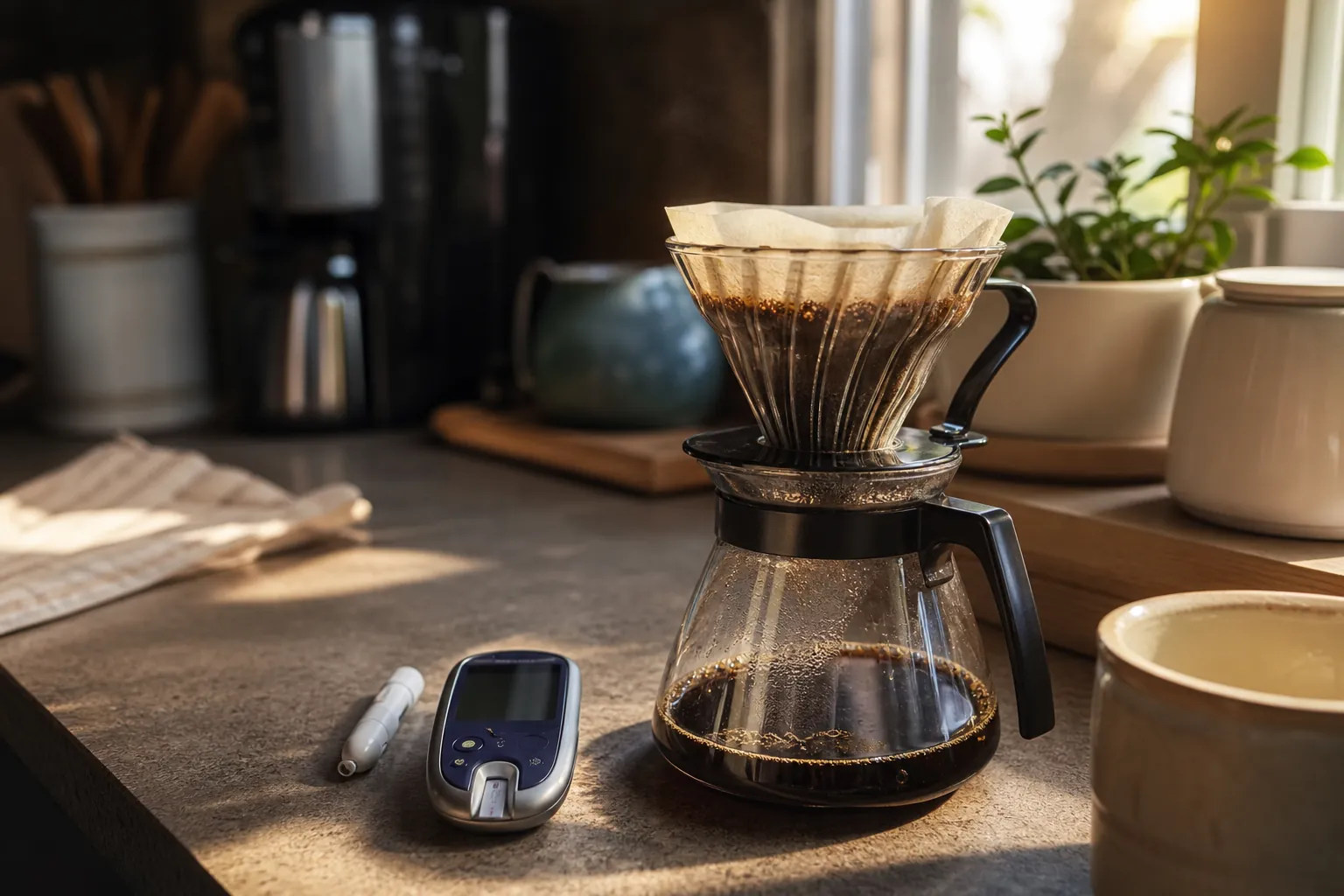
Why the paper filter matters
A 2026 study discussed in Daily Coffee News is the reason filtered coffee deserves separate attention. Researchers from Peking University used Mendelian randomization, a method that uses genetic variation to strengthen causal inference, and examined six coffee consumption patterns. Only filtered coffee showed a statistically significant causal association with lower HbA1c, the blood test that reflects average glucose over roughly the past few months rather than a single momentary reading.[1]
That HbA1c distinction matters at the kitchen table. A glucose meter reading after breakfast can rise or fall because of one meal, one poor night’s sleep, stress, medication timing, or caffeine sensitivity. HbA1c is slower-moving. If a coffee habit is associated with lower HbA1c, the claim is about a broader pattern in glucose control, not a promise that one cup will lower blood sugar before lunch.
The same 2026 report points toward a plausible mechanism: filtered coffee was associated with changes in the gut microbiome, including increased Veillonella bacteria and higher propionic acid, a short-chain fatty acid involved in glucose metabolism.[1] That is enough to make the finding biologically interesting, but not enough to turn it into a guarantee for every senior. The publicly summarized report did not provide the exact effect sizes, so the safe reading is narrower: filtered coffee stood out from other coffee patterns in a causal analysis, and the gut-microbiome pathway makes the result plausible.
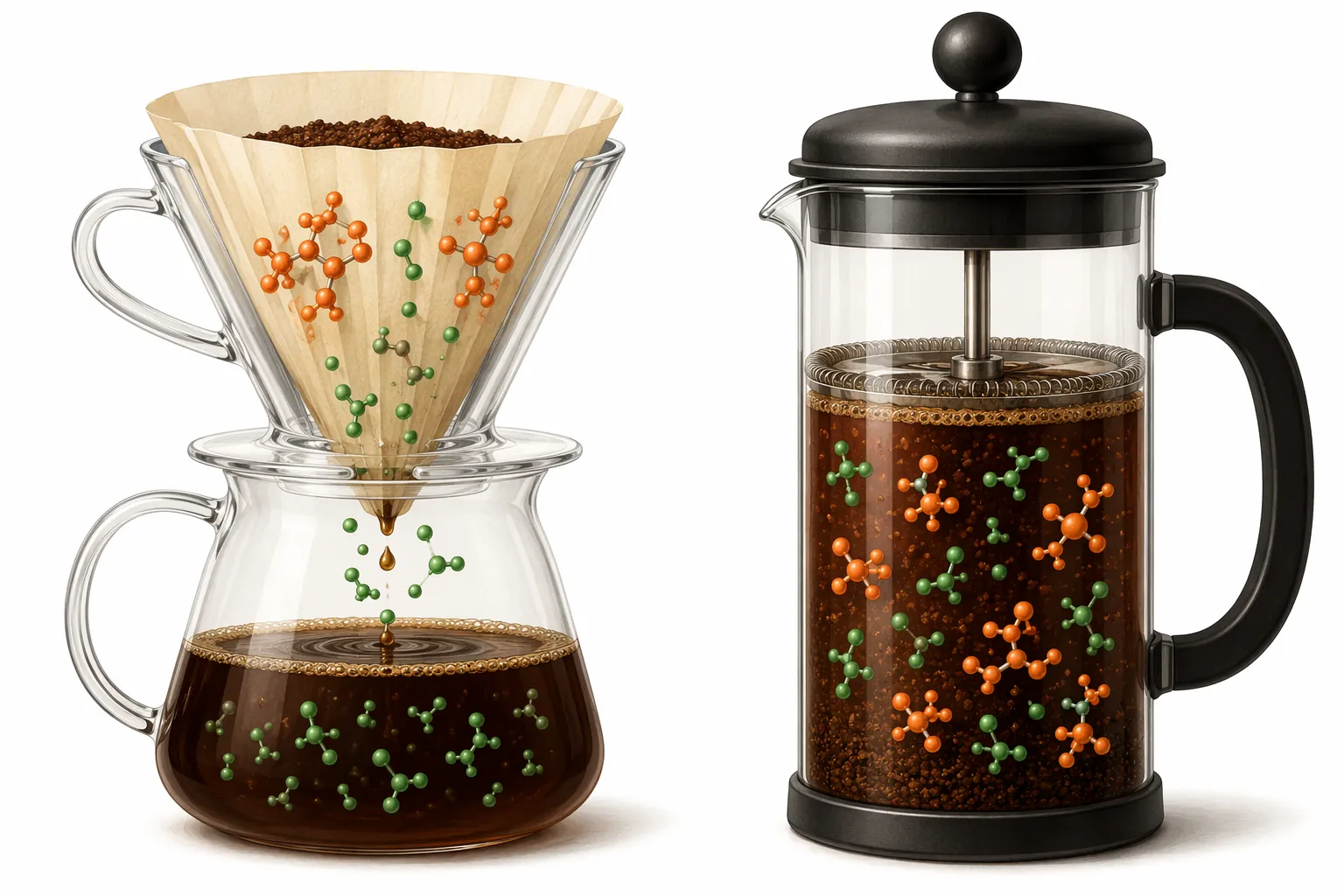
Filtered coffee is not just weaker unfiltered coffee
A paper filter does two things at once. It traps much of the oily fraction of coffee, including the diterpenes cafestol and kahweol, while still allowing many water-soluble compounds, including polyphenols and chlorogenic acids, into the cup. That combination is the reason filtered coffee can be discussed differently from French press or boiled coffee.
The diterpene issue is not a tiny footnote for older adults with diabetes. Harvard Health notes that unfiltered coffee can contain about 30 times more cholesterol-raising diterpenes than filtered coffee.[2] Since many seniors with diabetes are already managing cardiovascular risk alongside glucose control, a brew that raises LDL cholesterol is not an equal trade for a possible glucose benefit.
This is where many coffee headlines become too broad. “Coffee” may mean a paper-filter drip machine, a French press, espresso, boiled coffee, or a metal-filter method. Those drinks share coffee beans, but they do not deliver the same mix of compounds. If the goal is to preserve a familiar morning ritual while reducing avoidable risk, the paper filter is the practical dividing line.
| Brewing choice | What matters for seniors with diabetes |
|---|---|
| Paper-filter drip or pour-over | Best-supported option for the filtered-coffee evidence; removes much of the diterpene load while keeping many beneficial coffee compounds. |
| French press or boiled coffee | Unfiltered methods allow more diterpenes into the cup, so they do not deserve the same cardiovascular or glucose-metabolism assumptions. |
| Espresso or metal-filter methods | Not the same as paper-filter drip; the evidence should not be stretched to treat all coffee styles as equivalent. |
| Decaf paper-filter coffee | May reduce caffeine-related glucose swings for sensitive people, though the cited filtered-coffee evidence should not be overextended beyond what was studied. |
The 2–3 cup finding is useful, but only with the brewing method attached
The clearest supporting study from a different angle came from Chalmers University of Technology and Umeå University. Researchers used metabolomics to identify coffee-related biomarkers in blood samples, which helped reduce the problem of relying only on people’s memory of what they drank. In that study, people who drank 2–3 cups of filtered coffee per day had a 60% lower risk of developing type 2 diabetes compared with people who drank less than one cup per day.[3]
The important part is what did not happen: boiled coffee showed no protective association in the same study.[3] So the takeaway is not “2–3 cups of any coffee.” It is that filtered coffee, specifically, was linked with lower diabetes risk, while a common unfiltered method was not.
There are limits. The Chalmers/Umeå work was based on a Swedish population and blood samples from the early 1990s.[3] That does not make the finding useless for a U.S. senior in 2026, but it does mean the result should be treated as supportive evidence, not as a personal forecast. Diet patterns, medications, baseline health, and coffee preparation habits can differ.
Caffeine can still push blood sugar the wrong way for some people
Filtered coffee changes the compound profile of the drink, but it does not erase caffeine. Mayo Clinic notes that about 200 mg of caffeine can affect blood sugar in some people with diabetes, while others may not see the same effect.[4] That variation is exactly why a senior should not judge coffee by a headline or by a neighbor’s experience.
For many adults, up to 400 mg of caffeine per day is often described as generally safe, but older adults may have slower caffeine metabolism, more medication interactions, sleep disruption, blood pressure concerns, or heart rhythm issues. A person taking diabetes medication also has a different safety calculation than a healthy younger coffee drinker.
The sensible test is personal and boring in the best way: keep the rest of breakfast steady for several mornings, use the same coffee amount, and compare glucose readings before coffee and afterward. If readings repeatedly rise after caffeinated coffee, a paper filter has not solved that person’s caffeine response. A clinician may suggest reducing the amount, changing timing, trying decaf, or adjusting the broader meal plan.
What to change at home
If a senior with type 2 diabetes already drinks coffee, the least disruptive upgrade is usually not a new supplement, a complicated recipe, or a complete breakfast overhaul. It is making the regular coffee through a paper filter and then watching the actual glucose response.
- Use a paper-filter drip machine or pour-over instead of French press, boiled coffee, or other unfiltered methods.
- Keep the coffee plain or close to plain; sugar, sweetened creamers, and large flavored drinks can overwhelm any potential benefit.
- Track glucose before and after coffee for several comparable mornings rather than judging by one reading.
- Bring the pattern to a clinician if readings rise, if there are symptoms, or if medications make low or high blood sugar more likely.
- Do not change diabetes medication, meal planning, or prescribed care because coffee appears to help.
For an adult child helping a parent, this is also a tone issue. “You have to give up coffee” is a hard sell and may not be necessary. “Let’s use the paper-filter machine and see what your meter says” preserves the ritual while making the habit easier to evaluate.
It is also worth keeping coffee safety in perspective. Blood sugar swings, dehydration, dizziness, or medication timing can affect balance and daily function in older adults. If coffee seems to worsen shakiness, sleep, hydration, or glucose control, the brewing method is only one part of the conversation. For a different coffee-related senior safety issue, see the guide to recognizing botulism vs. stroke symptoms after the coffee recall.
The bottom line at the kitchen table
The benefits of filtered coffee for seniors with diabetes should be kept narrow: paper-filtered coffee has the best evidence for lower HbA1c and lower type 2 diabetes risk, while unfiltered coffee does not share the same support. The likely reason is the filter itself: it removes much of the cholesterol-raising diterpene load while allowing other coffee compounds to remain available for gut-microbiome and glucose-metabolism effects.
For a senior who already enjoys morning coffee, switching to paper-filtered coffee is a reasonable habit to discuss with a healthcare professional and test with real glucose readings. It is not a substitute for medication, food planning, activity, sleep, or regular diabetes care.
References
- Study Links Filter Coffee to Lower Blood Sugar via the Gut, Daily Coffee News, July 21, 2026.
- What’s the healthiest way to brew coffee?, Harvard Health.
- Filtered coffee helps prevent type 2 diabetes, show biomarkers in blood samples, Chalmers University of Technology.
- Caffeine: Does it affect blood sugar?, Mayo Clinic.
Browse more in the Glossary.