
Clinical term
7 Adapted Food Safety Steps Seniors Should Use to Avoid Cyclospora
Last verified 2026-07-27
Last updated: July 27, 2026. If there is lettuce, berries, or a bagged salad mix in the refrigerator right now, the first food safety question is not whether it has been rinsed. During the 2026 Cyclospora outbreak, the safer question for seniors is whether that food can be cooked to 158°F. CDC says cooking food to 158°F, or 70°C, kills Cyclospora; washing fruits and vegetables can reduce germs but cannot guarantee Cyclospora is removed, and FDA likewise warns that the parasite is not reliably removed by routine produce washing or chemical sanitizers.[1][2]
That changes the usual kitchen habit. A careful rinse under the tap may be good general practice, but for Cyclospora it is not a kill step. Pre-washed greens are not a guarantee. A chlorine rinse is not a guarantee. For an older adult, the margin for error is smaller because FoodSafety.gov notes that immune systems and organs change with age, including reduced stomach acid and changes in liver and kidney function that can affect how the body handles foodborne illness.[3]
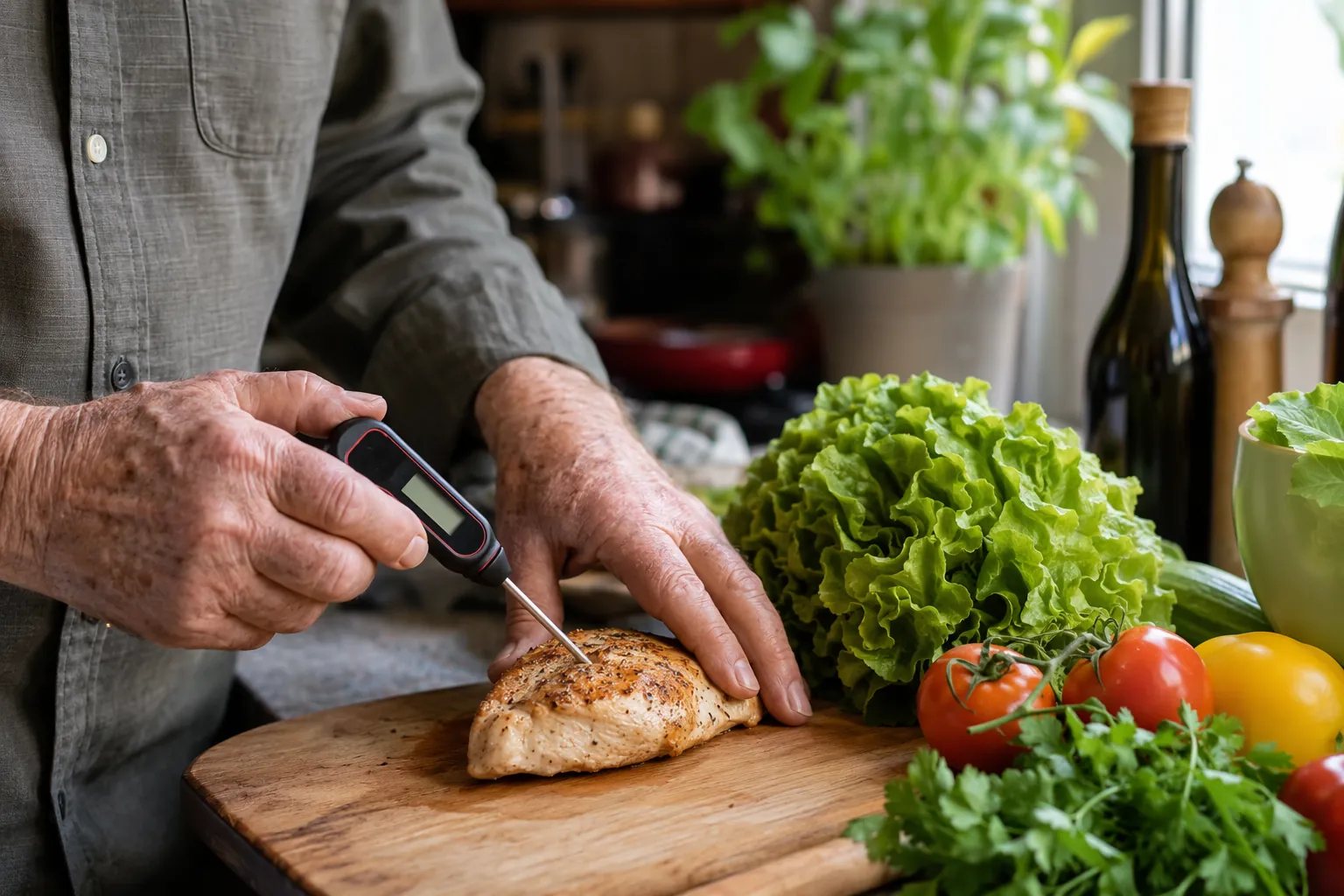
So the senior-adapted rule is plain: if a produce item is linked to current concern, hard to clean, or normally eaten raw, choose a cooked version, a safer substitute, or skip it for now.
The 7 adapted steps
| Step | What changes for seniors during the outbreak |
|---|---|
| 1. Use cooking as the real kill step | Treat 158°F as the dependable line for Cyclospora, not a better rinse. |
| 2. Check CDC and FDA updates before shopping | Do not rely on last week’s safe list when outbreak and recall details are changing. |
| 3. Choose produce differently | Favor items that can be cooked; avoid high-risk raw items under current guidance. |
| 4. Handle lettuce with extra limits | Prefer whole heads, discard outer leaves, wash inner leaves, and do not treat bagged pre-washed greens as risk-free. |
| 5. Be cautious with raspberries | Because the surface is hard to clean, use cooked options or choose another fruit during active concern. |
| 6. Make caregiver help specific | Ask for recall checks, grocery swaps, refrigerator cleanouts, and cooked meal planning. |
| 7. Watch symptoms and hydration early | Diarrhea can become more serious for older adults, especially those living alone or less aware of thirst. |
1. Use cooking as the real kill step
The practical line is 158°F. If the food can be cooked and still be useful in the meal, cook it. Use a food thermometer when temperature matters, especially if vision, hand strength, or confidence at the stove is not what it used to be. Guessing by steam, softness, or color is not the same as checking temperature.
This does not mean every meal has to become soup. Tomatoes can go into a cooked sauce. Greens can be wilted into eggs, beans, pasta, or soup. Berries can be cooked into oatmeal or a simple compote. The point is to move questionable raw produce into a form where the parasite has been killed, or to leave it out.
For a senior cooking for one, the easiest safe meal is often not a new recipe. It is the same meal with the raw produce removed or cooked: a sandwich without lettuce, a baked potato with cooked vegetables, scrambled eggs with cooked spinach, canned fruit instead of fresh berries, or soup instead of salad.
2. Check outbreak and recall updates before the grocery trip
This outbreak is large enough that it should change shopping behavior. CDC reported more than 1,645 confirmed cases across 34 states as of July 14, 2026, with more than 5,100 additional cases under investigation, and outbreak details were still developing.[5][6]
A Taylor Farms lettuce recall affecting 27 states is one reason not to rely on memory or on a single printed checklist taped to the refrigerator.[5][6] Recalls can change by brand, package size, lot code, state, and date. A person who shops once a week may still have an item bought before the latest update.
- Before shopping, check the current CDC outbreak page and FDA recall information.
- Before eating lettuce or berries already at home, check whether the item matches current recall or outbreak guidance.
- If the label is missing, unreadable, or the purchase date is uncertain, do not try to solve the problem by rinsing it again.
- When in doubt during an active outbreak, replace the raw item with something cooked or shelf-stable.
3. Choose differently, not just wash better
The hardest adjustment is mental. Many older adults have washed produce their whole lives and done fine. Cyclospora is exactly the kind of problem that makes that confidence less useful, because the reliable kill step is heat, not scrubbing.
At the store, the safer cart during an active outbreak leans toward produce that can be cooked without spoiling the meal. That can mean carrots, green beans, squash, frozen vegetables, canned vegetables, applesauce, canned peaches, or fruit intended for cooking. It can also mean choosing a cooked side dish instead of a raw salad until CDC and FDA updates give clearer guidance.
Small households need another adjustment: buy less raw produce at one time. A bargain bag is no bargain if it sits in the crisper while recall details change. For someone with a small appetite, smaller quantities reduce the chance of keeping uncertain food too long just because it feels wasteful to throw it out.
4. Treat lettuce as a special decision
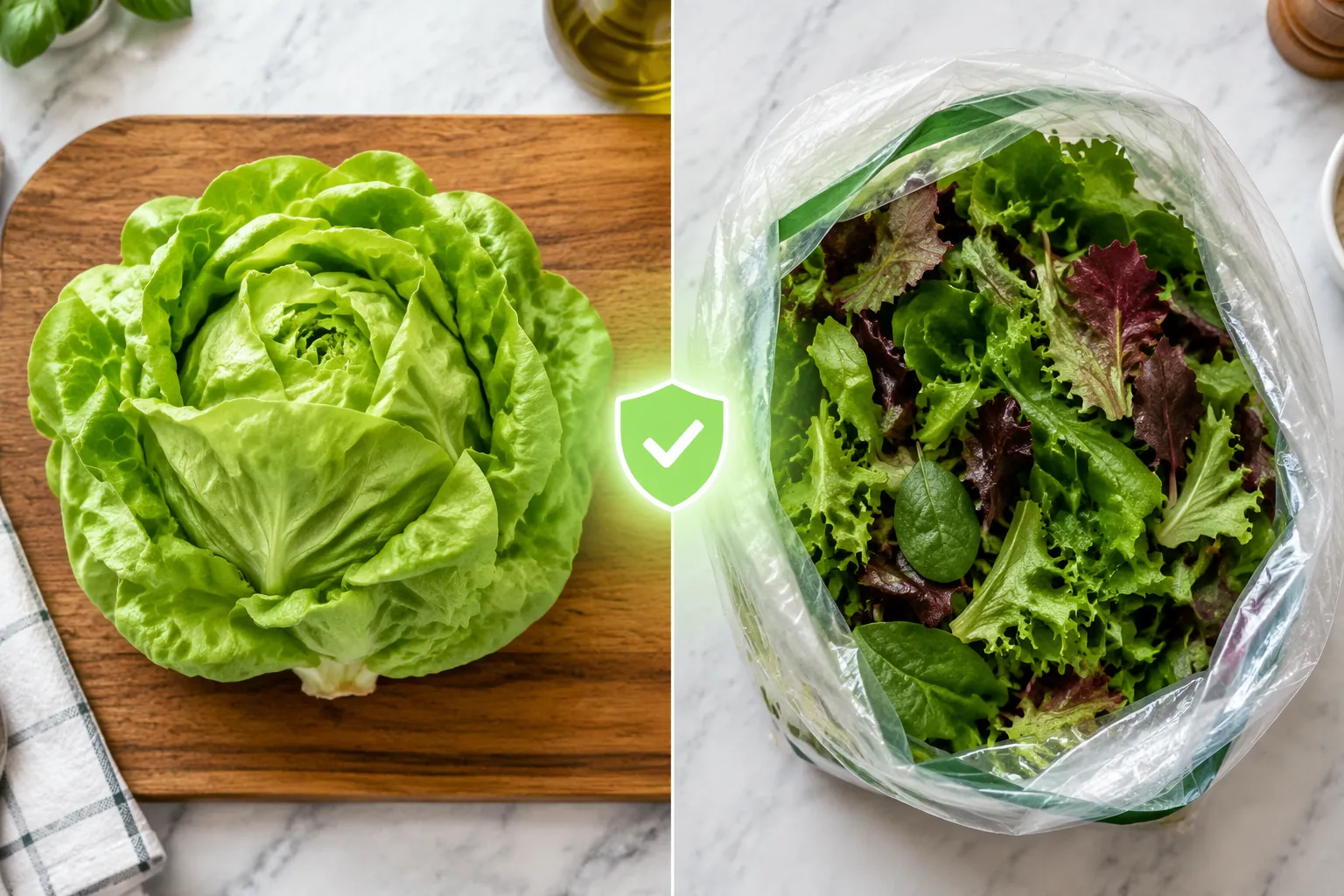
Michigan DHHS gives unusually practical lettuce advice for this outbreak: buy whole heads of lettuce instead of pre-cut or bagged products, discard the outer 2 to 3 layers of leaves, and wash the inner leaves before use.[4] That is not the same as saying whole lettuce is risk-free. It is a risk-reduction step when lettuce is still being used.
For seniors, the better question may be whether raw lettuce is necessary at all this week. Lettuce is often there for crunch or habit. A sandwich can manage without it. A plate can use cooked vegetables. Soup or beans can take the place of a side salad. If lettuce is eaten raw, the whole-head approach is more defensible than trusting a bag that says pre-washed.
- Choose a whole head over bagged, pre-cut, or mixed greens when lettuce is still on the menu.
- Throw away the outer 2 to 3 layers before washing the inner leaves.
- Wash inner leaves under running water, but do not count that as a guarantee against Cyclospora.
- Skip raw lettuce entirely if current CDC or FDA updates point to a product, brand, or region of concern.
5. Be especially cautious with raspberries

Raspberries deserve separate treatment because their bumpy surface makes them especially hard to clean, and Michigan DHHS advises cooking them or using frozen alternatives during the outbreak.[4] The shape of the berry is the problem: it gives water many little places to miss.
If raspberries are already in the refrigerator and they are meant to be eaten raw, the safer adapted choice is to avoid them for now unless current guidance clearly says otherwise. If they are used, cook them thoroughly. A cooked fruit topping for oatmeal is a more sensible choice than raw berries over yogurt during active concern.
For an older adult who likes fruit every morning, the substitute matters. Do not just remove the berries and leave breakfast smaller. Use canned fruit, applesauce, a banana if tolerated, or cooked fruit instead. Food safety advice fails when it quietly takes calories, fluids, and pleasure out of the day.
6. Make caregiver help concrete, not bossy
Adult children and caregivers can help most by taking over the chores that require fresh eyes and current information. Nobody needs a lecture about washing vegetables. What helps is a five-minute recall check, a second look at a tiny lot code, or a grocery swap that keeps meals familiar.
- Check CDC and FDA updates before placing an online grocery order or driving someone to the store.
- Look through the refrigerator for recalled lettuce, uncertain bagged greens, and raw raspberries.
- Replace risky raw items with cooked vegetables, canned fruit, frozen produce meant for cooking, or meals the person already likes.
- Write the date on newly bought produce in large print if vision is an issue.
- Put a thermometer where it is easy to reach, not in the back of a crowded drawer.
The tone matters. “Let’s swap the salad for cooked green beans until this outbreak notice changes” is easier to accept than “You can’t eat that.” Independence is not the same as refusing help. The goal is to make the safe choice the easy choice before hunger, fatigue, or stiff hands make shortcuts tempting.
7. Watch diarrhea and hydration sooner than feels necessary
This checklist is about prevention, not diagnosis, but symptoms cannot be ignored. Cyclospora infection can cause diarrhea, and older adults may have less reserve when fluid loss starts. Reduced thirst sensation is a common aging concern, and living alone can mean no one notices a person is drinking less than usual.
During an outbreak, a senior with ongoing diarrhea, signs of dehydration, worsening weakness, fever, blood in stool, severe abdominal pain, confusion, dizziness, or symptoms that feel unusual should contact a healthcare professional promptly. Anyone with a serious medical condition, immune suppression, kidney disease, or difficulty keeping fluids down should be more cautious, not less.
Caregivers should check in about drinking, urination, dizziness when standing, and whether meals are being skipped. A person can be proud, capable, and still need someone else to notice that two days of diarrhea has become a medical problem.
What this checklist can and cannot promise
This checklist cannot function as a live recall database. The 2026 Cyclospora outbreak is ongoing, and CDC and FDA updates should be checked directly before making decisions about specific brands, products, dates, or states. A printed page, saved article, or family text message can become outdated quickly.
It also cannot make raw produce risk-free. Washing is still useful for general produce safety, but it should not be treated as enough for Cyclospora when outbreak guidance points to concern. For seniors, the adapted rule is stricter because the consequences can be harder to absorb: cook it to 158°F, choose a safer substitute, or skip it for now.
This article is general food-safety education, not medical advice. For personal medical guidance, symptoms, medication questions, dehydration concerns, or decisions after a possible exposure, contact a licensed healthcare professional.
References
- Preventing Cyclosporiasis, CDC.
- Cyclospora, FDA.
- People at Risk: Older Adults, FoodSafety.gov.
- MDHHS makes recommendations on preventing foodborne illness amid growing cyclosporiasis outbreak, Michigan DHHS, July 4, 2026.
- CDC HAN-00531, CDC.
- Cyclosporiasis Outbreaks — July 2026, CDC.
Browse more in the Glossary.