
Glossary entry
Funeral Planning Checklist for Seniors and Caregivers
Last verified 2026-07-29
This is not financial or legal advice. Medicare/Medicaid and benefits rules vary by state and change over time — verify current rules with your state Medicaid office or Area Agency on Aging.
A funeral planning checklist for seniors and caregivers should do two jobs at once: record the person’s wishes clearly enough that family members do not have to guess, and slow down the money decisions so no one is pushed into an expensive commitment while grieving.
Those are separate jobs. Pre-planning means writing down choices, documents, contacts, and price information. Prepaying means signing a contract or setting aside money for a future funeral. A family can do the first without doing the second, and in many cases that flexibility is safer.
The need is not theoretical. Only 36% of Americans had written funeral plans in a 2021 NFDA survey cited by AARP, even though written instructions are exactly what surviving relatives need when the phone calls begin.[1] Another gap is just as familiar: 89% of adults 40 and older consider end-of-life discussions meaningful, but only 46% have had them, according to an FMIC Harris Poll cited by AgingCare.[2] Sonida Senior Living also cites NFDA data that only 21% of Americans have talked with a loved one specifically about funeral wishes.[3]

The working checklist
Use this as a working document, not a one-afternoon test. A senior may complete it alone and tell family where it is. A caregiver may sit beside a parent and take one section at a time. Either way, leave room for “not sure yet” and date the page whenever something changes.
| Planning area | What to record | Who should be able to find it |
|---|---|---|
| Personal records | Full legal name, date of birth, Social Security number location, parents’ names, marital history, next of kin, primary contacts, clergy or celebrant contact, attorney, executor, insurance agent | Executor, health care proxy, trusted caregiver, next of kin |
| Disposition choice | Burial, cremation, direct cremation, donation if applicable, religious or cultural requirements, whether embalming is wanted if not legally required | Next of kin, funeral home contact, clergy or celebrant |
| Service preferences | Funeral, memorial, graveside service, no formal service, visitation, readings, music, photos, clothing, flowers, livestreaming, reception notes | Person likely to arrange the service |
| Cemetery or memorial arrangements | Cemetery name, plot or niche ownership, deed location, opening and closing fees if known, headstone or marker preferences, scattering location if legal and permitted | Executor, next of kin, cemetery office |
| Budget and payment | Preferred budget range, price lists collected, insurance policies, payable-on-death account, prepaid contract if one already exists, who may authorize payment | Executor, financial power of attorney if still living, next of kin |
| Obituary and legacy | Preferred name, family names to include, military service, work, faith or community ties, charities, photo choice, paid obituary preference | Person writing the obituary |
| Digital assets | Phone passcode storage plan, password manager location, email and social media instructions, online photo storage, subscription accounts | Digital executor or trusted caregiver |
| Veteran benefits | DD214 or discharge papers location, branch and dates of service, VA cemetery preference, burial flag and marker wishes | Next of kin, funeral director, veterans service officer |
| Documents to store and share | Will, advance directive, health care proxy, financial power of attorney, life insurance, cemetery deed, prepaid contract, funeral plan, contact list | Executor and at least one trusted person who can access them quickly |
This article is general education, not legal, financial, medical, or tax advice. State law, cemetery rules, religious requirements, contract terms, and benefit eligibility can change. Last verified for 2026: July 29, 2026.
Start with records before preferences
Before choosing flowers or music, make the first page useful to the person who will be handed the folder. Write the senior’s full legal name, preferred name, date and place of birth, current address, marital status, parents’ names, and the location of key identity documents. Do not write a full Social Security number in a document that may be copied or emailed casually; instead, record where the card or official record is stored.
Then list the people who must be called early: next of kin, executor, health care agent, attorney, clergy or celebrant, cemetery office, veterans service officer if relevant, insurance agent, and the person who can reach distant relatives. Put phone numbers beside names. A beautiful plan with no phone numbers still leaves someone searching through an unlocked phone at the worst possible time.
- Name the primary decision-maker and one backup.
- Record where the will, advance directive, powers of attorney, and insurance policies are kept.
- Write down any religious, cultural, military, or family customs that should be respected.
- Mark whether the plan is a preference document only or is tied to an existing contract.
Choose disposition before choosing a service
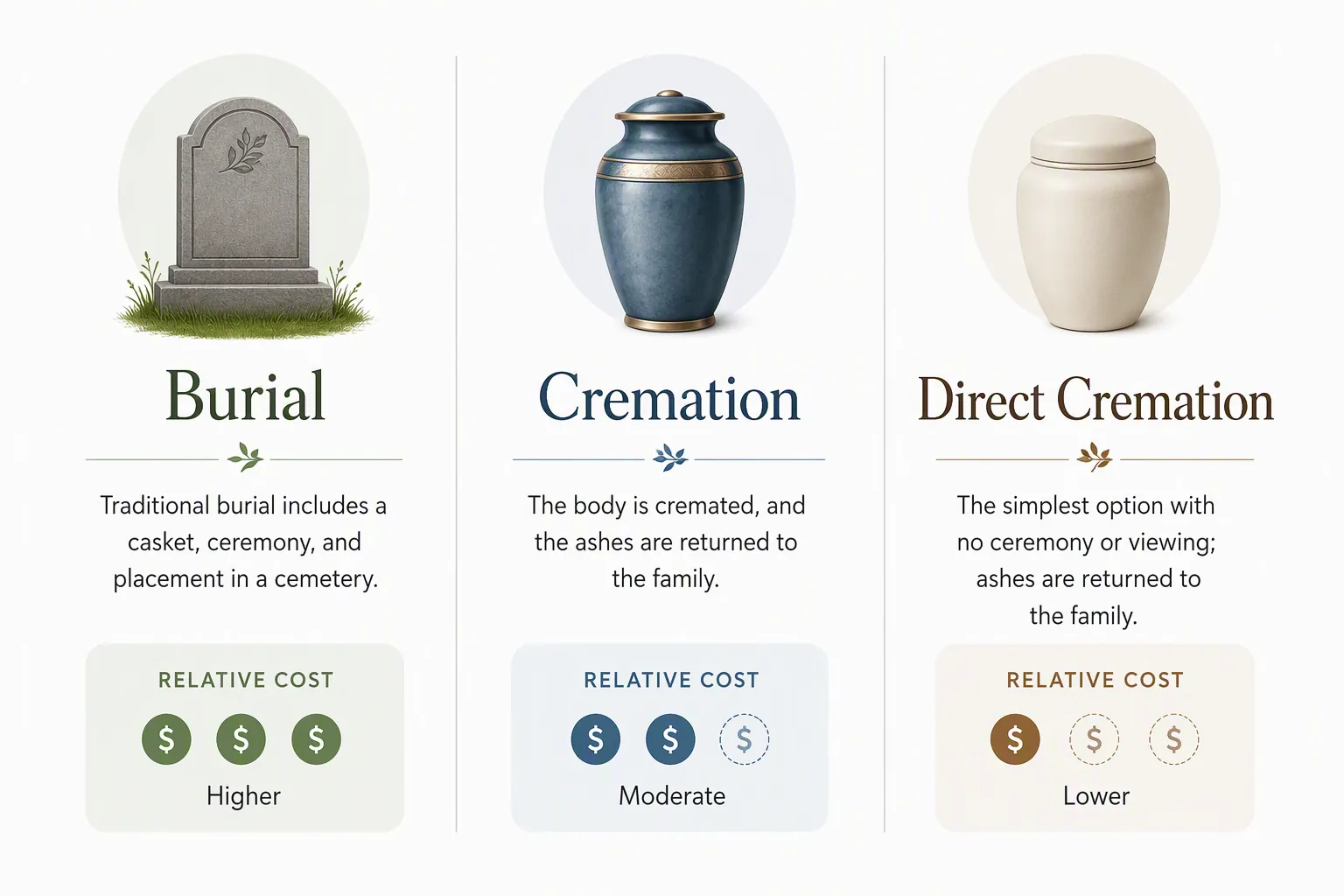
The disposition choice determines many later costs. Burial, cremation, and direct cremation are not just different ceremonies; they create different requirements for transportation, body preparation, containers, cemetery arrangements, and timing.
| Choice | What it usually means | Planning notes |
|---|---|---|
| Burial | The body is buried in a cemetery plot, often after viewing, visitation, or a funeral service. | Ask separately about funeral home charges and cemetery charges. Casket, vault, plot, opening and closing, marker, and service fees may be separate. |
| Cremation with service | Cremation occurs before or after a viewing, memorial, funeral, or religious service. | Ask whether a rental casket, cremation container, urn, or additional facility fee is included or separate. |
| Direct cremation | Cremation occurs without viewing or ceremony through the funeral home. | Usually the simplest lower-cost arrangement; family may hold a memorial later in a home, church, community room, cemetery, or other permitted place. |
| Donation or other arrangements | Body donation or another legally permitted arrangement may be chosen in advance. | Verify rules directly with the receiving institution or relevant authority; do not assume a funeral home can arrange every option. |
Cremation is now the majority choice in the United States. US Funerals Online reports a 2025 U.S. cremation rate of 63.4% and cites a projection of 82.3% by 2045.[4] That trend matters because families may have more cremation providers, simpler options, and wider price differences than they expected. It does not mean cremation is automatically inexpensive once services, urns, niches, travel, or cemetery fees are added.
Disposition prompts to write down
- I prefer burial, cremation, direct cremation, donation, or another arrangement.
- I do or do not want a public viewing.
- I do or do not want embalming unless required by law or necessary for the chosen arrangement.
- I want my remains placed, buried, scattered, or kept in this location, if legally allowed.
- If my first choice is unavailable or too costly, my acceptable backup choice is this.
Service preferences belong in writing, but they do not need to become a production
A family can honor someone better with three clear sentences than with a dozen vague memories. The useful question is not “What would be perfect?” It is “What would help your family make a respectful decision without guessing?”
- Service type: funeral, memorial, graveside service, celebration of life, religious service, military honors if eligible, private gathering, or no formal service.
- Location: funeral home, house of worship, cemetery, community room, home, outdoors if permitted, or no preference.
- People to involve: clergy, celebrant, reader, musician, pallbearers, eulogist, military contact, or a family member who should not be burdened with speaking.
- Tone and details: quiet, religious, informal, brief, music choices, readings, clothing, photos, flowers, charitable donations, livestreaming, reception.
- Limits: anything the senior does not want, such as an open casket, expensive flowers, a long visitation, a paid obituary, or a reception.
The last item matters. A caregiver trying to be generous may spend money because silence feels unsafe. A written “no” can be as kind as a written “yes.”
Separate funeral home costs from cemetery costs
Many families hear one funeral estimate and assume it covers everything. It often does not. Funeral home charges and cemetery charges are separate layers, and each layer can contain items that sound necessary but may be optional depending on the arrangement, state law, cemetery rules, and family preference.
| Cost layer | Common items | What to ask |
|---|---|---|
| Funeral home | Basic services fee, transfer of remains, embalming or other preparation, viewing, ceremony, staff, hearse, casket or urn, cremation fee, paperwork | Which items are required for our chosen arrangement, and which are optional? |
| Cemetery or memorial site | Plot, niche, crypt, opening and closing, vault or grave liner if required, headstone or marker, engraving, installation, perpetual care fees | Which fees are already paid, which are still due, and what does the cemetery require? |
| Outside vendors | Obituary, flowers, clergy or celebrant honorarium, musicians, reception, printed programs, livestreaming, death certificates | Can the family choose its own vendors or decline these items? |
If a cemetery plot has already been purchased, record the cemetery name, section, lot or niche number, deed location, and any rules. A paid plot does not always mean the opening and closing fee, vault, marker, or engraving has been paid. If no cemetery has been chosen, write down whether the senior wants local burial, burial near family, a veterans cemetery if eligible, a cremation niche, scattering where allowed, or no cemetery placement.
Use 2026 cost estimates as orientation, not as quotes
For 2026 planning, Parting Stone estimates the national median cost of a funeral with viewing and burial at about $9,170, and a funeral with cremation at about $6,940. Those figures are not newly published 2026 NFDA medians; they are estimates made by applying a 10.46% BLS funeral CPI increase from 2023 to mid-2026 to NFDA’s 2023 median cost data.[5]
Direct cremation is a different price category. The same 2026 cost discussion cites a national average around $2,200, while competitive metro markets may advertise direct cremation in the $495 to $995 range through providers cited in that analysis.[5] Those lower figures should be treated as local shopping signals, not guarantees. Transportation distance, death certificates, permits, container choices, provider fees, and local market conditions can change the final price.
| Arrangement | 2026 orientation estimate | Important caveat |
|---|---|---|
| Funeral with viewing and burial | About $9,170 nationally | May not include all cemetery costs, marker, obituary, flowers, reception, or local add-ons. |
| Funeral with cremation | About $6,940 nationally | Service choices, urn, rental casket, niche, or memorial events can raise the total. |
| Direct cremation | About $2,200 nationally; some competitive markets advertise $495-$995 | Usually excludes a formal service through the funeral home and may vary sharply by provider. |
The safest way to use these numbers is to write a budget range, then collect local prices. A family does not need to know every possible charge before making the first call. It does need to know enough to ask for the same items from each provider and compare them side by side.
Ask for General Price Lists before choosing a funeral home
The FTC Funeral Rule is the practical protection at the center of funeral shopping. The FTC says consumers have the right to get price information, buy only the goods and services they want, use an alternative container for direct cremation, provide a casket or urn bought elsewhere without being charged a handling fee, and decline embalming unless it is required by law in the specific situation.[6]
The General Price List, often called the GPL, is where those rights become usable. The FTC’s funeral pricing guidance tells consumers to compare prices, ask for itemized lists, and use the checklist approach to understand funeral costs before buying.[7] For advance planning, request General Price Lists from at least three funeral homes in the area where the funeral is likely to be arranged.
- Call or email and say: “Please send your current General Price List for burial, cremation with service, and direct cremation.”
- Ask for the Casket Price List and Outer Burial Container Price List if burial is being considered.
- Ask what is included in direct cremation and what fees are added for permits, death certificates, transportation, or containers.
- Ask whether the funeral home accepts a third-party casket or urn without an added handling fee.
- Save each price list with the date received, because prices can change.
Do not compare packages first. Compare the itemized prices for the arrangement the senior actually wants. A package may be convenient, but convenience is not the same as consent to every item inside it.
A simple price-comparison worksheet
| Item to compare | Funeral home A | Funeral home B | Funeral home C |
|---|---|---|---|
| Basic services fee | |||
| Transfer of remains | |||
| Embalming, if wanted or required | |||
| Viewing or visitation | |||
| Funeral or memorial service | |||
| Cremation fee or burial-related funeral home fee | |||
| Direct cremation total | |||
| Lowest-cost casket or alternative container | |||
| Urn options and whether family may provide one | |||
| Cash advance items and outside vendor charges |
Pre-planning is not the same as prepaying
A written plan can be changed. A prepaid contract may be harder to move, cancel, or use if the senior relocates, the funeral home changes ownership, prices rise differently than expected, or the family later chooses a different arrangement. The FTC and AARP both urge consumers to understand the terms before prepaying, including what is guaranteed, what is refundable, and what happens if the provider goes out of business or the person dies away from home.[1][6]
One flexible alternative is a payable-on-death bank account designated for funeral expenses. The money remains under the senior’s control while alive, then passes to the named beneficiary outside the ordinary account-transfer delay. That does not replace legal or financial advice, and it must be coordinated with the person’s broader estate and benefits situation, but it avoids tying every dollar to one funeral home contract.
If a prepaid plan already exists, do not leave it as a rumor. Put the contract in the funeral folder and write down the funeral home name, contract number, what is guaranteed, what is not guaranteed, refund or transfer terms, and who has authority to use it.
- Before signing a prepaid contract, ask whether prices are guaranteed or only credited toward future prices.
- Ask where the money is held and what state protections apply.
- Ask what happens if the senior moves, dies while traveling, or the funeral home closes.
- Ask whether the contract can be canceled, transferred, or changed.
- Give a copy to the person who will be expected to make arrangements.
For families also balancing housing, caregiving, and retirement cash flow, funeral spending belongs in the same practical conversation as other later-life costs. CareWise Guide’s resources on aging in place and retirement investing mistakes to avoid can help place funeral planning inside a wider senior-planning budget.
Obituary, legacy, and personal notes
The obituary section does not have to be polished. It only has to prevent avoidable mistakes. Write the name the person wants used, close family names, military service, work or volunteer history, faith community if any, clubs, causes, and whether a paid newspaper obituary is wanted. Newspaper notices can be expensive, and some families now choose a shorter paid notice plus a longer online tribute.
- Preferred photo or where to find several acceptable photos.
- Names to include, names to omit, and spellings that are often mistaken.
- Preferred charity, scholarship fund, church, veterans organization, or “flowers welcome” instruction.
- Short life details the family may not know: service, migration, work, caregiving, hobbies, honors, favorite places.
- Any message to family that should be kept private rather than printed.
If there are family tensions, be plain. The person arranging the obituary should not have to decide, under deadline, whether a former spouse, estranged relative, stepchild, or companion belongs in the notice.
Digital assets need a doorway, not a password pasted everywhere
Digital confusion often shows up quickly: the family needs photos, email access, a phone contact, an online obituary login, or a way to close subscriptions. The planning document should say where passwords are managed, who may access them, and what should happen to social media, cloud photos, email, and recurring accounts.
- Name a trusted person for digital tasks, if state law and account terms allow.
- Record the location of the password manager, sealed password list, or attorney-held instructions.
- Identify where family photos, military records, insurance files, and estate documents are stored digitally.
- Write down wishes for social media memorialization, deletion, or no action.
- Do not put active passwords in a widely shared funeral checklist.
Veteran benefits: verify eligibility before assuming costs
Veterans with an other-than-dishonorable discharge may qualify for burial in a VA national cemetery, along with memorial items such as a government-furnished headstone, marker, or medallion, a burial flag, and a Presidential Memorial Certificate, according to VA.gov.[8] Eligibility and available benefits depend on the person’s service and circumstances, so the planning folder should include discharge papers, usually the DD214, or clear instructions for where to find them.
- Record branch of service, service dates, and discharge document location.
- Write whether burial in a VA national cemetery is preferred if eligible.
- Note whether the family wants a burial flag, military honors, and a government marker.
- Confirm spouse or dependent eligibility directly with VA.gov or a veterans service officer.
- Tell the funeral home early if veteran benefits may apply, but verify official rules yourself.
Store the plan where the right person can use it
A funeral plan locked in a safe no one can open is almost the same as no plan. Store the original with other important papers, but give copies or access instructions to the people who will need it quickly. If there is an attorney, executor, or trusted caregiver, make sure that person knows whether the plan is legally binding, a preference document, or connected to a prepaid contract.
- Keep one printed copy in a clearly labeled folder with estate and medical planning documents.
- Give a copy to the likely arranger or tell them exactly where it is.
- Store price lists, cemetery papers, veteran discharge records, and prepaid contracts with the checklist.
- Do not rely on a will alone for funeral instructions; the will may be read too late for immediate arrangements.
- Review the plan after a move, spouse’s death, new diagnosis, cemetery purchase, contract change, or major price update.
A practical first session
Do not begin by choosing a casket. Begin with one planning session that can be finished. Print or copy the checklist. Fill in personal records, name the decision-maker, choose a first and second disposition preference, and request General Price Lists from three local funeral homes. Mark the page “last verified July 29, 2026.”
That is enough to change the next conversation. The best funeral plan is not the most elaborate or the most prepaid. It is documented, locally priced, legally informed, and easy for the right people to find.
References
- Funeral Planning Tips to Help You Make Smart Decisions — AARP
- Funeral Planning Tips for Seniors and Their Caregivers — AgingCare
- A Guide to Funeral Planning: How You and Your Senior Loved One Can Prepare — Sonida Senior Living
- What was the Cremation Rate in the US in 2025? — US Funerals Online
- What Is the Average Cost of a Funeral in 2026? — Parting Stone
- Planning Your Own Funeral — FTC Consumer Advice
- Funeral Costs and Pricing Checklist — FTC Consumer Advice
- VA Burial Benefits And Memorial Items — VA.gov
Browse more in the Glossary.