
Clinical term
When Is It Time for Hospice for a Loved One with Cancer?
Last verified 2026-07-27
You may notice it first in the ordinary accounting of a day: your father is in the recliner after breakfast, still there at lunch, and back in bed by midafternoon. Your mother needs help getting to the bathroom. The pill organizer is full of medications that no longer seem to restore much strength. Someone in the family is still saying, “But the oncologist hasn’t said hospice yet.”
Hospice care decisions for elderly loved ones with cancer are rarely made from one dramatic sign. More often, the evidence gathers in plain view: more time lying down, more help with bathing or toileting, more weight loss, more hospital trips, more treatment days that leave the person weaker than before. The useful question is not “Are we giving up?” It is: “Do the person’s function, disease course, treatment burden, and stated goals now point toward comfort-focused care?”
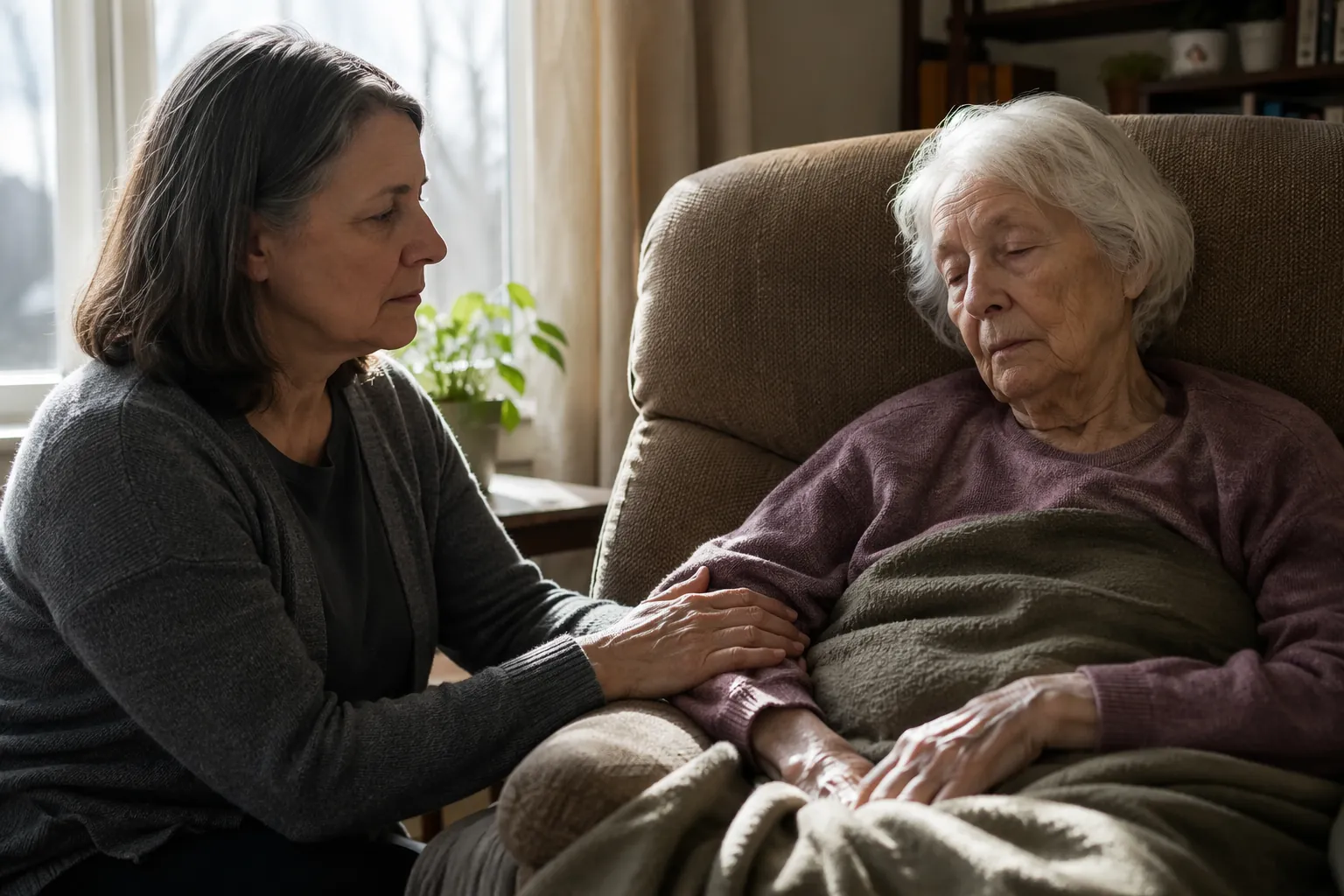
This article is for family understanding and preparation, not for self-diagnosis. Hospice eligibility requires physician certification of a terminal prognosis, generally six months or less if the illness follows its usual course. The scores and signs described here are conversation tools: they help you ask a doctor a clearer question and document what is happening at home.
The clearest threshold is functional decline
For many cancer patients, hospice eligibility language starts with two functional measures: the Palliative Performance Scale, often shortened to PPS, and the Eastern Cooperative Oncology Group performance status, usually called ECOG. Hospice-provider eligibility guides commonly describe a PPS of 70% or lower, an ECOG score of 3 or higher, dependence in two or more activities of daily living, and evidence that disease is progressing despite treatment as key markers for end-stage cancer eligibility discussions.[1][2]
Those numbers sound technical, but they describe things families already see.
| Clinical language | What it may look like at home | Why it matters |
|---|---|---|
| PPS 70% or lower | The person has reduced activity, cannot keep up normal routines, and needs at least occasional help with self-care. | A PPS at or below this level is commonly used as a hospice eligibility marker in advanced cancer. |
| PPS around 50% | The person is mainly sitting or lying down, needs considerable help, and may be eating less. | This level makes the decline hard to dismiss as “just a bad week.” |
| ECOG 3 | The person is capable of only limited self-care and is in bed or a chair more than half of waking hours. | This is a major functional threshold: the day is now organized around rest and assistance. |
| Dependence in 2 or more ADLs | The person needs help with bathing, dressing, toileting, transferring, eating, or continence care. | ADL dependence turns vague concern into observable caregiving evidence. |
| Progression despite treatment | Scans, symptoms, weight loss, hospitalizations, or the physician’s notes show the cancer is advancing even with therapy. | Hospice is not based on weakness alone; it is based on decline in the context of a terminal illness. |
A PPS of 70% does not mean a person is actively dying in the next few days. That is exactly why it is useful. It catches the point where a family can still plan instead of waiting until swallowing, pain, confusion, or exhaustion turns every decision into an emergency. ECOG 3 is similar: the person may still talk, eat some meals, recognize visitors, and have good hours, but more than half the day is now spent in bed or a chair.[1][2]
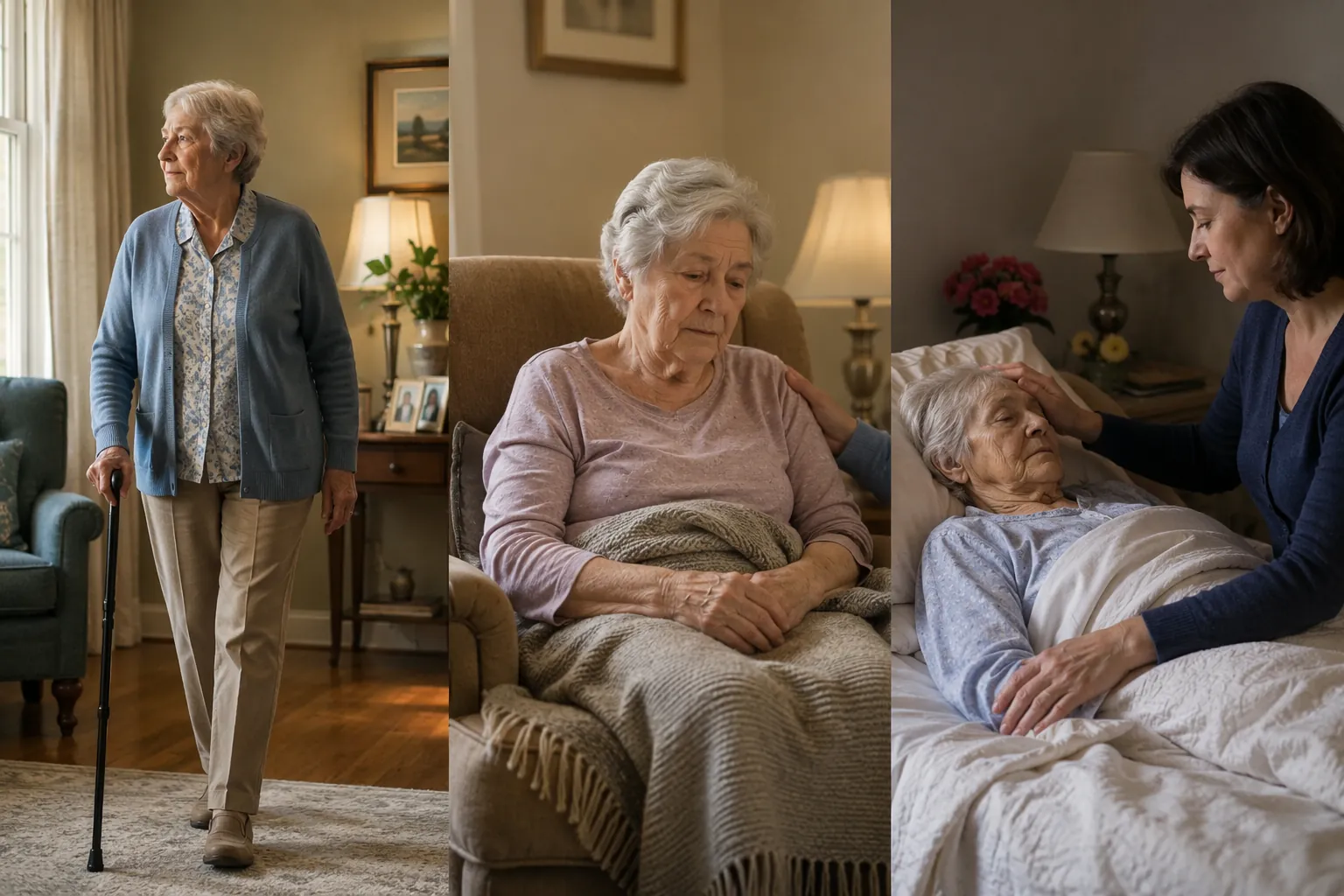
The activities of daily living matter because they name the work someone is doing. “Mom is declining” can be argued with. “Mom now needs help bathing and toileting, and she is in bed or the recliner most of the day” is harder to wave away. It also gives the doctor something specific to respond to.
The signs families notice should be tied back to function
Families often search for “signs it is time for hospice” because they are trying to make sense of many small changes. The National Cancer Institute and the American Cancer Society both describe care choices near advanced cancer in terms of comfort, symptom burden, treatment goals, and the person’s wishes; hospice becomes relevant when treatment is no longer controlling the disease or when the burden of treatment outweighs its benefit for the patient.[3][4]
Some signs deserve attention because they show the body has less reserve:
- Unintentional weight loss or eating much less than before.
- Sleeping more, being difficult to wake, or having fewer alert hours.
- Difficulty swallowing, coughing with liquids, or needing close watching during meals.
- Recurrent infections or wounds that do not heal well.
- More emergency room visits, hospitalizations, or urgent calls after treatment.
- New or increasing help needed with bathing, dressing, toileting, transferring, or eating.
These signs are not all equal. A poor appetite after one infusion may be temporary. A week of extra sleep during an infection may improve. But when weight loss, swallowing trouble, repeated hospital visits, and dependence in daily care are happening alongside cancer progression, they begin to support the same conclusion: the body is spending more of its limited energy on getting through the day.[3][4][5]
The patient’s own words belong in this evidence, too. If the person with cancer says, “I don’t want to go back to the hospital,” “I’m tired of treatment,” or “I just want to be home,” that is not a side comment. NCI and ACS materials both emphasize aligning care with the person’s goals and wishes in advanced cancer.[3][4]
Hospice and palliative care are related, but they are not the same
Palliative care can begin at any stage of a serious illness and can be provided alongside cancer treatment. It focuses on symptom relief, communication, and quality of life while a person may still be receiving treatment intended to control the cancer. Hospice is more specific: under the Medicare hospice benefit, it is for a person certified as having a terminal illness with a life expectancy of six months or less if the disease follows its usual course, and the person generally gives up curative treatment for that terminal condition in favor of comfort-focused care.[6][7]
That distinction helps families who feel trapped between “keep treating” and “do nothing.” Palliative care may be appropriate much earlier. Hospice becomes the right question when treatment is no longer achieving the patient’s goals, the cancer is progressing, and daily function has fallen into the range described by PPS, ECOG, and ADL dependence.
Some cancers may qualify earlier
Most families should think in terms of the full picture: diagnosis, disease progression, function, symptoms, treatment burden, and patient goals. There is one important caveat. Some hospice eligibility materials note that certain fast-progressing cancers, including pancreatic cancer, small-cell lung cancer, and primary central nervous system malignancies, may meet hospice eligibility on diagnosis alone, depending on the clinical situation.[8]
That does not mean every person with one of those cancers should immediately enroll in hospice. It means the family does not have to wait for a long visible decline before asking the physician whether hospice or palliative care should be discussed.
Why waiting for “the hospice talk” often means waiting too long
Cancer remains the largest single diagnostic category among hospice admissions, accounting for about 30% of admissions in recent hospice statistics, down from older figures near 37% as dementia-related admissions have grown.[9] So this is not a rare pathway. It is a common part of cancer care, even though many families experience it as if they are crossing an invisible line alone.
The problem is timing. Current hospice statistics report a median hospice length of stay of 17 days, and about one in four Medicare hospice patients enroll during the final week of life.[9] Another hospice-provider summary reports that about 25% of 2021 admissions received five or fewer days of hospice care.[10] Five days is enough time to order equipment and adjust urgent medications; it is often not enough time for a family to settle into the support hospice was designed to provide.
Delay is not only a family problem. The National Cancer Institute’s PDQ summary on the last days of life reports that about one-third of patients with advanced cancer continue chemotherapy near the end of life.[11] That figure should not be used to shame a person who wanted one more attempt at treatment. It does show how hard it is, for clinicians and families alike, to name the point when more treatment time is no longer giving the patient better time.
What to bring to the doctor
A useful hospice conversation starts before the crisis visit. Bring observations that are specific enough for the oncologist, primary care physician, or palliative care team to evaluate. You are not trying to prove a case against treatment. You are asking whether the medical plan still matches the person’s condition and goals.
- Track where the person spends the day: bed, recliner, walking around the house, or out of the home.
- Write down help needed with bathing, dressing, toileting, transferring, eating, and continence.
- Note weight loss, appetite changes, swallowing trouble, infections, falls, confusion, pain, or breathlessness.
- List emergency room visits, hospitalizations, urgent clinic visits, and treatment delays.
- Bring the patient’s own statements about treatment, hospitalization, home, comfort, fear, and goals.
Then ask direct questions:
- “Based on what we are seeing, what is their PPS or ECOG performance status?”
- “Are they dependent in two or more activities of daily living?”
- “Is the cancer progressing despite treatment?”
- “Would you be surprised if they died within six months if the illness follows its usual course?”
- “Is it time for a hospice informational visit?”
The last question is often the safest first step for a divided family. A hospice informational visit does not force enrollment. It lets the family hear what services would be available, what medications and equipment may be covered, who to call at night, and how the plan would change if the patient chose comfort-focused care.
Coverage questions should be checked with official sources
Medicare hospice is generally covered under Medicare Part A for services related to the terminal illness, but families still need to verify details: which hospice providers serve the area, which medications are included on the hospice formulary, what equipment can be delivered, and how respite or inpatient hospice care works locally.[6]
Because operations can vary by state, hospice provider, and insurance arrangement, confirm coverage through Medicare.gov, the person’s Medicare Advantage or supplemental plan if applicable, the state hospice association, and the hospice agency itself. Ask specifically what remains covered by the oncology practice and what shifts to the hospice plan of care.
The decision point
One more treatment trial can be reasonable when the person understands the likely benefits and burdens, still wants it, and has enough function to tolerate it. The harder truth comes when the signs begin to point in the same direction: the cancer is progressing, the person is in bed or a chair more than half the day, basic care now requires hands-on help, hospital visits are increasing, and the patient’s own goals have shifted toward being comfortable and being home.
Hospice is not chosen because a family has stopped caring. It becomes appropriate when functional decline, disease progression, treatment burden, and the patient’s goals all point toward comfort as the most medically and humanly honest plan.
References
- Hospice Eligibility Guidelines: End-Stage Cancer Patients, VITAS Healthcare
- Hospice Eligibility Criteria for Cancer, Compassus
- Choices for Care with Advanced Cancer, National Cancer Institute
- Hospice Care, American Cancer Society
- 10 Signs Your Aging Parents or Loved One Needs Hospice Care, Lake Superior Hospice
- Hospice vs. Palliative Care: What Families Really Need to Know, CCVNA
- How to Choose Palliative and Hospice Care, The Care Partner Project
- Hospice Eligibility for Cancer Patients, Crossroads Hospice
- Hospice in America by the Numbers — 2026 Statistics, Caring Hospice Institute
- Eight Signs That It's Time for Hospice, Amedisys
- Last Days of Life, National Cancer Institute
Browse more in the Glossary.