
Glossary entry
How Older Adults Can Avoid Student Loan Default
Last verified 2026-07-26
This is not financial or legal advice. Medicare/Medicaid and benefits rules vary by state and change over time — verify current rules with your state Medicaid office or Area Agency on Aging.
If you are an older borrower who cannot afford a federal student loan payment, the first danger is the calendar. A federal loan generally goes into default after 270 days of missed payments. Once that happens, the government can collect in ways ordinary bill collectors cannot, including taking part of a federal benefit check.
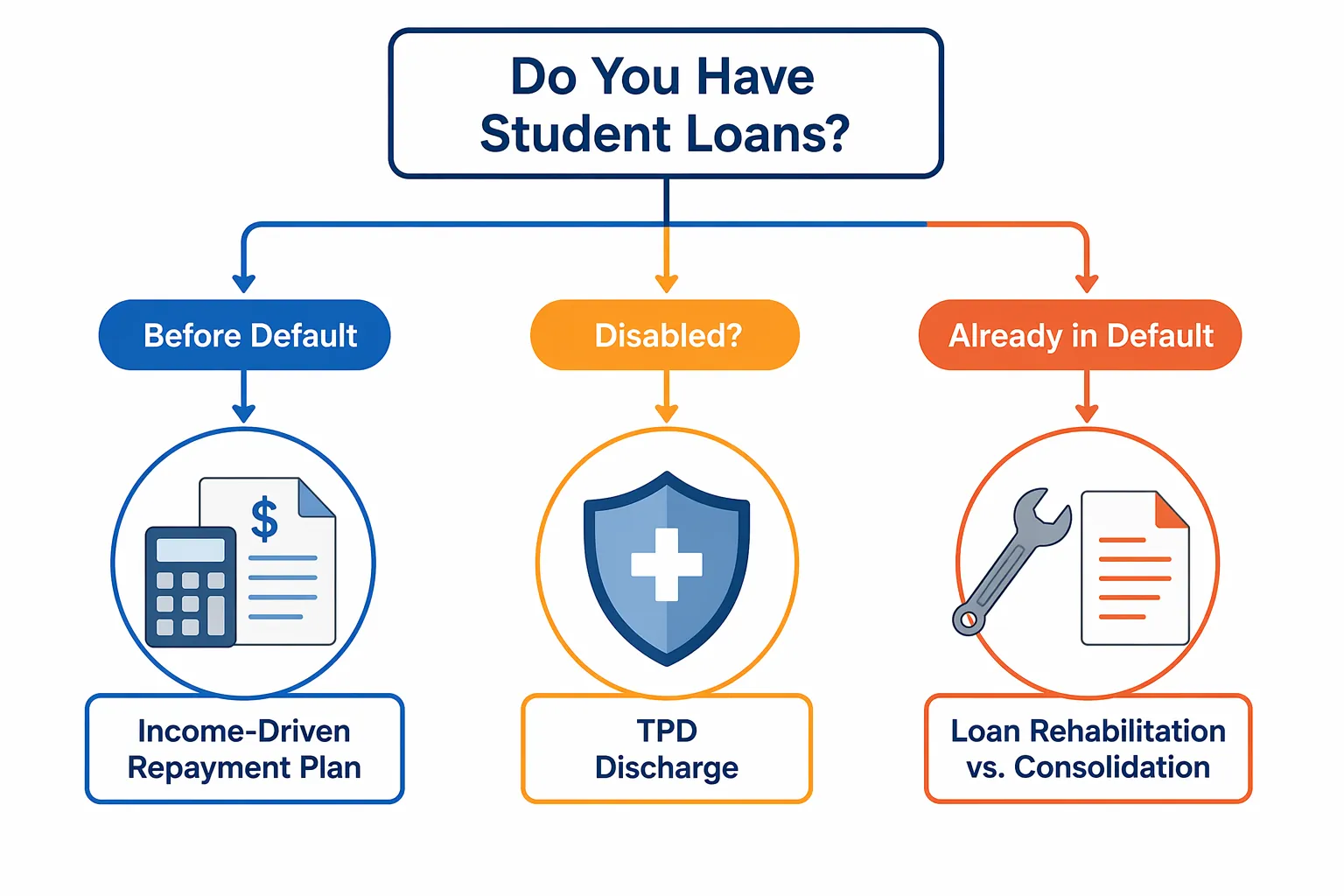
That is why the practical answer starts before any talk of forgiveness: find out whether the loan is already in default, protect the income coming into the household, and use the federal option that fits the borrower’s actual status. For many older federal borrowers, that means an income-driven repayment plan before default, Total and Permanent Disability discharge if the medical documentation fits, or rehabilitation if default has already happened.

The fear is not exaggerated. The Consumer Financial Protection Bureau reported that more than 450,000 federal student loan borrowers age 62 and older are in default and likely receiving Social Security benefits.[1] Another analysis notes that about 3.6 million seniors carry student loan debt, and New America has found that most seniors with student loans have held the debt for at least 15 years.[2][3] These are not always new loans or recent mistakes. Often they are old balances attached to households that now run on Social Security, a pension, part-time work, or help from family.
The harshest collection tool for many retirees is the Social Security offset. The government can garnish up to 15% of Social Security benefits for defaulted student loans, while protecting only $750 per month; that protected floor was set in 1996 and is now about $400 below the federal poverty line.[4] For a household already choosing which bill waits until next month, 15% is not a paperwork problem. It is food, medication, utilities, or rent.
There is also a telling failure in the system: the CFPB found that eight in ten Social Security beneficiaries with defaulted student loans report expenses equal to or greater than their income, which would qualify most for a hardship exemption from offset, yet fewer than 10% apply.[1] That gap is exactly where older borrowers and their adult children should focus. The relief may exist, but it does not help if no one opens the notice, asks for the right form, or acts before the default machinery starts moving.
First, find the loan status before choosing a remedy
Before calling anyone, separate two questions. Is the loan federal? And is it already in default? A Direct Loan, federally held consolidation loan, or federal Parent PLUS loan belongs in the federal student aid system. A private student loan does not use these federal default repair tools, although it may have its own hardship options.
The next call or account login should not be vague. Ask the servicer or check StudentAid.gov for the loan type, current repayment plan, delinquency status, number of days past due, and whether the loan has been transferred to default collections. If an adult child is helping, the parent may need to grant authorization before the servicer will discuss the account.
| What you find | What to ask for next |
|---|---|
| Federal loan, not yet in default | An income-driven repayment option before the 270-day window closes |
| Borrower has a qualifying disability record or certification | Total and Permanent Disability discharge review |
| Federal loan already in default | Rehabilitation terms first, then consolidation only if rehabilitation is unavailable or unsuitable |
| Parent PLUS loan | A specific review of whether it was consolidated by the June 30, 2026 deadline and what plans remain available |
| Private student loan | The lender’s hardship, settlement, or modification options; federal IDR, TPD, and rehabilitation rules may not apply |
If the loan is not in default, ask for income-driven repayment now
For an older borrower who cannot afford the regular bill, the most important prevention tool is an income-driven repayment plan. These plans calculate payments using income and family size. Depending on the borrower’s income, the required payment can be $0. A $0 required payment is still a valid payment for plan purposes; it is very different from simply not paying.
This matters for fixed-income households because the goal is not to prove hardship in a general way. The goal is to move the loan into a status where the required payment matches the borrower’s documented income before delinquency reaches default. If the monthly Social Security check, pension, or small wage income supports only basic expenses, an income-driven application may be the difference between a protected account and a defaulted account moving toward collection.
In 2026, the income-driven plan landscape is not the same as it was a few years ago. The SAVE plan was vacated on March 10, 2026. The new Repayment Assistance Plan, or RAP, began July 1, 2026, with payments generally set at 1% to 10% of adjusted gross income, a $10 monthly minimum, and forgiveness after 30 years. But Parent PLUS borrowers are excluded from RAP.[5]
That Parent PLUS boundary deserves plain language because many older borrowers took loans for a child or grandchild and then found themselves carrying the debt into retirement. Parent PLUS borrowers who did not consolidate by the June 30, 2026 deadline have lost access to income-driven repayment. Those who did consolidate in time may still have an ICR-to-IBR pathway, depending on their loan history and servicer processing.[5] A servicer letter that says “repayment options” is not enough; the borrower needs to know whether this specific Parent PLUS debt crossed the deadline in time.
What to say when asking for IDR
The request should be direct: “I cannot afford my current payment. I want to apply for every income-driven repayment plan available for my loan type, and I need to know whether a $0 payment is possible based on my income.” If the borrower has Parent PLUS debt, add: “Was this loan consolidated by June 30, 2026, and does it still qualify for any income-driven plan?”
The borrower should also ask what happens while the application is pending. Servicer handling can vary, especially for borrowers being moved from SAVE after the court decision. The important point is to keep the account from quietly aging toward 270 days while everyone assumes an application, phone call, or uploaded document solved the problem.
- Write down the date of every call, the representative’s name or ID if given, and the exact plan requested.
- Save proof of income used for the application, such as benefit statements, tax information, or other documents the servicer requests.
- Check the account again after submission; do not assume silence means approval.
- If the payment is unaffordable while the application is pending, ask what temporary status is available and how it affects delinquency.
If disability may qualify, check Total and Permanent Disability discharge
Some older borrowers should not be routed first into a lower payment. They should be screened for discharge. Total and Permanent Disability discharge can eliminate eligible federal student loan debt for borrowers who meet the program’s documentation rules. The relevant question is not whether the borrower feels unable to work, or whether the household plainly has medical hardship. The question is whether the borrower has qualifying documentation.
The documentation path may include Social Security Administration disability documentation, a physician’s certification, or an applicable automated discharge pathway for certain borrowers such as some veterans and SSDI recipients.[6] If the borrower has been receiving disability-related benefits, has a long-term medical condition, or has a physician who can certify the required standard, this branch should be checked before the family spends months trying to maintain payments that may not be owed after discharge.
This is not age-based forgiveness. Turning 65, retiring, or living on Social Security does not by itself erase a federal student loan. The discharge depends on the disability rules and the paperwork behind them. That distinction prevents two bad outcomes: giving up because “nothing exists,” or waiting for an automatic forgiveness that never comes.
If the loan is already in default, look at rehabilitation before consolidation
A defaulted federal loan is not the end of the road, but the next choice matters. Federal Student Aid lists two main routes out of default: loan rehabilitation and loan consolidation.[7] Both can move a borrower out of default. They do not have the same consequences.
Rehabilitation is often the better first question for an older borrower who can manage a very small required payment. Under rehabilitation, the borrower agrees to make a series of monthly payments; Consumer Reports describes rehabilitation for seniors in default as involving nine payments that can be as low as $5 per month.[8] After successful rehabilitation, the default notation is removed from the borrower’s credit history, though other late-payment history may remain.[7]
That credit-record repair is not cosmetic. Older adults may still need to rent an apartment, pass a utility or phone account screen, refinance a car, or move in with family under a lease that checks household credit. A repaired default record can preserve options in ways that a faster administrative fix may not.
The catch is important: rehabilitation can generally be used only once per loan.[7] If the borrower already rehabilitated the same loan years ago and defaulted again, the option may be gone. That is why no one should sign the first default-resolution document without asking whether rehabilitation is available, whether it has been used before, what the calculated payment will be, and when collection activity will stop.
Where consolidation fits
Consolidation can be faster than rehabilitation and may be useful when the borrower needs to exit default quickly or cannot use rehabilitation. But consolidation does not remove the default notation from the credit history in the same way rehabilitation can.[7] For a borrower trying to protect housing stability or future borrowing access, that difference deserves more than a rushed checkbox.
Consolidation also has special complications for Parent PLUS borrowers in 2026. Because the June 30, 2026 consolidation deadline has passed and RAP excludes Parent PLUS loans, a new consolidation cannot be treated as a magic door into income-driven repayment for Parent PLUS debt.[5] If the borrower is a parent borrower, the family should ask for plan eligibility in writing or through the official account record before relying on consolidation as the payment solution.
| Default option | Why an older borrower might choose it | Tradeoff to understand |
|---|---|---|
| Rehabilitation | Can restore the loan to good standing and remove the default notation from credit after successful completion | Usually available only once per loan and requires completing the agreed payment sequence |
| Consolidation | Can move a loan out of default faster and may help when rehabilitation is unavailable | Does not offer the same default-notation removal and may not solve Parent PLUS payment access after the 2026 deadline |
Do not ignore Social Security offset notices
If a notice says benefits may be offset, the borrower should treat it as urgent even if the loan is old, confusing, or emotionally exhausting. The CFPB’s findings on hardship exemptions show that many affected borrowers may have expenses that qualify them for protection, but very few apply.[1] The right response is not embarrassment and not silence. It is a request for the hardship exemption process, a default-resolution review, and a written explanation of what collection action is scheduled.
An adult child helping a parent should look for unopened mail from the loan servicer, the Default Resolution Group, Treasury, or any federal collection notice. The notice may contain deadlines, appeal rights, or contact instructions. Missing the date can turn a manageable paperwork problem into a reduced benefit check.
There is legislative debate over whether Social Security offsets for student loans should continue, and the protected floor has not kept pace with living costs. But as of July 2026, that debate has not replaced the borrower’s immediate tasks: apply for hardship relief if offset is threatened, get the loan out of default if possible, and move any nondefaulted federal loan into an affordable repayment status before the 270-day mark.
What to do this week
The best sequence is simple, but it needs to be done in order. First, identify the loan type and default status. Second, if the loan is not in default, apply for every income-driven plan still available for that loan type and ask specifically whether the payment can be $0. Third, if disability documentation may qualify, start the TPD discharge review. Fourth, if the loan is already in default, ask for rehabilitation terms before agreeing to consolidation.
- If the borrower is less than 270 days delinquent: ask for IDR immediately and confirm how the account will be handled while the application is pending.
- If the borrower has Parent PLUS loans: confirm whether consolidation happened by June 30, 2026 and whether any income-driven pathway remains.
- If the borrower is disabled: gather SSA documentation, physician certification, or other discharge-related records before assuming repayment is the only option.
- If the borrower is in default: ask whether rehabilitation is available, what the monthly rehabilitation payment would be, and whether the loan has been rehabilitated before.
- If Social Security offset is threatened or already happening: request hardship exemption information and default-resolution options right away.
Age alone does not cancel a student loan. Silence does not pause default. But for many older federal borrowers, the available tools are still strong enough to protect income, reduce the required payment to an amount the household can actually bear, or repair a default that has already occurred. The borrower has to reach the right door before 270 days pass or offsets begin.
References
- Issue Spotlight: Social Security Offsets and Defaulted Student Loans, Consumer Financial Protection Bureau
- 3.6 Million Seniors Have Student Loan Debt. Here's What To Do, Bankrate
- Seniors with Student Loans: 15 Years of Debt, New America
- Older Student Loan Borrowers Who Default May Face Reduction in Social Security Benefits, PNPI
- Explainer: Student Loan Repayment Changes Starting July 1, 2026, TICAS, June 29, 2026
- Student Loan Forgiveness at Age 65: What Seniors and Retirees Need to Know, Tateesq, July 2, 2026
- Getting Out of Default, Federal Student Aid
- How Seniors Crushed by Old Student Loans Can Get Relief, Consumer Reports
Browse more in the Glossary.