
Glossary entry
How Parkinson's Diagnosis Reshapes a Marriage and What Couples Can Do
A Parkinson's diagnosis usually does not turn a spouse into a caregiver in one dramatic afternoon. The marriage may still look familiar: the same kitchen, the same jokes, the same side of the bed. Then small tasks begin to move. One partner starts tracking medication times. One does more of the driving. One watches a foot catch on the rug, notices a change in handwriting, listens differently for depression, apathy, anxiety, or confusion. The shift can be quiet enough that nobody calls it caregiving at first.
That quietness is part of the problem. When people ask what a Parkinson's diagnosis does to a spouse-caregiver relationship, the honest answer is that the diagnosis begins a role transition before the couple may feel ready to name it. The person with Parkinson's is still an adult partner, not a project. The spouse is still a husband, wife, or partner, not simply staff. But the marriage has acquired a second job, and that job grows.
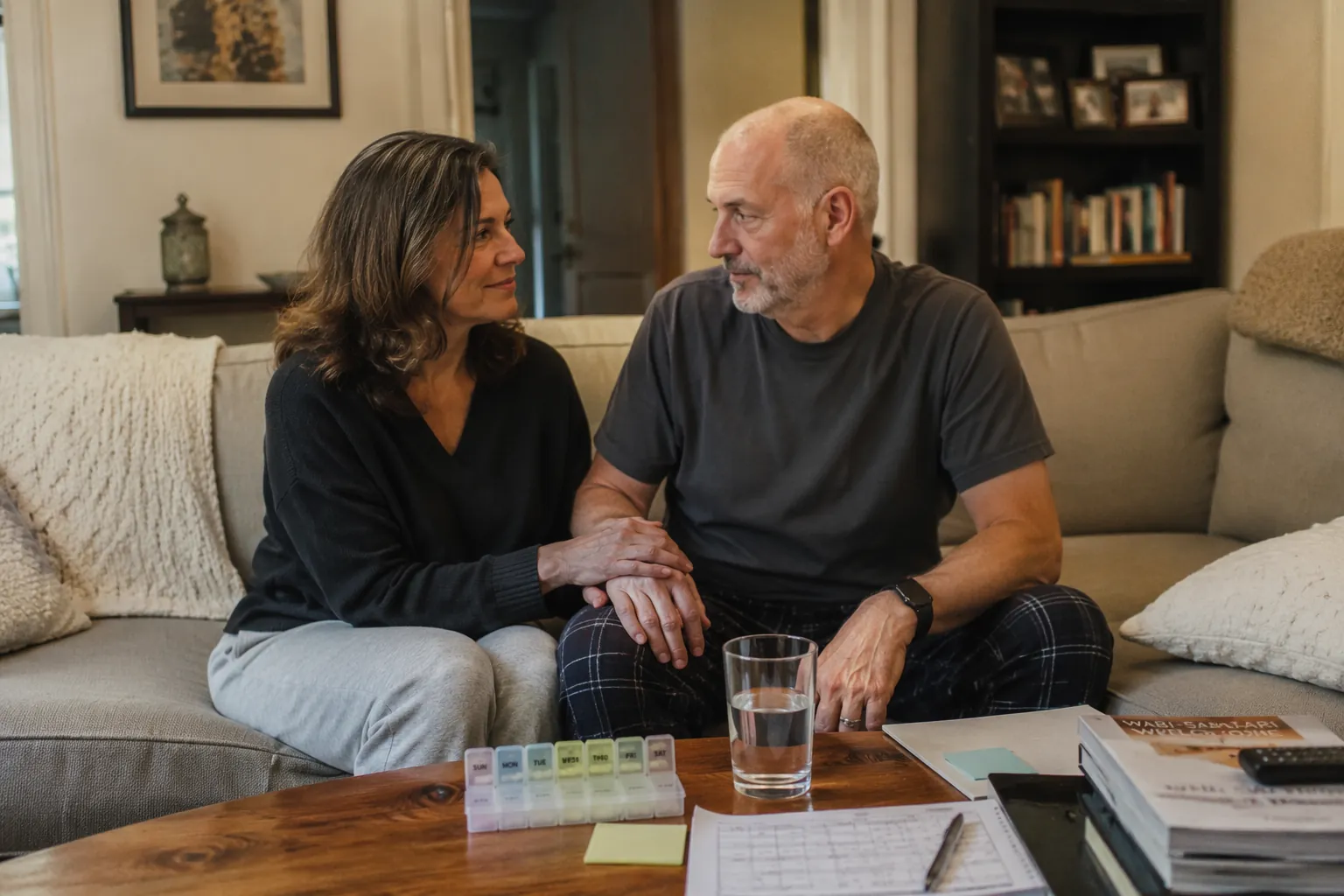
In the 2025 National Alliance for Caregiving and Michael J. Fox Foundation report, Parkinson's caregivers averaged more than 31 hours a week of unpaid care. Nearly half reported high emotional strain, and nearly a third reported physical strain, rates the report described as markedly higher than among caregivers of other conditions. The same report notes that about 65% of Parkinson's caregiving spouses are women and that the average caregiver is 65 or older, which means many spouses are doing this work while managing their own aging bodies, appointments, pain, fatigue, or fear about the future.[1]
Love matters here. It does not absorb 31 hours a week by itself.
The marriage changes before the couple has language for it
Early Parkinson's can leave enough independence intact that both partners hesitate to speak plainly. The spouse may think, I am only helping. The person with Parkinson's may think, I am still myself, so why is everyone watching me? Both can be true. The trouble begins when the marriage starts running on invisible adjustments: one person double-checks the calendar, one scans the room for tripping hazards, one listens for medication wearing off, one quietly takes over the tasks that used to belong to the other.
None of those acts is a betrayal. Many are necessary. But if they are never named, they can begin to feel like personality changes instead of workload changes. The spouse becomes tense, controlling, or withdrawn. The person with Parkinson's feels monitored, corrected, or diminished. What is really happening may be more specific: one partner is becoming a backup executive system for the household, and the other is losing pieces of privacy and competence in public view.
That is why relationship strain in Parkinson's should not be treated as a simple communication flaw. Couples do need better conversations, but the conversations are carrying the weight of real labor, neurological change, grief, and unequal risk. If a spouse has become the memory aid, medication alarm, safety officer, appointment manager, mood interpreter, and driver, the marriage is not just having a tone problem. It is undergoing a job redesign.
What the satisfaction numbers make visible
One of the more painful findings in the Parkinson's relationship literature comes from a 2018 qualitative study of female caregiving spouses whose male partners had Parkinson's-related cognitive decline. The wives rated their premorbid relationship satisfaction at 8.8 out of 10. That fell to 5.5 at the mild cognitive impairment stage and 2.1 at the dementia stage.[2]
Those numbers should be handled carefully. The study interviewed female spouses caring for male partners, so it cannot speak for every marriage, every gender pairing, or every same-sex couple. It also focuses on cognition, not only movement symptoms. Still, the trajectory matters because it gives shape to a loss many spouses describe privately: the relationship may remain loving while becoming less reciprocal, less emotionally safe, less sexually easy, and less companionable.
Cognitive change can be especially disruptive because it affects the parts of marriage that are hard to outsource. A spouse can hire help for cleaning more easily than for shared remembering. It is harder to replace the person who used to notice when you were upset, laugh at the same old reference, help make a decision, or carry half the emotional history of the household.
When memory, judgment, attention, or emotional regulation changes, the caregiving spouse may begin making decisions alone while still sitting beside the person they most want to consult. The person with Parkinson's may sense the withdrawal of trust before either partner knows how to talk about it. A question like "Can you still handle this?" can sound like supervision. Silence can feel like abandonment. The marriage can become crowded with things both people are trying not to say.
Intimacy suffers when affection turns into supervision
The most obvious caregiving tasks are practical: refilling prescriptions, driving to neurology visits, arranging physical therapy, watching for falls, adjusting the home. The less obvious ones are relational. A spouse may start touching a partner mainly to steady them, guide them, wake them, help them dress, or check whether they are safe. The body that used to be approached with desire is now also a body being assessed for risk.
That does not mean sexual or romantic intimacy disappears. It does mean the couple may have to protect it from being swallowed by care routines. Parkinson's can change facial expression, voice, movement, sleep, mood, energy, and confidence. Medication timing can affect when a person feels most mobile or available. Embarrassment can make both partners avoid initiating closeness, especially if one fears rejection and the other fears causing pressure.
The person with Parkinson's may also grieve being treated as fragile. A spouse who means to be loving can start correcting, reminding, or anticipating so often that the partner feels less like an equal adult. On the other side, the spouse may miss being desired rather than needed. Need can be intimate, but when it becomes the main form of contact, affection starts to feel like another shift on the schedule.
This is where vague advice to "be patient" falls short. Patience does not tell a couple how to keep holding hands when touch has become functional. It does not tell them when to talk about sex, how to preserve privacy, or how to stop every shared hour from becoming a health-status meeting. Couples need permission to notice that caregiving can crowd out marriage even when both partners are trying hard.
The wish for distance is not the same as lack of love
A 2026 qualitative study of Swedish couples living with late-stage Parkinson's described a useful protective idea: couples who approached Parkinson's as a "we-disease," a shared challenge rather than one person's private burden, reported better relationship outcomes. The same study also found something less comfortable and just as important: partners expressed a strong desire for solitude, and some admitted they had thought about living alone but felt afraid to say it aloud.[3]
That study was small: 6 couples, marriages lasting 31 to 60 years, all living with late-stage Parkinson's. Its Swedish cultural context and disease stage cannot simply be mapped onto a newly diagnosed U.S. couple in midlife. But the emotional pattern is worth taking seriously because many spouses recognize it long before they would say it in a clinic. Wanting an hour alone, a separate room, a quiet walk, or even imagining a life with less constant vigilance does not prove the marriage has failed. It may prove the caregiving role has expanded beyond what one relationship can hold without relief.
The person with Parkinson's may need solitude too. Being observed can be exhausting. So can being helped before asking, praised for ordinary tasks, or watched during every movement. A marriage that makes room for privacy protects dignity on both sides. The point of a shared approach is not to make the couple inseparable. It is to keep Parkinson's from quietly assigning one person all the responsibility and the other all the dependence.

What a "we-disease" approach looks like in daily life
A "we-disease" approach can sound sentimental if it is treated as a mood. It is more useful as a way of organizing decisions. The couple faces Parkinson's together, but that does not mean both people have the same symptoms, the same losses, or the same workload. It means the diagnosis belongs in shared planning instead of private resentment.
| When the pattern is | The couple can try |
|---|---|
| One spouse silently takes over more tasks | Name the task migration out loud and decide which duties truly need to shift |
| The person with Parkinson's feels supervised | Ask before helping when safety allows, and agree on situations where immediate help is welcome |
| Every conversation becomes about symptoms | Protect some time for ordinary topics, shared pleasure, and affection that is not care-related |
| The caregiving spouse feels trapped by vigilance | Build in predictable solitude, outside help, or respite before resentment becomes the only signal |
| Home safety depends on one exhausted person noticing everything | Treat fall prevention, medication routines, and home changes as shared systems, not proof of one spouse's devotion |
The first practical move is often administrative, not emotional: write down what has changed. Who now drives at night? Who tracks appointments? Who notices freezing, dizziness, sleep disruption, hallucinations, or medication wearing off? Who calls the doctor? Who worries about the stairs? Seeing the list can be sobering, but it can also reduce blame. A spouse who looks "controlling" may be carrying a safety system alone. A partner who looks "resistant" may be trying to preserve adulthood.
The next move is to separate safety from style. Some tasks need firm routines: medication timing, mobility precautions, emergency contacts, transportation decisions, and home modifications when gait or balance changes. Other tasks can preserve choice. A person with Parkinson's may still choose clothing, meals, social plans, exercise preferences, or when to disclose the diagnosis. Couples do better when they do not turn every change into a referendum on competence.
For CareWise Guide readers, this matters because home safety is not only about grab bars, lighting, rugs, stairs, and bathroom layouts. It is also about the couple's capacity to maintain routines. An exhausted spouse is more likely to miss a hazard, delay a repair, forget an appointment question, or avoid a difficult conversation about driving or mobility. Strain in the relationship can become strain in the safety system.
Mutuality is not a luxury
Research on mutuality in Parkinson's gives couples a more concrete target than "stay positive." Mutuality refers to the parts of the relationship that still move both ways: shared pleasurable activities, love and affection, reciprocity, and a felt sense that both partners still matter to each other. Studies by Tanji and colleagues and Karlstedt and colleagues found that mutuality helps mediate the effect of Parkinson's symptoms on quality of life and protects against caregiver strain.[4]
That finding can be misused if it becomes another assignment for the healthier spouse: create more joy, be more affectionate, preserve the marriage, manage the disease beautifully. Mutuality is protective because it is shared. It asks both partners, in whatever ways remain possible, to keep giving and receiving.
For one couple, that may mean continuing a weekly breakfast out, even if the timing changes around medication. For another, it may mean watching a favorite show without pausing to discuss symptoms. For another, it may mean the person with Parkinson's keeps responsibility for one household ritual that still feels manageable: making coffee, choosing music, reading to a grandchild, paying a familiar bill with support nearby but not hovering. The activity itself matters less than the message: you are not only cared for; you still contribute to us.
Affection may also need to be intentionally separated from assistance. A hand on the back can mean "I love you" or "I am preventing a fall." Both are valid. They should not become indistinguishable. Couples can make room for touch that is not corrective, conversation that is not clinical, and gratitude that is specific enough to feel real rather than obligatory.
A useful question for each partner
- For the caregiving spouse: "What am I now doing that my partner may not realize has become work?"
- For the person with Parkinson's: "Where can I still give care, attention, appreciation, or choice back to the relationship?"
- For both: "Which part of our week still feels like us, and how do we protect it?"
These questions do not fix tremor, freezing, cognitive decline, depression, or fatigue. They do help the couple avoid a narrower tragedy: letting Parkinson's define one person as the patient and the other as the function that keeps the patient going.
When cognitive changes enter the marriage
Movement symptoms are visible to outsiders. Cognitive and emotional changes often rearrange the marriage more privately. A spouse may notice slower processing, reduced initiative, impulsivity, apathy, hallucinations, or difficulty following a conversation. The person with Parkinson's may feel accused when the spouse raises concerns. The spouse may feel gaslit by symptoms neither partner chose.
The Vatter study's satisfaction decline through mild cognitive impairment and dementia stages is not a prediction for every couple, but it warns against waiting until the relationship is in crisis to talk about cognition.[2] Couples can decide earlier how they want to handle money management, driving, medication oversight, medical disclosure, and decision-making if thinking changes. These conversations are easier when framed as protection for both partners, not as a vote of no confidence in the person with Parkinson's.
It may help to distinguish privacy from secrecy. Privacy says: you are still entitled to dignity, space, and adult respect. Secrecy says: we will avoid naming changes until they create danger or resentment. Parkinson's marriages need the first and cannot afford too much of the second.
Do not use divorce as a scare tactic
There is a viral claim that most chronically ill couples divorce. It is not a sound basis for this conversation. No authoritative Parkinson's-specific divorce rate is available in the research used here, and the commonly circulated chronic-illness divorce statistic cannot be verified from a peer-reviewed source.
More importantly, divorce statistics would answer the wrong question for many couples. The immediate fear after diagnosis is often not, "Will we legally separate?" It is, "Will we still recognize each other?" Relationship satisfaction can decline without the marriage ending. A couple can stay together and still lose ease, playfulness, privacy, sexual confidence, or emotional equality. Those losses deserve attention without being inflated into threats.
What to name early
Newly diagnosed couples do not need to solve late-stage Parkinson's in the first months. They do need to begin naming the role shift while there is still enough flexibility to shape it. A few conversations are worth having before exhaustion decides the answers.
- Care tasks: Which responsibilities have already shifted, and which ones should stay with the person with Parkinson's for as long as safely possible?
- Decision rules: What symptoms or situations would trigger changes in driving, medication oversight, home safety, finances, or medical appointments?
- Affection: How will the couple preserve touch, humor, sex, companionship, or tenderness that is not mainly about monitoring symptoms?
- Solitude: When does each partner get time alone without guilt, surveillance, or interpretation as rejection?
- Outside help: Which tasks could eventually move to family, paid support, transportation services, therapy, support groups, or home modifications instead of landing entirely on the spouse?
The hardest item on that list may be outside help. Many couples delay it because accepting help feels like admitting decline. But help can also protect the marriage from becoming only a care arrangement. If someone else can handle a ride, a repair, a respite shift, a safety assessment, or a piece of household labor, the spouse may have a better chance of remaining a partner rather than the only functioning infrastructure.
The decline is real, but it is not the same as failure
Parkinson's can make a marriage less easy. It can shift a spouse into unpaid labor that is physically and emotionally heavy. It can reduce privacy, change desire, complicate decision-making, and make both partners lonely in different ways. The evidence is strong enough to say that these changes are not just attitude problems or private weaknesses.[1][2]
The evidence is also strong enough to avoid despair. Relationship decline is not the same as relationship failure. Couples who keep Parkinson's in shared view, preserve mutuality, and notice the spouse-caregiver transition early have a better chance of protecting the marriage inside the caregiving life.[3][4]
That protection is not control over the disease. It is the steadier work of saying what has changed, distributing what can be distributed, asking for help before resentment becomes the only honest language, and keeping some part of the relationship devoted to affection rather than supervision. Parkinson's may change the shape of the marriage. It does not have to be allowed to erase the fact that two people are still in it.
References
- Parkinson's Disease Caregiving in the U.S. — National Alliance for Caregiving and Michael J. Fox Foundation, 2025
- A qualitative study of female caregiving spouses' experiences of intimate relationships as cognition declines in Parkinson's disease — 2018
- Exploring the Impact of Parkinson's Disease on Marital Relationships — 2026
- Mutuality of the marital relationship in Parkinson's disease — 2008
Browse more in the Glossary.