
Clinical term
How to Care for an Elderly Parent with Cancer
Last verified 2026-07-27
The first weeks after a parent’s cancer diagnosis can feel like someone quietly handed you four jobs at once. You are still their child, but now you may be the person driving to oncology visits, hearing instructions they missed, checking the pill bottles, changing the bathroom setup, and deciding whether it is safe for them to be alone tonight.
If you are trying to figure out how to care for an elderly parent with cancer, start by separating the work into four threads: medical logistics, daily care, cancer-specific home safety, and protection for you as the caregiver. They overlap, but they are not the same job. A parent can have transportation covered and still be unsafe in the shower. They can understand their diagnosis and still forget which medication caused dizziness. You need a system that catches those ordinary failures before they become emergencies.
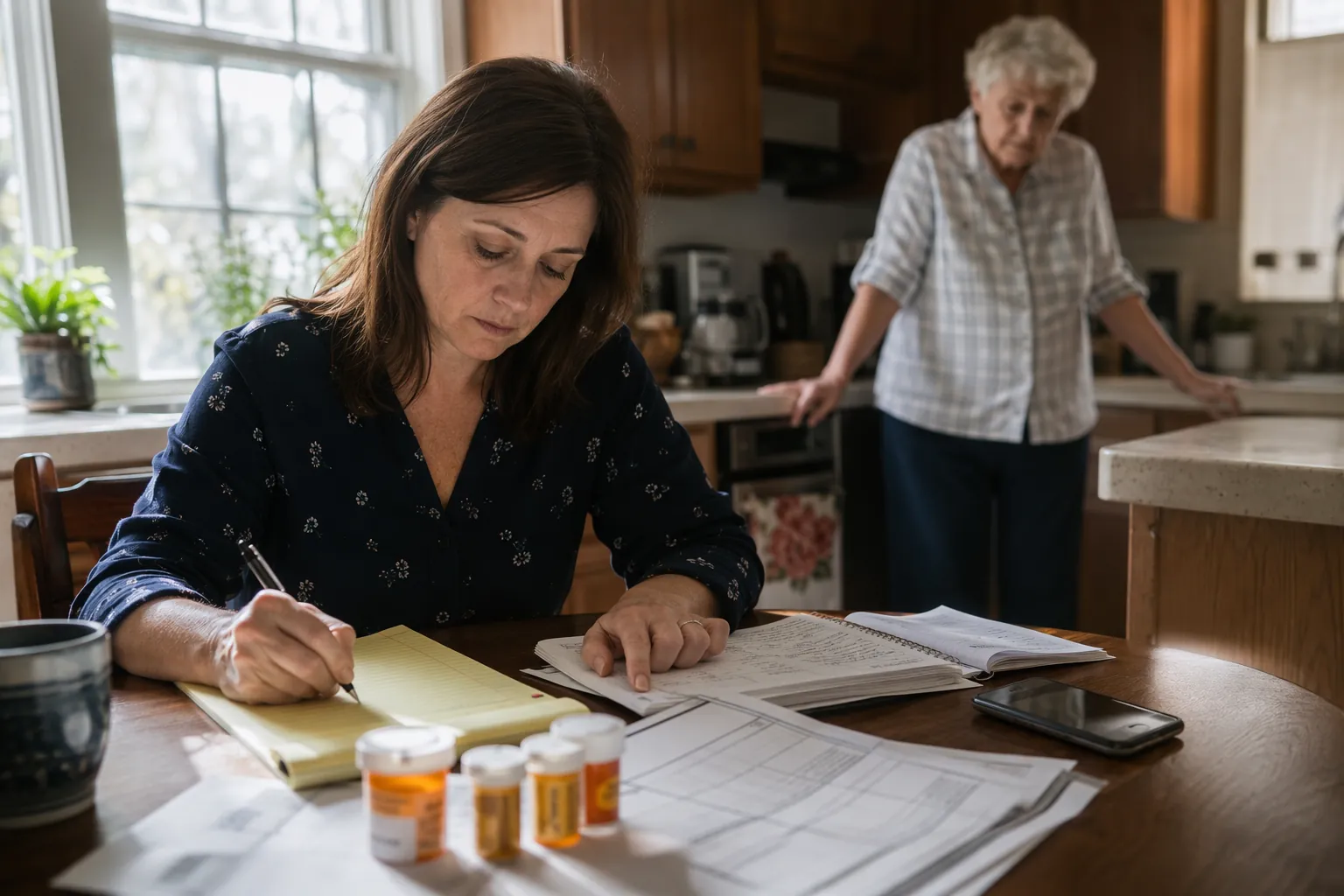
This guide is practical preparation, not medical, legal, or financial advice. Cancer type, stage, treatment plan, side effects, insurance rules, and home health eligibility vary. Use the steps below to organize questions, spot risks, and know when to ask the oncology team, primary care clinician, pharmacist, social worker, or benefits office for specific guidance.
What should I do first after my elderly parent is diagnosed with cancer?
In the first few days, do not try to solve the whole illness. Build the control center. That usually means one notebook or shared digital folder, one current medication list, one appointment calendar, and one written contact list for the care team.
| Thread | What to set up first | Why it matters |
|---|---|---|
| Medical logistics | Diagnosis details, treatment goal, appointment notes, medication list, care-team contacts | You need to know what the plan is and who to call when symptoms change. |
| Daily care | Transportation, groceries, meals, medication support, toileting, bathing, transfers | Cancer caregivers commonly help with both errands and hands-on personal care. |
| Home safety | Clear walking paths, bathroom supports, night lighting, shower safety, fall-monitoring plan | Treatment side effects can add fall risks beyond ordinary aging. |
| Caregiver protection | Backup drivers, respite options, work-leave questions, burnout warning signs | A care plan that depends on one exhausted adult child is not stable. |
The workload is not imagined. A 2023 analysis using the 2015 National Alliance for Caregiving/AARP dataset found that cancer caregivers spent an average of 32.9 hours per week caregiving, and 36% provided 40 or more hours per week. The data are not brand-new, but the numbers are useful because they name what many families discover the hard way: this can become a part-time or full-time job before anyone calls it one.[1]
How do I handle the role reversal without taking over everything?
A parent with cancer may still be mentally sharp, private, proud, and used to making decisions. You may feel grief, irritation, guilt, protectiveness, and embarrassment all in the same afternoon. That is not a character flaw. Adult children becoming caregivers for a parent is a specific emotional shift, and cancer organizations advise acknowledging that change rather than pretending the relationship has not been altered.[2][3]
The most useful communication is plain and permission-based. Try: “Can I take notes during the visit?” “Would you rather I manage the pharmacy refills or just remind you?” “If you feel weak in the bathroom, what help will you accept?” These questions keep your parent involved while still naming the risks no one wants to discuss at dinner.
Some parents will insist they are fine while gripping furniture to stand. Believe the behavior as much as the words. You do not have to argue about independence in the abstract. You can say, “I want you making your own choices as long as possible. That means we need to make the house safer and make the appointment plan clearer.”
What should go in the cancer care notebook?
Medical logistics deserve more attention than most families give them at the beginning. The appointment is where the plan is explained, but the kitchen table is where that plan either becomes usable or falls apart. MD Anderson advises caregivers to document health history, take notes at appointments, and understand treatment goals when caring for a parent with cancer.[3]
Keep the notebook boring and complete. It should help a tired person find the answer quickly at 9 p.m., not look impressive.
- Diagnosis and treatment basics: cancer type, stage if known, current treatment plan, treatment goal, and upcoming decision points.
- Care-team contacts: oncologist, oncology nurse line, primary care clinician, pharmacist, surgeon or radiation team if involved, social worker, home health agency if one is assigned.
- Who to call for what: pain, fever or infection concerns, falls, medication reactions, missed doses, dehydration, new confusion, transportation barriers, insurance questions.
- Medication list: prescription drugs, over-the-counter medications, supplements, cancer-related medications, allergies, pharmacy name, and who manages refills.
- Health history: other diagnoses, prior surgeries, mobility problems, hearing or vision issues, past falls, memory concerns, and current assistive devices.
- Appointment notes: what was decided, what changed, what symptoms to watch, what test results are pending, and when the next visit happens.
At each visit, ask the care team to slow down the parts that become work at home: medication timing, food and fluid guidance, activity limits, bathing restrictions after procedures, expected side effects, and symptoms that should trigger a call. If your parent wants to answer questions alone, respect that where possible. If they want you in the room, take notes as if you are writing for tomorrow’s exhausted version of yourself.
The question families forget to ask: who answers after hours?
Before the first treatment cycle, clarify the phone tree. Ask which number is for urgent symptoms, which is for medication questions, which is for scheduling, and which problems should go directly to emergency care. Write the answer down. The wrong number at the wrong hour can turn a manageable symptom into a scramble.
Which daily care tasks should I prioritize?
Start with the tasks that keep treatment possible and keep your parent safe. In the same cancer caregiver analysis, more than 80% of cancer caregivers helped with transportation and grocery shopping, and more than 50% helped with bed or chair transfers and toileting.[1] That spread matters. Cancer caregiving is not only rides to chemo; it can become hands-on help with standing, bathing, and bathroom safety.
- Transportation: decide who drives to treatment, who stays during the visit, who can be backup, and whether your parent can safely drive after appointments or medications.
- Medication and appointment support: set refill reminders, bring the medication list to visits, and check whether new symptoms began after a medication change.
- Food, groceries, and fluids: plan simple meals around appetite, fatigue, nausea, chewing or swallowing problems, and any care-team instructions.
- Transfers and walking: watch how your parent gets out of bed, rises from a chair, enters the bathroom, and moves at night.
- Toileting and bathing: treat these as safety tasks, not just privacy issues. Weakness, urgency, dizziness, and wet floors are a bad combination.
- Household management: laundry, trash, mail, bills, pet care, and cleaning often become caregiver tasks because fatigue makes them pile up.
If you are trying to decide what to do personally and what to delegate, choose based on risk. A neighbor can drop off groceries. A sibling can handle insurance calls. A trained aide may be better for bathing or transfers if your parent is weak, you are physically unable to help safely, or the task is damaging the parent-child relationship.
How is home safety different when an older parent has cancer?
General aging already raises fall concerns. Cancer can add a separate layer: chemotherapy-induced peripheral neuropathy, medication-related dizziness or orthostatic hypotension, and generalized weakness can all increase fall risk beyond standard aging.[4] A parent who was steady last month may be less steady after treatment starts. A loose rug that used to be annoying can become a hazard when numb feet, dizziness, fatigue, or nighttime bathroom trips enter the picture.

Home safety should be done before the first serious scare if possible. Caregiver Action Network, in collaboration with CancerCare, recommends changes such as raised toilet seats, grab bars near the toilet and tub, shower seats, hand-held showerheads, non-slip mats, clear pathways, nightlights, and removal of throw rugs for cancer caregivers preparing the home.[5]
Start with the path your parent uses when tired
Walk the route from bed to bathroom, bathroom to kitchen, favorite chair to front door, and car to entryway. Do it at the time your parent actually moves: early morning, after treatment, during the night, or when rushing to the toilet. Look for throw rugs, cords, clutter, uneven thresholds, unstable furniture, poor lighting, pets underfoot, and anything your parent grabs that was never meant to hold body weight.
Do not depend on willpower. A weak or dizzy person will reach for the towel rack, the sink edge, or the doorframe because it is there. Replace those accidental supports with real supports installed according to established home-safety guidance. Where exact placement or installation measurements are needed, use a qualified installer or a room-by-room home safety standard rather than guessing.
Make the bathroom the first modification zone
The bathroom combines urgency, water, hard surfaces, privacy, and often pride. If your parent needs help toileting or bathing, it can also become the place where both of you feel most awkward. Safety needs to be settled before every shower becomes a negotiation.
- Add grab bars near the toilet and bathing area; do not treat towel bars as grab bars.
- Consider a raised toilet seat if standing up from the toilet is difficult.
- Use a shower chair or bench when weakness, dizziness, neuropathy, or fatigue makes standing unsafe.
- Add a hand-held showerhead so bathing can happen while seated.
- Use non-slip mats and remove loose bath rugs that can slide or bunch.
- Add night lighting along the route to the bathroom and inside the bathroom.
Immune compromise changes the stakes. Caregiver Action Network notes that even a minor fall can lead to serious infection in an immune-compromised patient.[5] That does not mean panic over every step. It means a fall-prevention plan belongs in the cancer care plan, not on a someday list.
Plan for neuropathy, dizziness, and night movement
Neuropathy can make feet numb or unreliable. Dizziness can appear when standing. Weakness can make a familiar hallway feel longer. Nighttime bathroom trips add darkness and urgency. These are not personality issues, and they are not solved by telling your parent to “be careful.”
Put frequently used items within easy reach. Keep shoes or non-slip footwear where your parent actually gets up. Clear a wide, predictable path. Add nightlights before they are needed. If your parent lives alone or spends long stretches alone, discuss fall-monitoring options, check-in routines, and whether someone should be present after treatments that tend to cause weakness or dizziness.
How should I communicate with the oncology team?
Go into appointments with a short list, not a speech. The care team needs accurate symptoms, medication changes, function changes, and safety concerns. “She is tired” is less useful than “She needed help getting off the toilet twice this week and skipped dinner after treatment.”
- Ask what side effects are expected and which are not.
- Ask which symptoms should trigger a same-day call.
- Ask whether dizziness, weakness, neuropathy, confusion, appetite changes, or bathroom accidents could be treatment-related.
- Ask whether physical therapy, occupational therapy, home health, nutrition support, palliative care, or social work would be appropriate.
- Ask how medication changes should be tracked and who reviews the full medication list.
Bring up home safety directly. Clinicians may focus on labs, scans, and treatment response because that is the medical focus of the visit. You are allowed to say, “At home, the biggest problem is getting to the bathroom safely,” or “He is using the furniture to walk after treatment.” That information can change the support the team recommends.
When do I need more help at home?
Bring in more help when the care tasks become unsafe, constant, or technically beyond what family can reasonably do. The threshold is not whether you love your parent enough. It is whether the current setup protects both of you.
- Your parent needs hands-on help with transfers, toileting, or bathing and you are not trained or physically able to assist safely.
- Falls, near-falls, new confusion, medication mistakes, missed meals, or missed appointments are appearing.
- Your parent is alone during predictable high-risk times, such as after treatment or during nighttime bathroom trips.
- You are choosing between work, sleep, your own health care, and your parent’s basic needs.
- Family conflict is preventing reliable coverage.
Possible supports include relatives, neighbors, meal help, transportation services, home health if eligible, private-duty aides, adult day programs, respite care, and short-term facility care after hospitalizations. Coverage varies by state, plan type, medical need, and eligibility rules, so verify benefits directly with the insurer, Medicare or Medicaid plan, Veterans Affairs if applicable, or the hospital social worker.
If you are comparing care options or trying to understand what families may pay for, CareWise Guide’s guide to paying for elder care in 2026 can help you sort home care, assisted living, and nursing home pathways before a crisis forces the decision.
How do I protect myself without treating self-care like a luxury?
Caregiver protection belongs in the plan because the system often runs through one person. The 2023 analysis found that 31% of cancer caregivers reported moderate emotional strain, and 1 in 5 reported very high stress.[1] Those figures are not an invitation to buy a candle and breathe through a broken schedule. They are a reason to build backup.
Write down who can cover rides, who can sit with your parent, who can handle pharmacy pickups, who can make calls, and who should not be assigned tasks they will not actually do. If you work, ask early about leave policies. The American Cancer Society notes that the Family and Medical Leave Act can provide up to 12 weeks of unpaid leave per year to care for a seriously ill parent, but not all employees qualify.[6]
Respite is not abandonment. It is replacement coverage. If you need a starting point, read what respite care for seniors can look like, then match the option to the problem: a few hours of supervision, overnight coverage, transportation relief, or a longer break after a hard treatment stretch.
Watch your own symptoms with the same seriousness you bring to your parent’s. The American Cancer Society caregiver guide describes clinical depression as five or more symptoms nearly every day for two or more weeks, including sad mood, loss of interest, weight changes, sleep changes, fatigue, feelings of worthlessness, or suicidal thoughts.[6] If that list feels uncomfortably familiar, contact your own clinician or a mental health professional. If you are in immediate danger or thinking about self-harm, seek emergency help now.
For a practical way to sort exhaustion from a true coverage problem, use CareWise Guide’s burnout symptoms and respite matching guide. The goal is not to label yourself. It is to stop making the whole care plan depend on your ability to keep going without sleep.
What warning signs should change the plan?
Ask the oncology team for your parent’s specific urgent-symptom instructions, because cancer treatments and risks differ. At home, do not ignore changes in function just because they look ordinary. New trouble standing, repeated near-falls, sudden toileting accidents, skipped medications, poor intake, confusion, worsening dizziness, or a parent who stops bathing because it feels unsafe all mean the current plan is too thin.
When something changes, report what happened, when it started, what treatment or medication change came before it, and what your parent can no longer do safely. That is the difference between a vague complaint and information the care team can act on.
A workable first-week plan
If everything feels urgent, use the first week to make the basics visible.
- Create the care notebook or shared folder.
- Build the medication list and bring it to the next appointment.
- Ask the care team about treatment goals, expected side effects, urgent symptoms, and after-hours contacts.
- Walk the home for fall risks, especially the bedroom-to-bathroom path and bathroom itself.
- Remove throw rugs and clutter, improve night lighting, and plan bathroom supports.
- Decide who covers transportation, groceries, pharmacy pickups, and appointment notes.
- Identify one backup person and one respite option before you are desperate.
You cannot remove the cancer, and you cannot make caregiving easy by organizing it neatly. But you can reduce chaos. The medical notebook catches instructions. The daily care plan shows what actually has to be done. The home safety changes account for weakness, dizziness, neuropathy, toileting, showering, and infection risk. The backup plan keeps exhaustion from becoming the system.
References
- Understanding caregiver burden in the cancer caregiver population: The role of caregiving intensity and unmet needs, PMC / AMIA Annual Symposium Proceedings, 2023
- Support for Caregivers of Cancer Patients, National Cancer Institute
- Caring for a parent with cancer? Follow this advice, MD Anderson Cancerwise
- Cancer patients at risk: Tips for preventing falls in the hospital and at home, Roswell Park Comprehensive Cancer Center
- Cancer Caregivers: Home Safety, Caregiver Action Network
- Caregiver Resource Guide, American Cancer Society
Browse more in the Glossary.