
Clinical term
Is Immunotherapy an Option for Seniors With Pancreatic Cancer?
Last verified 2026-07-26
Immunotherapy for pancreatic cancer in seniors is worth asking about, but the first question is not age. It is biomarker status. For most older adults with pancreatic cancer, a single-agent checkpoint inhibitor is not expected to help in the way families may have heard about in melanoma or lung cancer. For a small group, though, the answer can be very different.
That distinction matters because pancreatic cancer is largely a disease of older adulthood: the median age at diagnosis is about 70, and more than 65% of cases occur in adults over 65.[1] Yet only about 1% to 3% of pancreatic cancer patients have tumors with MSI-H or dMMR biomarkers, the group most clearly linked to FDA-approved checkpoint immunotherapy options such as pembrolizumab and dostarlimab.[2]
So the practical answer is this: most seniors with pancreatic cancer will not currently benefit from standard single-agent immunotherapy, but every senior should ask whether the tumor has been tested for MSI-H, dMMR, and, in some situations, TMB-H. That testing is what keeps a rare but real opportunity from being missed.
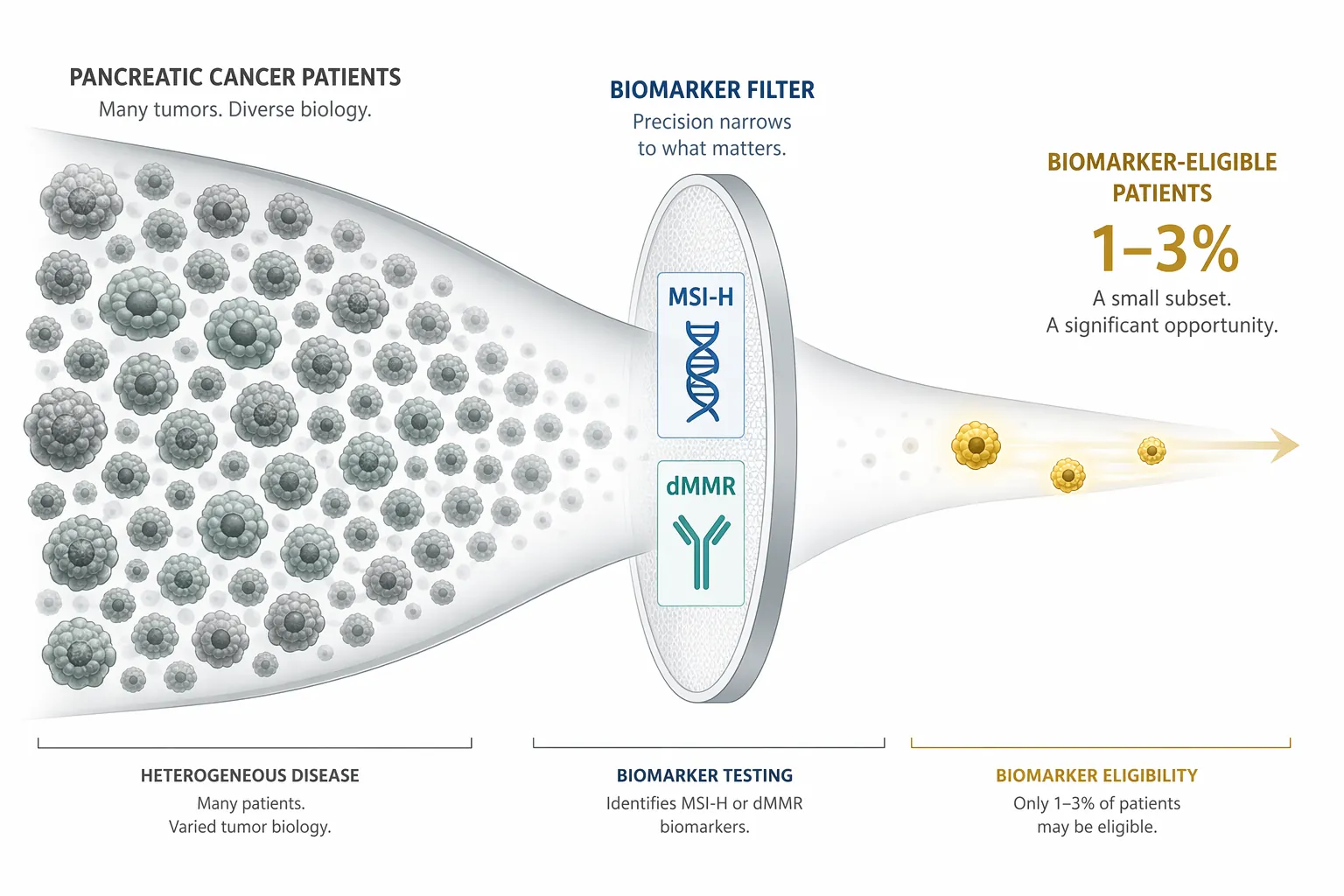
The Small Group Where Immunotherapy Can Matter
MSI-H means microsatellite instability-high. dMMR means deficient mismatch repair. In plain terms, these tumors have problems repairing DNA errors. That can make them more visible to the immune system and more vulnerable to drugs that release immune checkpoints.
For families sitting in an oncology visit, the important point is not the vocabulary itself. It is whether the pathology report or molecular testing report actually says MSI-H, dMMR, or another immunotherapy-relevant marker. If no one has looked, the family does not yet have the answer.
The reason this testing deserves attention is that the eligible subgroup is not just a technical exception. In a European cohort of MSI-H/dMMR advanced pancreatic adenocarcinoma, immune checkpoint inhibitors produced a 48.4% objective response rate and a median progression-free survival of 26.7 months.[3] Those numbers are not a promise to any one person, and they come from a biomarker-selected group. But they are strong enough to change the conversation when the biomarker is present.
This is where a caregiver should be careful with language. “Pancreatic cancer responds to immunotherapy” is too broad. “MSI-H or dMMR pancreatic cancer may respond to checkpoint immunotherapy” is closer to what the evidence supports. That smaller sentence is less exciting, but it is more useful in an appointment.
Why Most Pancreatic Tumors Do Not Respond the Same Way
Most pancreatic cancers are not MSI-H or dMMR. They also tend to have features that make checkpoint inhibition less effective: dense desmoplastic stroma around the tumor, a relatively low mutation burden, and KRAS-driven immune evasion are all part of the resistance picture described in current reviews of pancreatic cancer immunotherapy.[4][5]
In practical terms, the immune system may not see enough abnormal targets, immune cells may have trouble getting into the tumor, and the tumor environment may actively suppress the immune attack. This is why a drug class that sounds similar across cancers can behave very differently from one diagnosis to another.
The disappointing results in non-selected pancreatic cancer are part of that reality. In the CheckPAC trial, nivolumab with or without ipilimumab plus stereotactic body radiation therapy in metastatic pancreatic ductal adenocarcinoma produced an objective response rate of 14%.[5] That result does not mean immunotherapy research should stop. It does mean families should be cautious when a headline implies that adding an immune drug automatically changes the outlook for an unselected pancreatic cancer patient.
For Seniors, Eligibility Is Only One Part of the Decision
Older adults are often described as if they are one treatment group. They are not. A 67-year-old walking several miles a day, an 82-year-old with mild kidney disease and excellent family support, and a 76-year-old losing weight with uncontrolled pain may all be “seniors,” but their treatment decisions are not the same.
This is why geriatric assessment belongs near the beginning of the conversation, not after every other option has been listed. A good assessment looks beyond age and asks about function, falls, cognition, nutrition, mood, medications, organ function, social support, symptoms, and what the person is trying to preserve. It helps determine whether treatment should be full intensity, dose-attenuated, trial-based, symptom-focused, or some combination.
The senior-specific evidence base is not as strong as families deserve. Fewer than 10% of National Cancer Institute clinical trial participants are age 70 or older, which means many treatment decisions for older adults are extrapolated from studies that did not include enough people like the patient in front of us.[1] That gap should make everyone more precise, not more pessimistic.
There is also a reason to discuss gentler chemotherapy strategies before chasing an experimental immune approach. In the GIANT trial, older adults receiving dose-attenuated chemotherapy had a median overall survival of about 8 months, described as comparable to full-dose treatment but better tolerated.[1] For a senior who does not have MSI-H or dMMR disease, standard chemotherapy or dose-attenuated chemotherapy may be the more realistic backbone than immunotherapy.
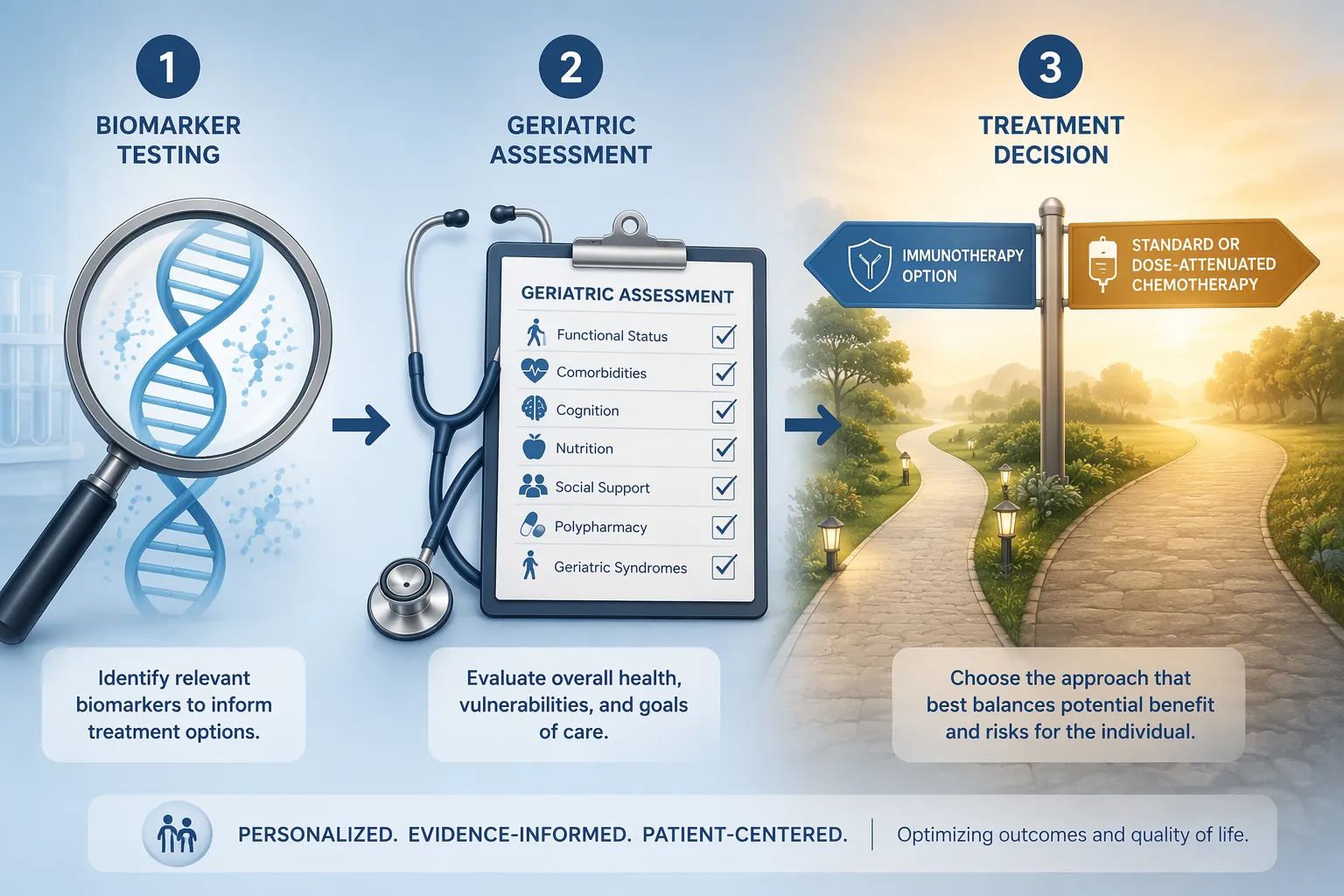
What to Ask Before the Next Oncology Visit Ends
The most useful questions are usually not broad ones like “Can we try immunotherapy?” A better sequence narrows the answer quickly and keeps the discussion tied to the person’s tumor and fitness.
- Has the tumor been tested for MSI-H and dMMR? If yes, where is that result in the report?
- Was broader molecular profiling done, including TMB-H and other potentially actionable alterations?
- If the tumor is MSI-H or dMMR, is pembrolizumab or dostarlimab appropriate in this specific situation?
- If the tumor is not MSI-H or dMMR, is there any reason to consider immunotherapy outside a clinical trial?
- Can we do a geriatric assessment before choosing treatment intensity?
- Would standard chemotherapy, dose-attenuated chemotherapy, supportive care, or a clinical trial best match the patient’s goals right now?
If the answer to biomarker testing is “not yet,” that is a concrete next step. If the answer is “negative,” the conversation should not linger on checkpoint inhibitors as if persistence alone makes them more likely to work. It should move to the best available standard treatment and, if appropriate, trials designed to overcome pancreatic cancer’s resistance.
The Trials Worth Understanding Without Confusing Them With Approved Options
For the large majority of seniors whose tumors are not MSI-H or dMMR, the question becomes whether an immunotherapy-based clinical trial is reasonable. That is different from asking whether immunotherapy is already a standard option. Trials have eligibility rules, travel demands, lab requirements, side-effect monitoring, and sometimes randomization. A trial can be promising and still not be the right fit for an older adult with frailty, uncontrolled symptoms, or a strong preference to stay close to home.
PRISM-1: Trying to Change the Tumor Environment
PRISM-1 is a Phase III trial studying quemliclustat, a CD73 inhibitor, combined with chemotherapy. The point of this approach is not simply to “add immunotherapy” but to interfere with immune-suppressive signaling in the tumor environment while chemotherapy attacks the cancer more directly.
The reason this trial is getting attention is that earlier Phase Ib data showed a 37% reduction in risk of death and a 5.9-month median overall survival improvement with quemliclustat plus chemotherapy. PRISM-1 is described as an actively recruiting Phase III trial with more than 600 participants.[6] Because trial status can change, families should ask the oncology team to verify whether it is recruiting at nearby centers at the time of the visit.
TACTOPS: Training T Cells Against Multiple Antigens
TACTOPS is a Phase 1/2 approach using multi-antigen T cell therapy after surgery. In reported results, the trial showed an 84.6% disease control rate, and some patients were disease-free beyond 5 years after surgery.[7] That is a signal worth respecting, especially because pancreatic cancer after surgery remains a high-risk setting.
It is also a good example of why the details matter. A post-surgery cellular therapy study is not the same option as a drug for widely metastatic disease. The patient has to fit the disease setting, timing, organ function, performance status, and trial logistics. For an older adult, the question is not only whether the science is promising. It is whether the whole treatment pathway is bearable and aligned with the person’s goals.
Personalized mRNA Vaccines: A Serious Research Direction, Not a Shortcut
Personalized cancer vaccines are another area families may hear about because the word “vaccine” travels quickly. Autogene cevumeran is being studied in the Phase II IMCODE003 trial, an ongoing personalized mRNA vaccine effort in pancreatic cancer.[8] The idea is to train the immune system against tumor-specific targets, rather than relying on a one-size-fits-all immune trigger.
This work is scientifically important, but it should not be heard as an available substitute for a tested treatment plan. Personalized vaccines often require tissue, sequencing, manufacturing time, and strict eligibility. For a senior with rapidly worsening symptoms, waiting may carry its own risk. For a fit older adult in the right disease setting, asking about availability may be reasonable.
| Situation | What it usually means for immunotherapy |
|---|---|
| MSI-H or dMMR tumor | FDA-approved checkpoint immunotherapy may be worth discussing directly. |
| TMB-H or other relevant molecular finding | Ask whether it changes eligibility for an approved drug or a trial. |
| No immunotherapy-relevant biomarker | Single-agent checkpoint immunotherapy is usually not expected to help outside a trial. |
| Fit older adult with trial access | A trial may be reasonable if the disease setting, logistics, and goals match. |
| Frailty, severe symptoms, or limited support | Dose-attenuated chemotherapy, symptom control, or closer-to-home care may be safer priorities. |
A Practical Appointment Sequence
When a family has one oncology visit and too many fears to carry, order helps. Start with the tumor. Then the person. Then the treatment.
- Confirm biomarker testing: MSI-H, dMMR, and whether broader profiling included TMB-H.
- If eligible biomarkers are present, ask which checkpoint inhibitor is appropriate and what response, side-effect, and monitoring expectations apply.
- If eligible biomarkers are absent, ask whether immunotherapy has any role outside a clinical trial.
- Request geriatric assessment or an equivalent structured review of function, nutrition, cognition, medications, organ function, symptoms, and support.
- Discuss the safest treatment backbone: standard chemotherapy, dose-attenuated chemotherapy, a trial, supportive care, or a staged plan that changes if tolerance is better or worse than expected.
- If a trial is mentioned, ask whether it is currently recruiting, where it is offered, what visits are required, and what would make the patient ineligible.
One hopeful word should not have to carry the whole family. Immunotherapy is rarely the answer for seniors with pancreatic cancer today. But biomarker testing and geriatric assessment are not small details. They are the steps that identify the rare patient with a real immunotherapy opening, and they protect everyone else from chasing a headline when a safer, more realistic plan is needed.
References
- A Delicate Balance: Treating Older Adults With Metastatic Pancreatic Cancer — Ioffe & Dotan, ASCO Post, 2024
- Immunotherapy for Pancreatic Cancer — PanCAN
- Efficacy of immune checkpoint inhibitors in MSI-H/dMMR advanced pancreatic adenocarcinoma: AGEO European Cohort — Taïeb et al., PubMed
- Pancreatic Cancer — Cancer Research Institute
- Updates in Immunotherapy for Pancreatic Cancer — PMC/NIH
- New Phase III Clinical Trial Actively Recruiting — Let's Win PC
- Immunotherapy honing in on multiple targets shows promise — Baylor College of Medicine
- Research Spotlight: A Look Ahead at Pancreatic Cancer in 2026 — PanCAN
Browse more in the Glossary.