
Clinical term
Is Lettuce Safe for Seniors During the Cyclospora Recall?
Last verified 2026-07-30
Last verified: July 30, 2026. The cyclospora recall is still changing, so check CDC.gov and FDA.gov before you shop or serve lettuce today.
Lettuce is not automatically unsafe for seniors during the cyclospora recall. Recalled iceberg lettuce, prepared foods made with recalled iceberg lettuce, and any iceberg lettuce whose origin you cannot confirm should not be served. For an older adult, the safer move is to clear the uncertain items from the refrigerator now, use cooked greens or lower-risk fresh options for the next meal, and watch closely for diarrhea-related dehydration.
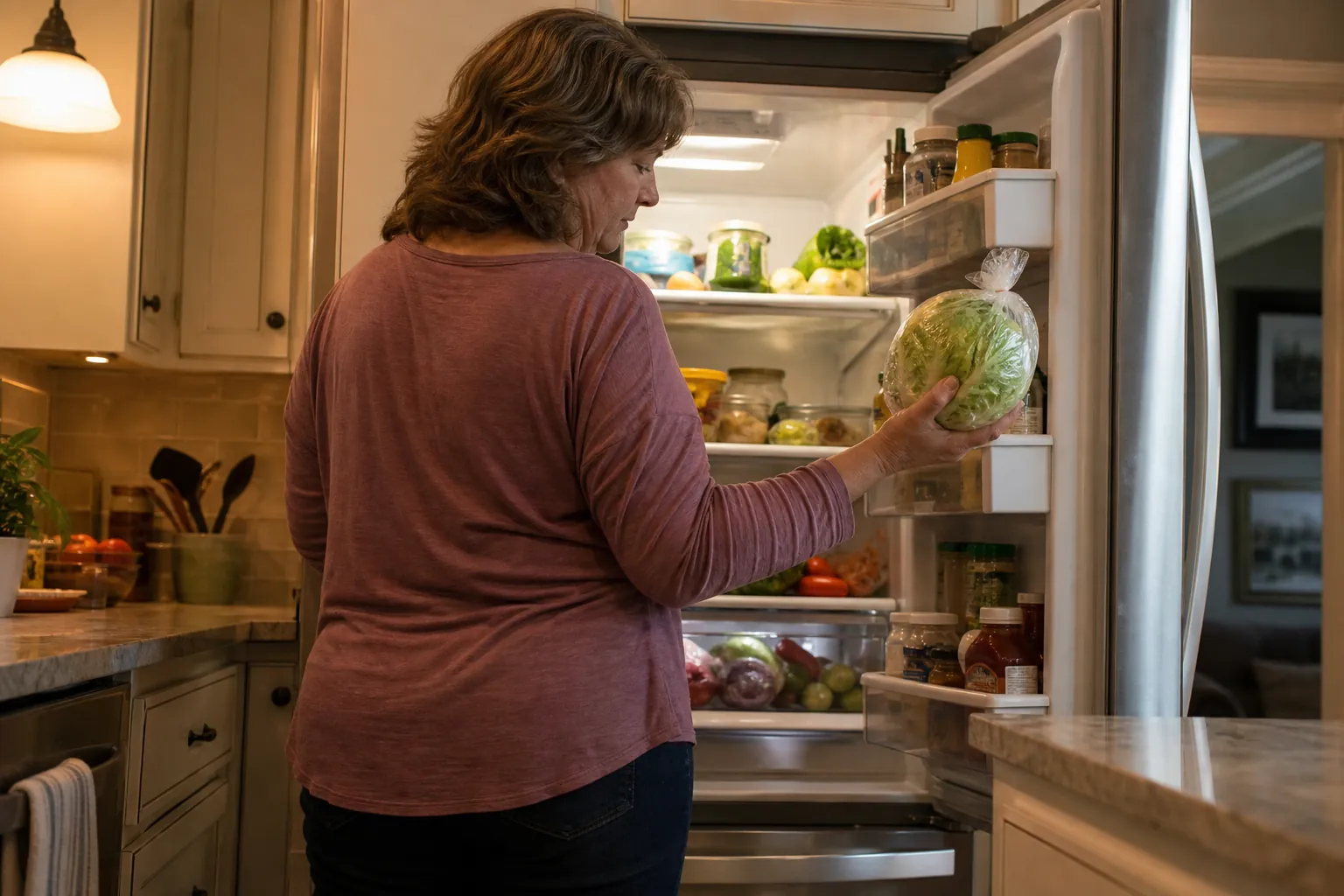
That last part matters as much as the food recall itself. In older adults, diarrhea can turn into weakness, dizziness, confusion, missed medications, and a fall long before anyone thinks of it as an emergency. The infection is the headline; dehydration is often the household crisis.
Start With the Refrigerator, Not the Parasite
The current recall points to Taylor Farms de Mexico iceberg lettuce linked to a multistate cyclospora outbreak. Reports as of July 2026 identify affected products in 28 states, including Marketside brand products sold at Walmart and lettuce used in some Taco Bell and Jack in the Box products.[1][2][3]
For a caregiver trying to make lunch, the practical rule is plain: if the lettuce is iceberg and you cannot confirm it is outside the recalled supply, discard it. Do not taste it. Do not serve it to the older adult while you look for the receipt. Do not assume a salad kit, sandwich topping, fast-food item, or prepared tray is safe just because it is not sitting in the produce drawer.
- Check bags, clamshells, salad kits, shredded lettuce, chopped iceberg, and prepared salads.
- Look for Taylor Farms de Mexico, Marketside at Walmart, and any store or restaurant notices tied to iceberg lettuce.
- Throw out iceberg lettuce when the origin is missing, unclear, or no longer attached to the packaging.
- Clean the refrigerator drawer or container where the recalled lettuce sat, especially if leaves or liquid touched other foods.
- If an older parent already ate a recalled item, do not panic; start symptom monitoring and make fluids easier to reach.
This is not a reason to remove all vegetables from an older adult’s diet. It is a reason to be strict about this recall, this lettuce type, and this uncertain packaging.
What to Serve Instead
If greens are still on the menu, cooked options are the simplest risk-reduction choice. Cooking food to 158°F, or 70°C, kills Cyclospora cayetanensis, the parasite that causes cyclosporiasis.[4][5]

For raw greens, choose the option with the fewest mysteries. A whole head of lettuce washed at home is generally easier to inspect than a bag of pre-cut lettuce, and experts have noted that cyclospora can resist chlorine-based commercial sanitizing used in produce processing.[6][7] Locally grown produce may also reduce some handling and processing steps, though it is not a guarantee of safety.[6][8]
| If you have this | Safer decision for a senior during the recall |
|---|---|
| Recalled iceberg lettuce | Discard it. |
| Iceberg lettuce with no clear origin | Discard it. |
| Prepared salad, sandwich, taco, or fast-food item with iceberg lettuce | Check the seller’s recall notice; discard if uncertain. |
| Whole head of non-recalled lettuce | Wash under running water at home and inspect before serving. |
| Cooked greens or cooked vegetables | Use these when you want the lowest-effort substitute. |
Washing produce is still worth doing, but it should not be treated as a rescue plan for recalled lettuce. If the product is recalled or its source cannot be confirmed, the answer is the trash.
The Symptoms That Matter Most in Older Adults
Cyclospora infection often causes watery diarrhea, and symptoms can last long enough to wear down an older adult’s fluid balance. For seniors, the concern is not only the infection; it is the dehydration that can follow prolonged diarrhea, including electrolyte problems, acute kidney injury, weakness, dizziness, and falls. Dr. Luis Marcos of Stony Brook Medicine emphasized this dehydration pathway in AARP’s guidance for older adults.[9]

Call a clinician if diarrhea lasts more than 2 to 3 days, or sooner if it is severe, including more than 6 to 8 episodes in a day.[9][10] That threshold should be lower in practice if the person is frail, lives alone, has kidney disease, takes diuretics, has diabetes, or already has balance problems.
Watch for dehydration signs that can look ordinary until they are not: excessive thirst, dry mouth, little or no urination, dark-colored urine, weakness, dizziness, lightheadedness, fatigue, and confusion.[9] Confusion and dizziness are especially tricky in a parent who already has memory changes, neuropathy, low blood pressure, or a slow gait. A small change from their usual baseline may be the sign that matters.
- Are they getting up more often to use the bathroom, especially at night?
- Are they grabbing furniture, walls, or the counter when they walk?
- Are they sleepier, more irritable, or more confused than usual?
- Are they urinating less than usual, or is the urine noticeably darker?
- Have they skipped pills because of nausea, urgency, or fear of leaving the bathroom?
For fall prevention, treat the bathroom route as part of the illness plan. Clear the path, turn on night-lights, put a stable chair nearby if they get winded, and keep a phone within reach. CareWise Guide’s guidance on dehydration-related dizziness and falls during heat waves is useful here too, because the mechanism is similar: fluid loss can quickly become unsteadiness.
When to Seek Emergency Care
Seek emergency care for bloody stool, persistent vomiting, high fever, severe abdominal pain, or inability to keep fluids down.[9][10] Also escalate quickly if the older adult is too weak to stand safely, seems newly confused, faints, has chest pain, or cannot get to the bathroom without nearly falling.
Do not wait for the diarrhea to look dramatic if the fall risk is already obvious. A parent who is dizzy, dehydrated, and rushing to the bathroom is already in a danger zone.
Medication Review Is Part of the Call
Treatment decisions belong to the clinician, but caregivers can make that visit safer by bringing an accurate medication list. The standard antibiotic treatment for cyclosporiasis is trimethoprim-sulfamethoxazole, or TMP-SMX, and AARP’s report notes that it can interact with blood thinners such as warfarin, sulfonylurea diabetes medications, and potassium-affecting drugs.[9]
That is not a reason to refuse treatment. It is a reason to say, clearly, “Please review these medications before prescribing.” Include prescription drugs, over-the-counter pain relievers, supplements, potassium pills, diuretics, blood pressure medicines, diabetes medicines, and any recent medication changes.
A Calm Boundary for Today’s Meal
If the lettuce source cannot be confirmed, toss it. If greens are still wanted, use cooked vegetables, a whole head of non-recalled lettuce washed at home, or local produce when appropriate. If diarrhea persists beyond 2 to 3 days, becomes severe, or is paired with dehydration signs, call a clinician. If there is bloody stool, persistent vomiting, high fever, severe abdominal pain, inability to keep fluids down, fainting, or unsafe weakness, seek emergency care.
References
- Investigation Update: Cyclospora Outbreak, CDC, July 2026
- Investigation of 9-State Outbreak of Cyclospora Illnesses: Iceberg Lettuce, July 2026, FDA, July 2026
- Taylor Farms Pulls Mexican Lettuce Linked to Cyclospora Parasite, Consumer Reports
- Preventing Cyclosporiasis, CDC
- Cyclospora, FDA
- Cyclosporiasis expert Q&A, Stanford Medicine, July 2026
- Can you eat lettuce safely during the cyclospora outbreak? Advice from an infectious disease expert, PBS / The Conversation
- You Shouldn’t Avoid Fruits and Vegetables Due to Cyclospora, Consumer Reports
- What Older Adults Should Know About Cyclospora, AARP
- Cyclosporiasis Outbreak 2026, Johns Hopkins Medicine
Browse more in the Glossary.