
Clinical term
Can Ivermectin Treat Demodex Blepharitis in Seniors?
Last verified 2026-07-30
An older parent who keeps saying “my eyes are just tired” may be describing something more specific than fatigue. Itchy lids, crust at the lash line, burning, light sensitivity, and blur that comes and goes can be signs of Demodex blepharitis, especially when the usual dry-eye routine has not helped. In seniors, this is not an exotic possibility: Demodex mite prevalence rises sharply with age, reaching more than 80% in people over 60 and becoming nearly universal in people over 70 in review data.[1] Cleveland Clinic’s patient guidance also describes Demodex blepharitis as more common in older adults.[2]
That matters because families often meet this condition late. In a psychosocial impact study, 58% of people with Demodex blepharitis had not received the correct diagnosis despite symptoms for a median of at least 4 years.[3] Four years is a long time to live with blurred vision, gritty eyes, and eyelid irritation while being told, or assuming, that it is just dry eye.

What Demodex Blepharitis Looks Like at the Lash Line
Demodex mites are tiny organisms that live around hair follicles and oil glands. The problem is not simply that mites exist; many adults have them. The problem is when they contribute to inflammation at the eyelid margin. Eye doctors often look for collarettes, the sleeve-like crusts or cylindrical dandruff wrapped around the base of eyelashes. Collarettes are useful because they are visible during an eye exam and can be counted before and after treatment.
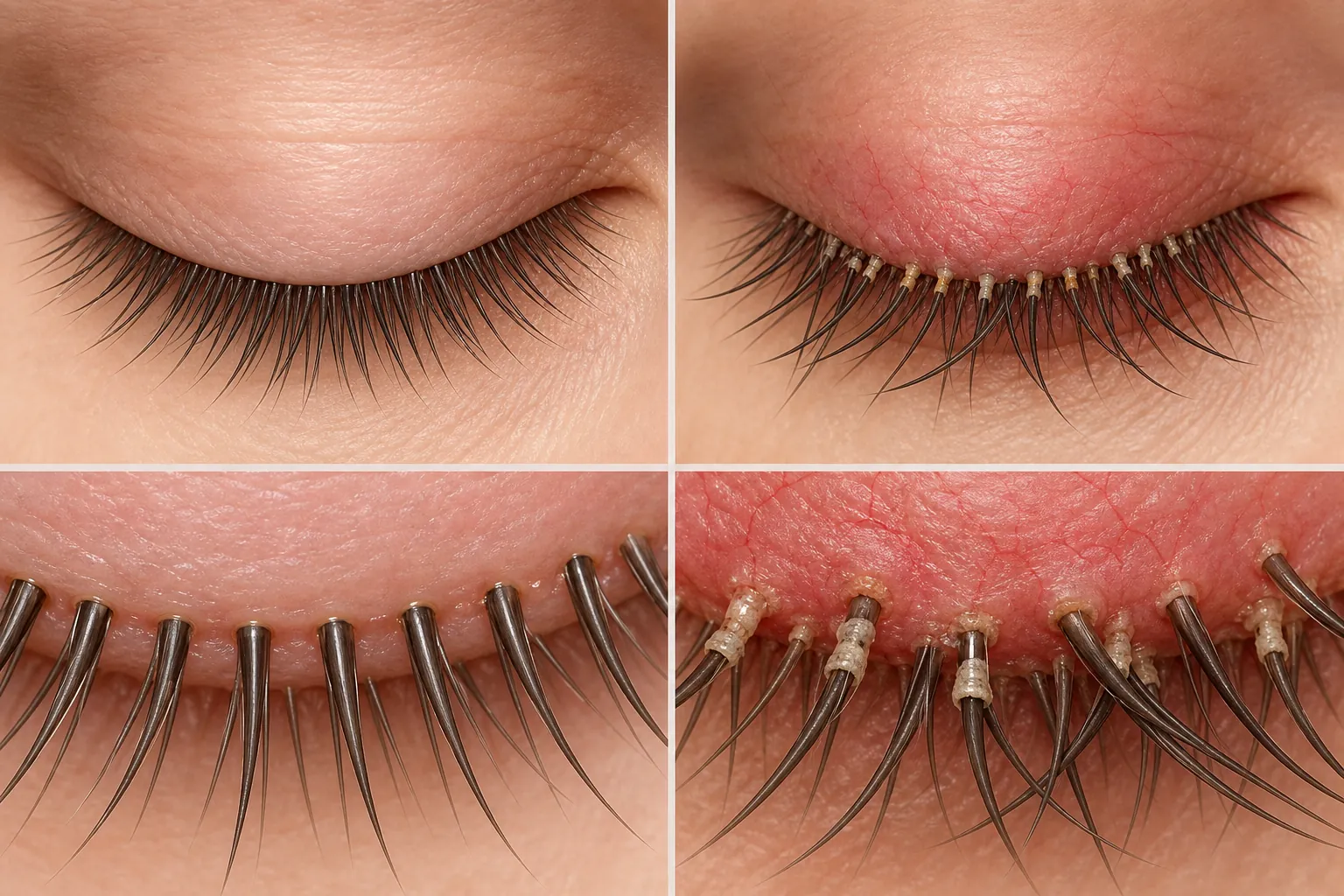
A few terms are worth translating before comparing treatments. Tear-film instability means the thin layer of moisture over the eye breaks up too quickly, so vision may clear after a blink and blur again moments later. Photophobia means light sensitivity. Meibomian gland dysfunction, often shortened to MGD, means the eyelid oil glands are not working well; Demodex infestation is reported in 85% of MGD patients compared with 34% of healthy controls in a comprehensive review.[1]
Those details sound small until someone is walking down a dim hallway, stepping off a curb, or driving at dusk. A senior does not need total vision loss for vision to become unreliable. Fluctuating blur can be enough to make edges, steps, and obstacles harder to judge.
Can Ivermectin Treat Demodex Blepharitis in Seniors?
Topical ivermectin 1% cream can be effective for Demodex blepharitis, including in an older adult population, but this is an off-label use. The cream is FDA-approved for rosacea, not as an ophthalmic eyelid treatment. That does not mean it is automatically inappropriate; it means the decision belongs with an eye doctor who can examine the lid margin, explain application instructions, and weigh risks for the individual patient.
The most concrete ivermectin evidence comes from a retrospective study of 75 patients with a mean age of 66.6 years. Patients applied topical ivermectin 1% cream nightly to the lid margins for 3 months. Median collarette count fell from 8 to 0, visible mite tails were eliminated, fluorescein staining severity improved, no serious side effects were reported, and improvement was sustained at 12-month follow-up.[4]
That before-and-after change is hard to ignore because it describes something the eye doctor can actually see at the lashes. Still, the study design matters. It was retrospective, not a large randomized controlled trial. It was not a senior-exclusive trial. And the product was being used off-label near the eyes, where irritation, incorrect placement, or accidental ocular exposure would matter more than on ordinary facial skin.
How XDEMVY Changes the Conversation
XDEMVY, the brand name for lotilaner ophthalmic solution, is different because it is FDA-approved for Demodex blepharitis. The FDA approved it in 2023, and its pivotal Saturn-1 and Saturn-2 trials included 833 patients; 62% were age 65 or older.[5]
The age-subgroup data are especially relevant for families making decisions for an older parent. In Saturn-1, collarette cure was 41.5% in patients 65 and older and 47.7% in patients younger than 65. In Saturn-2, collarette cure was 55.2% in patients 65 and older and 53.5% in patients younger than 65.[5] That does not make every individual response predictable, but it does mean older adults were not an afterthought in the approval data.
| Question | Topical ivermectin 1% cream | XDEMVY |
|---|---|---|
| Regulatory status | Off-label for eyelid/Demodex blepharitis use; FDA-approved for rosacea | FDA-approved for Demodex blepharitis |
| Main evidence in this brief | Retrospective 75-patient study with mean age 66.6 years | Saturn-1 and Saturn-2 pivotal trials with 833 total patients |
| Older adult relevance | Older average age in the study, but not a senior-only trial | 62% of trial participants were 65 or older |
| Practical access issue | Often discussed because generic cream may be less expensive, but instructions must be clinician-guided | Approved ophthalmic product, but insurance coverage and out-of-pocket cost can vary |
| How to frame it with the doctor | “Is off-label lid-margin ivermectin reasonable for this person?” | “Is the FDA-approved drop covered and appropriate for this person?” |
This is not a clean winner-takes-all comparison. XDEMVY has the stronger regulatory footing and larger trial base in older adults. Topical ivermectin has promising clinical results and may be easier for some patients to access financially, but it carries the extra step of an off-label discussion. A treatment that cannot be filled, used correctly, or tolerated is not much of a plan; neither is a cheaper option used casually near the eye without examination and instructions.
Why This Eye Problem Belongs in a Fall-Risk Conversation
No study cited here directly proves that treating Demodex blepharitis reduces falls. That caveat is important. The stronger statement is more practical and narrower: untreated Demodex blepharitis can worsen vision quality through tear-film instability, fluctuating blur, photophobia, and foreign body sensation, and unreliable vision can make home hazards harder for an older adult to detect.

The chain is easy to picture. Inflamed lids and mite-related debris disturb the tear film. The tear film breaks up, so vision shifts between clear and hazy. Bright light becomes uncomfortable. The person blinks, squints, reaches for the wall, or avoids turning on harsh lights. At home, that can affect how quickly they notice a rug edge, stair shadow, pet bowl, threshold, or low contrast step.
This is where an eye condition becomes a household safety issue without pretending that mites directly cause falls. Treatable vision impairment is one modifiable factor among many. If an older adult is already furniture-walking, hesitating on stairs, or saying their eyes are tired while moving through the house, treating the eyelid disease and reviewing the home environment belong in the same care conversation. A room-by-room review, such as the home safety assessment checklist, can help families look for lighting, trip hazards, and bathroom risks while the eye doctor addresses the medical cause.
What Not to Assume From Dry-Eye Treatment
Artificial tears, warm compresses, and lid hygiene may still have a place, especially when dry eye or meibomian gland dysfunction is also present. But they do not always remove the root cause when Demodex is driving the inflammation. If symptoms keep returning, the useful question is not “Have we tried enough wipes?” but “Did someone actually look for collarettes or mites at the lash base?”
Oral ivermectin is sometimes discussed in ocular demodicosis, but it is a different kind of decision. The dosing noted in treatment references is 200 mcg/kg as a single dose repeated after 7 days, and it carries a broader side-effect profile and requires caution with anticoagulants.[6] For an older adult taking multiple medications, that is not a casual substitute for an ophthalmic plan.
Questions to Bring to the Eye Doctor
The appointment does not need to sound like a family member prescribing from the internet. It can be a short, specific conversation about what was seen and which treatment fits the person in the chair.
- “Do the symptoms and exam suggest Demodex blepharitis, or is this mainly dry eye, allergy, infection, or another eyelid problem?”
- “Did you see collarettes at the base of the lashes, and can we use them to track whether treatment is working?”
- “Is XDEMVY appropriate, and do we know whether this person’s insurance is likely to cover it?”
- “If cost or access is a problem, is off-label topical ivermectin 1% cream a reasonable option for this patient?”
- “Exactly where should the medicine go, how often should it be used, and what symptoms mean we should stop and call?”
- “When should we reassess the lids, vision symptoms, and walking confidence?”
For seniors, the treatment choice is rarely just a drug comparison. It is an evidence, safety, access, and follow-through decision. Ivermectin for Demodex blepharitis in seniors has promising off-label evidence, while XDEMVY has FDA approval and larger older-adult trial data. The right next step is an eye exam that names the problem clearly, checks whether mites and collarettes are actually present, and turns the answer into a treatment plan the patient can afford and use correctly.
References
- Demodex Blepharitis: A Comprehensive Review
- Demodex Blepharitis: What It Is, Symptoms & Treatment, Cleveland Clinic, medically reviewed May 2026
- Psychosocial Impact of Demodex Blepharitis
- Ivermectin Cream Effective Against Demodex Blepharitis, Review of Optometry
- Drug Trials Snapshots: XDEMVY, FDA
- Ocular Demodicosis Treatment & Management, Medscape
Browse more in the Glossary.