
Glossary entry
Are Georgia seniors affected by Medicare Advantage cuts?
Last verified 2026-07-30
This is not financial or legal advice. Medicare/Medicaid and benefits rules vary by state and change over time — verify current rules with your state Medicaid office or Area Agency on Aging.
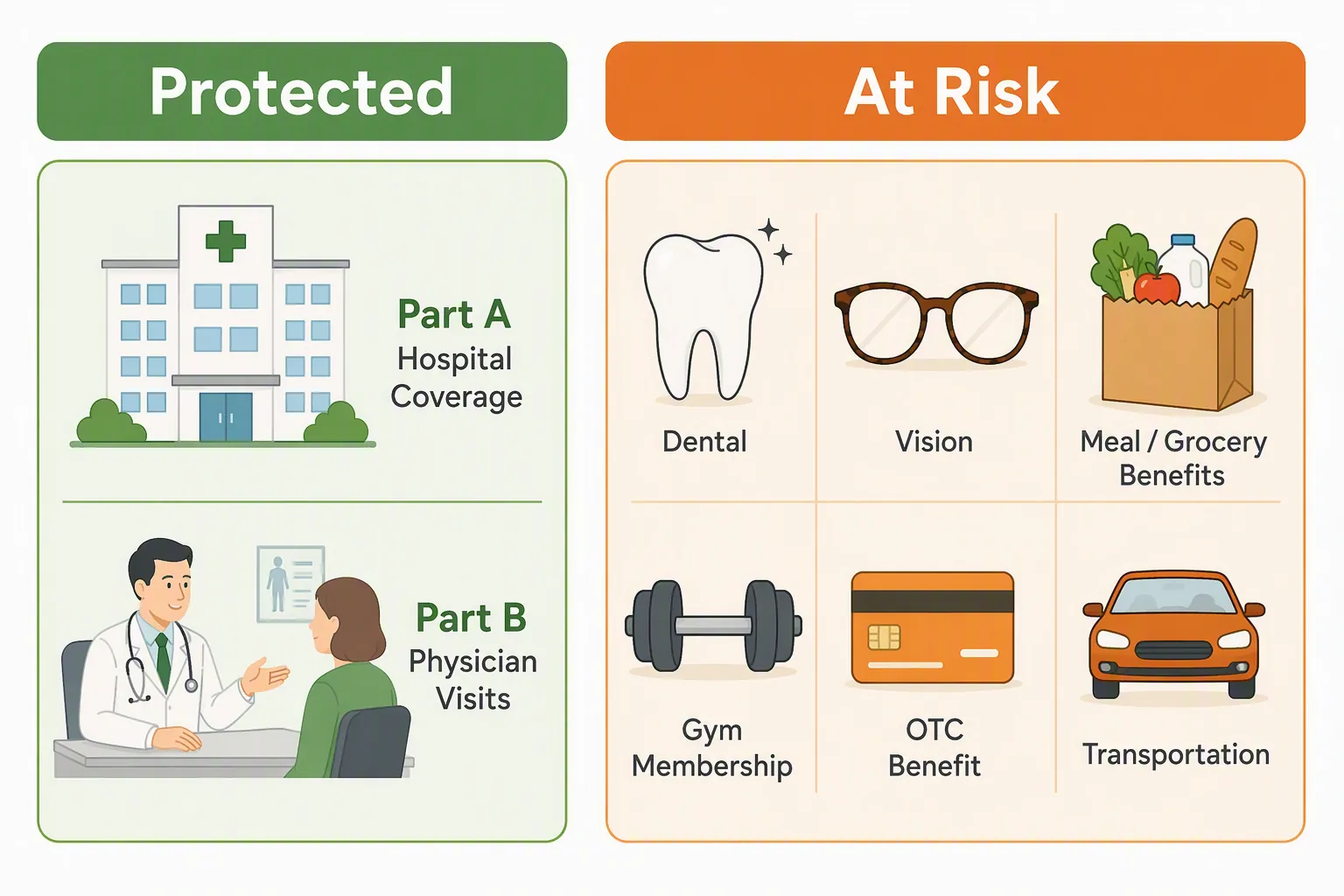
Yes, many Georgia seniors may be affected by Medicare Advantage cuts in 2027, but the first thing to separate is medical coverage from extras: Part A hospital coverage and Part B physician coverage are not the benefits being described in these reports; the pressure is on supplemental Medicare Advantage benefits such as dental, vision, gym memberships, meal delivery, grocery allowances, transportation credits, and over-the-counter benefit cards.[1]
Last verified: July 30, 2026. Because Medicare Advantage changes are plan-specific, this article should be treated as a document-review guide, not a statement that any one Georgia senior’s exact plan has already lost a specific benefit.
Which Georgia seniors are most likely to feel the Medicare Advantage cuts?
The highest-risk group is not “all seniors” in the same way. The people who need to read their mail most carefully are Georgia seniors enrolled in Medicare Advantage plans that have been relying on rich supplemental benefits, especially Humana members and people enrolled in Special Needs Plans.
Georgia is unusually exposed because Medicare Advantage is not a small side market here. The state has more than 760,000 Medicare Advantage enrollees, representing 55.3% of Medicare-eligible residents, and roughly one-third could be directly affected by benefit reductions discussed for 2027.[2]
Humana deserves special attention in Georgia because the company’s footprint is large. Georgia has about 336,617 Humana Medicare Advantage enrollees, making it the third-highest Humana Medicare Advantage state.[2] That does not mean every Humana member in Georgia will lose the same benefit. It does mean that if Humana trims dental allowances, meal support, transportation, OTC cards, or similar extras in particular counties or products, a large number of Georgia households will be reading those changes at the kitchen table.
Special Needs Plan members also need extra care. Thirty percent of Georgia’s Medicare Advantage enrollment is in Special Needs Plans, compared with 23% nationally, and those plans often serve people who are dual-eligible for Medicare and Medicaid or who have chronic conditions.[3] For these members, a change in transportation, food support, care coordination, or drug coverage is not a lifestyle inconvenience. It can affect whether a person gets to appointments, fills prescriptions on time, or has help after a hospitalization.
What is actually being cut?
The likely 2027 pressure is on the add-on benefits that made many Medicare Advantage plans attractive in the first place. These are the items that tend to appear in brochures in bright boxes: dental coverage beyond basic limits, vision allowances, hearing-related extras, gym memberships, post-hospital meal delivery, grocery or healthy food allowances, transportation credits, and OTC cards.[1]
| Benefit area | What Georgia seniors should check |
|---|---|
| Hospital and physician coverage | Do not assume Part A and Part B medical coverage is being removed because a plan reduces extras. |
| Dental | Look for lower annual allowances, fewer covered services, different networks, or higher cost sharing. |
| Vision and hearing extras | Check allowance amounts, frequency limits, and whether preferred vendors changed. |
| Meals or grocery support | Confirm whether the benefit still exists, whether eligibility narrowed, and whether the dollar amount changed. |
| Transportation | Check ride limits, service area rules, and whether medical-trip credits were reduced. |
| OTC card | Compare the 2026 card amount and eligible items with the 2027 notice. |
The mistake to avoid is hearing “Medicare Advantage cuts” and assuming the plan is taking away every form of care. The other mistake is hearing “your premium is still low” and assuming the plan stayed the same. A zero-dollar or low-premium plan can still become thinner if the dental allowance shrinks, the OTC card is reduced, or post-hospital meals disappear.
Why are insurers talking about 2027 benefit reductions?
The short version is that Medicare Advantage insurers say the federal payment increase for 2027 does not keep up with their medical cost trend. CMS approved a 2.48% payment increase for 2027, and Humana CEO Jim Rechtin said on the company’s April 29, 2026 earnings call that the increase was insufficient to cover rising medical costs, forcing benefit reductions.[4]
That explanation matters because it tells members why the letters may look different this fall. It should not be allowed to blur the practical question. A Georgia enrollee still needs to know: What changed in my county, in my plan, for my dentist, my pharmacy, my ride benefit, and my out-of-pocket costs?
It is also worth separating two different cycles. Some 2026 stories focused on plan-count reductions or counties losing certain options. The 2027 concern discussed here is more about benefit-thinning inside remaining Medicare Advantage plans. Those are different problems. One asks whether a plan is still offered; the other asks whether the plan still offers the extras a member counted on.
Does a lower premium mean Georgia seniors are safe from cuts?
No. A lower premium can make a plan look stable while other parts of the benefit package get leaner. In Georgia, the average Medicare Advantage premium dropped to $6.74 per month in 2026 from $13.76 in 2025.[5] That is useful for monthly budgeting, but it does not prove the dental allowance, transportation benefit, grocery support, or OTC card stayed equally strong.
For a senior on a tight income, the monthly premium is only one line. If the plan saves a few dollars on premium but removes a benefit that covered dental work, rides to appointments, or meals after discharge, the household budget can still come out worse.
What should Georgia Medicare Advantage members do next?
Start with the Annual Notice of Change, not with a television ad, a neighbor’s plan, or a sales call. The ANOC is the document that tells you how your current plan will change for the next year.
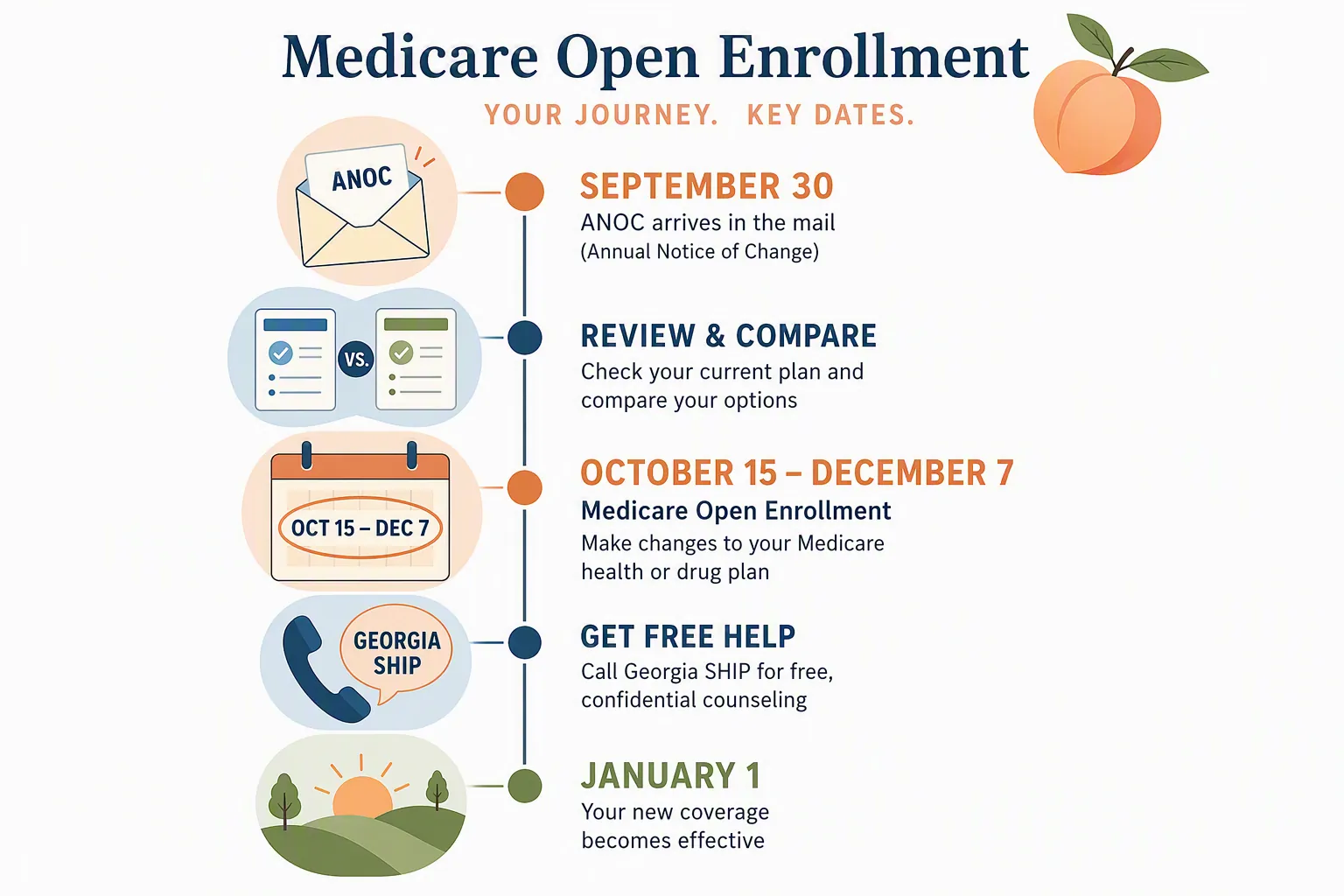
- Watch for the Annual Notice of Change by September 30. Put it beside the plan documents or benefit summary you used in 2026.
- Compare benefits line by line. Do not only check the premium. Look at dental, vision, hearing, meals, grocery support, transportation, OTC card amounts, drug coverage, copays, maximum out-of-pocket limits, provider networks, and pharmacy rules.
- Use Medicare open enrollment from October 15 through December 7 if you need to change plans for 2027. Changes made during that window take effect January 1, 2027.
- If you leave a Medicare Advantage plan or your plan is no longer available, confirm whether you will have Part D prescription drug coverage. Missing that step can create a costly prescription gap.
- Call Georgia SHIP at 866-552-4464 for free counseling before making a final decision, especially if you have Medicaid, a chronic condition, expensive prescriptions, or several doctors.
The prescription drug step deserves its own warning. Seniors who miss open enrollment after a plan termination can risk being moved into Original Medicare without Part D prescription drug coverage, depending on the situation.[6] That is not a small paperwork error for someone taking heart medication, insulin, anticoagulants, inhalers, or specialty drugs.
Georgia SHIP is the State Health Insurance Assistance Program, and its role is counseling rather than selling a plan. Georgia lists SHIP counseling through the state aging services office and provides the 866-552-4464 contact number for Medicare help.[7] For families sorting through a parent’s mail, that distinction matters. A free counselor can help compare options without earning a commission from the choice.
A practical way to read the ANOC
Do not read the ANOC like a brochure. Read it like a change order. Make a two-column sheet: “2026 benefit I used” and “2027 benefit listed.” If the senior never used the gym benefit but depends on dental, transportation, and a particular pharmacy, spend your energy there.
- Circle every dollar amount that changed.
- Underline any phrase such as “prior authorization,” “network,” “maximum,” “allowance,” “quarterly,” “copay,” or “not covered.”
- Call the dentist, doctor, pharmacy, and preferred hospital system directly if the network language is unclear.
- Check whether drug tiers, preferred pharmacies, or mail-order rules changed.
- Save the ANOC, Evidence of Coverage, and any notes from phone calls in one folder.
A hypothetical example shows why this matters: if a senior’s premium stays low but the dental allowance falls, the OTC card is smaller, and the preferred pharmacy changes, the plan may cost more in real life even though the monthly bill looks comfortable. The only way to catch that is to compare the actual benefits the person uses.
Should Humana members in Georgia switch plans?
Not automatically. Humana members in Georgia should pay close attention because the company’s Georgia enrollment is large and because Humana has publicly discussed 2027 Medicare Advantage benefit adjustments.[2][4] But switching just because a headline says “cuts” can create a different problem if the new plan does not include a key doctor, drug, hospital, dentist, or pharmacy.
As of July 30, 2026, plan-specific details may be more concrete than earlier company-wide reporting. A member should not rely on a general statewide statement when the relevant question is county, plan name, benefit package, provider network, and prescription list. If your ANOC has arrived, it outranks every general article.
What if the most important benefit is dental, meals, transportation, or an OTC card?
Treat that benefit as a decision point, not as a nice extra. Many seniors chose Medicare Advantage because those supports solved real problems: a dental bill they could not absorb, a ride they could not arrange, meals after a hospital stay, or an OTC card that stretched a fixed income. If one of those benefits is the reason the plan works, it belongs at the top of the comparison.
For Special Needs Plan members, the review should be even more careful. If a plan coordinates Medicaid-related services, chronic-condition care, transportation, or food support, ask Georgia SHIP or another qualified counselor to help read the notice before changing anything. A plan with weaker extras may still be better than an alternative that disrupts doctors, drugs, or care coordination.
Are Georgia seniors affected even if their plan is not Humana?
Possibly. Humana is the most obvious Georgia watch point because of its large enrollment and public comments, but the broader Medicare Advantage market has been under pressure. National reporting has described insurers considering reductions in extra benefits for 2027.[1] A non-Humana member should still read the ANOC instead of assuming the issue belongs to someone else.
The safest rule is simple: if you are in any Medicare Advantage plan in Georgia, verify your own 2027 benefits before December 7. The state’s high Medicare Advantage enrollment means the issue is widespread enough to deserve attention, but the final answer is still found in the member’s own documents.
What should adult children and caregivers do for a parent in Georgia?
If you help a parent with Medicare mail, ask for the ANOC before the fall rush. Do not wait until Thanksgiving week, when call centers are busy and family schedules get crowded. Put the plan name, member ID, doctors, pharmacy, prescriptions, and most-used extras on one page before calling anyone.

The phone calls go better when they are specific. Instead of asking, “Is this plan still good?” ask, “Is her dentist in network for 2027?” “What is the OTC card amount?” “Are post-hospital meals still covered?” “Are her three prescriptions on the formulary, and at which tier?” “Is her cardiologist still in network?” Keep notes with dates, names, and confirmation numbers when available.
The bottom line for Georgia seniors
Georgia seniors are affected in a meaningful way because the state has heavy Medicare Advantage enrollment, a large Humana presence, and a higher-than-national share of Special Needs Plan enrollment.[2][3] The cuts being discussed are mainly about supplemental extras, not the basic existence of Medicare hospital and physician coverage.
Panic is not useful. Guessing is not useful. The next step is to read the Annual Notice of Change, identify which benefits changed, compare options during the October 15 to December 7 open enrollment window, confirm prescription drug coverage, and use Georgia SHIP before relying on sales calls or rumor. This article is informational only and is not financial, legal, or individualized insurance advice.
References
- Medicare Advantage health plans may cut extra benefits in 2027, Reuters.
- Georgia faces major Medicare Advantage benefit reductions, Ledger-Enquirer, May 2026.
- Medicare Advantage in 2026: Enrollment Update and Key Trends, KFF, June 2026.
- Humana to adjust Medicare Advantage benefits in 2027 as funding gap widens, CEO says, Becker's Payer, April 2026.
- Georgia Medicare Plans in 2026, Healthline, 2026.
- Will Your County Lose Medicare Advantage Coverage in 2026?, Investopedia.
- Georgia SHIP, Georgia SHIP.
Browse more in the Glossary.