
Glossary entry
What the Medicare Part D Subsidy Cut Means for Your 2027 Costs
Last verified 2026-07-30
This is not financial or legal advice. Medicare/Medicaid and benefits rules vary by state and change over time — verify current rules with your state Medicaid office or Area Agency on Aging.
Here is the plain answer on Medicare drug plan subsidy cuts: the Part D Premium Stabilization Demonstration ends after 2026, the 2027 national base beneficiary premium is $41.33, and that does not mean every senior’s drug plan premium is going up by exactly $2.34 a month. The $41.33 figure is up from $38.99 in 2026, a 6% increase, and CMS announced it on July 28, 2026. Plan-specific 2027 premiums are not available yet; those are expected with the 2027 plan information in September 2026. [1]
Last verified: July 30, 2026. This article is educational information, not medical, legal, or financial advice. Before changing coverage, check your own plan documents, Medicare.gov, or a trusted Medicare counselor.

Is my Medicare Part D premium going up in 2027?
Maybe. Some people may see a higher monthly premium, some may see little change, and some may even find a lower-premium plan if they compare their choices during Open Enrollment. What you should not do is take the $41.33 national base premium and assume it is your bill.
CMS says most enrollees are expected to see less than $10 added to their monthly premiums, with many seeing no change or lower premiums. That is useful to know, but it is still an administration statement made before final plan-level premiums are public. The amount that matters at the kitchen table is the amount printed on your own plan’s 2027 materials. [1]
The national base beneficiary premium is used in the Part D premium calculation. It is not a price tag that every plan must charge. A plan’s premium can land above or below that figure because plans differ in drug coverage, bids, formularies, pharmacy networks, deductibles, and whether they are standalone prescription drug plans or part of Medicare Advantage coverage.
Why a 6% base-premium increase can still mean very different bills
The Inflation Reduction Act limits growth in the national base beneficiary premium to 6% through 2029, which is why the base premium moves from $38.99 to $41.33 for 2027. That cap applies to the national base figure, not to every plan’s listed monthly premium. [1]
That distinction is where people get tripped up. One plan could raise its premium more than the base increase. Another could hold fairly steady. Another might lower the premium but change a formulary, preferred pharmacy arrangement, or cost-sharing pattern in a way that still costs you more over the year. A lower premium is not automatically a cheaper plan if your medicines move to a higher tier or your regular pharmacy is no longer preferred.
So the first answer is cautious: the subsidy cut matters, but your actual 2027 cost cannot be read from the national base premium alone.
What subsidy is ending?
The program ending after 2026 is the Medicare Part D Premium Stabilization Demonstration. It was a Biden-era demonstration that gave participating drug plans extra support to help limit premium increases while other Part D changes were taking effect. The Trump administration announced that the demonstration would not continue into 2027. [1]
For a person enrolled in a drug plan, the mechanics are less important than the timing. CMS said nearly all standalone Part D beneficiaries were in plans that opted into the demonstration in 2026, which means the removal of that premium-stabilization support first shows up in the 2027 premium-setting cycle. [2]
That does not give anyone permission to guess a precise 2027 premium today. It does mean the 2027 Annual Notice of Change deserves a careful read, even if your plan was comfortable in 2026.
The bigger warning: fewer Part D plans and wider variation
The premium subsidy ending is the headline. The shrinking menu of plans is what can make the headline harder on actual people.
Avalere found that standalone prescription drug plan choices dropped 22% for 2026, from 464 plans to 360 plans, after a 35% drop the prior year. That is not a forecast for 2027. It is evidence that the Part D shopping aisle was already getting narrower before the 2027 subsidy change takes effect. [3]
Avalere also found that among non-LIS beneficiaries in standalone plans offered in both 2025 and 2026, 25% were in plans with monthly premium increases of $30 or more for 2026, while 17% saw little change. Again, that is a 2026 finding, not a precise prediction for 2027. But it is a good warning against assuming all premiums move together by one neat national amount. [3]
| What is known now | What it means for a senior checking 2027 coverage |
|---|---|
| The 2027 national base beneficiary premium is $41.33. | It is a national calculation figure, not your exact plan premium. |
| The base premium rose 6% from 2026. | The cap limits the base premium increase, but individual plan premiums can vary. |
| Final 2027 plan premiums are not yet available. | Do not make a 2027 decision until plan-level details are released. |
| Standalone PDP choices have already fallen sharply. | Shopping around may matter more, but there may be fewer good alternatives. |
A smaller plan market changes the practical meaning of “just compare plans.” If there are many plans, a retiree whose premium jumps can often find another plan with similar drug coverage. If there are fewer plans, the replacement may have a different deductible, a weaker pharmacy network, or a formulary that treats one regular medication less favorably. The risk is not only paying a higher premium. The risk is discovering in January that the plan you kept out of habit no longer fits the prescriptions you actually fill.
Does Extra Help still protect me?
Yes, the Extra Help program is separate from the Premium Stabilization Demonstration. If you qualify for Medicare Part D Extra Help, the program can help pay prescription drug plan premiums, deductibles, and other drug costs. The end of the demonstration does not repeal Extra Help. [4]
For 2026, Medicare lists Extra Help income limits of $23,940 for an individual and $32,460 for a married couple, with resource limits of $18,090 for an individual and $36,100 for a married couple. Those are 2026 figures and may adjust for 2027. If your income or savings are limited, do not assume you are ineligible just because you were turned down years ago or never applied. [4]
The harder part is choice. Avalere found that LIS benchmark plans fell from 191 in 2023 to 88 in 2026, a 54% decline. It also found that 20 states plus the District of Columbia had only one or two benchmark plan options in 2026. [3]
That matters because a $0-premium protection is only as useful as the plans available in your area that qualify for that treatment. Extra Help beneficiaries may still be protected on paper, but fewer benchmark plans can mean less room to move if a plan’s formulary, pharmacy network, or drug tiers stop working well for them.
There is also a temporary safety net called LINET for eligible low-income people who qualify for Medicare drug coverage but are not yet enrolled in a Part D plan. It can provide temporary drug coverage for up to two months while enrollment is sorted out. That is not a substitute for choosing a plan, but it can prevent a gap for someone who is eligible and not yet properly covered. [4]
When will I know my actual 2027 Part D cost?
The useful dates are simple, and they belong on the front of the folder.
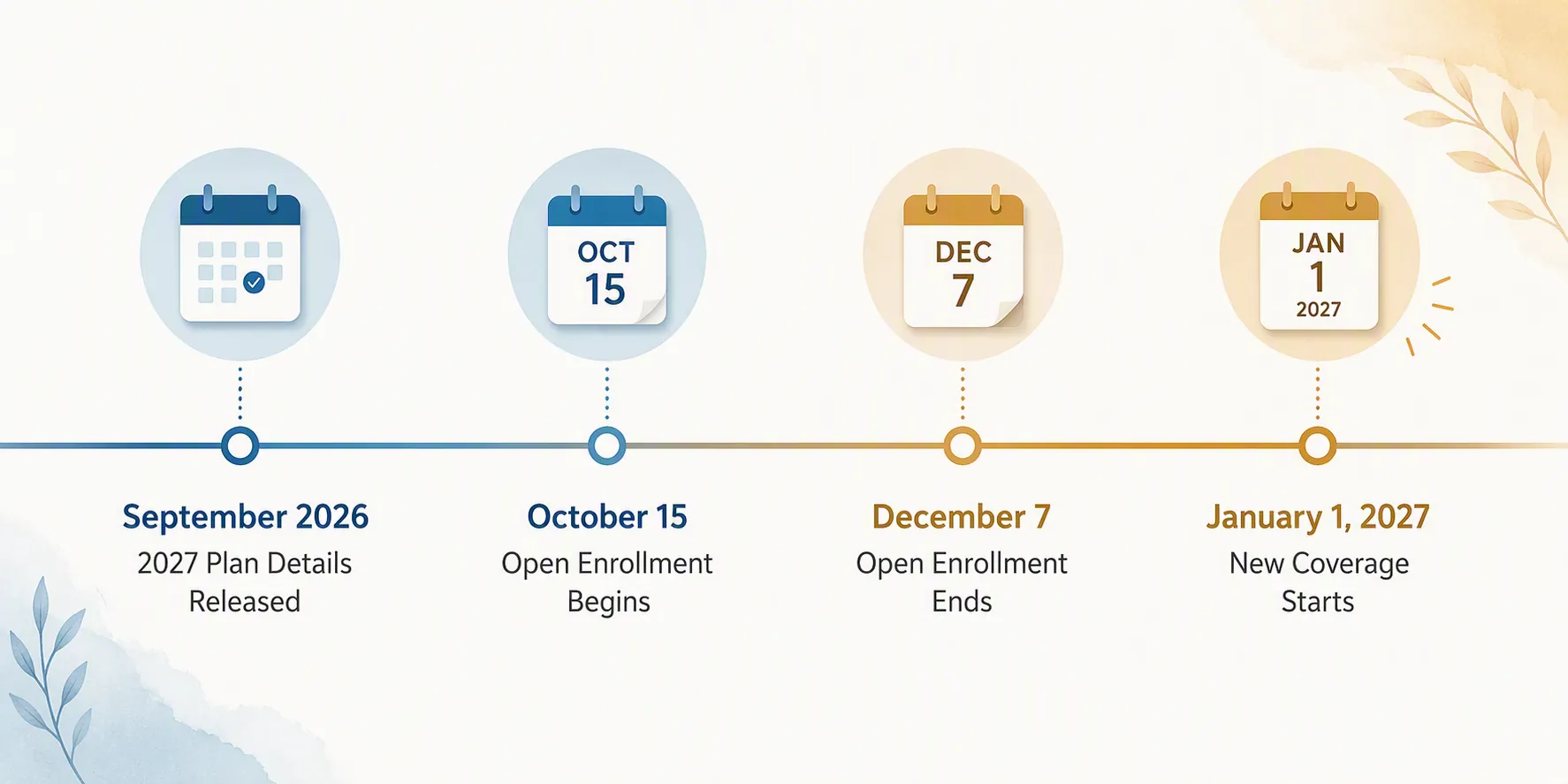
| Date | What to watch |
|---|---|
| September 2026 | 2027 plan-level premiums and plan details are expected. This is when the real comparison can begin. |
| October 15, 2026 | Medicare Open Enrollment begins. |
| December 7, 2026 | Medicare Open Enrollment ends. |
| January 1, 2027 | New 2027 coverage takes effect for people who changed plans during Open Enrollment. |
Your Annual Notice of Change is the first document to read closely. Do not stop at the monthly premium. Circle the premium, then check the deductible, drug list, tiers, prior authorization rules, quantity limits, preferred pharmacies, mail-order terms, and the estimated full-year cost of your regular medicines.
What should I compare during Open Enrollment?
Use your own medication list, not a general headline. A plan that is cheap for your neighbor may be poor for you if your drugs, dosage, pharmacy, or county are different.
- Monthly premium: Check the 2027 amount for your exact plan, not the national base premium.
- Deductible: See whether the plan deductible changed and whether it applies to your medications.
- Formulary: Confirm each prescription is still covered.
- Drug tier: A covered drug can still become more expensive if it moves to a higher tier.
- Restrictions: Look for prior authorization, step therapy, or quantity limits.
- Pharmacy network: Check whether your regular pharmacy is still preferred, not just in network.
- Total annual cost: Compare the whole year’s estimated cost, including premium and out-of-pocket drug costs.
- Extra Help status: If your finances are tight, check eligibility before assuming you must absorb the full cost.
If you help a parent or spouse, bring the pill bottles or an up-to-date medication list to the comparison. One missed inhaler, insulin product, blood thinner, or specialty medication can make the whole comparison wrong.
What seniors should do now
Before September, do not panic-shop based on national numbers. Keep your current plan documents, make a clean list of your prescriptions, note your preferred pharmacy, and watch for the 2027 plan information when it becomes available.
During Open Enrollment, compare your current plan against the other plans available in your area. If you have Extra Help, make sure the plan still works with your subsidy protection and your medications. If you do not have Extra Help but your income or resources are limited, check eligibility using the current Medicare limits and watch for any 2027 updates.
The subsidy cut is real. But the bigger mistake would be assuming last year’s Part D plan is still the best or cheapest choice in a market with fewer plans and more uneven premium changes.
References
Browse more in the Glossary.