
Glossary entry
What to Look for When Touring a Memory Care Facility
Last verified 2026-08-03
This is not financial or legal advice. Medicare/Medicaid and benefits rules vary by state and change over time — verify current rules with your state Medicaid office or Area Agency on Aging.
By the time you are touring memory care, the question is usually no longer theoretical. You have an appointment, a parent who needs more supervision than home can safely provide, and a building full of reassuring words: secure, enriching, specialized, person-centered. The useful question is narrower: what should you actually look for in a memory care facility for an elderly parent when the tour itself has been prepared for you?
Look first for evidence that survives after the tour director stops talking: inspection records, care-planning examples, activity and meal routines, staffing answers by shift, and resident–staff interactions you can see with your own eyes. If your family is still deciding whether a move is necessary at all, step back to the five-domain framework for when aging in place is no longer safe. This article assumes you are already comparing facilities.

Arrive with a document request, not just a tour appointment
A polished tour can keep you in guest mode. A document request changes the relationship. It asks the facility to show how care is recorded, reviewed, staffed, inspected, and corrected.
Ask for the packet before the tour if possible, or at the beginning if not. If the answer is “we can get that to you later,” write down exactly what is missing and who promised it. A good facility may need time to pull some records, but it should not act surprised that a family wants to see oversight documents and care-planning samples.
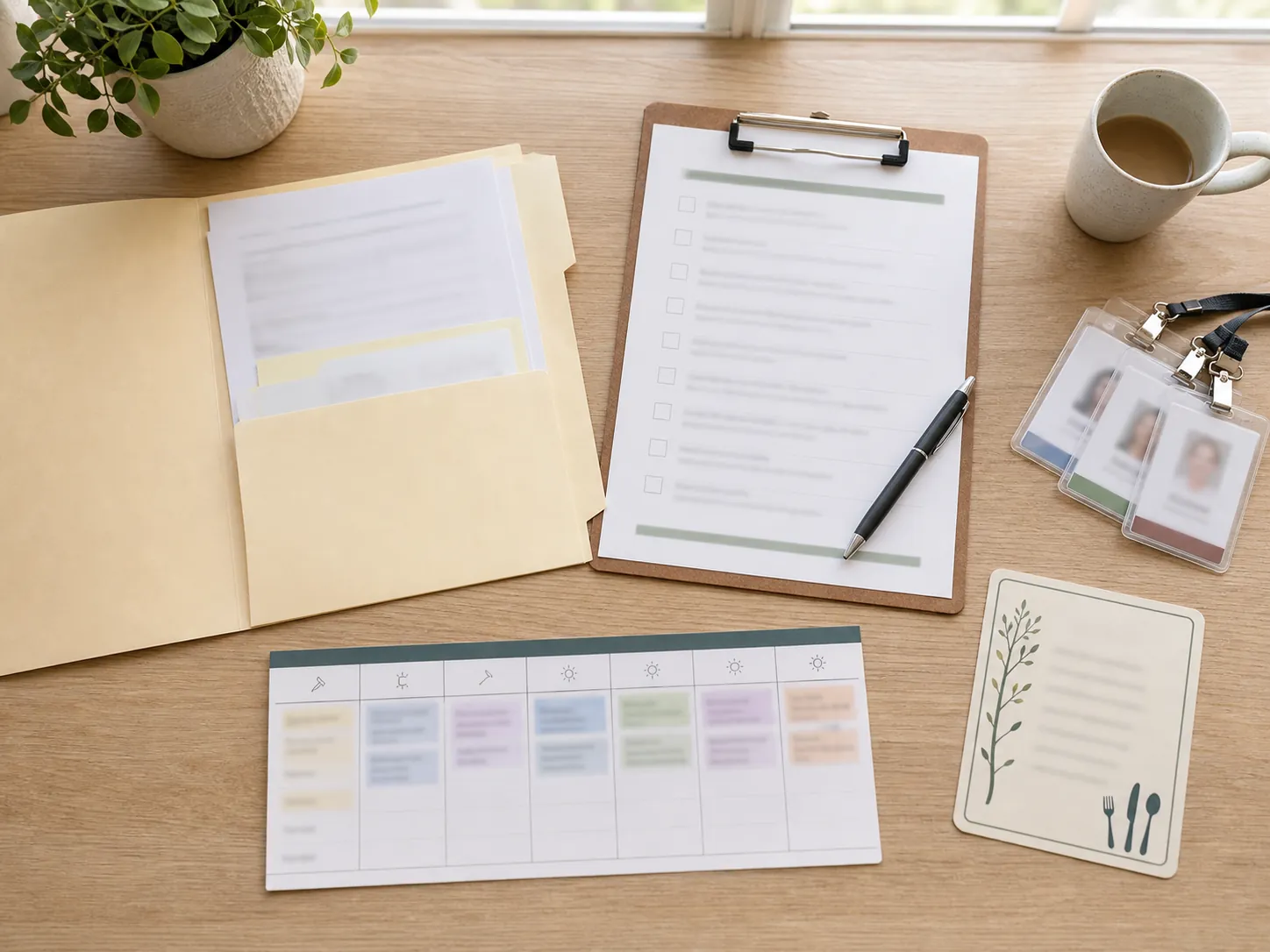
Documents worth asking for
- Recent state survey, inspection, or licensing reports, plus any correction plans. Ask where families can verify these with the state licensing agency.
- Special Care Unit Disclosure form or equivalent dementia-care disclosure, where your state requires one. California’s CANHR dementia-care checklist, for example, points families toward this kind of disclosure, but state rules vary; do not treat one state’s form as universal. [1]
- A sample care plan with identifying information removed. You are not looking for private resident details; you are looking for whether the plan is specific enough to guide real care.
- A current weekly activity calendar. Circle the times that require actual staff involvement, not just passive entertainment.
- Current weekly menus and snack routines, including how the facility supports residents who forget to eat, eat slowly, need cueing, or lose interest during meals.
- Dementia-care training materials or credentials for direct-care staff, including who receives training and how often it is refreshed.
- Staff turnover and leadership turnover information. Exact formats vary, but evasiveness here matters because consistency is part of memory care.
- For a nursing-home-based memory care unit, the Medicare Care Compare listing and any quality or inspection information available there. [2]
The sample care plan deserves more attention than most families give it. A weak one says, in effect, “resident has dementia; provide supervision.” A useful one tells staff what agitation looks like for this person, what helps during bathing, what foods are usually accepted, what time of day is harder, what music or activities have meaning, how family should be contacted, and what changes trigger a reassessment.
You can ask the facility to walk you through a hypothetical path: “If my mother starts refusing showers, who notices, who documents it, who updates the care plan, and how would aides on the evening shift know what changed?” The answer should name people and steps. If it turns into a brochure paragraph about dignity, ask again.
During the tour, watch residents before you watch the room
The lobby is not the unit. The private dining room is not the unit. The model apartment is certainly not the unit. Once you enter the actual memory care area, look at the people who live there before you evaluate the furniture.
Notice whether residents are awake, groomed, included, and occupied in ways that fit dementia care. A few people resting is normal. A whole room of residents lined up in wheelchairs with no visible engagement is different. CANHR’s checklist flags unengaged residents parked in wheelchairs as a concern families should notice during a dementia-care visit. [1]
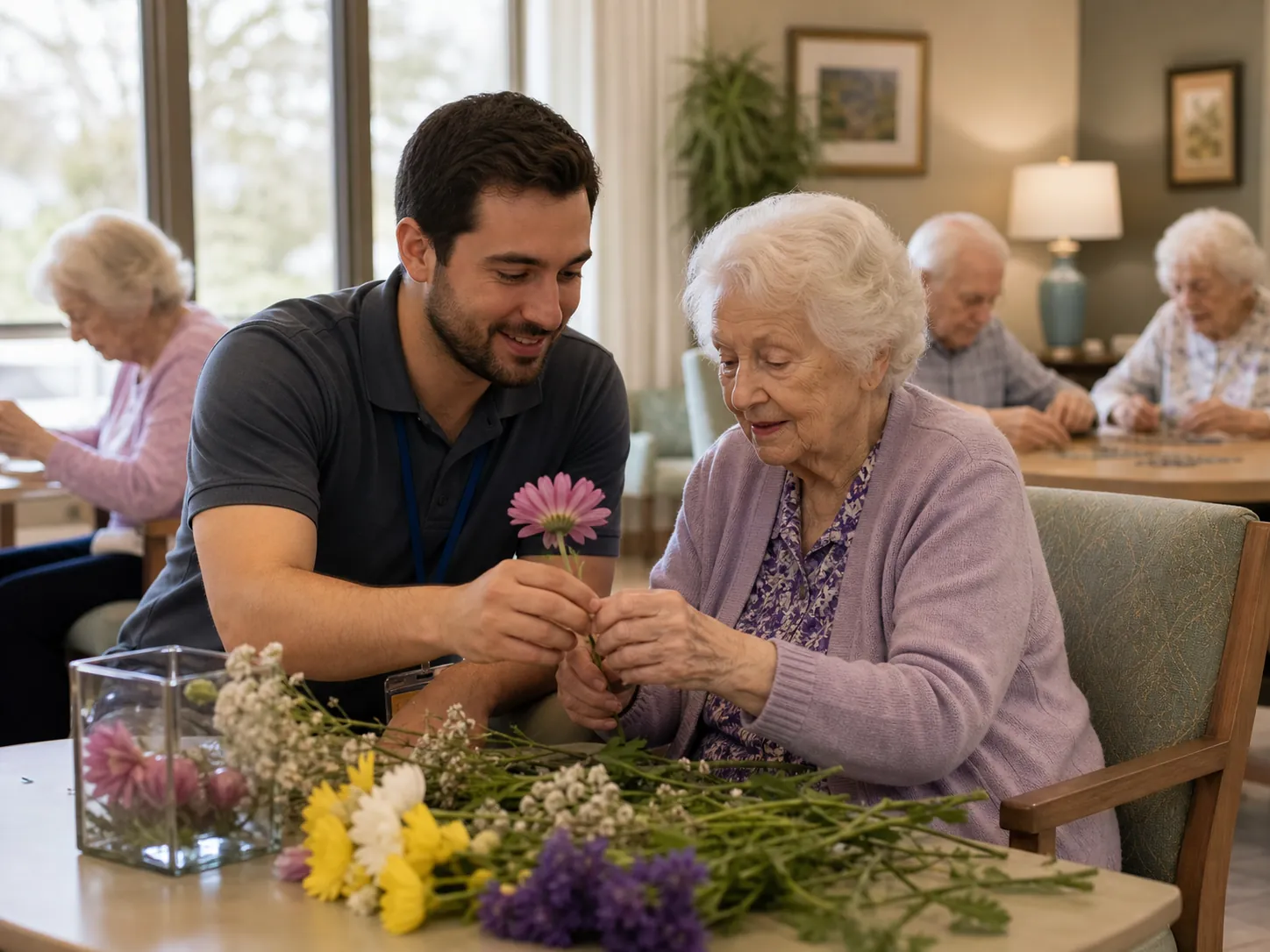
The best clues are often small
Listen for names. A staff member who says, “Mrs. Lewis, your daughter is coming after lunch,” is doing something different from someone calling across the room, “Sweetie, sit down.” Terms of endearment are not automatically cruel, and names are not automatically proof of quality, but name use is one sign that residents are known as individuals rather than managed as a group.
Watch how confusion is redirected. Does a caregiver crouch to eye level? Does she give the resident time to answer? Does he move a resident away from distress without shaming him? Or do staff correct, scold, ignore, or talk over people as if dementia has made them invisible?
Use your nose, too. No congregate-care setting will smell like a hotel lobby every minute of the day, especially near bathrooms or after meals. But heavy, stale odors that seem embedded in hallways or resident areas deserve direct questions about toileting support, laundry routines, housekeeping, and staffing.
Pay attention to sound. A memory care unit does not need to be hushed. Meaningful activity has noise: dishes, music, conversation, a staff member cueing someone through a task. But constant alarm sounds, unanswered call bells, residents calling out without response, or an eerie quiet in the middle of the day can all point to a mismatch between resident needs and staff capacity.
Amenities only matter when they touch daily life
A theater room, salon, bistro, or bright lobby may be pleasant. None of them tells you whether your parent will be helped to the bathroom in time, recognized when she is frightened, or invited into an activity after lunch. If the facility points out an amenity, ask when residents in memory care actually use it, who brings them there, and what happens when someone becomes anxious or wants to leave.
The activity calendar should match what you see. If the calendar says a small-group program is happening, look for a small group. If everyone is watching television instead, ask whether the program was canceled, moved, or never realistic in the first place.
Safety design is necessary, but it is not care
Memory care needs physical safeguards. Check for secured exits, door alarms or wander-alert systems, handrails, nonslip flooring, zero-threshold showers, grab bars, emergency call buttons, enclosed courtyards, and doorways wide enough for walkers and wheelchairs. CANHR and Harvard Health both point families toward dementia-appropriate environmental and safety features when evaluating care settings. [1][3]
Then ask whether those features are actually usable. A secured courtyard that residents can enter only during rare staff-led events is different from one that is safely available as part of the day. A beautiful shower room matters less if aides are too rushed to use it calmly. A wander-alert bracelet is a tool; it does not replace supervision.
Families who have already studied home safety will recognize many of these features from fall-prevention work: nonslip surfaces, grab bars, thresholds, lighting, and bathroom access. The difference is that in memory care, the building has to support people who may not remember to ask for help or use equipment consistently.
Ask staffing questions by shift, not in averages
Staffing is where vague answers become expensive. “We staff according to resident needs” may be true, but it is not enough. Ask for the actual number of direct-care staff assigned to memory care on days, evenings, nights, and weekends. Ask whether those numbers include nurses, activity staff, medication aides, reception staff, or only the people providing hands-on care.
The Alzheimer’s Foundation of America cites a common daytime staffing range of 1 staff member for every 5 to 6 residents in memory care, but that should be used as a question prompt rather than a universal benchmark. Ratios vary by state, setting, resident acuity, and shift. [4]
| Ask | Listen for |
|---|---|
| How many direct-care staff are assigned to memory care on day shift? | A number, not a philosophy. |
| How does that change on evenings, nights, and weekends? | Separate answers for each shift. |
| Who administers medications, and what training do they have? | Role clarity and supervision. |
| How often do agency or temporary staff cover the unit? | Whether residents regularly see unfamiliar caregivers. |
| How long has the memory care director or administrator been here? | Leadership stability, not just corporate branding. |
| What happens when two residents need urgent help at the same time? | A real escalation process. |
Do not apologize for writing the answers down. The aides will live with the consequences of understaffing, and your parent will live inside those consequences. If a facility cannot explain who is on the floor at 7 p.m. on a Sunday, you do not yet know the facility.
Ask how your parent would be known
Memory care is often sold through security, but daily quality depends on familiarity. Ask how the facility learns a new resident’s routines, fears, food preferences, former work, family relationships, sleep patterns, bathing preferences, and triggers for distress.
A useful answer should connect intake, care planning, frontline communication, and updates. For example, if your father becomes anxious every afternoon and tries to leave, who records the pattern? Who adjusts the plan? Who tells the night staff? Who calls you? If the answer lives only in a binder that aides do not have time to read, it is not yet a care plan in practice.
Ask what would happen after a fall, hospitalization, infection, new medication, or sudden change in behavior. Families often arrive at memory care after a fall or hospital stay; if that is your situation, it may help to review the steps for activating senior health services after a fall or why a parent may resist fall prevention after the hospital. On a facility tour, the same issue becomes operational: who notices decline, who updates the plan, and who makes sure the next shift knows?
Meals show more than menus
If you can see only one ordinary routine, try to see a meal. Meals reveal staffing, patience, cueing, dignity, appetite support, and whether residents are treated as people rather than tasks.
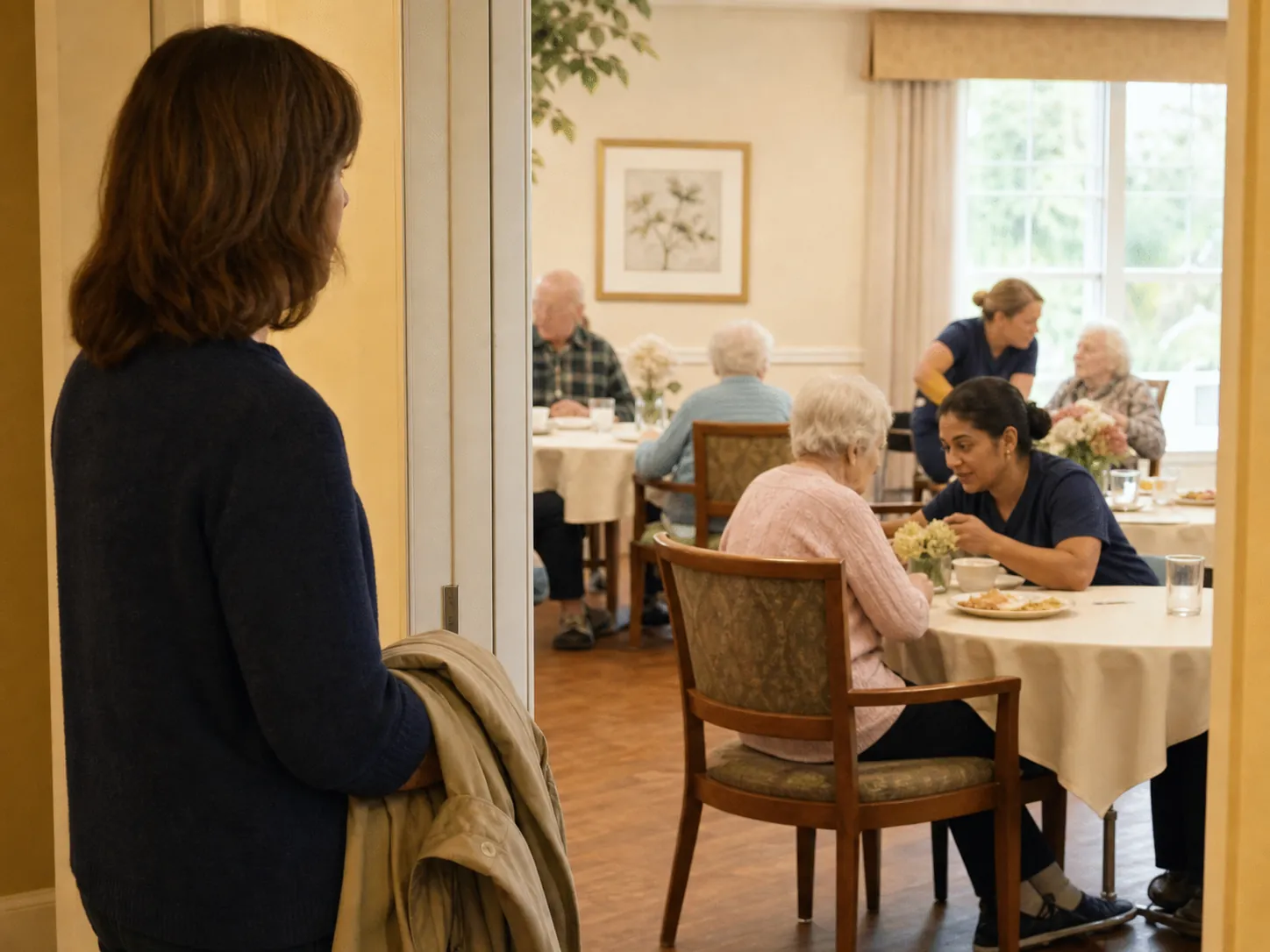
Watch whether residents are seated comfortably, whether staff sit or stand over them, whether people who need help are helped without being rushed, and whether conversation continues after food is served. A menu can tell you what was planned. A meal tells you whether the plan reaches the person.
The unannounced second visit is not a trick
A scheduled tour is a sample under ideal conditions. A second visit at a different time is the fairest way to see whether the facility functions when it is not performing for visitors. The Alzheimer’s Association recommends visiting care providers more than once and making unannounced visits, and Harvard Health likewise advises families to visit memory care facilities at different times, including during meals and on weekends. [5][3]
Choose a time that tests the parts of care most likely to strain: lunch, dinner, early evening, a weekend afternoon, or a shift-change period. You do not need to be dramatic. Walk in, say you are continuing your decision process, and ask to see the memory care area again. If the facility discourages any unannounced return, that resistance belongs in your decision.
On the second visit, compare rather than restart. Are the same staff claims still plausible? Are residents still engaged? Do odors, noise, and response times look different? Is the activity calendar still connected to real activity? Does the secured outdoor space still exist as more than a sales point?
Cost is context, not a quality score
Memory care costs vary by state, building type, level of care, and whether the unit is part of assisted living or a nursing home. Published 2026 estimates are not identical: A Place for Mom reports a $6,690 monthly median, SeniorLiving.org reports $8,019 per month as of June 2026, and NIC data cited by WebMD reports $6,935 per month. [6][7][8]
Harvard Health, citing the Alzheimer’s Association, reports roughly $116,800 per year for a private nursing-home memory care room. [3]
Medicare generally does not cover room and board or custodial long-term care in memory care. Medicaid coverage depends on state rules, facility participation, eligibility, and available waiver or long-term-care programs. Treat this as financial context, not financial advice; confirm coverage with the facility, your state Medicaid office, and a qualified benefits or elder-law professional.
A more expensive building may still be understaffed. A less ornate building may have stable aides who know residents well. Price tells you what the facility charges; it does not tell you whether someone will notice your mother is frightened before dinner.
Before you choose
This is a care decision with medical, legal, and financial consequences, and this article is not a substitute for professional medical, legal, or financial advice. It is a touring framework: what to request, what to watch, what to ask, and how to verify.
Do not choose the memory care facility that performs best on the scheduled tour. Choose the one whose records, staff behavior, care planning, safety practices, and off-script visit all tell the same story.
References
- Dementia Care Checklist, CANHR
- Care Compare, Medicare.gov
- Memory care: A senior living option for those with dementia or Alzheimer's disease, Harvard Health
- 10 Questions to Ask When Considering a Memory Care Community, Alzheimer's Foundation of America
- Choosing Care Providers, Alzheimer's Association
- Memory Care Costs, A Place for Mom, 2026
- Memory Care Costs in 2026, SeniorLiving.org, June 2026
- How Much Does Memory Care Cost?, WebMD
Browse more in the Glossary.