
Clinical term
What the Research Says About Microdosing for Anxiety in Seniors
Last verified 2026-07-27
For microdosing for anxiety in seniors, the plain answer is still no: no rigorous clinical trial has tested microdosing as an anxiety treatment specifically in older adults. That does not mean every early signal is meaningless. It means the evidence cannot yet carry the weight of a recommendation, especially for people already managing anxiety, sleep problems, blood pressure medications, antidepressants, dizziness, or fear of falling.

The question many families are really asking is not whether microdosing sounds promising online. It is whether a parent or spouse can try it safely for anxiety. Current research does not answer that question well enough.
The research gap is not a footnote
The most important fact in this area is not a glowing outcome report. It is the absence of older adults from the psychedelic trial base. A 2024 systematic review by Bouchet and colleagues found that, across about 1,400 participants in classic psychedelic clinical trials, only 19 were age 65 or older—fewer than 1.4% of participants.[1]
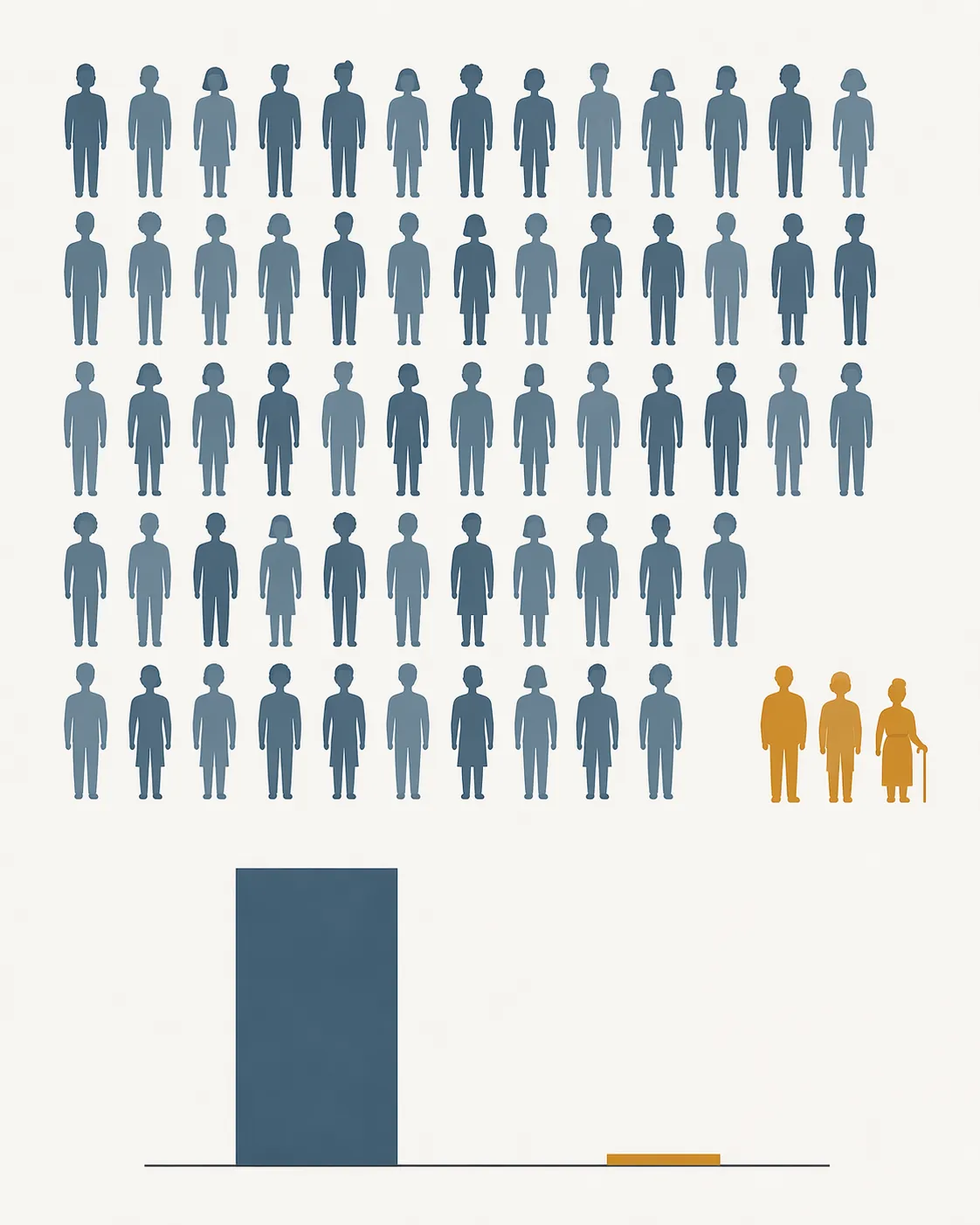
That matters because late-life anxiety is rarely a single, tidy symptom. It may be tied to bereavement, loneliness, chronic pain, fear of falling, medication fatigue, or a recent loss of independence. Older adults are also more likely to be taking several medications at once. A study that mostly includes younger or middle-aged adults may be useful, but it cannot simply be stretched to cover people in their 70s or 80s.
This is where many popular discussions move too quickly. They treat “participants felt better” as if it were the same as “this is a tested treatment.” Those are not the same claim. A treatment recommendation for seniors would need evidence on dose, monitoring, adverse effects, interactions, durability of benefit, and what happens to people whose anxiety worsens rather than improves.
What the observational studies actually found
The best-known microdosing studies are observational. That means researchers compare people who choose to microdose with people who do not. These studies can identify patterns worth following. They cannot show that microdosing caused the outcome, because the groups may differ in motivation, expectations, health behaviors, prior psychedelic experience, finances, access to care, and willingness to report improvement.
The largest anxiety comparison: useful context, not proof
Rootman and colleagues analyzed data from 8,703 adults in a large observational study of psychedelic microdosing. Among people with mental health concerns, microdosers reported lower anxiety scores than non-microdosers on the DASS-21 anxiety scale, with mean scores of 11.64 versus 13.22 and a small effect size of d=0.17.[2]
That finding is worth noticing. It suggests that people who microdose and report mental health concerns may also report somewhat lower anxiety. But the study was not a placebo-controlled trial, and it was not a senior-specific anxiety trial. The result does not tell us whether microdosing would reduce anxiety in an older adult who is already taking an SSRI, wakes at night, has unsteady balance, and worries about falling on the way to the bathroom.
The most age-relevant signal: adults over 55
The most directly relevant microdosing result for older readers comes from a 2022 Microdose.me/Quantified Citizen follow-up. In that observational study, adults over 55 who microdosed showed larger mood improvements over one month than non-microdosers and performed about 40% better on a psychomotor finger-tap test. The strongest signal was reported among people using the “Stamets Stack,” a combination of psilocybin, Lion’s Mane, and niacin.[3]
This is the finding that deserves the most careful reading. Mood matters. Psychomotor performance matters too, especially in older adults, because speed, coordination, and steadiness are not abstract laboratory concerns. They touch daily life: getting out of a chair, walking in low light, reacting to a stumble, or carrying groceries up a step.
Still, the study design limits the conclusion. Participants were not randomly assigned to microdose or take placebo. People who sign up for a microdosing study may already expect benefit, may be more health-engaged, or may differ from non-microdosers in ways the study cannot fully separate. A one-month observational improvement is not the same thing as evidence that microdosing treats anxiety in seniors.
The Stamets Stack detail also needs restraint. Combining psilocybin with Lion’s Mane and niacin may be interesting as a research question, but the available finding does not prove that the stack is safer or more effective for older adults. It also complicates interpretation: if people improve, it is harder to know which component, expectation, behavior change, or selection factor is doing the work.
Even the word “microdosing” is less settled than it sounds
Microdosing is often described as taking a very small, subperceptual amount of a psychedelic—enough that the person does not expect a full psychedelic experience. But there is no single standard definition in ordinary use. A 2026 RAND survey used benchmarks including a “subperceptual dose” and no more than 10% of a full dose, while also showing that psychedelic use and microdosing are being discussed and reported in the United States outside clinical settings.[4]
That definition problem is not just academic tidying. If one person means a barely noticeable amount and another means a dose that changes sleep, balance, mood, or perception, they are not talking about the same exposure. For an older adult with anxiety, that difference could matter the same day it is taken.
The safety questions are where caution becomes practical
Safety is not a vague warning label here. It is the part of the question that most directly affects older adults and caregivers. Anxiety treatment decisions in later life often already involve tradeoffs: a medication may help worry but worsen dizziness; a sleep aid may help rest but increase nighttime confusion; a blood pressure drug may be necessary but contribute to lightheadedness. Microdosing would enter that same crowded field, not a blank slate.
The National Center for Complementary and Integrative Health warns that psilocybin can be associated with risks including insomnia, increased anxiety, and depression.[5] For a younger adult, a poor night’s sleep may be unpleasant. For an older adult with balance problems, nighttime waking, agitation, or next-day grogginess can have larger consequences.
Medication interactions deserve special attention. UCSF’s psychedelic contraindications guidance flags concern about combining classic psychedelics with serotonergic medications, including SSRIs, SNRIs, and MAOIs, because of potential serotonin syndrome risk.[6] Those medication classes are not rare in people seeking help for anxiety or depression.
This is also where “natural” language can mislead. A mushroom-derived substance can still interact with prescriptions. A low dose can still matter if it changes sleep, blood pressure, alertness, mood, or judgment. An older person who falls, becomes more anxious, or stops a prescribed antidepressant abruptly is the one who carries the consequence, not the online thread that made microdosing sound gentle.
There is also an unresolved cardiac question around repeated exposure to substances that activate 5-HT2B receptors, a mechanism discussed in relation to possible heart valve concerns. The current senior-specific evidence does not establish that microdosing causes valvular heart disease, but it also does not clear the concern for older adults who may already have cardiovascular vulnerability.
A caregiver’s checklist, before any conversation goes further, would start with ordinary but important facts: current antidepressants, sleep medicines, blood pressure drugs, heart history, dizziness, prior falls, alcohol use, cognitive changes, and whether anxiety has recently worsened. None of those details proves that microdosing is safe or unsafe by itself. They are the details that determine whether a clinician can even begin to assess risk.
Newer research is asking better late-life questions
There are signs that researchers are finally looking more directly at older adults. UC Berkeley’s PLASTICITY study, described in 2026, is a neuroimaging study in healthy adults ages 60 to 85 examining whether psilocybin can enhance synaptic connections in the aging brain.[7]
That is not evidence that microdosing treats anxiety in seniors. It is evidence that the right population is beginning to enter more serious study designs. The distinction matters. A brain-aging study in healthy older adults cannot be converted into home-use advice for an anxious older adult with multiple prescriptions.
A 2026 review by Konstantinou and colleagues examined psilocybin in relation to late-life depression, loneliness, and existential anxiety, and identified critical gaps in dosing, safety, and long-term outcome data for late-life populations.[8] That is a sober conclusion, and a useful one. It says the questions are real, but not yet answered.
Legal status is another practical constraint
As last verified on July 27, 2026, psilocybin remains a Schedule I substance under U.S. federal law, while state rules vary and some states, including Oregon and Colorado, have created different state-level frameworks or reforms.[5] This article is not legal advice. For older adults and families, the legal question is not separate from the safety question, because illegal or unregulated access also affects product identity, dose reliability, supervision, and what help is available if something goes wrong.
What a careful answer looks like today
The current evidence supports curiosity, not endorsement. Rootman’s large observational comparison suggests lower reported anxiety among microdosers with mental health concerns. The Microdose.me/Quantified Citizen follow-up offers an age-relevant signal in adults over 55, including mood and psychomotor findings. Bouchet’s review shows why those signals are not enough: older adults have barely been represented in the clinical trial evidence base.
For seniors with anxiety, especially those dealing with polypharmacy, cardiovascular vulnerability, sleep disruption, dizziness, or fall-risk concerns, microdosing should not be treated as a proven treatment. If it is being considered at all, it belongs in a medically informed and legally appropriate conversation, not in a private experiment built from online confidence.
References
- Classic Psychedelic Clinical Trials Are Failing Older Adults: A Systematic Review of Older Adults’ Inclusion in Psychedelic Clinical Trials — PubMed, 2024.
- Adults who microdose psychedelics report health related motivations and lower levels of anxiety and depression compared to non-microdosers — Scientific Reports, 2021.
- Latest Psilocybin Microdosing Study Finds Improved Mental Health and Psychomotor Performance in Those Over 55 Years of Age — Quantified Citizen, 2022.
- RAND survey on U.S. psychedelic use and microdosing prevalence — RAND, 2026.
- Psilocybin for Mental Health and Addiction: What You Need To Know — National Center for Complementary and Integrative Health.
- Medical Contraindications to Classic Psychedelic Use — UCSF Psychedelics Division.
- Tripping into old age: Can psychedelics protect the aging brain? — UC Berkeley News, June 8, 2026.
- Psilocybin for late-life depression, loneliness, and existential anxiety — General Hospital Psychiatry, 2026.
Browse more in the Glossary.