
Clinical term
New Enzyme Reverses Aging in Tissue — What It Means for Seniors
Last verified 2026-07-24
Yes, the headlines about a new enzyme reversing aging in human tissue are pointing to a real 2026 scientific paper. No, the enzyme is not available for your parent, spouse, or yourself. The important distinction is this: researchers reversed one specific aging-related chemical mark in donated human tissue slices, not aging in a living person.
The study, published in Nature Communications in July 2026, tested an engineered enzyme called CMLase on donated human artery, skin, and lens tissue. In tissue from a 75-year-old donor, the enzyme reduced CML damage by more than 70% in artery tissue and by more than 55% in skin; treated skin CML fell below levels typically seen in 31-year-old skin.[1]
That is unusually concrete for an “aging reversal” claim. It used human tissue, not only cells in a dish. It measured a defined chemical target, not a vague wellness score. But it still leaves the senior-health question unanswered: did the artery become more elastic, did skin heal faster, did a lens become clearer, or did anyone safely deliver the enzyme inside a living body? The study did not show those things.
What the Study Actually Reversed
The enzyme targeted CML, short for Nε-carboxymethyl-lysine. CML is one kind of advanced glycation end product, or AGE. In plain English, it is a sugar-related chemical change that can attach to proteins over time.
Proteins are not just ingredients floating around the body. They help form the structure of artery walls, skin, lenses, tendons, and many other tissues. When sugar-related chemical changes accumulate on long-lived proteins, the tissue can become less flexible and more prone to inflammatory signaling. CML has been associated with tissue aging, arterial stiffness, skin changes, lens aging, and activation of the inflammatory RAGE receptor pathway.[1]
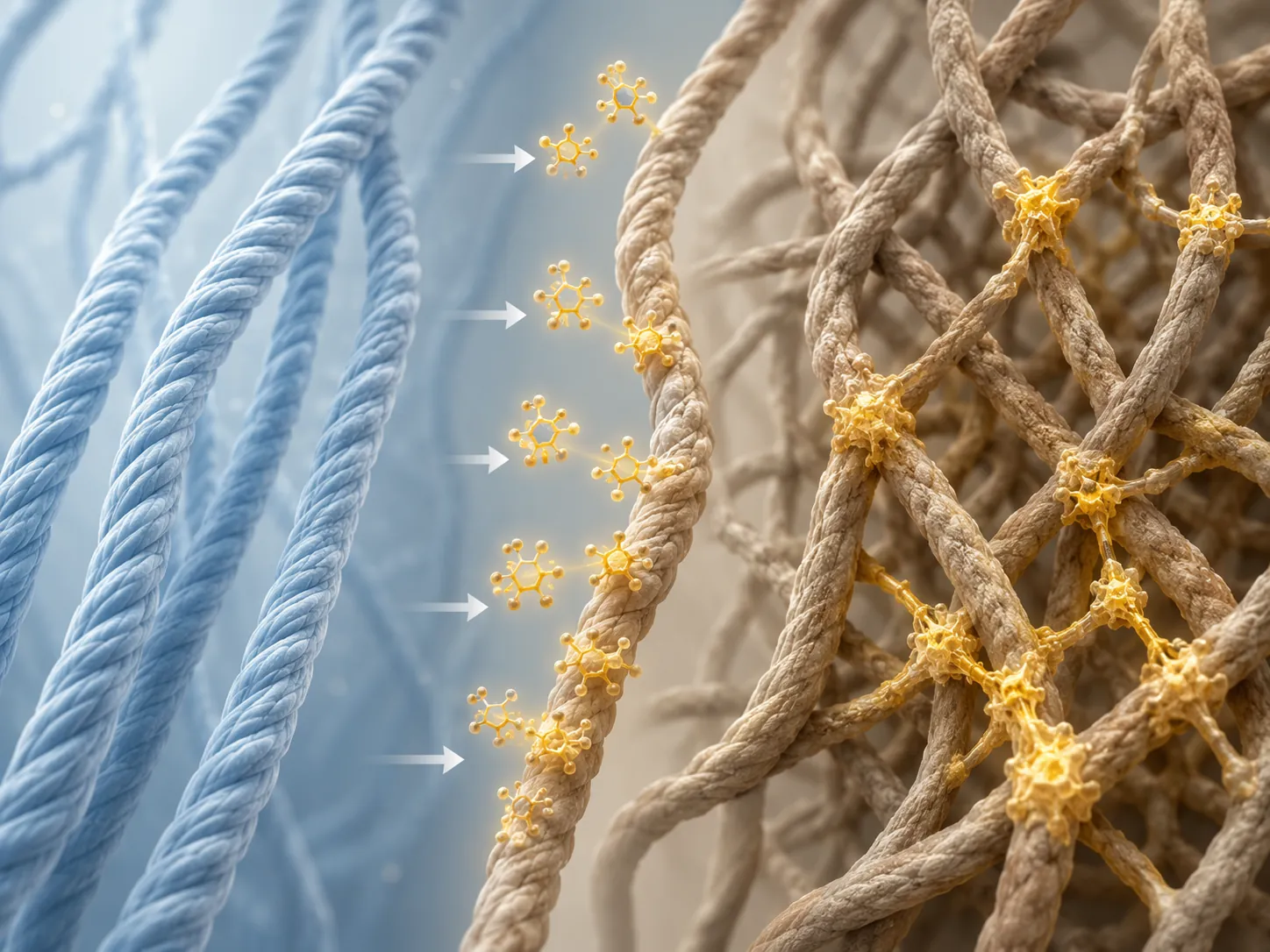
For a caregiver, this matters because the affected tissues are not abstract. Stiffer arteries can be part of cardiovascular risk. Fragile skin can mean bruises, tears, pressure injuries, and slower recovery after a fall or scrape. Chronic inflammatory signaling can make recovery harder. The study did not prove that removing CML fixes these problems, but it explains why scientists care about this target in the first place.
Why CMLase Is a Real Milestone
For years, many AGE changes were treated as chemically stubborn once they had formed. The notable part of CMLase is that researchers engineered an enzyme that could break down one of these accumulated chemical marks in actual donated human tissue.
The team developed CMLase through directed evolution from more than 500 million bacterial enzyme variants, starting from a bacterial enzyme related to glycine oxidase.[1] That technical achievement matters, but the more practical fact is simpler: the engineered enzyme found and removed a specific AGE mark in artery, skin, and lens tissue samples.
| What was tested | What changed | What was not shown |
|---|---|---|
| Donated human artery tissue from a 75-year-old donor | CML damage fell by more than 70% | No proof that the artery became more elastic or healthier in a living person |
| Donated human skin tissue | CML fell by more than 55%, below levels typical of 31-year-old skin | No proof of faster wound healing, stronger skin, or less bruising |
| Donated human lens tissue | CML was enzymatically targeted in tissue samples | No proof of improved vision or cataract-related benefit |
The skin result is especially easy to misread. “Below levels typical of 31-year-old skin” refers to the measured CML level in treated tissue. It does not mean the 75-year-old donor’s skin became biologically 31 years old, and it does not mean a person’s skin would look, stretch, heal, or resist tearing like younger skin after treatment.[1]
Why This Is Not a Treatment for Seniors
The experiment used thin, micron-scale tissue sections in a dish. That setup lets researchers expose tissue directly to the enzyme and measure whether CML is removed. It does not answer the harder medical questions that decide whether a therapy can help an older adult.
- Delivery was not solved: the study did not show how to get CMLase into a living person’s artery wall, deeper skin layers, or lens tissue.
- Tissue penetration was not proven: thin sections are very different from intact tissue inside the body.
- Immune safety was not established: CMLase comes from an engineered bacterial-origin enzyme, and human immunogenicity has not been tested.
- Functional recovery was not shown: the study did not demonstrate better arterial elasticity, faster skin repair, clearer lenses, or improved health outcomes.
- Human dosing was not tested: there were no living-human participants receiving the enzyme.
Those are not small footnotes. For a senior with peripheral artery disease, a pressure sore, fragile skin, diabetes-related wound risk, or slow recovery after injury, the useful question is not whether a molecule changed in a laboratory slice. It is whether a treatment safely reaches the right tissue and improves something the person can feel, survive, or recover from. That bridge has not been crossed.
The Part of Aging It Does Not Address
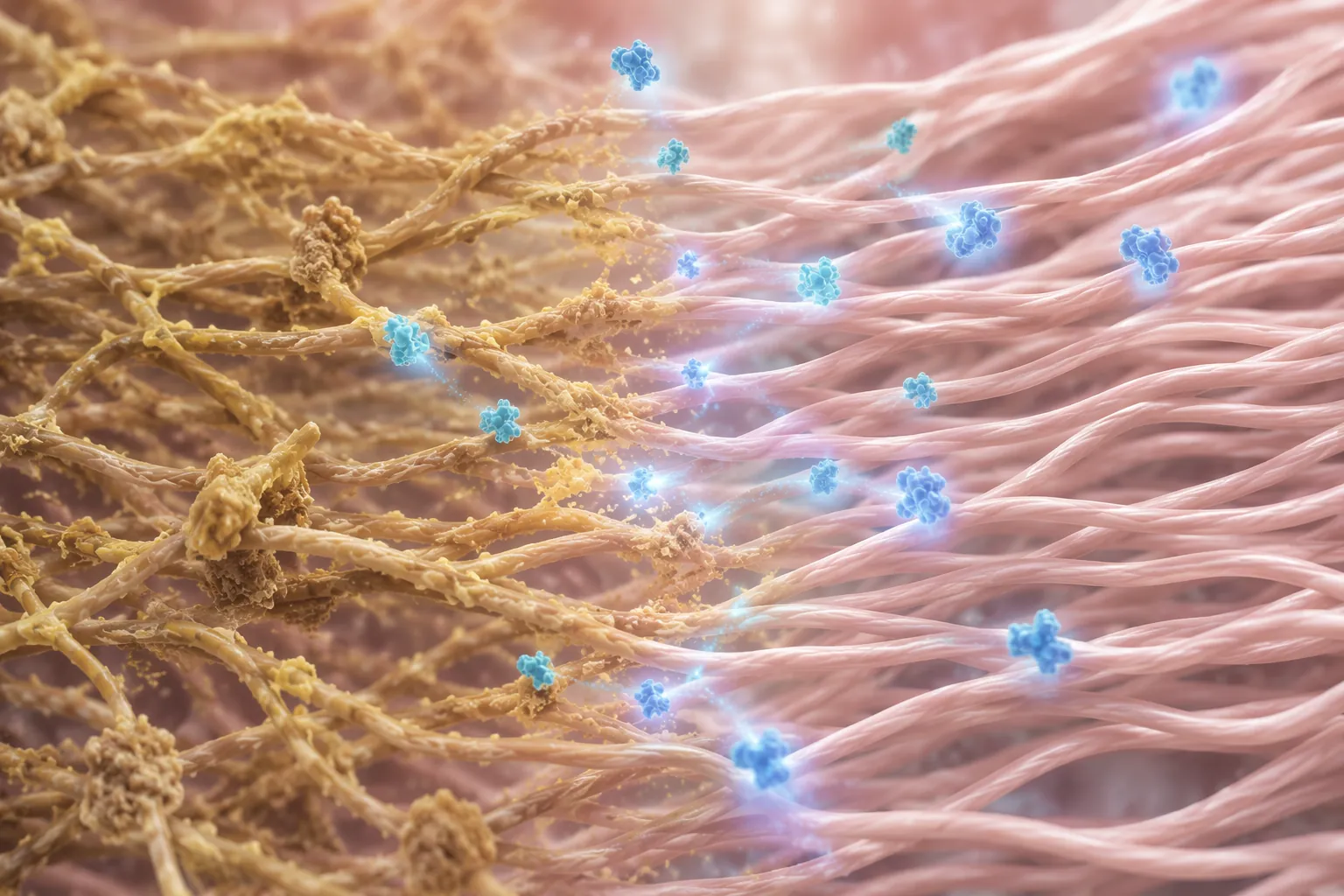
CML is one AGE, not the whole AGE problem. Other AGEs also accumulate with age, and glucosepane is often discussed as a dominant crosslink affecting tissue elasticity. Coverage of the study has noted that CML may be an easier enzymatic target than glucosepane and that CMLase does not remove glucosepane crosslinks.[2][3]
This matters because stiffness is not caused by one chemical mark alone. If a future therapy removed CML but left other important crosslinks untouched, it might reduce one kind of molecular damage without restoring tissue flexibility. The CMLase result is best understood as proof that at least one AGE can be enzymatically removed from human tissue, not proof that all AGE-related stiffness can be reversed.
How to Read the Commercial Angle
The research group included Revel Pharmaceuticals, Calico, and the University of Colorado, and company-linked coverage presented the work as a step toward enzymatic reversal of molecular aging.[1][4] That does not make the finding meaningless. It does mean the result deserves the normal next step for a high-interest biomedical claim: independent replication and testing in systems closer to living human biology.
A single study can be both impressive and early. The donated-tissue data are stronger than a supplement ad or a vague anti-aging claim. They are still far from evidence that a clinic, product, injection, cream, or pill can help seniors today.
What Seniors and Caregivers Should Do With This Information Now
For Q3 2026, CMLase changes understanding, not care decisions. It gives researchers a credible pathway to watch for conditions where AGE damage may matter, especially arterial stiffness, fragile or slow-healing skin, and inflammatory tissue aging. It does not give families an available treatment to seek out.
If an older adult is dealing with leg pain while walking, known cardiovascular disease, recurring wounds, skin tears, bruising, pressure injuries, or slow recovery after a fall, those concerns still belong with clinicians and established safety planning. Do not delay wound care, vascular evaluation, medication review, fall-risk reduction, nutrition support, or home-safety changes because of headlines about an enzyme study.
The fair reading is neither “aging has been reversed” nor “nothing happened.” Something meaningful did happen: an engineered enzyme removed a specific aging-related chemical mark from donated human tissue. What has not happened is the part seniors need most — safe delivery into a living body and proof that removing that mark improves health.
References
- Reversal of protein chemical aging by enzymatic deglycation, Nature Communications, July 2026
- CMLase Enzyme Developed to Break Down CML Advanced Glycation Endproducts, Fight Aging!, July 2026
- Engineered Enzyme Reverses Age-Related Protein Damage, Lifespan.io
- Revel Pharmaceuticals and Collaborators Report Enzymatic Reversal of Molecular Aging in Human Tissue, Yahoo Finance / Business Wire
Browse more in the Glossary.