
Clinical term
How to Recognize Pancreatic Cancer Early Signs in Elderly Parents
Last verified 2026-07-24
At home, pancreatic cancer in elderly parents rarely announces itself as one clean, unmistakable symptom. It may look like toast left on the plate for the third morning, a waistband that needs another notch, a parent who keeps saying the ache is “just my back,” or a diabetes diagnosis that seems to come out of nowhere. Most of those changes have ordinary explanations. The part worth watching is the pattern.

This is not medical advice or a diagnosis guide, and it cannot tell you whether your parent has cancer. A clinician has to evaluate symptoms and decide what testing is appropriate. But it can help you recognize which early warning signs deserve timely medical attention instead of being filed away as age, digestion, diabetes, or low energy.
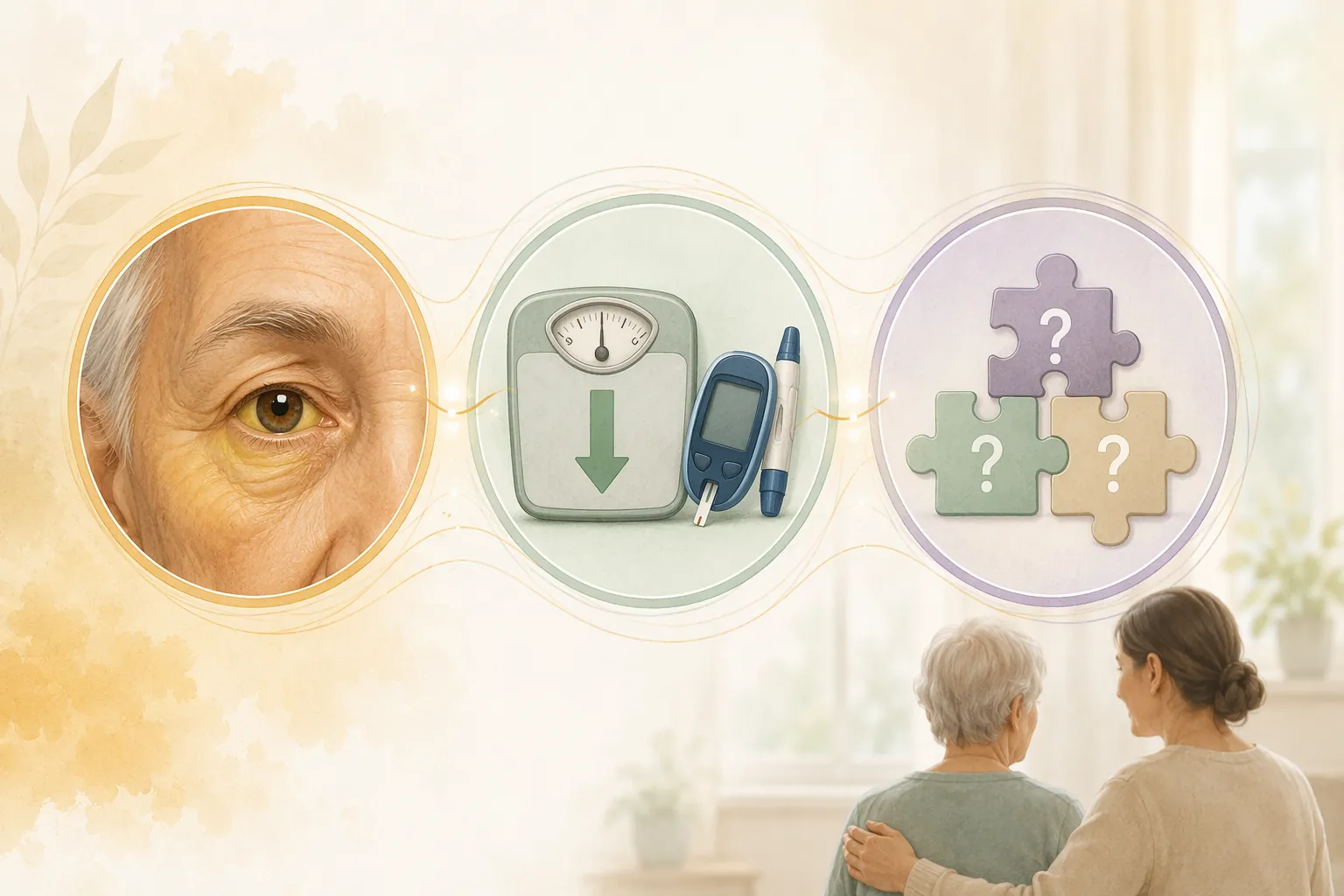
The highest-signal signs are not every stomachache or every tired week. The patterns that should move a caregiver from casual observation to active evaluation are painless jaundice, new-onset diabetes with unexplained weight loss, and two or more unexplained symptoms developing around the same time.
The red flag that should not wait: painless jaundice
Jaundice is one of the clearest changes a family can see. The skin or the whites of the eyes may look yellow. Urine may turn dark. Stools may become pale, greasy, floating, or clay-colored. The skin may itch in a way that seems out of proportion to any rash. The American Cancer Society notes that jaundice is often one of the first symptoms of pancreatic cancer, especially when a tumor blocks the bile duct near the head of the pancreas.[1]
There are many causes of jaundice, including gallstones and liver conditions. The point is not to assume pancreatic cancer. The point is that jaundice is visible evidence that bile flow or liver function may be affected, and it deserves prompt medical contact. If your parent looks yellow, has very dark urine, or suddenly has pale or floating stools, that is not a “mention it next month” change.
When you call the doctor, use plain, specific language: “Her eyes look yellow,” “His urine has been tea-colored for three days,” “Her stools are pale and floating,” or “He is itching all over and has no rash.” Those details are more useful than saying your parent seems “off.”
New diabetes plus weight loss deserves a closer look
Diabetes is common in older adults, so a new diagnosis does not automatically point to cancer. What changes the concern is the combination: diabetes appearing suddenly in an older parent, especially without a strong family history or obvious explanation, while weight is dropping or appetite is fading. PanCAN identifies new-onset diabetes, particularly when paired with weight loss, as a warning sign that can be associated with pancreatic cancer.[2]
This is where families can get lulled into a reasonable-sounding delay. Blood sugar gets treated. Diet gets adjusted. The scale keeps moving down. Everyone waits to see whether the numbers settle. Sometimes that is appropriate; sometimes it lets the larger pattern disappear into separate labels.
A useful question for the appointment is: “Given that this diabetes is new and she is losing weight without trying, should we consider pancreatic imaging or another evaluation for causes beyond type 2 diabetes?” That question does not demand a particular test. It asks the clinician to account for the cluster.
Two or more vague symptoms matter more than one vague symptom
A single symptom can be watched in context. Back pain may be arthritis. Fatigue may follow poor sleep. Appetite may dip after a medication change. The pattern becomes more concerning when two or more warning signs appear together. Roswell Park’s Dr. Karyn Stiles advises that if two or more pancreatic cancer symptoms develop simultaneously, the person should be evaluated.[3]
For an elderly parent, the combinations may look like this:
- Unexplained weight loss plus loss of appetite.
- Belly pain that moves through to the back plus fatigue.
- New diabetes plus weight loss.
- Dark urine plus pale, greasy, or floating stools.
- Itching plus yellowing eyes or skin.
- Several weeks of reduced eating plus a looser waistband and new abdominal discomfort.
This is not a scoring system. It is a way to stop symptoms from being split apart across different days, different relatives, and different appointments. A parent may tell one person about stool changes, another person about back pain, and the doctor only about fatigue. The caregiver who sees the whole week may be the only one who realizes these are not isolated complaints.
Why elderly parents are easy to miss
Pancreatic cancer is uncommon; SEER estimates it accounts for 3.2% of all new cancer cases. But age makes the concern more relevant in families caring for older parents: the median age at diagnosis is 71, and 32.7% of cases occur in people ages 65 to 74.[4]
The other reason not to be too casual is stage. SEER data show that only 15% of pancreatic cancers are found while localized. The 5-year relative survival rate is 43.6% when localized, compared with 3.4% when the cancer is distant.[4] Those numbers do not mean every symptom is cancer. They do mean that when a real cluster is present, waiting for symptoms to become dramatic is not a harmless strategy.
What to watch in daily life
Mayo Clinic lists pancreatic cancer symptoms that include abdominal pain radiating to the back, appetite loss or unintended weight loss, jaundice, light-colored stools, dark urine, itchy skin, new diabetes or diabetes that becomes harder to control, blood clots, and fatigue.[5] For a caregiver, the list becomes more useful when it is translated into what can actually be seen, heard, or measured.
| What you notice | What to document before calling |
|---|---|
| Weight loss | Approximate pounds lost, whether the parent is trying to lose weight, appetite changes, and clothing fit. |
| Pain | Where it starts, whether it moves to the back, whether it is new, constant, worse after eating, or waking the parent at night. |
| Jaundice signs | Yellow eyes or skin, dark urine, pale stools, floating or greasy stools, and itching. |
| Diabetes changes | Date of diagnosis, recent A1C or glucose concerns if known, weight change, family history, and whether diabetes is worsening despite treatment. |
| Fatigue | Whether it is new, limiting usual activities, paired with reduced eating, or accompanied by other symptoms. |
| Blood clot concern | New leg swelling, redness, pain, shortness of breath, or chest pain should be treated as urgent symptoms. |
Pain needs careful handling because it is so common in older adults. Pancreatic cancer pain may be felt in the belly and radiate to the back, and one review notes that more than 75% of patients experience pain related to pancreatic and celiac plexus infiltration.[6] That does not make an ordinary backache suspicious by itself. It does mean new, persistent upper abdominal or mid-back pain deserves more attention when it travels with weight loss, jaundice, appetite loss, or diabetes changes.
How long not to sit on symptoms
Some changes should trigger a prompt call rather than a long observation period. Contact your parent’s physician promptly for yellowing skin or eyes, dark urine with pale stools, new unexplained itching with jaundice signs, new diabetes with unexplained weight loss, or two or more warning signs appearing together. If your parent has chest pain, trouble breathing, sudden confusion, severe weakness, fainting, signs of dehydration, fever with acute illness, or symptoms of a possible blood clot, seek urgent care.
For less urgent but persistent changes, document instead of vaguely remembering. Write down the first date you noticed the change, what has gotten better or worse, and what else appeared around the same time. A short note such as “lost about 8 pounds since May, eating half meals, new upper belly pain after dinner, diabetes diagnosed last month” gives the clinician something concrete to evaluate.
How to talk to the doctor without sounding alarmist
The goal is not to walk into the appointment announcing pancreatic cancer. The goal is to keep the pattern from being minimized. Start with the timeline, then the measurable changes, then the question you need answered.
- “This started three weeks ago, and it is new for him.”
- “She has lost weight without trying and is eating less than half of what she used to.”
- “His urine is dark, his stools are pale, and his eyes look yellow.”
- “The pain is in the upper abdomen and goes through to the back.”
- “The diabetes diagnosis is new, and the weight loss came at the same time.”
- “What conditions are we ruling out, and is imaging of the pancreas or biliary system appropriate?”
If the first answer is to watch and wait, ask what would change the plan: “At what point should we call back?” “Which symptom would make this urgent?” “If the weight loss continues for another two weeks, what is the next test?” These questions respect diagnostic uncertainty while making sure the family has a clear threshold.
It is also fair to say, “I understand there are more common causes. I am worried because these symptoms are happening together.” That sentence often captures the caregiver’s real concern better than a list of internet searches.
What not to do with one ordinary symptom
Do not turn every backache, tired week, or skipped meal into a cancer scare. Older adults get constipated, lose sleep, react to medications, strain muscles, and have gallbladder, liver, stomach, and metabolic problems that are not pancreatic cancer. Overcalling every symptom can make both the parent and the doctor tune out.
But do not let the opposite habit take over either. Do not let painless jaundice wait. Do not let new diabetes with weight loss be treated as routine without asking whether the combination needs evaluation. Do not let multiple unexplained changes be scattered across separate explanations until no one is tracking the whole picture.
The practical standard is simple enough to use at home: one common symptom can often be monitored in context; a clear red flag should prompt medical contact; two or more unexplained warning signs developing together should move the family toward timely evaluation.
References
- Signs and Symptoms of Pancreatic Cancer, American Cancer Society.
- Symptoms of Pancreatic Cancer, Pancreatic Cancer Action Network.
- Pancreatic Cancer Symptoms: Know the Warning Signs, Roswell Park Comprehensive Cancer Center.
- Cancer Stat Facts: Pancreatic Cancer, National Cancer Institute SEER.
- Pancreatic cancer - Symptoms and causes, Mayo Clinic.
- Management of pancreatic cancer pain, World Journal of Gastrointestinal Oncology, 2016.
Browse more in the Glossary.