
Product term
Pickleball Equipment That Keeps Older Players Safe and Pain-Free
Last verified 2026-07-26
The moment that matters in pickleball is often small: a low ball, one sideways step, a quick reach, and a split-second decision about whether your shoes grip the court or your body has to save the point by twisting. For older players, the best pickleball equipment is not the gear that promises the most spin on a product page. It is the combination that lets you move, stop, reach, and play again tomorrow.
That does not mean playing fearfully. Pickleball has become a wonderfully social way for adults 55 and older to stay active; one 2025 participation figure cited by an equipment source puts the sport at 24.3 million players.[1] But the injury pattern deserves more attention than it gets in ordinary paddle reviews. In a peer-reviewed analysis of U.S. emergency department data from 2013 through 2022, adults ages 65 to 80 accounted for 61% of pickleball-related ER injuries. Falls caused 65.5% of injuries in that age group, fractures made up 32.7% of injuries, and women accounted for 69.1% of fractures. Among players 81 and older, 96% of injuries were fall-related.[2]
Those numbers do not prove that a specific paddle or shoe prevents falls. They do make one thing hard to ignore: equipment choices are part of the playing environment. A shoe that is made for forward running instead of lateral stopping, a paddle that feels light at first but wobbles through contact, or a grip that makes the forearm clench can all make ordinary movements harder than they need to be.
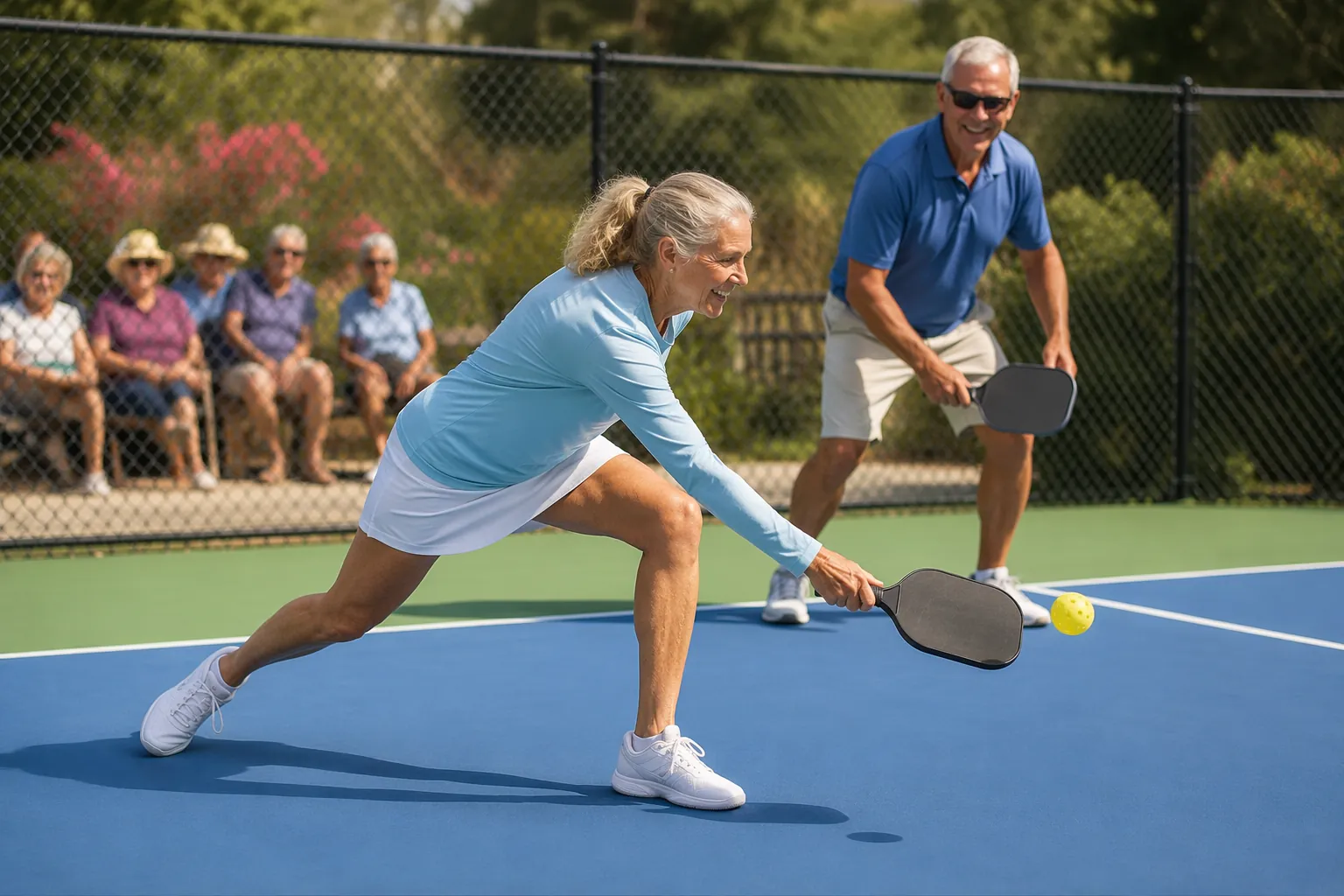
What equipment should older pickleball players buy first?
Start with the gear that affects balance, joint load, and repeatable movement before spending money on advanced performance features.
| Priority | What to look for | Why it matters |
|---|---|---|
| Court shoes | Lateral support, non-slip outsole, secure heel, court-specific construction | Falls dominate the injury data, and pickleball movement is side-to-side as much as forward |
| Paddle | 7.3-7.8 oz, 16mm polymer honeycomb core, raw carbon face, widebody or hybrid shape | A midweight, vibration-dampening paddle can be easier to control without forcing extra swing effort |
| Grip fit | Measured grip around 4 1/8-4 1/4 inches, often with a cushioned overgrip | A grip that is too large or too slick can increase hand and forearm strain |
| Protective accessories | Eye protection, hydration, sun protection, simple gear bag | These do not replace good shoes and paddle fit, but they remove avoidable irritations and distractions |
If your budget is limited, do not put all of it into the paddle. Shoes are safety equipment. A recreational player can adjust to a modest paddle more easily than to footwear that slips, catches, or lets the ankle roll during a lateral step.
The safest paddle is not always the lightest paddle
Many older players are steered toward the lightest paddle on the rack. That sounds sensible if shoulder or elbow pain is already a worry. The problem is that static weight is only one part of how a paddle behaves.
Equipment guides for senior players commonly point to a paddle weight around 7.3 to 7.8 ounces as a practical middle range.[3] Below that, the paddle may feel easy in the hand but less stable when returning a faster shot. Above that, the paddle may drive the ball well but tire the wrist, elbow, or shoulder over a long social session.
There is also swingweight, which is how heavy the paddle feels when it is moving. A long, head-heavy paddle can feel more tiring than its listed weight suggests. A slightly shorter widebody or hybrid paddle may feel easier to bring around, especially during quick exchanges near the kitchen line.
A good older-player paddle usually has four traits
- Weight around 7.3-7.8 oz: light enough for repeated play, but not so light that the player has to overswing to create depth.
- 16mm polymer honeycomb core: thicker polymer cores are commonly recommended for senior players because they can soften feel and absorb vibration better than thinner or harsher builds.[3][4]
- Raw carbon face: raw carbon is often favored in equipment guidance because it can provide controlled texture and feel without requiring an exaggerated swing.[5]
- Widebody or hybrid shape: these shapes usually give more forgiving contact than elongated shapes, which may reward reach and power but can feel less stable for recreational play.[3]
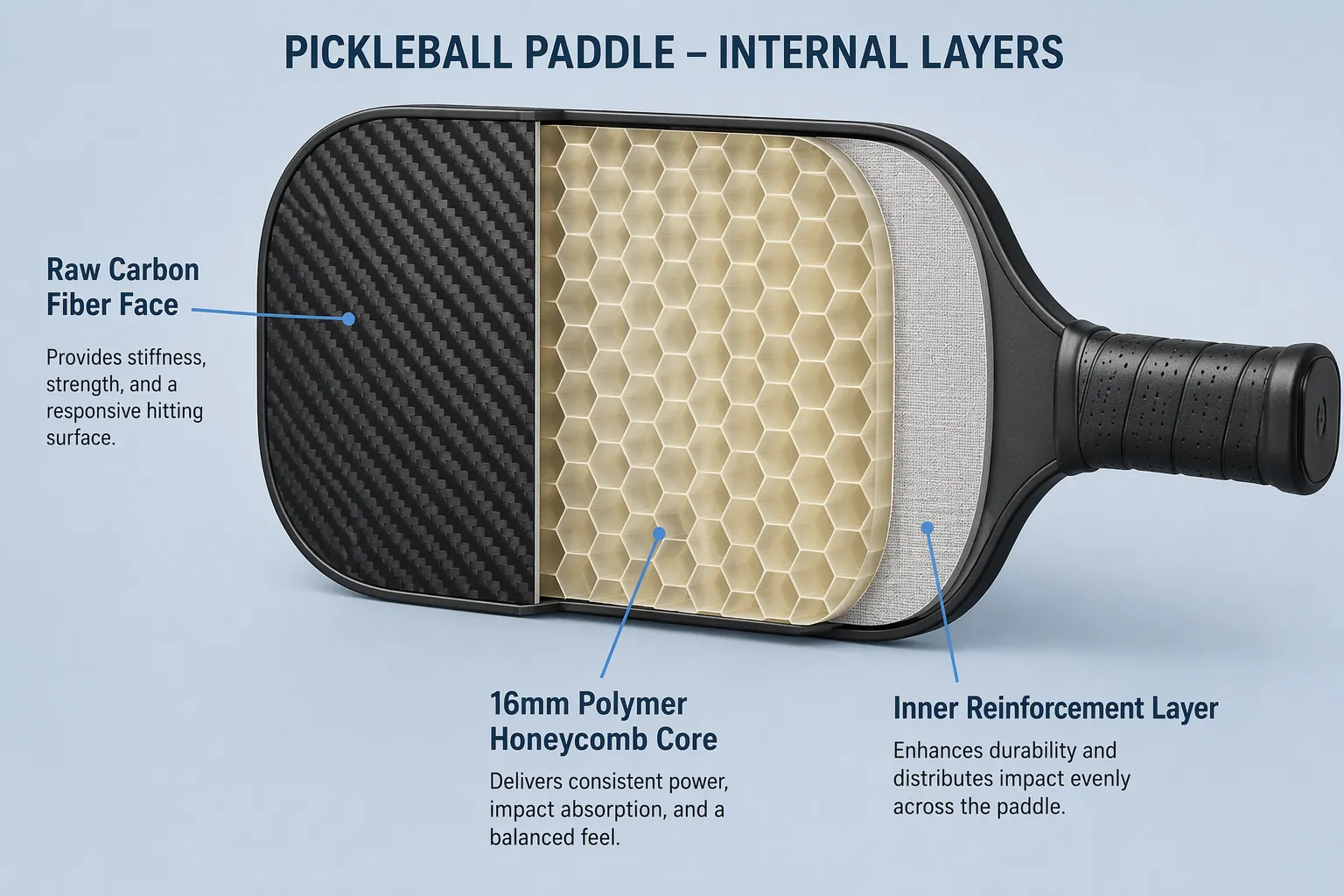
The 16mm core deserves special attention. A thicker paddle is not automatically better for every player, but it often suits recreational older players because the game becomes less jarring. A paddle that dampens vibration can make mishits less punishing, and a calmer feel can reduce the temptation to grip harder after every off-center shot.
Raw carbon also needs a careful explanation. It is not magic, and it is not a medical feature. Its advantage is practical: good surface feel can help a player place the ball without muscling it. For an older player who wants steady dinks, controlled returns, and less frantic swinging, that matters more than a paddle advertised mainly for power.
What about price?
Some equipment-focused sources describe the $150-$200 range as a strong value band for recreational senior paddles.[3][5] Treat that as buying guidance, not clinical evidence. The claim comes from commercial and affiliate-style equipment sources, not from an independent study showing that paddles in that price range reduce injuries.
The useful takeaway is narrower: by the time a paddle reaches that range, it is often possible to find the specs that matter most here — a 16mm polymer core, a raw carbon face, a stable shape, and a comfortable grip. A more expensive paddle may be fun, but price alone does not make it safer.
Grip size is a comfort issue and a strain issue
A paddle can have the right weight and still feel wrong if the grip does not fit. Older players often do better starting around 4 1/8 to 4 1/4 inches, then adjusting with a cushioned overgrip if needed.[1][3] That range is not a rule for every hand. It is a starting point that should be checked against the player’s actual grip.
A grip that is too small can make the player squeeze to keep the paddle from turning. A grip that is too large can make the hand stay open and tense, which may contribute to forearm and elbow discomfort. A cushioned overgrip can help with sweat, vibration, and mild size adjustment, but it should not turn a correctly sized handle into a bulky one.
A simple test is to hold the paddle as you would during play, not in a showroom pose. The wrist should feel neutral, the fingers should wrap without strain, and the paddle should not twist easily when you mimic a gentle backhand block. If the only way to control the face is to squeeze harder, the grip or paddle balance is working against you.
Shoes matter because pickleball is not walking and not jogging
Running shoes are built mainly for forward motion. Pickleball asks for side steps, small pivots, starts, stops, and half-reaches. That is why footwear guidance from the National Council on Aging emphasizes court shoes rather than running shoes, with lateral support and non-slip outsoles for pickleball movement.[6]
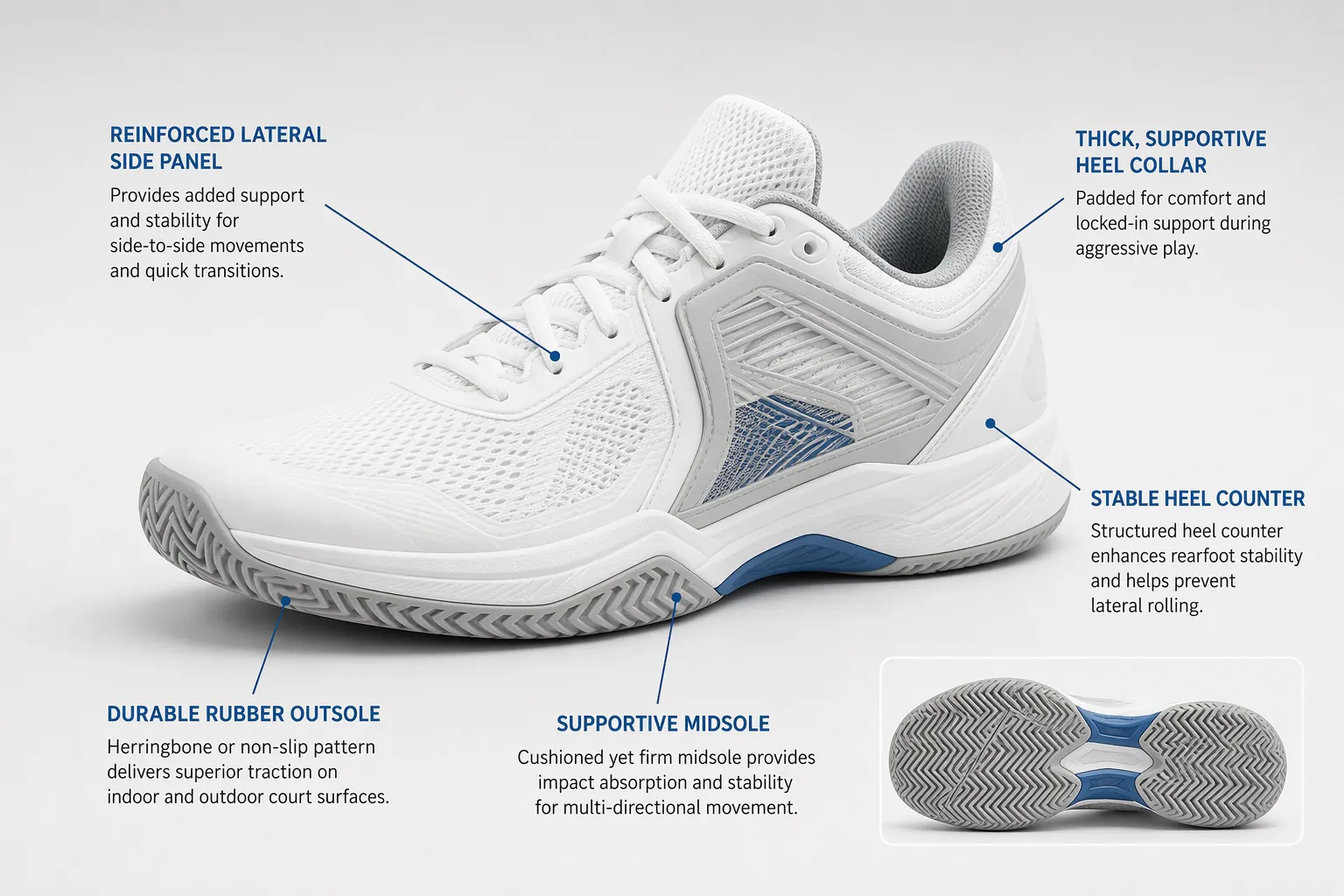
This is the place to be picky. A shoe that feels wonderfully cushioned for walking may sit too high, flex too much, or lack sidewall support when the player moves laterally. On the court, that can mean the foot keeps going after the body tries to stop.
- Choose court shoes, not running shoes: tennis, pickleball, or court-specific shoes are designed for lateral movement.
- Check lateral support: the shoe should resist rolling when you press outward through the side of the foot.
- Look at the outsole: a non-slip rubber court outsole with appropriate tread is more relevant than deep outdoor lugs.
- Secure the heel: the heel should not lift or slide during a quick stop.
- Replace worn shoes: once the outsole smooths out or the side support collapses, the shoe is no longer doing its job.
Players with diabetes-related foot changes, neuropathy, severe bunions, balance problems, or a history of falls should be even more cautious. In those cases, shoe selection is not just a sporting-goods decision; it may be worth discussing with a clinician, podiatrist, or physical therapist.
Accessories should solve real problems, not create a bigger bag
Accessories come after shoes, paddle, and grip fit. They are still useful when they reduce distraction or protect against predictable mishaps. Senior-focused gear guidance commonly includes eye protection, hydration, sun protection, and a practical way to carry equipment.[7]
- Protective eyewear: useful for close net exchanges, especially in doubles where balls and paddles move quickly in crowded space.
- Water bottle: dehydration can affect energy and attention before a player feels truly thirsty.
- Hat or visor: helpful for outdoor play when glare changes depth perception.
- Small towel or grip cloth: useful if sweat makes the paddle turn in the hand.
- Simple gear bag: helpful if it keeps shoes, water, and eyewear together without becoming heavy or awkward to carry.
None of these accessories makes up for poor footwear or a painful paddle. They are supporting safeguards. The goal is to arrive at the court with fewer small problems competing for attention.
What should older players skip?
Skip gear that is designed around a younger tournament player’s priorities if it makes your own movement less steady. A long, head-heavy paddle may add reach, but it can also feel late in the hand. A very powerful paddle may be exciting for a few drives, but it can encourage over-swinging when a softer block would do. A slick grip may look clean and new, but it is a problem if it makes the hand clamp down.
Also skip the idea that a new paddle is the answer to every ache. Elbow pain, shoulder pain, numbness, new balance trouble, dizziness, or repeated stumbling should prompt a health conversation, not another round of online reviews. Equipment can reduce avoidable strain, but it cannot diagnose arthritis, vestibular problems, medication side effects, neuropathy, or bone-health concerns.
A product-neutral buying standard
For most recreational players 55 and older, the best pickleball equipment is a stable court shoe, a midweight vibration-dampening paddle, a measured grip, and a few modest protective accessories. Brand names change quickly. These checks hold up better:
- Shoes: court-specific, laterally stable, non-slip, secure at the heel, and not worn down.
- Paddle weight: generally 7.3-7.8 oz, with attention to how heavy it feels while swinging.
- Paddle core: 16mm polymer honeycomb for a softer, more vibration-dampening feel.
- Paddle face and shape: raw carbon face with a widebody or hybrid shape for controlled, forgiving recreational play.
- Grip: measured around 4 1/8-4 1/4 inches for many players, adjusted carefully with a cushioned overgrip.
- Accessories: eyewear, water, sun protection, and a towel or grip cloth as needed.
Pickleball can still be quick, playful, and competitive with this kind of setup. Safety-minded gear is not dull gear. It is equipment chosen for the body that is actually on the court — the one reaching for the low ball, stopping near the kitchen line, and hoping to play again next week.
References
- Best Pickleball Paddles for Seniors, Spinwave Pickleball.
- Pickleball-Related Injuries in the United States: A National Electronic Injury Surveillance System Study, PubMed Central, 2025.
- Best Pickleball Paddles for Seniors, Dinkologist.
- Best Pickleball Paddle for Seniors, DinkUSA.
- Best Pickleball Paddle for Seniors, Quick Shot Paddles.
- Staying Strong and Injury-Free on the Pickleball Court, National Council on Aging.
- The Best Pickleball Gear for Seniors, Pickleball Lessons.
Browse more in the Glossary.