
Glossary entry
How Property Tax Relief for Seniors Funds Home Safety in 2026
Last verified 2026-07-27
This is not financial or legal advice. Medicare/Medicaid and benefits rules vary by state and change over time — verify current rules with your state Medicaid office or Area Agency on Aging.
A $1,200 property tax bill reduction does not arrive with a label that says “fall prevention.” It usually shows up as a lower bill, a refundable credit, a quarterly payment, or a tax increase that did not happen. But on a real kitchen table, that same $1,200 can become two properly placed grab bars, better light on the way to the bathroom, or the first safe step into a shower.
That is the practical way to look at property tax relief for seniors 2026: not as a home-modification grant, because it is not one, but as household money that may be freed up for safety work an older homeowner has been postponing. The program rules are local, the forms matter, and the timing matters. Still, when relief is real and verified, it can change what a family can afford to do this year.
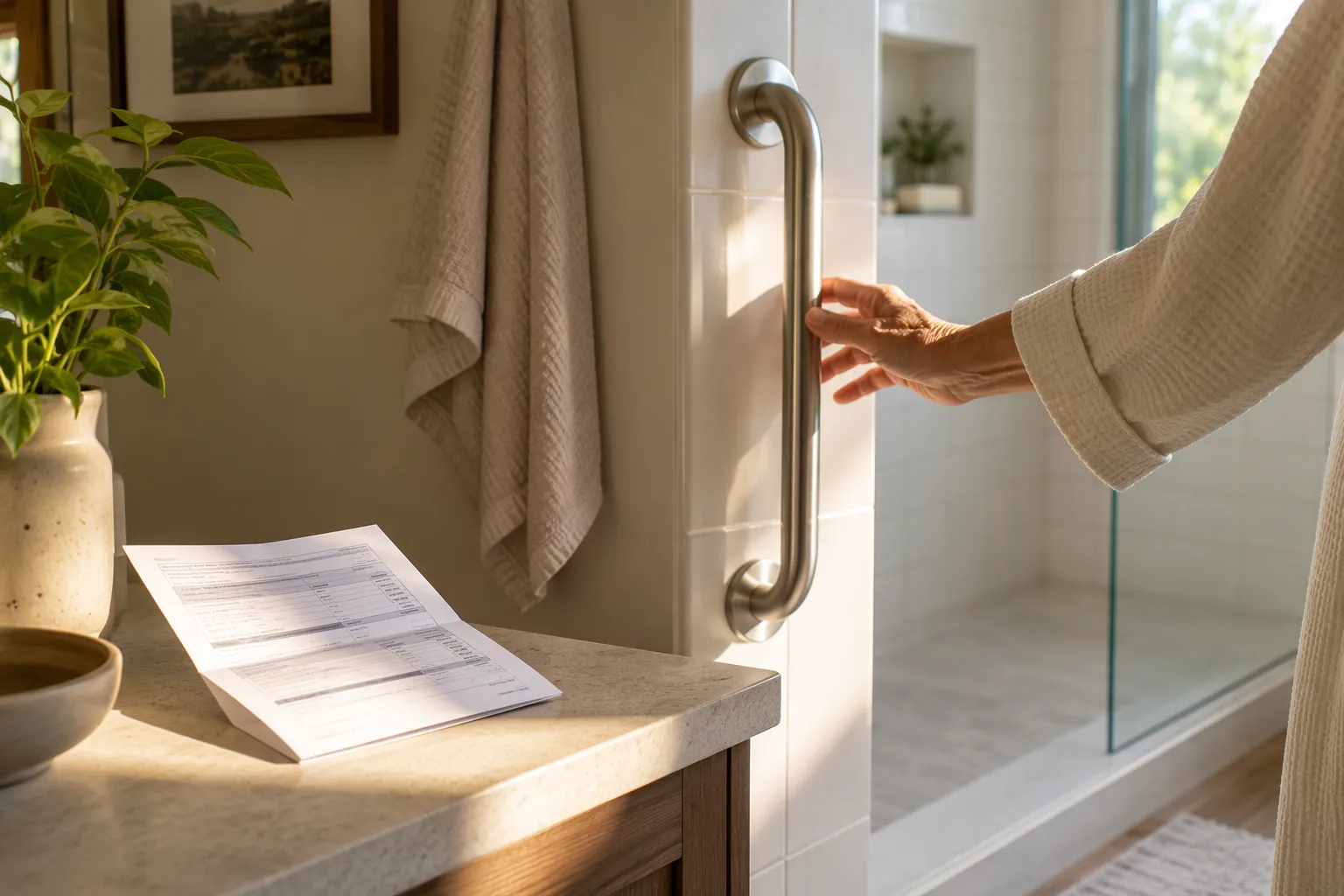
This article is for general education only. It is not tax, legal, or financial advice. Property tax relief rules change by state, county, city, school district, income, age, disability status, home value, residency, and filing deadline. Before making a plan around any benefit, verify the current 2026 rules with your county assessor, state tax agency, or a qualified tax professional.
Turn the Tax Savings Into a Safety Budget
The useful question is not only “How much can I save?” It is “What can that amount safely fix first?” A senior exemption, freeze, credit, or deferral may reduce the pressure on the household budget, but the safety value comes from assigning that relief to a specific job before the money disappears into groceries, insurance, utility increases, or the next repair.
Use these as planning ranges, then price the work locally with licensed or qualified installers where appropriate. If you need a broader cost framework, compare these amounts with aging-in-place home modification costs and funding options before choosing the first project.
| If verified relief frees up about... | A practical first safety use could be... | Why it matters |
|---|---|---|
| $500 | Non-slip bath treads, night lights, a handheld shower head, or a small threshold ramp | This level can reduce obvious trip and bathroom hazards without waiting for a larger renovation. |
| $1,000-$1,300 | Two professionally installed grab bars | Placement and anchoring matter; a bar that pulls out of drywall is not a safety improvement. |
| $1,800-$2,500 | Bathroom grab bars, handheld shower, raised toilet seat or toilet safety frame, and night lighting | This starts to address the bathroom as a system, not one isolated fixture. |
| Up to $6,500 | Professional home safety assessment, a fuller bathroom safety package, stair handrails, and several priority fixes | This can support a more complete aging-in-place plan when the benefit is actually received and budgeted. |
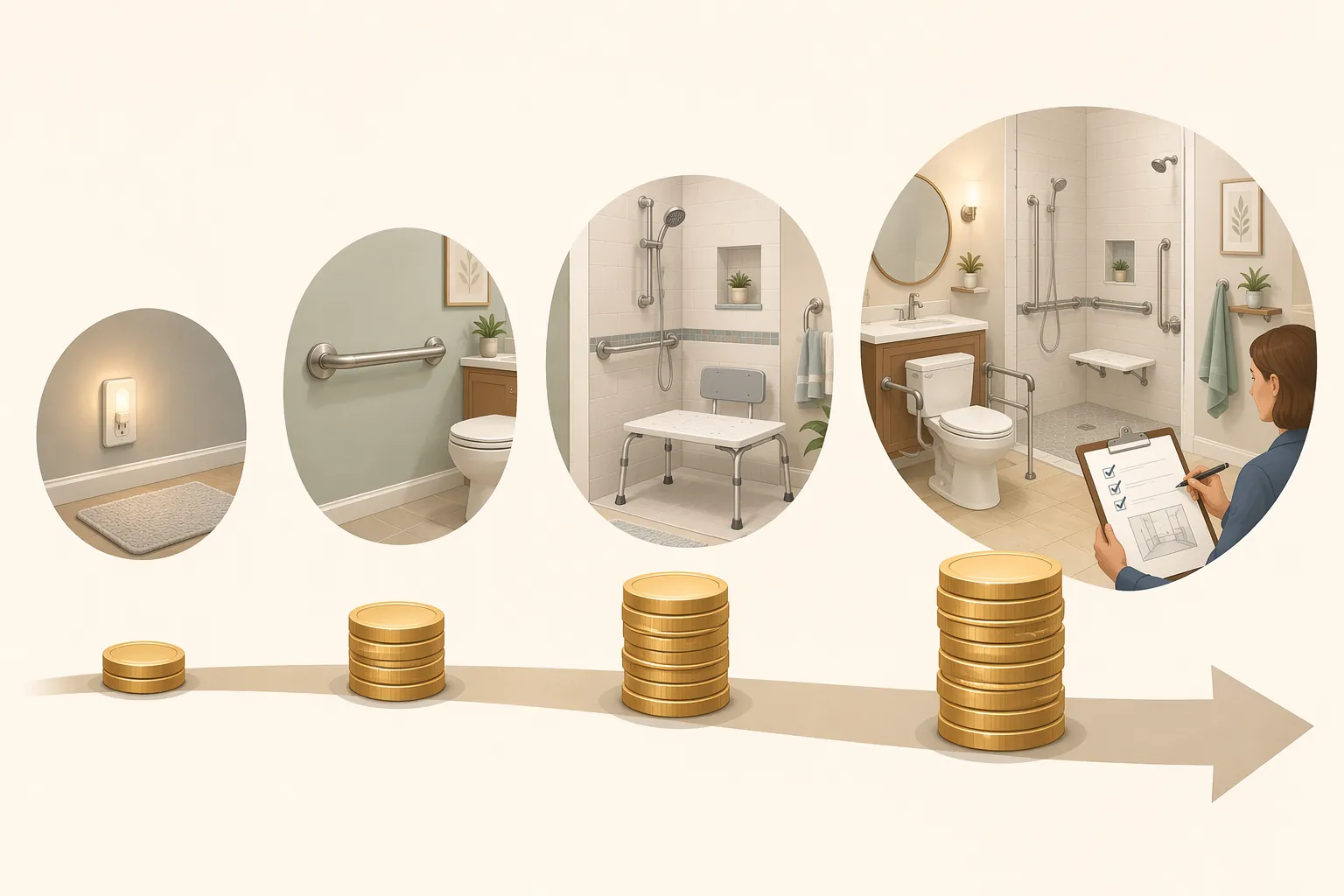
Bathroom safety deserves early attention because it is where families often wait too long. A person may manage the front steps carefully and still be one wet floor, one low toilet, or one unsteady shower entry away from losing confidence at home. If the bathroom is already the worry spot, use a phased plan such as the bathroom modification roadmap instead of shopping randomly for equipment.
What Counts as Property Tax Relief
The names vary, but most senior property tax relief falls into a few working categories. You do not need a tax textbook to use them well; you need to know how each one affects cash flow.
- Exemption: lowers the taxable value of the home, which may lower the tax bill.
- Freeze: limits or freezes increases in assessed value or taxes, depending on the local program.
- Credit: reduces the tax owed or may come back as a refundable income tax credit.
- Deferral: postpones payment, often until the home is sold or the owner no longer qualifies.
Those differences matter. A refundable credit may give a household money it can assign to a grab bar installation. A deferral may improve short-term cash flow but leave a balance for later. A freeze may protect against increases without producing a new lump sum. The safety plan should match the way the relief actually arrives.
State Examples That Are Large Enough to Change the Home Plan
No state example should be treated as universal. Even statewide programs can depend on local administration, filing deadlines, income limits, ownership rules, and whether the home is the primary residence. The figures below are useful because they show the size of relief that can matter for home safety, not because every older homeowner will qualify.
New Jersey: Stay NJ Can Support a Broader Safety Plan
New Jersey’s Stay NJ program is one of the clearest examples of why property tax relief and aging-in-place planning belong in the same conversation. The state describes Stay NJ as providing eligible senior homeowners with a benefit of up to $6,500, calculated as 50% of property taxes, with an income limit of $200,000; payments are scheduled quarterly beginning in 2026.[1]
That does not mean New Jersey is paying for grab bars. It means an eligible household that actually receives that level of relief could choose to redirect part of the freed-up cash toward a professional home safety assessment, a bathroom package, and railings or lighting in other high-risk spots. A Certified Aging-in-Place Specialist assessment often falls in the $300-$600 planning range, leaving room for several practical changes if the full benefit is available.
Texas: School Tax Exemptions Can Reach the Bathroom Package Range
Texas homeowners age 65 and older may benefit from a larger school-district exclusion after the November 2025 amendments: a $140,000 general school homestead exemption plus a $60,000 over-65 exemption, for a combined $200,000 school-district exclusion. Depending on the local tax rate, that could save roughly $1,800-$2,500 a year.[2]
That range lines up with a practical bathroom safety package: grab bars, a handheld shower head, a raised toilet solution, and better night lighting. If the older adult is already furniture-walking or avoiding showers unless someone is home, this is the kind of work I would price before spending the savings on anything cosmetic.
Massachusetts: The Senior Circuit Breaker Fits a Smaller First Fix
Massachusetts’ Senior Circuit Breaker is described as a refundable credit of up to $1,290.[3] In home-safety terms, that is not a remodel. It is closer to the level of two professionally installed grab bars, or a focused set of bathroom improvements if the family shops carefully and the wall conditions are straightforward.
Small does not mean trivial. A properly placed bar at the shower entry and another near the toilet can be the difference between an older adult using the bathroom independently and waiting for help every time.
Help With the Forms Can Be the Missing Piece
AARP Foundation Property Tax-Aide offers free property tax application help for low- to moderate-income older adults. At the program’s 2019 launch, AARP reported average savings of $1,025 per filer; that average is dated and may not reflect current 2026 results, but it shows why application help can matter when the barrier is paperwork rather than eligibility itself.[4][5]
For some households, the hardest part is not deciding whether a grab bar is useful. It is gathering the tax bill, proof of age, proof of ownership, income records, and the correct local form before the deadline. If that is the sticking point, application assistance may be as important as the benefit amount.
Other 2026 Rules Worth Verifying Locally
Illinois expanded the income limit for its Senior Citizens Assessment Freeze Homestead Exemption to $75,000 for 2026, with the limit scheduled to rise to $79,000 by 2028. The state also describes a senior deferral program for incomes up to $77,000, with a $7,500 annual cap.[6]
New York localities can now offer a senior citizens exemption of up to 65% of assessed value, up from 50%, under December 2025 legislation, and the Enhanced STAR income limit is listed at $98,700.[2] Oregon’s senior property tax deferral income limit is listed as $70,000 for 2026.[3] These are exactly the kinds of figures to confirm before counting the savings, because local adoption and individual eligibility can decide whether the number helps your household at all.
One caution: do not rely on stale lists that still describe California’s 60+ property tax exemption ballot measure as an active option. CalMatters reported that the measure was pulled in June 2026.[7] That kind of dead end can waste the time of a caregiver who already has too many forms on the table.
A Simple Workflow for Redirecting the Savings
The safest way to use property tax relief is to move in order: verify the benefit, estimate the amount, inspect the home, rank the risks, then assign the first dollars. Skipping straight to buying equipment can lead to a hallway full of products that do not solve the main hazard.
- Call or check the county assessor or state tax agency page for the current 2026 program rules, deadline, and required documents.
- Ask how the relief arrives: lower bill, exemption, refundable credit, freeze, quarterly payment, or deferral.
- Estimate the annual and quarterly cash-flow effect, not just the headline maximum.
- Walk the home room by room and list the places where the older adult hesitates, grabs furniture, avoids a task, or needs another person nearby.
- Rank the first project by fall risk and daily use, then match it to the verified savings amount.
For the home walk-through, use a structured room-by-room home safety assessment checklist. The point is not to make the house perfect. It is to find the first affordable fix that lowers the most immediate risk.
A family might discover that the bathroom feels urgent, but the first dangerous spot is actually the two steps from the garage into the kitchen. Another household might have a safe entrance but a tub wall that has become too high to step over. The savings amount should serve the risk list, not the other way around.
When Relief Is Not Enough
Property tax relief can help, but it will not cover every aging-in-place need. A ramp, widened doorway, walk-in shower, roof repair, or major plumbing change can outrun the savings from even a good local program. That is not a reason to wait on the smaller high-risk fixes.
If the verified tax savings only covers part of the work, combine it with other possibilities: local home repair programs, nonprofit repair help, weatherization or accessibility programs, and Medicaid waiver information where relevant. A comparison such as Habitat for Humanity Aging in Place vs. other senior home repair programs can help families look beyond the tax bill without losing the safety priority.
For homeowners trying to understand the larger retirement budget, property taxes belong beside insurance, utilities, maintenance, health care, and paid help at home. A broader retirement housing-cost stress test can show whether the home is still affordable after the safety work is done.
The measured answer is this: property tax relief is one practical funding lever, not a promise and not a repair grant. Verify it locally, understand how the relief reaches the household, and give the first available dollars a safety job before a preventable hazard becomes the thing that decides whether staying home is still possible.
References
- Stay NJ – Property Tax Relief for Senior Citizens, NJ Division of Taxation.
- Property Tax Exemptions by Type: A 2026 State-by-State Guide, Ownwell.
- Property Tax Exemption for Seniors, The Mortgage Reports.
- AARP Foundation Launches Property Tax Program To Help Older Adults Save Money, AARP, May 9, 2019.
- Property Tax Help and Resources From Property Tax-Aide, AARP Foundation.
- More Seniors Now Eligible for Property Tax Relief Under New Illinois Law, Illinois Department of Revenue.
- Tax cut measure pulled, CalMatters, June 2026.
Browse more in the Glossary.